






IndoAsia Defense
  • Home
  • Air
    • All
    • Air Defence
    • Drones
    • Fighters
    • ISR & Mobility
    Ghatak UCAV stealth, autonomy, integration

    Inside India’s Ghatak UCAV Program: Stealth, Autonomy, and the Integration Gap

    The F414 engine co-production agreement between Hindustan Aeronautics Limited and GE Aerospace

    India-US F414 Engine Deal Explained: Technology Transfer, Tejas Mk2, and AMCA

    What is the Su-57M1 India deal

    Su-57M1 for India: A Fifth-Generation Shortcut or a Strategic Dependency Trap?

    India indigenous long range surveillance radar with X-band drone detection capability

    450km Eyes, Machine-Speed Decisions: How India’s Indigenous Long Range Surveillance Radar Is Rewriting Air Defence

    Why Software Defined Radios Are the IAF’s Most Consequential Upgrade

    IAF Signs BEL Deal for Software Defined Radios: Rewiring India’s Air Combat Network

    How the Ghatak UCAV Stealth Design Redefines India’s Drone Warfare Doctrine

    Ghatak UCAV: India’s Carbon Composite Stealth Strategy Dissected

    Ballistic Missile Defense system intercepting incoming missile during midcourse phase

    How Ballistic Missile Defense Works: Inside Modern Missile Interception Systems

    Swarm logistics drones delivering military supplies in high-altitude Himalayan terrain with Indian Army presence

    Swarm Logistics Drones in Himalayan Warfare: Can India Close the Supply Gap with China?

    India’s 6th-Gen Fighter Strategy FCAS vs GCAP Explained

    India’s 6th-Gen Fighter Strategy: FCAS vs GCAP Explained

  • Land
    • All
    • Armour & Artillery
    • China Front
    • Future Combat
    • Pakistan Front
    The India-South Korea defence deal

    The India-South Korea Defence Deal Through China’s Operational Lens

    Railways as War Arteries Can India Match China’s Military Mobility Before the Next Crisis

    Railways as War Arteries: Can India Match China’s Military Mobility Before the Next Crisis?

    China maritime front in Indian Ocean

    What If China Opens a Maritime Front in the Indian Ocean During a LAC Conflict?

    What is Indian military modernization strategy in 2026?

    Indian Military Modernization: Systems, Doctrine, and Capability Architecture (2026-27)

    Tank launching loitering munition in battle

    From Smoke to Strike: India’s Indigenous Loitering Munitions for T-72, T-90, and Arjun Tanks

    How China Mobilizes Forces Along the LAC Speed, Systems, and Strategic Control

    How China Mobilizes Forces Along the LAC: Systems, Speed, and Strategic Signaling

    Ballistic Missile Defense system intercepting incoming missile during midcourse phase

    How Ballistic Missile Defense Works: Inside Modern Missile Interception Systems

    Swarm logistics drones delivering military supplies in high-altitude Himalayan terrain with Indian Army presence

    Swarm Logistics Drones in Himalayan Warfare: Can India Close the Supply Gap with China?

    India defence proposals Rs 2.38 trillion showing S-400 system, strike drones, fighter jets and military architecture shift

    India Defence Proposals Rs 2.38 Trillion: Why This Approval Changes How India Will Fight, Not Just What It Buys

  • Navy
    • All
    • Fleet Expansion
    • Indian Ocean
    • Maritime Security
    • Submarines
    China maritime front in Indian Ocean

    What If China Opens a Maritime Front in the Indian Ocean During a LAC Conflict?

    The Strait of Hormuz Crisis

    India’s Oil Artery Under Threat: Strategic Implications of a Hormuz Crisis

    India’s VL-Shtil Missile Deal with Russia

    India’s VL-Shtil Missile Deal with Russia: Strengthening Naval Air Defense in the Indo-Pacific

    Andaman & Nicobar Command Sleeping Giant of India’s Maritime Strategy

    Andaman & Nicobar Command: Sleeping Giant of India’s Maritime Strategy

    Maritime Surveillance 2.0: Why EO/IR Modernisation Matters for India’s Ocean Security

    Maritime Surveillance 2.0: Why EO/IR Modernisation Matters for India’s Ocean Security

    2030 Will Decide the India ASEAN Maritime Equation

    2030 Will Decide the India ASEAN Maritime Equation

    India Military Transformation Series — Part 3: Maritime Power and the Indian Ocean Imperative

    India Military Transformation Series — Part 3: Maritime Power and the Indian Ocean Imperative

    Indian Navy TEDBF PPP Model: China Factor and 2030–2040 Carrier Strategy

    Indian Navy TEDBF PPP Model: China Factor and 2030–2040 Carrier Strategy

    India’s Maritime Strategy: India’s Blue-Water Ambition in a Contested Indo-Pacific

    India’s Maritime Strategy: India’s Blue-Water Ambition in a Contested Indo-Pacific

  • Indo-Pacific
    • All
    • 2035 Outlook
    • China Strategy
    • India Strategy
    • Pakistan Outlook
    The India-South Korea defence deal

    The India-South Korea Defence Deal Through China’s Operational Lens

    Railways as War Arteries Can India Match China’s Military Mobility Before the Next Crisis

    Railways as War Arteries: Can India Match China’s Military Mobility Before the Next Crisis?

    india military integration gap

    Is India Building Military Power Faster Than It Can Integrate It?

    China maritime front in Indian Ocean

    What If China Opens a Maritime Front in the Indian Ocean During a LAC Conflict?

    Can India Fight Beyond 30 Days? Inside India’s War Sustainment Reality

    Can India Fight Beyond 30 Days? Inside India’s War Sustainment Reality

    What is Indian military modernization strategy in 2026?

    Indian Military Modernization: Systems, Doctrine, and Capability Architecture (2026-27)

    The end of Naxalism in India

    End of Naxalism in India: Inside the Fall of the Red Corridor

    Ballistic Missile Defense system intercepting incoming missile during midcourse phase

    How Ballistic Missile Defense Works: Inside Modern Missile Interception Systems

    Swarm logistics drones delivering military supplies in high-altitude Himalayan terrain with Indian Army presence

    Swarm Logistics Drones in Himalayan Warfare: Can India Close the Supply Gap with China?

  • Joint
    • All
    • Integrated Ops
    • Procurement Reform
    • Theater Commands
    Ballistic Missile Defense system intercepting incoming missile during midcourse phase

    How Ballistic Missile Defense Works: Inside Modern Missile Interception Systems

    India defence proposals Rs 2.38 trillion showing S-400 system, strike drones, fighter jets and military architecture shift

    India Defence Proposals Rs 2.38 Trillion: Why This Approval Changes How India Will Fight, Not Just What It Buys

    DAP 2026 India’s Quiet Revolution in Defence Procurement

    DAP 2026: India’s Quiet Revolution in Defence Procurement

    Integrated Battle Groups vs China’s Western Theater Command

    Integrated Battle Groups vs China’s Western Theater Command: Can Doctrine Survive the Himalayan Reality?

    Andaman & Nicobar Command Sleeping Giant of India’s Maritime Strategy

    Andaman & Nicobar Command: Sleeping Giant of India’s Maritime Strategy

    India Military Transformation Series — Part 2: The Theatre Command Reckoning

    India Military Transformation Series — Part 2: The Theatre Command Reckoning

    India AI C4ISR modernization

    India Military Transformation Series — Part 1: India AI C4ISR Modernization

    India’s Two-Front Theatre Command: Preparing for Simultaneous Conflict

    India’s Two-Front Theatre Command: Preparing for Simultaneous Conflict

    The Networked Force: India’s Transition to Integrated Warfare Systems

    The Networked Force: India’s Transition to Integrated Warfare Systems

  • Tech
    • All
    • AI & Autonomous Systems
    • Cyber
    • Electronic Warfare
    • Space
    Why Software Defined Radios Are the IAF’s Most Consequential Upgrade

    IAF Signs BEL Deal for Software Defined Radios: Rewiring India’s Air Combat Network

    Source Code or ICD India’s Source Code Negotiation Explained

    Source Code or ICD: India’s Source Code Negotiation Explained

    Supply Chain Weaponization

    Supply Chain Weaponization: Strategic Autonomy Meets Semiconductor Reality

    AI-driven battlefield in India's military

    The Algorithm of Borders: What India’s Military AI Push Actually Looks Like on the Ground

    India AI C4ISR modernization

    India Military Transformation Series — Part 1: India AI C4ISR Modernization

    PRAHAR Explained India Counter Terror Policy Prahaar

    PRAHAAR Explained: Why ‘PRAHAAR’ India’s National Counter-terrorism Doctrine, Signals the End of Traditional Warfare

    The Weapons Making the AMCA Unbeatable

    The Weapons Making the AMCA Unbeatable

    India’s Aerospace Ecosystem After Rafale: The 2026–2030 Industrial Test

    India’s Aerospace Ecosystem After Rafale: The 2026–2030 Industrial Test

    PLA’s Cyber Warfare Units and the Question of Indian Critical Infrastructure Resilience

    PLA’s Cyber Warfare Units and the Question of Indian Critical Infrastructure Resilience

  • Industry
    • All
    • Budget
    • Exports
    • Make in India
    • Supply Chains
    Ghatak UCAV stealth, autonomy, integration

    Inside India’s Ghatak UCAV Program: Stealth, Autonomy, and the Integration Gap

    The India-South Korea defence deal

    The India-South Korea Defence Deal Through China’s Operational Lens

    The F414 engine co-production agreement between Hindustan Aeronautics Limited and GE Aerospace

    India-US F414 Engine Deal Explained: Technology Transfer, Tejas Mk2, and AMCA

    Why Software Defined Radios Are the IAF’s Most Consequential Upgrade

    IAF Signs BEL Deal for Software Defined Radios: Rewiring India’s Air Combat Network

    How the Ghatak UCAV Stealth Design Redefines India’s Drone Warfare Doctrine

    Ghatak UCAV: India’s Carbon Composite Stealth Strategy Dissected

    Swarm logistics drones delivering military supplies in high-altitude Himalayan terrain with Indian Army presence

    Swarm Logistics Drones in Himalayan Warfare: Can India Close the Supply Gap with China?

    India defence proposals Rs 2.38 trillion showing S-400 system, strike drones, fighter jets and military architecture shift

    India Defence Proposals Rs 2.38 Trillion: Why This Approval Changes How India Will Fight, Not Just What It Buys

    Helicopter-Mounted Counter-Drone Systems

    Helicopter-Mounted Counter-Drone Systems: The Indian Army’s Answer to Kamikaze Drone Warfare

    India vs China Defence Industrial Base Explained

    India vs China Defence Industrial Base: Scale vs Strategic Depth

  • Global
    • All
    • China-Pak
    • Emerging Tech
    • Middle Eeast
    • Regional Trends
    • US-India
    • US-Israel
    Ghatak UCAV stealth, autonomy, integration

    Inside India’s Ghatak UCAV Program: Stealth, Autonomy, and the Integration Gap

    The F414 engine co-production agreement between Hindustan Aeronautics Limited and GE Aerospace

    India-US F414 Engine Deal Explained: Technology Transfer, Tejas Mk2, and AMCA

    india military integration gap

    Is India Building Military Power Faster Than It Can Integrate It?

    India indigenous long range surveillance radar with X-band drone detection capability

    450km Eyes, Machine-Speed Decisions: How India’s Indigenous Long Range Surveillance Radar Is Rewriting Air Defence

    What is Indian military modernization strategy in 2026?

    Indian Military Modernization: Systems, Doctrine, and Capability Architecture (2026-27)

    India defence proposals Rs 2.38 trillion showing S-400 system, strike drones, fighter jets and military architecture shift

    India Defence Proposals Rs 2.38 Trillion: Why This Approval Changes How India Will Fight, Not Just What It Buys

    India’s 6th-Gen Fighter Strategy FCAS vs GCAP Explained

    India’s 6th-Gen Fighter Strategy: FCAS vs GCAP Explained

    India’s Two-Front War Doctrine When and Why It Emerged

    When India’s Two-Front War Doctrine Emerged

    From Non-Alignment to Multi-Alignment India’s New Strategy

    Is India Quietly Shifting from Non-Alignment to Multi-Alignment 2.0?

  • Resources
    • India Military Capability Index
    • India vs China Military Balance
    • China Western Theater Command Guide
    • Pakistan Military Tracker 2026-27
    • India’s Military Doctrine Library
    • India vs China vs Pakistan Missile Arsenal Comparison
    • India’s Missile List
    • India Missile Range Map
    • Indo-Pacific Military Power Map
    • Indo-Pacific Defense Timeline
    • Global Military Balance Dashboard
    • Global Weapons Systems Database
    • Global Missile Systems Database
  • What If
    • China India Naval Conflict
No Result
View All Result
  • Home
  • Air
    • All
    • Air Defence
    • Drones
    • Fighters
    • ISR & Mobility
    Ghatak UCAV stealth, autonomy, integration

    Inside India’s Ghatak UCAV Program: Stealth, Autonomy, and the Integration Gap

    The F414 engine co-production agreement between Hindustan Aeronautics Limited and GE Aerospace

    India-US F414 Engine Deal Explained: Technology Transfer, Tejas Mk2, and AMCA

    What is the Su-57M1 India deal

    Su-57M1 for India: A Fifth-Generation Shortcut or a Strategic Dependency Trap?

    India indigenous long range surveillance radar with X-band drone detection capability

    450km Eyes, Machine-Speed Decisions: How India’s Indigenous Long Range Surveillance Radar Is Rewriting Air Defence

    Why Software Defined Radios Are the IAF’s Most Consequential Upgrade

    IAF Signs BEL Deal for Software Defined Radios: Rewiring India’s Air Combat Network

    How the Ghatak UCAV Stealth Design Redefines India’s Drone Warfare Doctrine

    Ghatak UCAV: India’s Carbon Composite Stealth Strategy Dissected

    Ballistic Missile Defense system intercepting incoming missile during midcourse phase

    How Ballistic Missile Defense Works: Inside Modern Missile Interception Systems

    Swarm logistics drones delivering military supplies in high-altitude Himalayan terrain with Indian Army presence

    Swarm Logistics Drones in Himalayan Warfare: Can India Close the Supply Gap with China?

    India’s 6th-Gen Fighter Strategy FCAS vs GCAP Explained

    India’s 6th-Gen Fighter Strategy: FCAS vs GCAP Explained

  • Land
    • All
    • Armour & Artillery
    • China Front
    • Future Combat
    • Pakistan Front
    The India-South Korea defence deal

    The India-South Korea Defence Deal Through China’s Operational Lens

    Railways as War Arteries Can India Match China’s Military Mobility Before the Next Crisis

    Railways as War Arteries: Can India Match China’s Military Mobility Before the Next Crisis?

    China maritime front in Indian Ocean

    What If China Opens a Maritime Front in the Indian Ocean During a LAC Conflict?

    What is Indian military modernization strategy in 2026?

    Indian Military Modernization: Systems, Doctrine, and Capability Architecture (2026-27)

    Tank launching loitering munition in battle

    From Smoke to Strike: India’s Indigenous Loitering Munitions for T-72, T-90, and Arjun Tanks

    How China Mobilizes Forces Along the LAC Speed, Systems, and Strategic Control

    How China Mobilizes Forces Along the LAC: Systems, Speed, and Strategic Signaling

    Ballistic Missile Defense system intercepting incoming missile during midcourse phase

    How Ballistic Missile Defense Works: Inside Modern Missile Interception Systems

    Swarm logistics drones delivering military supplies in high-altitude Himalayan terrain with Indian Army presence

    Swarm Logistics Drones in Himalayan Warfare: Can India Close the Supply Gap with China?

    India defence proposals Rs 2.38 trillion showing S-400 system, strike drones, fighter jets and military architecture shift

    India Defence Proposals Rs 2.38 Trillion: Why This Approval Changes How India Will Fight, Not Just What It Buys

  • Navy
    • All
    • Fleet Expansion
    • Indian Ocean
    • Maritime Security
    • Submarines
    China maritime front in Indian Ocean

    What If China Opens a Maritime Front in the Indian Ocean During a LAC Conflict?

    The Strait of Hormuz Crisis

    India’s Oil Artery Under Threat: Strategic Implications of a Hormuz Crisis

    India’s VL-Shtil Missile Deal with Russia

    India’s VL-Shtil Missile Deal with Russia: Strengthening Naval Air Defense in the Indo-Pacific

    Andaman & Nicobar Command Sleeping Giant of India’s Maritime Strategy

    Andaman & Nicobar Command: Sleeping Giant of India’s Maritime Strategy

    Maritime Surveillance 2.0: Why EO/IR Modernisation Matters for India’s Ocean Security

    Maritime Surveillance 2.0: Why EO/IR Modernisation Matters for India’s Ocean Security

    2030 Will Decide the India ASEAN Maritime Equation

    2030 Will Decide the India ASEAN Maritime Equation

    India Military Transformation Series — Part 3: Maritime Power and the Indian Ocean Imperative

    India Military Transformation Series — Part 3: Maritime Power and the Indian Ocean Imperative

    Indian Navy TEDBF PPP Model: China Factor and 2030–2040 Carrier Strategy

    Indian Navy TEDBF PPP Model: China Factor and 2030–2040 Carrier Strategy

    India’s Maritime Strategy: India’s Blue-Water Ambition in a Contested Indo-Pacific

    India’s Maritime Strategy: India’s Blue-Water Ambition in a Contested Indo-Pacific

  • Indo-Pacific
    • All
    • 2035 Outlook
    • China Strategy
    • India Strategy
    • Pakistan Outlook
    The India-South Korea defence deal

    The India-South Korea Defence Deal Through China’s Operational Lens

    Railways as War Arteries Can India Match China’s Military Mobility Before the Next Crisis

    Railways as War Arteries: Can India Match China’s Military Mobility Before the Next Crisis?

    india military integration gap

    Is India Building Military Power Faster Than It Can Integrate It?

    China maritime front in Indian Ocean

    What If China Opens a Maritime Front in the Indian Ocean During a LAC Conflict?

    Can India Fight Beyond 30 Days? Inside India’s War Sustainment Reality

    Can India Fight Beyond 30 Days? Inside India’s War Sustainment Reality

    What is Indian military modernization strategy in 2026?

    Indian Military Modernization: Systems, Doctrine, and Capability Architecture (2026-27)

    The end of Naxalism in India

    End of Naxalism in India: Inside the Fall of the Red Corridor

    Ballistic Missile Defense system intercepting incoming missile during midcourse phase

    How Ballistic Missile Defense Works: Inside Modern Missile Interception Systems

    Swarm logistics drones delivering military supplies in high-altitude Himalayan terrain with Indian Army presence

    Swarm Logistics Drones in Himalayan Warfare: Can India Close the Supply Gap with China?

  • Joint
    • All
    • Integrated Ops
    • Procurement Reform
    • Theater Commands
    Ballistic Missile Defense system intercepting incoming missile during midcourse phase

    How Ballistic Missile Defense Works: Inside Modern Missile Interception Systems

    India defence proposals Rs 2.38 trillion showing S-400 system, strike drones, fighter jets and military architecture shift

    India Defence Proposals Rs 2.38 Trillion: Why This Approval Changes How India Will Fight, Not Just What It Buys

    DAP 2026 India’s Quiet Revolution in Defence Procurement

    DAP 2026: India’s Quiet Revolution in Defence Procurement

    Integrated Battle Groups vs China’s Western Theater Command

    Integrated Battle Groups vs China’s Western Theater Command: Can Doctrine Survive the Himalayan Reality?

    Andaman & Nicobar Command Sleeping Giant of India’s Maritime Strategy

    Andaman & Nicobar Command: Sleeping Giant of India’s Maritime Strategy

    India Military Transformation Series — Part 2: The Theatre Command Reckoning

    India Military Transformation Series — Part 2: The Theatre Command Reckoning

    India AI C4ISR modernization

    India Military Transformation Series — Part 1: India AI C4ISR Modernization

    India’s Two-Front Theatre Command: Preparing for Simultaneous Conflict

    India’s Two-Front Theatre Command: Preparing for Simultaneous Conflict

    The Networked Force: India’s Transition to Integrated Warfare Systems

    The Networked Force: India’s Transition to Integrated Warfare Systems

  • Tech
    • All
    • AI & Autonomous Systems
    • Cyber
    • Electronic Warfare
    • Space
    Why Software Defined Radios Are the IAF’s Most Consequential Upgrade

    IAF Signs BEL Deal for Software Defined Radios: Rewiring India’s Air Combat Network

    Source Code or ICD India’s Source Code Negotiation Explained

    Source Code or ICD: India’s Source Code Negotiation Explained

    Supply Chain Weaponization

    Supply Chain Weaponization: Strategic Autonomy Meets Semiconductor Reality

    AI-driven battlefield in India's military

    The Algorithm of Borders: What India’s Military AI Push Actually Looks Like on the Ground

    India AI C4ISR modernization

    India Military Transformation Series — Part 1: India AI C4ISR Modernization

    PRAHAR Explained India Counter Terror Policy Prahaar

    PRAHAAR Explained: Why ‘PRAHAAR’ India’s National Counter-terrorism Doctrine, Signals the End of Traditional Warfare

    The Weapons Making the AMCA Unbeatable

    The Weapons Making the AMCA Unbeatable

    India’s Aerospace Ecosystem After Rafale: The 2026–2030 Industrial Test

    India’s Aerospace Ecosystem After Rafale: The 2026–2030 Industrial Test

    PLA’s Cyber Warfare Units and the Question of Indian Critical Infrastructure Resilience

    PLA’s Cyber Warfare Units and the Question of Indian Critical Infrastructure Resilience

  • Industry
    • All
    • Budget
    • Exports
    • Make in India
    • Supply Chains
    Ghatak UCAV stealth, autonomy, integration

    Inside India’s Ghatak UCAV Program: Stealth, Autonomy, and the Integration Gap

    The India-South Korea defence deal

    The India-South Korea Defence Deal Through China’s Operational Lens

    The F414 engine co-production agreement between Hindustan Aeronautics Limited and GE Aerospace

    India-US F414 Engine Deal Explained: Technology Transfer, Tejas Mk2, and AMCA

    Why Software Defined Radios Are the IAF’s Most Consequential Upgrade

    IAF Signs BEL Deal for Software Defined Radios: Rewiring India’s Air Combat Network

    How the Ghatak UCAV Stealth Design Redefines India’s Drone Warfare Doctrine

    Ghatak UCAV: India’s Carbon Composite Stealth Strategy Dissected

    Swarm logistics drones delivering military supplies in high-altitude Himalayan terrain with Indian Army presence

    Swarm Logistics Drones in Himalayan Warfare: Can India Close the Supply Gap with China?

    India defence proposals Rs 2.38 trillion showing S-400 system, strike drones, fighter jets and military architecture shift

    India Defence Proposals Rs 2.38 Trillion: Why This Approval Changes How India Will Fight, Not Just What It Buys

    Helicopter-Mounted Counter-Drone Systems

    Helicopter-Mounted Counter-Drone Systems: The Indian Army’s Answer to Kamikaze Drone Warfare

    India vs China Defence Industrial Base Explained

    India vs China Defence Industrial Base: Scale vs Strategic Depth

  • Global
    • All
    • China-Pak
    • Emerging Tech
    • Middle Eeast
    • Regional Trends
    • US-India
    • US-Israel
    Ghatak UCAV stealth, autonomy, integration

    Inside India’s Ghatak UCAV Program: Stealth, Autonomy, and the Integration Gap

    The F414 engine co-production agreement between Hindustan Aeronautics Limited and GE Aerospace

    India-US F414 Engine Deal Explained: Technology Transfer, Tejas Mk2, and AMCA

    india military integration gap

    Is India Building Military Power Faster Than It Can Integrate It?

    India indigenous long range surveillance radar with X-band drone detection capability

    450km Eyes, Machine-Speed Decisions: How India’s Indigenous Long Range Surveillance Radar Is Rewriting Air Defence

    What is Indian military modernization strategy in 2026?

    Indian Military Modernization: Systems, Doctrine, and Capability Architecture (2026-27)

    India defence proposals Rs 2.38 trillion showing S-400 system, strike drones, fighter jets and military architecture shift

    India Defence Proposals Rs 2.38 Trillion: Why This Approval Changes How India Will Fight, Not Just What It Buys

    India’s 6th-Gen Fighter Strategy FCAS vs GCAP Explained

    India’s 6th-Gen Fighter Strategy: FCAS vs GCAP Explained

    India’s Two-Front War Doctrine When and Why It Emerged

    When India’s Two-Front War Doctrine Emerged

    From Non-Alignment to Multi-Alignment India’s New Strategy

    Is India Quietly Shifting from Non-Alignment to Multi-Alignment 2.0?

  • Resources
    • India Military Capability Index
    • India vs China Military Balance
    • China Western Theater Command Guide
    • Pakistan Military Tracker 2026-27
    • India’s Military Doctrine Library
    • India vs China vs Pakistan Missile Arsenal Comparison
    • India’s Missile List
    • India Missile Range Map
    • Indo-Pacific Military Power Map
    • Indo-Pacific Defense Timeline
    • Global Military Balance Dashboard
    • Global Weapons Systems Database
    • Global Missile Systems Database
  • What If
    • China India Naval Conflict
No Result
View All Result
IndoAsia Defense
No Result
View All Result
Home Indo-Pacific India Strategy

End of Naxalism in India: Inside the Fall of the Red Corridor

India has declared itself Naxal-free in 2026, marking the collapse of a decades-long Maoist insurgency. This analysis examines how the state dismantled the Red Corridor and why the urban ideological battle may define the next phase.

IndoAsia Defense by IndoAsia Defense
April 6, 2026
in India Strategy
0
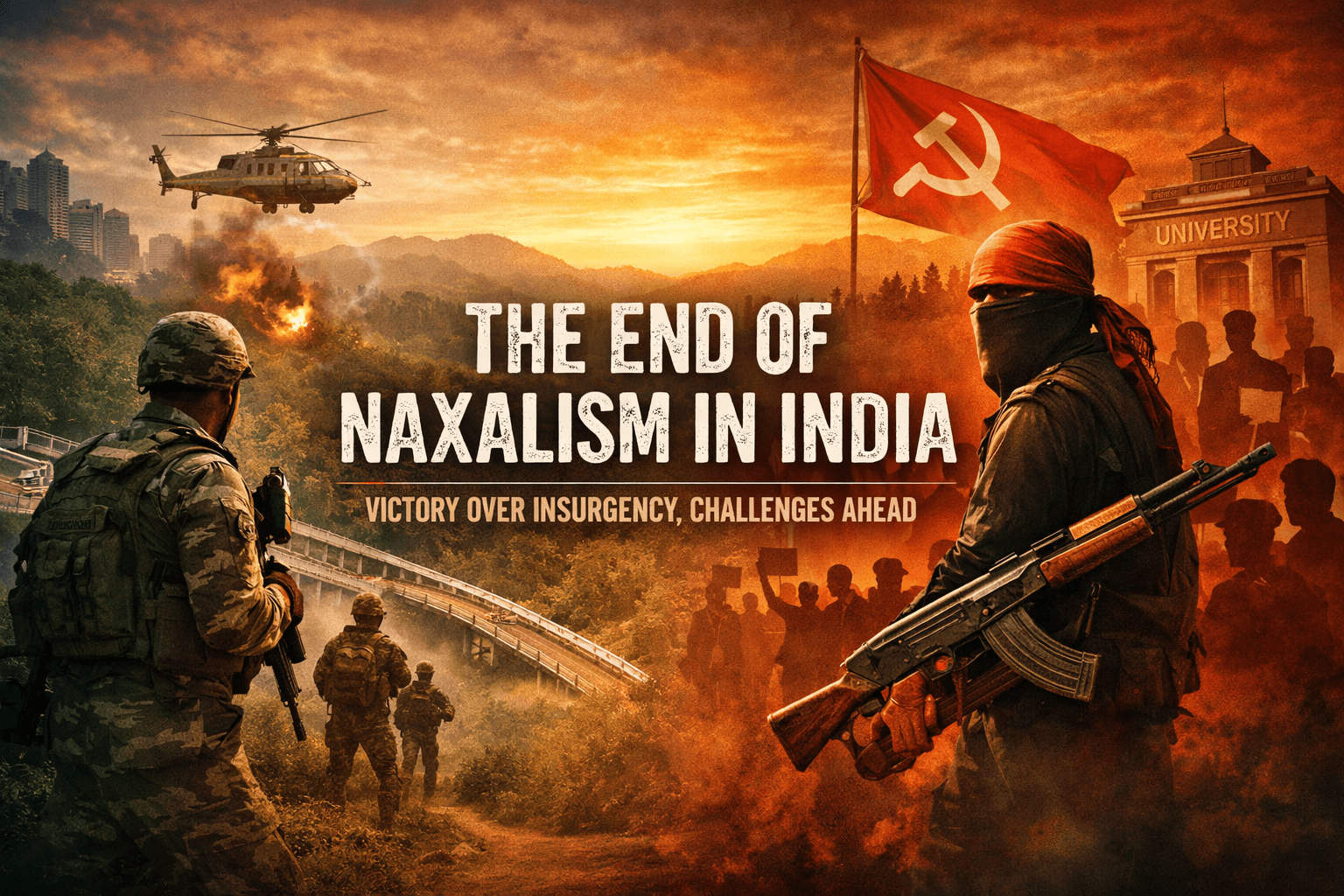
The end of Naxalism in India

Victory in the Forest. Battle Moves to the Cities.

0
SHARES
11
VIEWS
Share on LinkedinShare on FacebookShare on Twitter

Naxalism’s Endgame: How India Dismantled Its Deepest Internal Security Threat and Where the Real Battle Now Shifts

For decades, Naxalism in India represented a structural fracture within the Indian state, not merely an insurgency but a competing system of control embedded in the country’s most resource-rich and governance-deficient regions. The end of Naxalism in India, now officially declared by the government in 2026, marks a decisive inflection point in India’s internal security trajectory. Yet the significance of this moment lies less in the declaration itself and more in the underlying transformation that made it possible.

When Union Home Minister Amit Shah announced that India had effectively become “Naxal-free” following the March 31, 2026 deadline, it was framed as the culmination of a decade-long campaign that fused security operations with governance expansion.

Naxal-affected districts, which stood at 126 in 2014, have reportedly been reduced to just two. Violent incidents have declined sharply, leadership structures have collapsed, and large-scale surrenders have hollowed out the insurgency’s operational core.

But declaring the end of Naxalism in India is only analytically meaningful if we understand what exactly has ended. The forest insurgency has been structurally broken. The deeper ideological and institutional ecosystem that sustained it remains a more complex and enduring challenge.

From Red Corridor to Strategic Liability: Why Naxalism Became India’s Biggest Internal Threat

At its peak, Naxalism in India was not a peripheral insurgency. It was a territorial and governance challenge that spanned a contiguous belt across central and eastern India, commonly described as the Red Corridor. This was not simply about armed cadres operating in forests. It was about the systematic absence of the state and the emergence of an alternative order.

The Communist Party of India (Maoist) built a layered insurgent architecture that combined armed struggle with political control. It established parallel judicial systems, controlled economic flows through extortion networks, and shaped local governance in areas where state institutions had limited reach.

According to Ministry of Home Affairs data, more than 100 districts were affected at various intensities, with violence peaking between 2008 and 2010.

What made Naxalism India’s biggest internal security threat was its intersection with economic geography. The insurgency was concentrated in mineral-rich zones containing coal, iron ore, and bauxite reserves critical to India’s industrial growth. This meant that the insurgency was not just a security problem. It was a direct constraint on India’s economic expansion and infrastructure development.

The deeper insight is this: Naxalism thrived not because the state was weak everywhere, but because it was selectively absent where it mattered most. The insurgency weaponized that absence with remarkable efficiency.

The Strategic Shift After 2014: From Containment to Systematic Dismantling

The period after 2014 marked a shift from fragmented counterinsurgency efforts to a coordinated national campaign. The Indian government under Modi did not reinvent the doctrine from scratch, but it significantly altered the intensity, coordination, and persistence of implementation.

The SAMADHAN framework operationalized this shift by integrating intelligence, operations, and development into a single strategic grid. Security forces moved from reactive deployments to sustained area domination. Forward operating bases were established deep within Maoist strongholds, particularly in Bastar, a region long considered difficult terrain for sustained operations.

Operations such as Operation Octopus and Operation Double Bull were part of a broader push that targeted leadership structures and disrupted command chains. The attrition of Maoist leadership, combined with sustained pressure on their logistics networks, created a cascading effect across the organization.

Between 2014 and 2024, official data indicates that violent incidents declined by over 50 percent, security force fatalities dropped by approximately 73 percent, and civilian deaths fell by nearly 70 percent. These are not just indicators of improved policing. They reflect a structural weakening of the insurgency’s ability to operate.

The strategic implication is clear. The state moved from containment to dismantling. The insurgency lost both territory and initiative.

Infrastructure as Strategy: When Roads Became Counterinsurgency Assets

One of the most decisive, yet underexamined, elements in the end of Naxalism in India is the role of infrastructure. Counterinsurgency in forested terrain is not won solely through kinetic operations. It is won by altering the geography of control.

The Indian government’s infrastructure push in former Naxal strongholds fundamentally changed the operational environment. Over 17,000 kilometers of roads were constructed in Left Wing Extremism-affected areas. Thousands of mobile towers were installed, and banking access expanded significantly.

The impact of this transformation is best understood through its second-order effects. Roads disrupted insurgent movement corridors. Telecom networks enabled real-time intelligence and coordination. Banking access reduced reliance on insurgent-controlled cash networks. Schools, hospitals, and ration shops introduced a visible and sustained state presence.

This was not development as a post-conflict activity. It was development as a counterinsurgency tool.

The strategic implication is that the state did not just outfight the insurgency. It outgoverned it.

The Numbers That Tell the Story: A Decade of Decline

The transformation of Naxalism in India can be captured through a comparative lens:

Indicator 2014 Baseline 2026 Outcome Strategic Meaning
Naxal-Affected Districts 126 2 Near-total collapse of territorial influence
Violent Incidents High baseline -53% Loss of operational capacity
Security Force Deaths High -73% Improved tactical dominance
Civilian Deaths High -70% Reduced insurgent reach and coercion
Cadre Strength ~15,000–20,000 (est.) Severely degraded Organizational collapse

Source: Ministry of Home Affairs; Government statements (2026)

These numbers must be interpreted carefully. They do not indicate absolute elimination, but they do signal that the insurgency has fallen below the threshold required to sustain itself as a systemic threat.

What Actually Broke the Insurgency: Leadership Collapse and Social Legitimacy Loss

The decline of Naxalism in India cannot be explained by force alone. The more decisive factor was the erosion of legitimacy.

Thousands of cadres surrendered over the past decade, including mid-level commanders. Rehabilitation policies offered financial incentives, housing, and livelihood support, creating exit pathways that did not exist earlier. At the same time, sustained operations eliminated key leaders, effectively decapitating the command structure.

But the deeper shift occurred at the level of perception. As infrastructure and welfare delivery improved, the insurgency’s claim to represent marginalized communities weakened. The gap between Maoist rhetoric and lived reality became more visible.

This is where most analyses remain shallow. Insurgencies collapse not only when they are defeated militarily, but when they lose their narrative.

The Urban Front: Where the Narrative Battle Now Sits

The declaration of the end of Naxalism in India risks creating a false sense of closure. The forest insurgency has been degraded, but the ideological ecosystem that sustained it has not disappeared. Instead, the terrain of contestation is shifting.

In India, the broader left ecosystem has historically held significant influence over sections of academic discourse, civil society narratives, and parts of the intellectual space. This influence has shaped how issues like tribal rights, state violence, and development are framed in public debate.

In some cases, these narratives have overlapped with or indirectly reinforced positions that align with Maoist ideological arguments, even if not explicitly supporting armed insurgency.

Over the past decade, there has been a gradual shift. Alternative narratives have begun to emerge, state-led development outcomes are more visible, and the information space is more contested than it was earlier. However, this shift is uneven and far from complete.

What is often described as urban Naxalism sits within this broader contest. It is not an organized armed network but a loose ecosystem where ideological sympathy, activism, and narrative framing can intersect in ways that complicate state responses. The challenge is not simply identifying adversaries. It is managing a contested narrative space within a democratic framework.

The strategic implication is that while the state has gained dominance in the physical battlespace, the informational and institutional domain remains competitive. This is where the next phase of the challenge lies.

The Unresolved Core: Tribal Rights, Development, and the Risk of Recurrence

Despite the success in dismantling the insurgency’s operational capacity, the structural drivers of Naxalism have not been fully resolved.

The relationship between the Indian state and tribal communities remains contested in several regions. Laws such as the Forest Rights Act and PESA were designed to address these issues, but their implementation has been uneven. Land rights, displacement due to mining, and administrative exclusion continue to generate friction.

This creates a strategic paradox. The same regions that are now opening up for economic development are also those where governance must be most carefully calibrated. If development is perceived as extractive rather than inclusive, it could recreate the conditions that allowed the insurgency to emerge in the first place.

The end of Naxalism in India, therefore, is contingent. It depends on whether the state can convert security gains into durable political legitimacy.

Scenario 2030: Three Futures After the End of Naxalism in India

Looking ahead, three plausible trajectories emerge.

The first is consolidation, where the insurgency remains marginal and governance gains are sustained. This scenario requires continuous investment in infrastructure, welfare, and administrative presence.

The second is transformation, where remnants of the insurgency evolve into decentralized or ideologically diffused networks with stronger urban linkages. The threat becomes less visible but more complex, particularly in the narrative domain.

The third is re-emergence, driven by governance failures or economic disruptions. While a return to peak insurgency levels is unlikely, localized flare-ups could still occur.

The strategic implication is that the end of Naxalism in India is not a static outcome. It is a moving equilibrium.

Beyond Internal Security: Strategic Implications for India and the Indo-Pacific

The decline of Naxalism has implications that extend beyond internal security. It frees up state capacity, both in terms of resources and strategic attention, for external priorities.

For the Indo-Pacific, this matters. A more internally stable India is a more credible strategic actor. It can invest more in military modernization, deepen partnerships, and play a larger role in regional security dynamics.

There is also a governance dimension. India’s ability to manage a long-running insurgency within a democratic framework strengthens its position as an alternative model to centralized or authoritarian approaches.

Closing Reflection: Victory, But Not Closure

The end of Naxalism in India is a significant milestone. It reflects a decade of sustained effort, strategic clarity, and institutional coordination. The insurgency that once challenged the Indian state across vast territories has been reduced to a residual presence.

But this is not closure. It is transition.

The forest insurgency has been broken. The narrative and institutional contest is still unfolding. The left ecosystem continues to retain influence in shaping discourse, even as that dominance is gradually being challenged. The balance is shifting, but not decisively.

The real test lies ahead, in how the state manages this transition without losing the legitimacy that ultimately made victory possible.

The end of Naxalism in India is not just about defeating an insurgency. It is about sustaining a state.

—————————————————————————

Frequently Asked Questions (FAQs)

Has India officially declared the end of Naxalism?

Yes, the Indian government has declared that the Naxalite-Maoist insurgency is in its final phase, with Union Home Minister Amit Shah stating that India has effectively become “Naxal-free” after the March 31, 2026 deadline. The number of affected districts has reportedly reduced from 126 in 2014 to just two. However, this reflects the collapse of organized insurgent structures rather than complete elimination of all residual elements.

What factors led to the end of Naxalism in India?

The end of Naxalism in India is the result of a combined strategy involving sustained security operations, infrastructure development, and governance expansion. Intelligence-led operations weakened leadership structures, while roads, telecom networks, and welfare programs expanded state presence. The integration of these elements created cumulative pressure that the insurgency could not sustain over time.

What is urban Naxalism and why is it a concern?

Urban Naxalism refers to a loose ecosystem where ideological narratives, activism, and institutional influence may intersect with Maoist-aligned positions. Unlike armed insurgents, this operates within legal and institutional frameworks, making it more complex to address. The concern lies in its potential to shape narratives, influence discourse, and sustain ideological continuity even after the decline of the armed movement.

Is there still a risk of Naxalism returning in India?

While the insurgency has been significantly weakened, the risk of localized resurgence cannot be completely ruled out. Structural issues such as land rights, displacement, and governance gaps persist in some regions. If these are not addressed effectively, they could create conditions for renewed unrest, even if not at the same scale as before.

How did development contribute to the decline of Naxalism?

Development played a critical role by reducing the governance vacuum that insurgents had exploited. Infrastructure projects improved connectivity, welfare schemes increased economic inclusion, and institutional presence strengthened state legitimacy. Over time, this reduced the local support base for the insurgency and made recruitment more difficult.

What is the biggest challenge after the end of Naxalism in India?

The biggest challenge is sustaining the gains achieved and managing the transition from conflict to stability. This includes addressing underlying socio-economic issues in former conflict areas and navigating the more complex narrative and institutional dimensions of the movement. The focus now shifts from defeating insurgents to preventing their re-emergence in new forms.

Tags: Editor’s Pick
Previous Post

IAF Signs BEL Deal for Software Defined Radios: Rewiring India’s Air Combat Network

Next Post

Indian Military Modernization: Systems, Doctrine, and Capability Architecture (2026-27)

IndoAsia Defense

IndoAsia Defense

IndoAsia Defense Team is a specialist research and analysis group focused on India’s military modernization and Indo-Pacific strategic dynamics. The platform delivers structured, data-driven insights on doctrine, force posture, defense technology, and regional power balance.

Next Post
What is Indian military modernization strategy in 2026?

Indian Military Modernization: Systems, Doctrine, and Capability Architecture (2026-27)

Leave a Reply Cancel reply

Login with your Social ID

Your email address will not be published. Required fields are marked *

Category

  • Air
  • Global
  • Indo-Pacific
  • Industry
  • Joint
  • Land
  • Navy
  • Tech

Defence Capabilities

  • Air Defence
  • Drones
  • Fighters
  • ISR & Mobility
  • China Military
  • Emerging Tech
  • Regional Trends
  • U.S. Posture

Strategy

  • 2035 Outlook
  • China Strategy
  • India Strategy
  • Pakistan Outlook
  • Budget
  • Exports
  • Make in India
  • Supply Chains

Operations

  • Integrated Ops
  • Procurement Reform
  • Theater Commands
  • Armour & Artillery
  • China Front
  • Future Combat
  • Pakistan Front
  • Fleet Expansion

Resources

  • India vs China Military Balance
  • Indo-Pacific Military Power Map
  • Global Military Balance Dashboard
  • Global Weapons Systems Database
  • Global Missile Systems Database
  • Indo-Pacific Defense Timeline
  • India Military Capability Index
  • About
  • Contact
  • Privacy & Policy
  • Editorial Policy
  • Cookie Policy
  • Disclaimer
  • Terms And Conditions
Facebook Linkedin X-twitter
© 2026 IndoAsia Defense. All Rights Reserved.
No Result
View All Result
  • Home
  • Air
    • Air Defence
    • Drones
    • Fighters
    • ISR & Mobility
  • Land
    • Armour & Artillery
    • China Front
    • Future Combat
    • Pakistan Front
  • Navy
    • Fleet Expansion
    • Indian Ocean
    • Maritime Security
    • Submarines
  • Indo-Pacific
    • 2035 Outlook
    • China Strategy
    • India Strategy
    • Pakistan Outlook
  • Joint
    • Integrated Ops
    • Procurement Reform
    • Theater Commands
  • Tech
    • AI & Autonomous Systems
    • Cyber
    • Electronic Warfare
    • Space
  • Industry
    • Budget
    • Exports
    • Make in India
    • Supply Chains
  • Global
    • China-Pak
    • Emerging Tech
    • Regional Trends
    • US-India