



























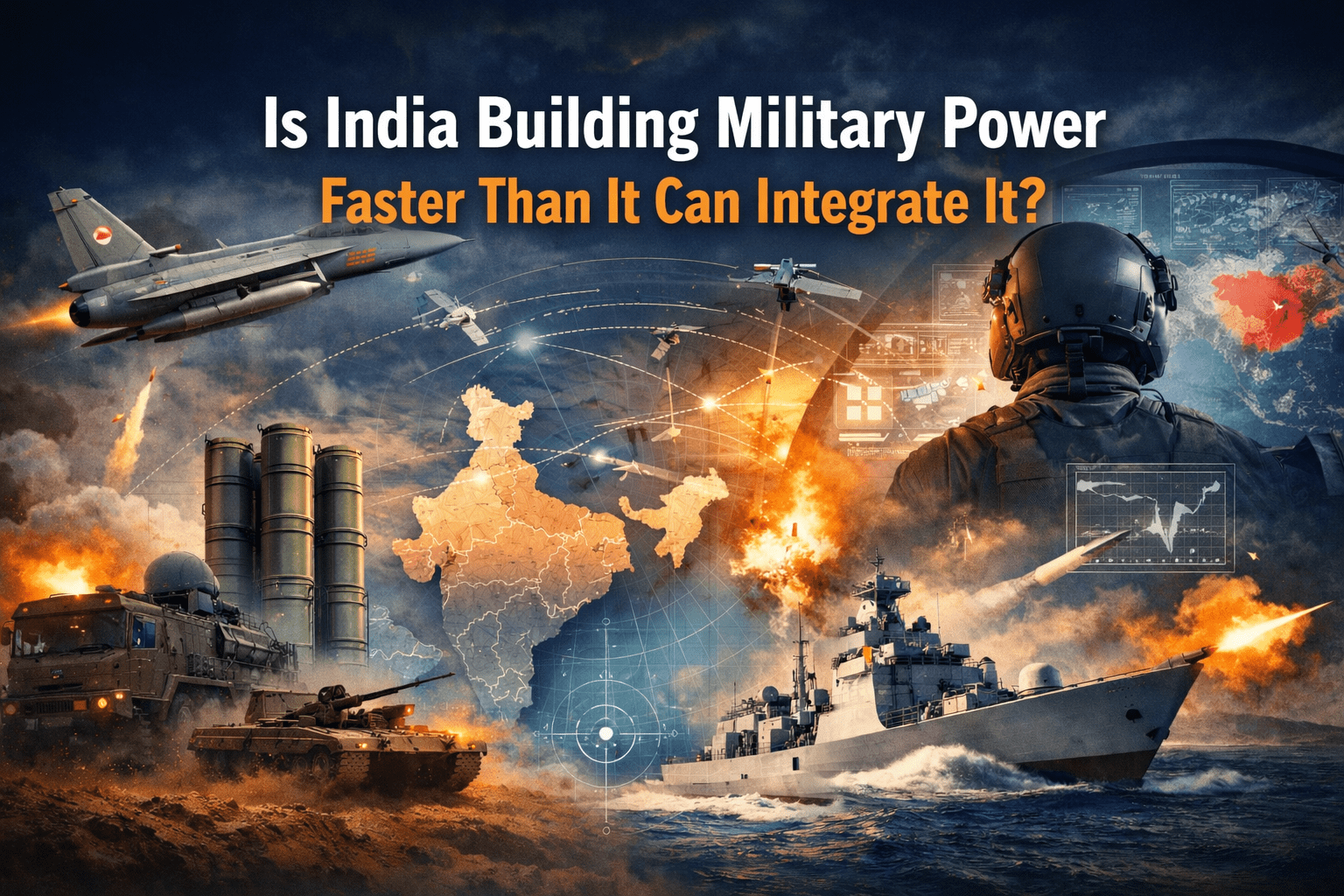
India is building capabilities faster than it can integrate them. That is no longer a provocative claim. It is an observable structural condition shaping how the Indian military will fight its next war. Over the past five years, India has accelerated procurement, expanded indigenous production, and deployed a wider spectrum of sensors, strike systems, and surveillance networks across both continental and maritime theatres. Yet the effectiveness of these capabilities is increasingly constrained not by their individual performance, but by how unevenly they connect to each other.
The central issue is not acquisition. It is absorption. Integration is where capability becomes combat power, and this is precisely where friction is accumulating. Doctrine, data links, training pipelines, logistics chains, and command structures are evolving at a slower pace than hardware induction.
India is building capabilities faster than it can integrate them, and the result is a military that appears formidable in inventory terms but remains uneven in system-level effectiveness.
This gap matters because modern warfare is no longer decided by platforms in isolation. It is decided by how quickly a force can detect, decide, and deliver effects across domains. Integration compresses that cycle. Fragmentation stretches it. India’s challenge is not that it lacks capability. It is that its kill chains are not yet consistently coherent.
Procurement Momentum Without System-Level Convergence
India’s acquisition trajectory since 2020 reflects urgency shaped by the China challenge and a broader Indo-Pacific recalibration. Indigenous platforms such as Tejas Mk1A, Akash-NG, and Advanced Towed Artillery Gun Systems have moved alongside high-end imports like the S-400 and expanded maritime ISR capabilities. The shift toward domestic production under the Defence Acquisition Procedure 2020 has added further momentum.
However, procurement has largely remained platform-centric. Systems are inducted based on their standalone performance rather than their role within a unified battlespace architecture. This creates what can be described as managed fragmentation, where advanced platforms coexist without being fully synchronized. India is building capabilities faster than it can integrate them, and procurement pipelines are reinforcing that imbalance.
The layered air defence ecosystem illustrates this clearly. India operates a mix of legacy Soviet-origin systems, indigenous Akash variants, and imported long-range interceptors. Each brings value, but their integration into a seamless air defence grid remains incomplete.
The Comptroller and Auditor General has previously highlighted gaps in fire control integration across inducted systems, pointing to a structural rather than technical limitation. The issue is not whether these systems work. It is whether they work together under time pressure.
The Sensor-Rich, Shooter-Constrained Reality
Nowhere is the integration gap more operationally visible than in the maritime domain. The Indian Navy has built a dense surveillance architecture across the northern Indian Ocean. P-8I aircraft, long-endurance drones, coastal radar chains, and satellite-based tracking systems generate a high volume of maritime awareness data. Since 2019, surveillance coverage and data density have increased significantly, creating near-continuous tracking capability across key sea lanes.
The problem is what happens next. The number of platforms capable of acting on that data in real time has not expanded at the same pace. This creates a sensor-rich, shooter-constrained environment where detection exceeds engagement capacity. Integration here is not about connecting systems.
It is about compressing decision cycles. India is building capabilities faster than it can integrate them, and this gap manifests as latency between detection and strike.
A conceptual chart mapping sensor-to-shooter timelines would show wide variance across domains. In some cases, data moves quickly from sensor to command node but slows before reaching a shooter. In others, decision authority introduces delays. In high-intensity conflict, these delays are not marginal.
They are decisive. Submarine engagements, missile flight times, and aerial interception windows operate on compressed timelines. A delay of even a few minutes can render detection irrelevant.
Jointness Remains the Missing Operating System
The integration challenge is most acute at the inter-service level. India’s Army, Navy, and Air Force continue to operate with distinct command structures, procurement priorities, and communication architectures. The creation of the Chief of Defence Staff was intended to address this, but the transition to integrated theatre commands remains incomplete.
Without theatre commands, jointness is episodic rather than institutional. Capabilities acquired by one service are not automatically available to another in operational scenarios. India is building capabilities faster than it can integrate them across service boundaries, and this creates structural inefficiencies that become critical in conflict.
The implications go beyond efficiency. They extend into risk. Separate identification and tracking systems increase the probability of fratricide. Lack of common data links limits real-time coordination. Exercises have already revealed instances where coordination depended on manual intervention rather than automated integration. These are not isolated procedural issues. They are indicators of deeper systemic gaps.
China’s military reforms offer a useful comparison point. Since 2017, the People’s Liberation Army has enforced joint data link standards and reorganized its forces into theatre commands designed around integrated operations. India is still in transition. The gap is not simply about technology. It is about institutional design.
The Data Layer Problem Few Are Prioritizing
Integration in modern warfare is fundamentally a data problem. Sensors generate information, but combat effectiveness depends on how that information is processed, shared, and acted upon. India has invested in network-centric systems such as the Defence Communication Network and Integrated Air Command and Control System. These are critical steps, but they do not yet form a fully unified data architecture.
Different services and platforms continue to operate on varied communication protocols and data standards. This creates bottlenecks where data must be translated, relayed, or manually interpreted before action can be taken. India is building capabilities faster than it can integrate them, and the weakest link is often not the platform but the network connecting it.
This has implications for multi-domain operations. A surveillance drone detecting a target must be able to cue a missile battery or aircraft without delay. If that data transfer requires multiple intermediaries or manual confirmation, the kill chain becomes vulnerable. In a contested environment, adversaries will target precisely these points of friction through electronic warfare and cyber disruption.
Industrial Expansion Without Integration Discipline
India’s defence industrial base is expanding rapidly under the Atmanirbhar Bharat framework. Public sector units and private firms are delivering a growing range of platforms, from missiles to drones to artillery systems. This expansion is strategically important, reducing dependence on imports and building long-term capacity.
However, industrial growth has introduced a second-order integration challenge. Systems are often inducted while still evolving, with training, maintenance doctrine, and interoperability standards developing in parallel. This compresses timelines in ways that can undermine integration. India is building capabilities faster than it can integrate them, and industrial processes are contributing to that dynamic.
There is also a standardization issue. Multiple variants of similar systems increase logistical complexity. Spare parts, training modules, and maintenance protocols multiply. Over time, this affects availability rates. A platform that is technically advanced but difficult to sustain does not translate into reliable combat power.
The political economy reinforces this pattern. Success is often measured in terms of platforms delivered rather than systems integrated. Induction becomes the milestone, even when operational readiness remains incomplete. This creates an accountability gap where integration is treated as a downstream task rather than a core metric of success.
Human Capital: The Quiet Constraint on Integration
Technology does not integrate itself. People do. This is where India’s most underexamined constraint lies. Operating modern military systems requires sustained technical proficiency. Training cycles are long, and expertise accumulates over years. Yet personnel policies and career structures are not fully aligned with these requirements.
Specialist roles such as drone operators, network managers, and air defence controllers require deep familiarity with complex systems. Achieving operational proficiency can take close to two years. If personnel rotate soon after reaching that level, the system loses accumulated expertise. India is building capabilities faster than it can integrate them into human capital pipelines, and this creates a persistent skills gap.
The officer corps faces a similar challenge. Mid-career officers must bridge legacy systems and new digital architectures. Training institutions have expanded, but not at a pace matching technological complexity. The result is a mismatch between system sophistication and operator familiarity.
A data-driven indicator of this gap is the throughput of joint-trained officers relative to requirement. Current training capacity does not fully meet projected needs for integrated operations. This is not a budgetary issue. It is a structural one, tied to how careers are designed and expertise is retained.
The Indo-Pacific Implication: Integration as Deterrence
The integration gap is not just an internal military issue. It has direct implications for the Indo-Pacific balance. India’s partners, particularly within the Quad framework, assess not just India’s capabilities but its ability to deploy them effectively. Exercises, interoperability, and technology-sharing arrangements are shaped by these assessments.
India is building capabilities faster than it can integrate them, and this affects how its role is perceived within regional security architectures. A force that can detect but not rapidly respond creates ambiguity. Deterrence relies on credible, timely response. Integration is therefore not a technical detail. It is a strategic signal.
There is also an escalation dimension. In a crisis with China, compressed timelines will define decision-making. An integration gap can lead to delayed responses or misinterpretation of adversary actions. This increases the risk of escalation miscalculation. Adversaries may exploit these gaps through saturation tactics, forcing India into reactive cycles.
A useful way to conceptualize this is to view integration as a deterrence multiplier. Platforms contribute to deterrence only when they can be employed coherently. Without integration, capability exists but credibility weakens.
Rethinking Military Power Beyond Inventory
Traditional metrics of military strength focus on numbers. Platforms, missiles, aircraft, and personnel dominate most assessments. These metrics are visible and easy to quantify. Integration is not. Yet it is increasingly the defining factor of combat effectiveness.
India is building capabilities faster than it can integrate them, and this raises questions about how military readiness should be measured. A more relevant framework would examine integration indicators such as data connectivity, joint training frequency, and command interoperability.
A conceptual chart comparing platform induction rates with integration completion rates from 2018 to 2026 would likely show a widening gap. This gap is the real measure of readiness. It captures not just what a military has, but what it can use effectively.
Toward a Coherent Warfighting System
The solution is not to slow down acquisition. It is to elevate integration to the same level of priority. This requires a shift in how success is defined and measured within the defence establishment.
First, unified data architectures must become the foundation of all new acquisitions. Systems should be designed for interoperability from the outset, not retrofitted later.
Second, theatre command reforms must move from planning to execution, creating a structure where jointness is built into operations rather than improvised.
Third, industrial policy must incorporate integration discipline. Standardization, lifecycle management, and interoperability should be embedded into production processes.
Fourth, human capital policies must prioritize retention of technical expertise, ensuring that operators and commanders can fully exploit complex systems.
India is building capabilities faster than it can integrate them, but this is a transitional phase rather than a permanent limitation. The trajectory of reform suggests that integration will improve. The critical variable is timing. The Indo-Pacific environment is evolving rapidly, and the window to close this gap is finite.
Capability Without Integration Is Not Power
India’s military modernization is real, and its trajectory is upward. The country has expanded its surveillance reach, improved strike capabilities, and strengthened its industrial base. Yet these gains are constrained by a systemic integration gap.
India is building capabilities faster than it can integrate them, and this gap will shape its operational effectiveness in any future conflict. The decisive factor will not be the number of platforms India fields, but how effectively they function as a unified system.
Integration is not an auxiliary task. It is the core of modern warfighting. The sooner it is treated as such, the more effectively India can translate capability into credible power.
————————————
FAQ: India’s Capability-Integration Gap
What does it mean when analysts say India is building capabilities faster than it can integrate them?
It means India is acquiring advanced military systems at a pace that exceeds its ability to connect them into a unified operational framework. Integration involves doctrine, training, data sharing, and command structures, not just equipment deployment. Without integration, capabilities remain partially effective.
Why is integration more important than procurement in modern warfare?
Modern warfare depends on speed of decision-making and coordination across domains. Integration enables sensors, command systems, and weapons to function together in real time. Without it, even advanced platforms cannot deliver their full combat potential.
How does the integration gap affect India’s deterrence against China?
Deterrence depends on credible and timely response. If integration gaps slow decision cycles or limit coordination, adversaries may perceive opportunities to exploit these weaknesses. This can reduce deterrence effectiveness despite strong capabilities.
Can theatre commands solve India’s integration challenges?
Theatre commands can significantly improve integration by unifying command structures across services. However, they must be implemented effectively and supported by shared data systems and joint doctrines. Structural reform alone is not sufficient without operational alignment.
Is India’s defence industrial push making integration harder?
In some cases, yes. Rapid induction of domestically developed systems can outpace the development of training, maintenance, and interoperability frameworks. Without coordination, this can increase complexity and slow integration.
How long will it take for India to close the integration gap?
Closing the gap will take several years because it involves institutional, technological, and cultural changes. Progress is already underway, but the pace of integration must accelerate to match capability acquisition.

