














Context
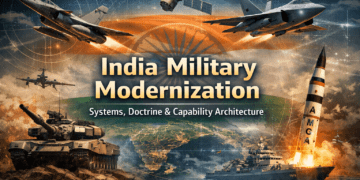
India’s armed forces are undergoing one of the most significant modernization cycles in their history. As the geopolitical balance in the Indo-Pacific shifts and the possibility of a two-front contingency persists, assessing military capability requires more than headline platform counts.
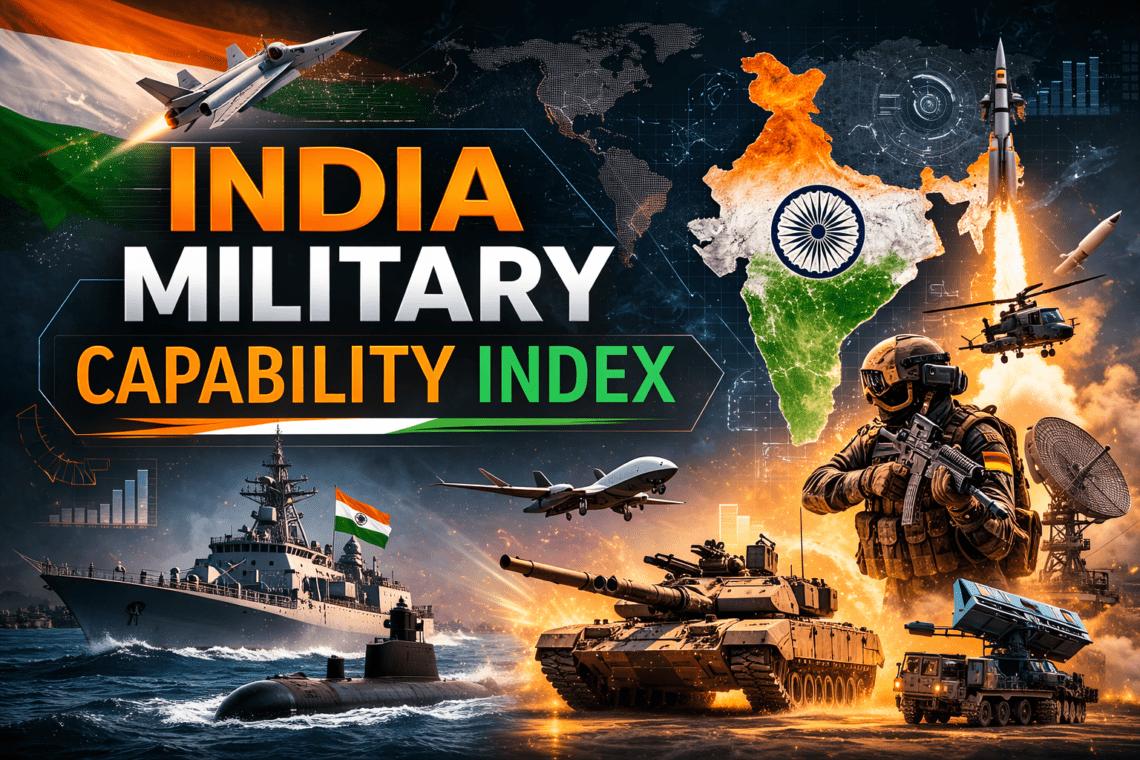
The India Military Capability Index tracks key pillars of India’s defense strength, including force structure, industrial capacity, technological modernization, and operational readiness. The index is designed as an analytical framework that helps readers understand how India’s military power is evolving across multiple domains.
Land Power
India maintains one of the world’s largest standing armies with extensive combat experience and a wide geographic operational spectrum ranging from high-altitude warfare in the Himalayas to mechanized maneuver warfare in desert environments.
Key strengths include armored formations, artillery modernization, and expanding missile forces. The development of Integrated Battle Groups aims to improve rapid offensive capability along the western front while improving responsiveness along the northern border.
Important capability indicators:
- Active Army personnel
- Main battle tanks
- Self-propelled artillery systems
- Rocket artillery
- Tactical missile forces
Air Power
The Indian Air Force remains a critical pillar of deterrence in a potential two-front scenario. Air superiority, deep strike capability, and integrated air defense networks define India’s evolving airpower doctrine.
Modernization priorities include fighter fleet expansion, stand-off precision strike capability, and improved airborne surveillance through platforms such as airborne early warning and control aircraft.
Important capability indicators:
- Fighter aircraft strength
- Airborne early warning aircraft
- Air defense systems
- Precision strike missiles
- Strategic airlift capability
Naval Power
India’s naval doctrine increasingly focuses on sea control and sea denial across the Indian Ocean Region. As maritime competition expands, naval power is becoming central to India’s long-term strategic posture.
Aircraft carriers, nuclear submarines, and long-range maritime surveillance aircraft form the backbone of India’s maritime deterrence capability.
Important capability indicators:
- Aircraft carriers
- Destroyers and frigates
- Submarine fleet
- Naval aviation assets
- Anti-ship missile capability
Strategic Forces
India maintains a nuclear deterrent based on credible minimum deterrence and assured retaliation. The nuclear triad forms the backbone of India’s strategic posture.
Key elements include land-based ballistic missiles, submarine-launched ballistic missiles, and strategic air-delivered nuclear capability.
Important capability indicators:
- Ballistic missile range spectrum
- Submarine launched nuclear missiles
- Second strike survivability
- Command and control resilience
Defence Industrial Capacity
India’s ability to sustain military capability increasingly depends on domestic production and technology development.
Programs such as Atmanirbhar Bharat in defense aim to reduce import dependence and expand indigenous manufacturing capacity.
Important capability indicators:
- Domestic defence production value
- Export growth
- Private sector participation
- Missile manufacturing capacity
- Electronics and radar production
Emerging Technologies
Future warfare will be shaped by advances in artificial intelligence, electronic warfare, cyber operations, and space-based military infrastructure.
India is expanding investment in these domains to maintain technological parity with major powers.
Important capability indicators:
- Military space assets
- Drone and autonomous systems
- Electronic warfare capability
- Cyber defense infrastructure
- Artificial intelligence in military systems

