







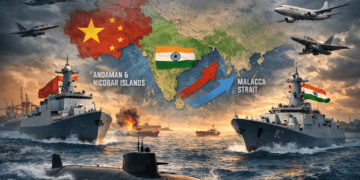












There is a map Indian strategists mention often but rarely interrogate deeply enough.
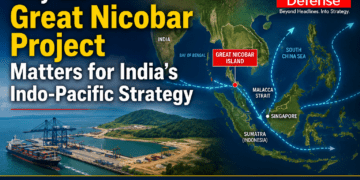
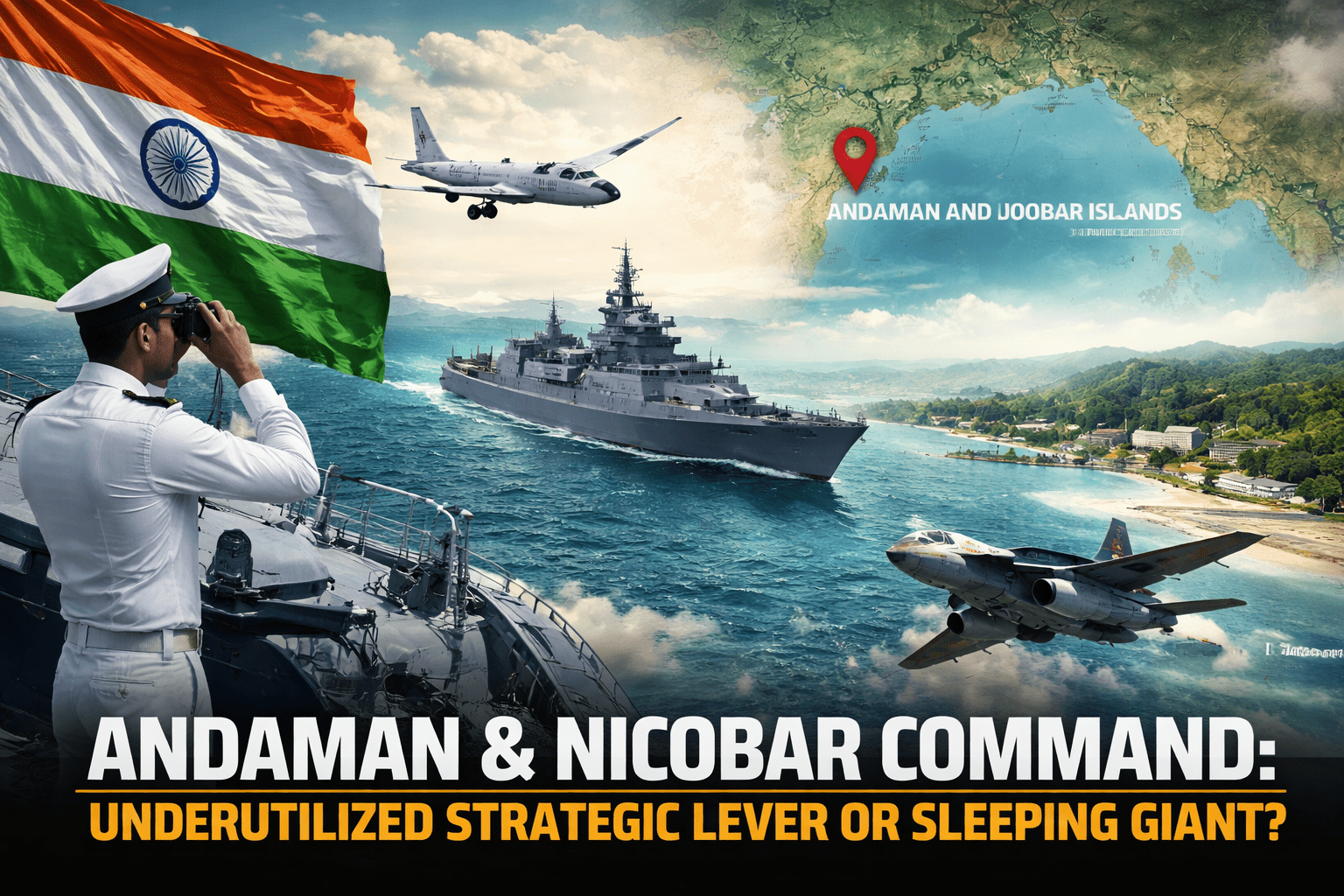
Shift east from the subcontinent and you encounter a thin arc of islands reaching toward Southeast Asia. That geography is not peripheral. It sits at the hinge of the Indian and Pacific Oceans. At the center of that hinge lies the Andaman & Nicobar Command.
For more than two decades, the Andaman & Nicobar Command has existed as India’s only operational tri-service command. It was meant to embody jointness before jointness became doctrine. It was meant to anchor India’s eastern maritime posture. Yet in strategic practice, it remains more symbol than fulcrum.
The real debate is not about whether the Andaman & Nicobar Command matters. It is about whether India has fully decided what it wants this command to do in a contested Indo-Pacific.
Geography Is Not Strategy: The Untapped Leverage of the Andaman & Nicobar Command
The islands sit just outside the Malacca Strait, one of the world’s most critical maritime arteries. Energy shipments from the Middle East to East Asia, containerized trade, industrial supply chains all pass within reach.
But geography by itself is inert. It becomes power only when matched by doctrine, infrastructure, and credible force projection.
At present, the Andaman & Nicobar Command provides maritime domain awareness, forward basing, patrol capability, and limited air operations. Infrastructure has improved. ISR assets are more persistent. Naval deployments are more regular.
Yet the command is still not structured as a sustained maritime denial hub. Fighter presence is rotational, not permanent. Missile deployments remain limited. Submarine basing is functional but not optimized for surge scenarios.
The Andaman & Nicobar Command is positioned at a strategic chokepoint. It is not yet structured to fully exploit that leverage.
The China Variable: Strategic Anxiety Without Activation
Much commentary reduces the Andaman & Nicobar Command to a counter-China tool. That framing misses the nuance.
Beijing’s concern is not an Indian blockade in peacetime. That would be diplomatically reckless and economically disruptive for India itself. The real issue is crisis leverage.
In a Taiwan contingency or a broader Indo-Pacific escalation, the People’s Liberation Army Navy must factor in the vulnerability of its sea lines of communication. The Andaman & Nicobar Command introduces uncertainty into Chinese operational planning. It complicates submarine transit. It increases surveillance risk. It forces force allocation decisions.
Even if never activated kinetically, the command exerts quiet psychological pressure.
But deterrence requires more than potential. If the Andaman & Nicobar Command is to shape Chinese behavior in a meaningful way, it must evolve from surveillance node to scalable denial architecture.
That transformation has not yet occurred.
The Jointness Question: Concept Ahead of Capability?
The Andaman & Nicobar Command was designed as a tri-service experiment. Army, Navy, and Air Force integrated under a unified structure. On paper, this makes it ideal for island defense and maritime denial.
In practice, resource allocation tells a different story.
Continental priorities dominate Indian defense spending. Northern border infrastructure and force posture absorb significant capital and political attention. Maritime investments grow, but incrementally.
This creates a structural imbalance. India speaks the language of Indo-Pacific centrality while undercapitalizing its most forward Indo-Pacific bastion.
If the Andaman & Nicobar Command is to evolve into a true strategic lever, it requires more than rhetorical endorsement. It requires sustained basing of advanced air assets, hardened missile deployments, enhanced submarine logistics, and layered air defense.
Otherwise, it remains a conceptual success without operational punch.
Escalation Modeling: The Lever Delhi Has Not Fully War-Gamed
Imagine a crisis in 2028. Border tensions with China intensify. Simultaneously, the Western Pacific heats up.
Where does the Andaman & Nicobar Command sit on India’s escalation ladder?
If India limits its role to surveillance and defensive posturing, the islands remain supportive but secondary. If Delhi chooses to signal intent by dispersing long-range anti-ship systems, sustaining high-tempo maritime patrols, and forward-positioning submarines, the Indian Ocean becomes a contested rear theater for China.
That choice alters escalation geometry.
It also binds India more tightly to Indo-Pacific crisis dynamics. Activation of the Andaman & Nicobar Command in a regional crisis would not be a local move. It would ripple across alliance calculations, energy markets, and naval deployments.
The existence of the lever is clear. The doctrine governing its use remains under-articulated.
Geoeconomics and the Andaman & Nicobar Command
The Andaman & Nicobar Command is not only a military instrument. It sits astride the arteries of global supply chains.
In an era of semiconductor chokepoints, sanctions regimes, and economic coercion, physical maritime control regains salience. The ability to monitor and potentially influence flows through Malacca carries latent economic bargaining power.
India rarely frames the command in geoeconomic terms. It should.
Energy security, trade continuity, and maritime insurance dynamics are tied to these waters. A more robust Andaman & Nicobar Command strengthens India’s strategic relevance not only in military coalitions but also in supply chain resilience discussions with Japan, the United States, and ASEAN economies.
The Vulnerability Trap
There is a strategic risk most analysts gloss over.
Upgrading the Andaman & Nicobar Command without hardening it could create a high-value target. Fixed runways, ports, and missile sites are vulnerable to precision strikes. In a high-intensity conflict, the islands could face concentrated early targeting.
If India expands the command’s offensive potential, it must simultaneously invest in hardened shelters, rapid runway repair capability, integrated air and missile defense, redundancy in logistics, and distributed basing concepts.
A forward bastion without resilience is a liability.
The sleeping giant narrative is seductive. Activation without protection would be reckless.
Three Plausible Trajectories for the Andaman & Nicobar Command
The first trajectory is incremental enhancement. Gradual infrastructure upgrades continue. ISR deepens. Naval deployments grow modestly. The command becomes more capable but remains secondary in crisis calculus.
The second trajectory is strategic activation. Permanent fighter detachments, long-range anti-ship missile networks, hardened infrastructure, and deeper interoperability with Indo-Pacific partners transform the Andaman & Nicobar Command into a credible maritime denial node.
The third trajectory is symbolic overreach. Rapid militarization without resilience invites vulnerability and escalatory miscalculation.
Which path Delhi chooses will signal how seriously it intends to anchor its Indo-Pacific identity in operational reality.
What the Andaman & Nicobar Command Ultimately Reveals
The Andaman & Nicobar Command is not simply about islands. It is about strategic self-definition.
India is navigating a structural transition. It remains a continental power facing land-based challenges. Yet it increasingly aspires to shape maritime balances across the Indo-Pacific.
The command sits at that intersection.
If India continues to treat it as a forward outpost, its influence will remain latent.
If Delhi integrates the Andaman & Nicobar Command into deterrence doctrine, procurement logic, alliance behavior, and economic security planning, it could quietly alter Indo-Pacific power geometry.
The real question is not whether the Andaman & Nicobar Command is a sleeping giant.
The question is whether India is ready to accept the geopolitical consequences of waking it.

