































The Arsenal Within: Decoding the AMCA”s Weapons Bay
There is a lot of buzz about India”s 5th generation fighter, the Advanced Medium Combat Aircraft (AMCA). We often talk about its stealthy shape, the futuristic cockpit, or the timelines for its first flight—which, by the way, DRDO chief Sameer V. Kamat has recently accelerated, targeting a rollout by late 2028 and a first flight by mid-2029 .
But here is a question that doesn”t get asked enough: What is this bird going to shoot?
In the world of 5th-gen fighters, the aircraft is only as good as its weapons.
You can have the stealthiest platform in the world, but if the missiles hanging out of it (or inside it) can”t reach the target or give away your position, the game is up.
So, let”s pop open the internal weapons bay of the AMCA and look at the “Made in India” arsenal that DRDO is frantically testing and tailoring to fit inside.
The “Small Missile” Big Problem
Here is the biggest headache DRDO engineers are solving right now. On a regular fighter like the Su-30MKI or the Tejas, if you want to carry a big, heavy, long-range missile, you just hook it onto the wings or the belly. The aircraft bulks up, the radar signature goes through the roof, but hey, it works.
The AMCA can”t do that.
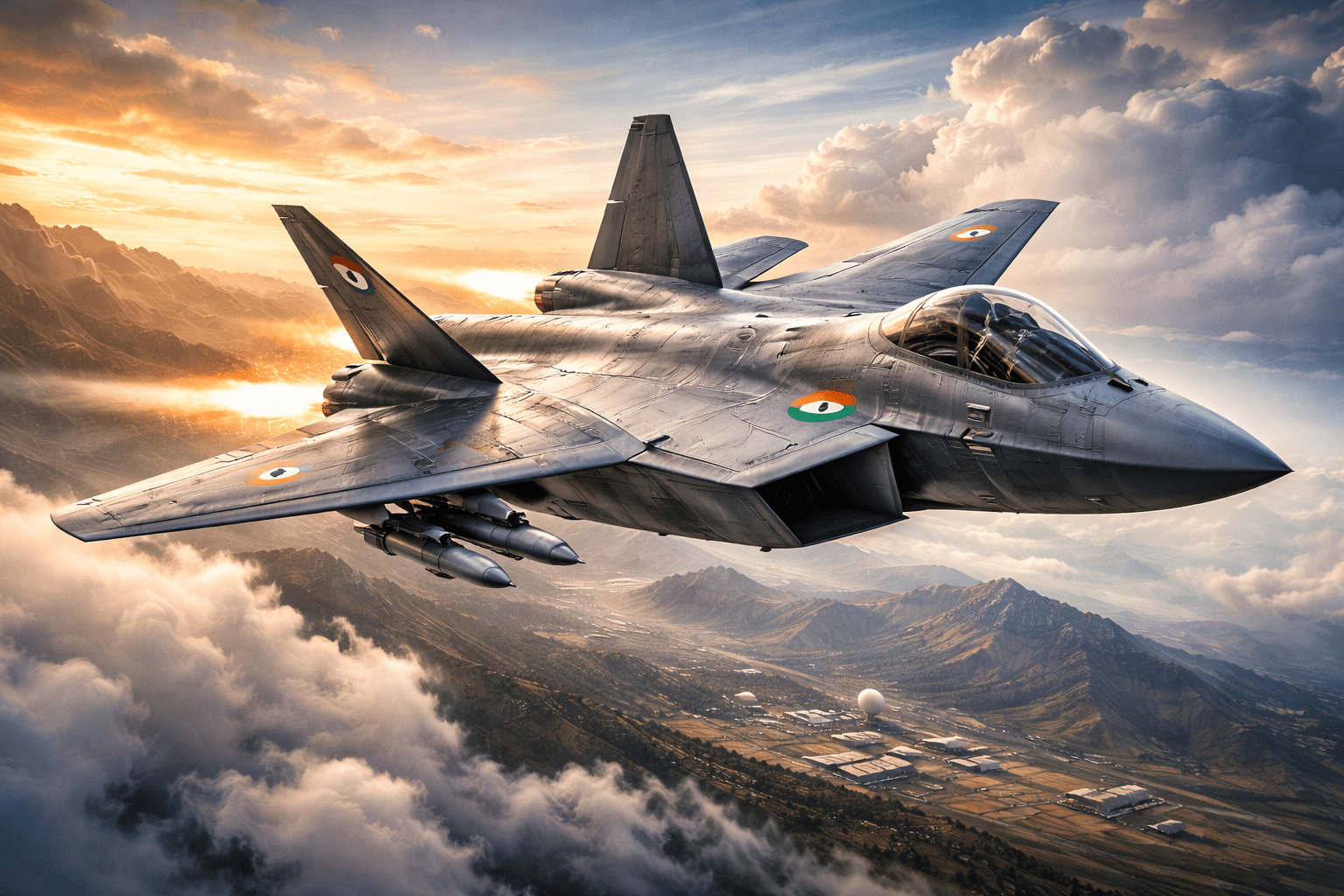
To stay stealthy, it has to carry its birthday gifts inside the belly. When the doors open, it unleashes hell; when the doors close, it vanishes again. This means every weapon has to go on a diet. It has to be compact.
This is why the DRDO and IAF are quietly working on what we can call the “AMCA Specials.” Reports suggest a new class of compact cruise missiles is on the drawing board .
Think of it as the younger, fitter sibling of the Nirbhay cruise missile. The Nirbhay is a beast—it can fly 1,000 km, but it”s bulky. For the AMCA, DRDO is looking at a missile that weighs around 1,000 kg—light enough for the jet to carry two of them internally. The goal is a stealthy, subsonic cruiser with a range of about 600-700 km .
Imagine this: The AMCA, flying deep into enemy territory with its radar cross-section smaller than a bird, launches a missile that skims the ground at 50 feet, uses indigenous electronic warfare tools to jam and confuse air defenses, and hits a bunker or a ship 600 km away. That”s the kind of “stand-off” punch we are building .
And the heart of this missile? A desi GTRE Manik small turbo fan engine—the same one that powers the Nirbhay—proving that our engine programme is finally finding its feet, even if it”s just for missiles right now .
Rudram: The “Radar Killer” Gets a Range Boost
Now, let”s talk about the Rudram-1. If the AMCA is the sniper, the Rudram is the bullet that takes out the enemy spotlights.
Officially called the New Generation Anti-Radiation Missile (NGARM), the Rudram-1 is designed to hunt down enemy radars. It locks onto the signals from tracking systems and shuts them up permanently. Currently, it has a range of about 200 km.
But here is where the story gets interesting. DRDO just had a massive success with the Astra Mk2 air-to-air missile, specifically with its new dual-pulse rocket motor technology .
If you are not a tech geek, “dual-pulse” simply means the missile doesn”t just fire once and glide. It fires, coasts to save energy, and then fires again at the last moment to chase down a running target. This technology is gold.
And gold is meant to be shared.
Recent reports indicate that DRDO is taking that same high-energy propellant tech from the Astra program and shoving it into the Rudram-1. The result? The Rudram-1″s range is being stretched to nearly 300 km .
For the AMCA, this is massive. It means the jet can loiter behind the forward line of troops, locate an enemy air defense radar trying to lock onto our jets, and fire a Rudram from 300 km away without ever entering the danger zone. It turns the AMCA into a “Wild Weasel”—a hunter of air defense systems—on steroids.
The Air-to-Air Game: Beyond Visual Range
Of course, the AMCA”s primary job will be to establish air superiority. And for that, it needs to see and kill the enemy before they even know it”s there.
The Astra Mk2, with its 200+ km range, is just the starting point . The real game-changer will be the Astra Mk3. This isn”t just a tweak; it”s a whole different beast.
It uses a Ramjet propulsion system (Solid Fuel Ducted Ramjet – SFDR).
Why a Ramjet? Because it can sustain high speeds for much longer. While a regular rocket motor burns out quickly, a ramjet breathes air as it flies, maintaining its energy right until the point of impact. The Astra Mk3 is expected to have a range exceeding 350 km .
But DRDO isn’t stopping there. There are talks of going even further—pushing ranges beyond 400 km using Triple-Pulse Rocket Motors .
This would put the AMCA in a league of its own, able to engage enemy tankers, AWACS (airborne early warning aircraft), and fighters from distances that seem impossible today.
The “Brain” Behind the Brawn
Having the missiles is one thing. Talking to them is another.
Here is a ground reality check from January 2026. At the Aeronautics 2047 show, Bharat Electronics Limited (BEL) showcased the fully indigenous avionics suite for the AMCA . This includes the Weapon Interface Computer.
Think of this computer as the ultimate party host. It ensures that the Uttam AESA Radar (the eyes), the Mission Computer (the brain), and the missiles (the fists) are all speaking the same language fluently .
Furthermore, the AMCA will feature a Distributed Aperture System (DAS) , developed by BEL. This gives the pilot 360-degree vision around the aircraft.
If a missile is launched from behind, the DAS sees it, and the computer can automatically cue the pilot or defensive systems . This level of sensor fusion is what makes a 5th-gen aircraft “smart.”
The “Phased” Approach to Armageddon
The best part about this whole integration story is the practical approach the IAF and DRDO are taking.
Remember how the Tejas took forever to get fully operational because they wanted to integrate every single weapon before declaring it ready? For the AMCA, they are doing a “Phased Approach” .
The plan is to get the AMCA into service with just a core set of weapons—maybe 4-5 types of air-to-air and air-to-ground missiles. Once the fleet is with the squadrons and pilots are training on it, they will keep adding more weapons via software updates.
It is literally like your smartphone getting a new OS update that unlocks a better camera mode.
Final Word
The AMCA is not just an aircraft project; it is a systems integration project. The real brilliance of the program lies in how DRDO is shrinking down massive cruise missiles, extending the reach of radar killers with new propellant tech, and weaving it all together with a completely indigenous digital brain.
By the time the AMCA breaks cover in 2028, it won”t be walking into the fight empty-handed. It will be carrying the deadliest “Made in India” arsenal we have ever built. And that, quite frankly, is worth the wait.

