
















IndoAsia Defense
  • Home
  • Air
    • All
    • Air Defence
    • Drones
    • Fighters
    • ISR & Mobility
    Ghatak UCAV stealth, autonomy, integration

    Inside India’s Ghatak UCAV Program: Stealth, Autonomy, and the Integration Gap

    The F414 engine co-production agreement between Hindustan Aeronautics Limited and GE Aerospace

    India-US F414 Engine Deal Explained: Technology Transfer, Tejas Mk2, and AMCA

    What is the Su-57M1 India deal

    Su-57M1 for India: A Fifth-Generation Shortcut or a Strategic Dependency Trap?

    India indigenous long range surveillance radar with X-band drone detection capability

    450km Eyes, Machine-Speed Decisions: How India’s Indigenous Long Range Surveillance Radar Is Rewriting Air Defence

    Why Software Defined Radios Are the IAF’s Most Consequential Upgrade

    IAF Signs BEL Deal for Software Defined Radios: Rewiring India’s Air Combat Network

    How the Ghatak UCAV Stealth Design Redefines India’s Drone Warfare Doctrine

    Ghatak UCAV: India’s Carbon Composite Stealth Strategy Dissected

    Ballistic Missile Defense system intercepting incoming missile during midcourse phase

    How Ballistic Missile Defense Works: Inside Modern Missile Interception Systems

    Swarm logistics drones delivering military supplies in high-altitude Himalayan terrain with Indian Army presence

    Swarm Logistics Drones in Himalayan Warfare: Can India Close the Supply Gap with China?

    India’s 6th-Gen Fighter Strategy FCAS vs GCAP Explained

    India’s 6th-Gen Fighter Strategy: FCAS vs GCAP Explained

  • Land
    • All
    • Armour & Artillery
    • China Front
    • Future Combat
    • Pakistan Front
    The India-South Korea defence deal

    The India-South Korea Defence Deal Through China’s Operational Lens

    Railways as War Arteries Can India Match China’s Military Mobility Before the Next Crisis

    Railways as War Arteries: Can India Match China’s Military Mobility Before the Next Crisis?

    China maritime front in Indian Ocean

    What If China Opens a Maritime Front in the Indian Ocean During a LAC Conflict?

    What is Indian military modernization strategy in 2026?

    Indian Military Modernization: Systems, Doctrine, and Capability Architecture (2026-27)

    Tank launching loitering munition in battle

    From Smoke to Strike: India’s Indigenous Loitering Munitions for T-72, T-90, and Arjun Tanks

    How China Mobilizes Forces Along the LAC Speed, Systems, and Strategic Control

    How China Mobilizes Forces Along the LAC: Systems, Speed, and Strategic Signaling

    Ballistic Missile Defense system intercepting incoming missile during midcourse phase

    How Ballistic Missile Defense Works: Inside Modern Missile Interception Systems

    Swarm logistics drones delivering military supplies in high-altitude Himalayan terrain with Indian Army presence

    Swarm Logistics Drones in Himalayan Warfare: Can India Close the Supply Gap with China?

    India defence proposals Rs 2.38 trillion showing S-400 system, strike drones, fighter jets and military architecture shift

    India Defence Proposals Rs 2.38 Trillion: Why This Approval Changes How India Will Fight, Not Just What It Buys

  • Navy
    • All
    • Fleet Expansion
    • Indian Ocean
    • Maritime Security
    • Submarines
    China maritime front in Indian Ocean

    What If China Opens a Maritime Front in the Indian Ocean During a LAC Conflict?

    The Strait of Hormuz Crisis

    India’s Oil Artery Under Threat: Strategic Implications of a Hormuz Crisis

    India’s VL-Shtil Missile Deal with Russia

    India’s VL-Shtil Missile Deal with Russia: Strengthening Naval Air Defense in the Indo-Pacific

    Andaman & Nicobar Command Sleeping Giant of India’s Maritime Strategy

    Andaman & Nicobar Command: Sleeping Giant of India’s Maritime Strategy

    Maritime Surveillance 2.0: Why EO/IR Modernisation Matters for India’s Ocean Security

    Maritime Surveillance 2.0: Why EO/IR Modernisation Matters for India’s Ocean Security

    2030 Will Decide the India ASEAN Maritime Equation

    2030 Will Decide the India ASEAN Maritime Equation

    India Military Transformation Series — Part 3: Maritime Power and the Indian Ocean Imperative

    India Military Transformation Series — Part 3: Maritime Power and the Indian Ocean Imperative

    Indian Navy TEDBF PPP Model: China Factor and 2030–2040 Carrier Strategy

    Indian Navy TEDBF PPP Model: China Factor and 2030–2040 Carrier Strategy

    India’s Maritime Strategy: India’s Blue-Water Ambition in a Contested Indo-Pacific

    India’s Maritime Strategy: India’s Blue-Water Ambition in a Contested Indo-Pacific

  • Indo-Pacific
    • All
    • 2035 Outlook
    • China Strategy
    • India Strategy
    • Pakistan Outlook
    The India-South Korea defence deal

    The India-South Korea Defence Deal Through China’s Operational Lens

    Railways as War Arteries Can India Match China’s Military Mobility Before the Next Crisis

    Railways as War Arteries: Can India Match China’s Military Mobility Before the Next Crisis?

    india military integration gap

    Is India Building Military Power Faster Than It Can Integrate It?

    China maritime front in Indian Ocean

    What If China Opens a Maritime Front in the Indian Ocean During a LAC Conflict?

    Can India Fight Beyond 30 Days? Inside India’s War Sustainment Reality

    Can India Fight Beyond 30 Days? Inside India’s War Sustainment Reality

    What is Indian military modernization strategy in 2026?

    Indian Military Modernization: Systems, Doctrine, and Capability Architecture (2026-27)

    The end of Naxalism in India

    End of Naxalism in India: Inside the Fall of the Red Corridor

    Ballistic Missile Defense system intercepting incoming missile during midcourse phase

    How Ballistic Missile Defense Works: Inside Modern Missile Interception Systems

    Swarm logistics drones delivering military supplies in high-altitude Himalayan terrain with Indian Army presence

    Swarm Logistics Drones in Himalayan Warfare: Can India Close the Supply Gap with China?

  • Joint
    • All
    • Integrated Ops
    • Procurement Reform
    • Theater Commands
    Ballistic Missile Defense system intercepting incoming missile during midcourse phase

    How Ballistic Missile Defense Works: Inside Modern Missile Interception Systems

    India defence proposals Rs 2.38 trillion showing S-400 system, strike drones, fighter jets and military architecture shift

    India Defence Proposals Rs 2.38 Trillion: Why This Approval Changes How India Will Fight, Not Just What It Buys

    DAP 2026 India’s Quiet Revolution in Defence Procurement

    DAP 2026: India’s Quiet Revolution in Defence Procurement

    Integrated Battle Groups vs China’s Western Theater Command

    Integrated Battle Groups vs China’s Western Theater Command: Can Doctrine Survive the Himalayan Reality?

    Andaman & Nicobar Command Sleeping Giant of India’s Maritime Strategy

    Andaman & Nicobar Command: Sleeping Giant of India’s Maritime Strategy

    India Military Transformation Series — Part 2: The Theatre Command Reckoning

    India Military Transformation Series — Part 2: The Theatre Command Reckoning

    India AI C4ISR modernization

    India Military Transformation Series — Part 1: India AI C4ISR Modernization

    India’s Two-Front Theatre Command: Preparing for Simultaneous Conflict

    India’s Two-Front Theatre Command: Preparing for Simultaneous Conflict

    The Networked Force: India’s Transition to Integrated Warfare Systems

    The Networked Force: India’s Transition to Integrated Warfare Systems

  • Tech
    • All
    • AI & Autonomous Systems
    • Cyber
    • Electronic Warfare
    • Space
    Why Software Defined Radios Are the IAF’s Most Consequential Upgrade

    IAF Signs BEL Deal for Software Defined Radios: Rewiring India’s Air Combat Network

    Source Code or ICD India’s Source Code Negotiation Explained

    Source Code or ICD: India’s Source Code Negotiation Explained

    Supply Chain Weaponization

    Supply Chain Weaponization: Strategic Autonomy Meets Semiconductor Reality

    AI-driven battlefield in India's military

    The Algorithm of Borders: What India’s Military AI Push Actually Looks Like on the Ground

    India AI C4ISR modernization

    India Military Transformation Series — Part 1: India AI C4ISR Modernization

    PRAHAR Explained India Counter Terror Policy Prahaar

    PRAHAAR Explained: Why ‘PRAHAAR’ India’s National Counter-terrorism Doctrine, Signals the End of Traditional Warfare

    The Weapons Making the AMCA Unbeatable

    The Weapons Making the AMCA Unbeatable

    India’s Aerospace Ecosystem After Rafale: The 2026–2030 Industrial Test

    India’s Aerospace Ecosystem After Rafale: The 2026–2030 Industrial Test

    PLA’s Cyber Warfare Units and the Question of Indian Critical Infrastructure Resilience

    PLA’s Cyber Warfare Units and the Question of Indian Critical Infrastructure Resilience

  • Industry
    • All
    • Budget
    • Exports
    • Make in India
    • Supply Chains
    Ghatak UCAV stealth, autonomy, integration

    Inside India’s Ghatak UCAV Program: Stealth, Autonomy, and the Integration Gap

    The India-South Korea defence deal

    The India-South Korea Defence Deal Through China’s Operational Lens

    The F414 engine co-production agreement between Hindustan Aeronautics Limited and GE Aerospace

    India-US F414 Engine Deal Explained: Technology Transfer, Tejas Mk2, and AMCA

    Why Software Defined Radios Are the IAF’s Most Consequential Upgrade

    IAF Signs BEL Deal for Software Defined Radios: Rewiring India’s Air Combat Network

    How the Ghatak UCAV Stealth Design Redefines India’s Drone Warfare Doctrine

    Ghatak UCAV: India’s Carbon Composite Stealth Strategy Dissected

    Swarm logistics drones delivering military supplies in high-altitude Himalayan terrain with Indian Army presence

    Swarm Logistics Drones in Himalayan Warfare: Can India Close the Supply Gap with China?

    India defence proposals Rs 2.38 trillion showing S-400 system, strike drones, fighter jets and military architecture shift

    India Defence Proposals Rs 2.38 Trillion: Why This Approval Changes How India Will Fight, Not Just What It Buys

    Helicopter-Mounted Counter-Drone Systems

    Helicopter-Mounted Counter-Drone Systems: The Indian Army’s Answer to Kamikaze Drone Warfare

    India vs China Defence Industrial Base Explained

    India vs China Defence Industrial Base: Scale vs Strategic Depth

  • Global
    • All
    • China-Pak
    • Emerging Tech
    • Middle Eeast
    • Regional Trends
    • US-India
    • US-Israel
    Ghatak UCAV stealth, autonomy, integration

    Inside India’s Ghatak UCAV Program: Stealth, Autonomy, and the Integration Gap

    The F414 engine co-production agreement between Hindustan Aeronautics Limited and GE Aerospace

    India-US F414 Engine Deal Explained: Technology Transfer, Tejas Mk2, and AMCA

    india military integration gap

    Is India Building Military Power Faster Than It Can Integrate It?

    India indigenous long range surveillance radar with X-band drone detection capability

    450km Eyes, Machine-Speed Decisions: How India’s Indigenous Long Range Surveillance Radar Is Rewriting Air Defence

    What is Indian military modernization strategy in 2026?

    Indian Military Modernization: Systems, Doctrine, and Capability Architecture (2026-27)

    India defence proposals Rs 2.38 trillion showing S-400 system, strike drones, fighter jets and military architecture shift

    India Defence Proposals Rs 2.38 Trillion: Why This Approval Changes How India Will Fight, Not Just What It Buys

    India’s 6th-Gen Fighter Strategy FCAS vs GCAP Explained

    India’s 6th-Gen Fighter Strategy: FCAS vs GCAP Explained

    India’s Two-Front War Doctrine When and Why It Emerged

    When India’s Two-Front War Doctrine Emerged

    From Non-Alignment to Multi-Alignment India’s New Strategy

    Is India Quietly Shifting from Non-Alignment to Multi-Alignment 2.0?

  • Resources
    • India Military Capability Index
    • India vs China Military Balance
    • China Western Theater Command Guide
    • Pakistan Military Tracker 2026-27
    • India’s Military Doctrine Library
    • India vs China vs Pakistan Missile Arsenal Comparison
    • India’s Missile List
    • India Missile Range Map
    • Indo-Pacific Military Power Map
    • Indo-Pacific Defense Timeline
    • Global Military Balance Dashboard
    • Global Weapons Systems Database
    • Global Missile Systems Database
  • What If
    • China India Naval Conflict
No Result
View All Result
  • Home
  • Air
    • All
    • Air Defence
    • Drones
    • Fighters
    • ISR & Mobility
    Ghatak UCAV stealth, autonomy, integration

    Inside India’s Ghatak UCAV Program: Stealth, Autonomy, and the Integration Gap

    The F414 engine co-production agreement between Hindustan Aeronautics Limited and GE Aerospace

    India-US F414 Engine Deal Explained: Technology Transfer, Tejas Mk2, and AMCA

    What is the Su-57M1 India deal

    Su-57M1 for India: A Fifth-Generation Shortcut or a Strategic Dependency Trap?

    India indigenous long range surveillance radar with X-band drone detection capability

    450km Eyes, Machine-Speed Decisions: How India’s Indigenous Long Range Surveillance Radar Is Rewriting Air Defence

    Why Software Defined Radios Are the IAF’s Most Consequential Upgrade

    IAF Signs BEL Deal for Software Defined Radios: Rewiring India’s Air Combat Network

    How the Ghatak UCAV Stealth Design Redefines India’s Drone Warfare Doctrine

    Ghatak UCAV: India’s Carbon Composite Stealth Strategy Dissected

    Ballistic Missile Defense system intercepting incoming missile during midcourse phase

    How Ballistic Missile Defense Works: Inside Modern Missile Interception Systems

    Swarm logistics drones delivering military supplies in high-altitude Himalayan terrain with Indian Army presence

    Swarm Logistics Drones in Himalayan Warfare: Can India Close the Supply Gap with China?

    India’s 6th-Gen Fighter Strategy FCAS vs GCAP Explained

    India’s 6th-Gen Fighter Strategy: FCAS vs GCAP Explained

  • Land
    • All
    • Armour & Artillery
    • China Front
    • Future Combat
    • Pakistan Front
    The India-South Korea defence deal

    The India-South Korea Defence Deal Through China’s Operational Lens

    Railways as War Arteries Can India Match China’s Military Mobility Before the Next Crisis

    Railways as War Arteries: Can India Match China’s Military Mobility Before the Next Crisis?

    China maritime front in Indian Ocean

    What If China Opens a Maritime Front in the Indian Ocean During a LAC Conflict?

    What is Indian military modernization strategy in 2026?

    Indian Military Modernization: Systems, Doctrine, and Capability Architecture (2026-27)

    Tank launching loitering munition in battle

    From Smoke to Strike: India’s Indigenous Loitering Munitions for T-72, T-90, and Arjun Tanks

    How China Mobilizes Forces Along the LAC Speed, Systems, and Strategic Control

    How China Mobilizes Forces Along the LAC: Systems, Speed, and Strategic Signaling

    Ballistic Missile Defense system intercepting incoming missile during midcourse phase

    How Ballistic Missile Defense Works: Inside Modern Missile Interception Systems

    Swarm logistics drones delivering military supplies in high-altitude Himalayan terrain with Indian Army presence

    Swarm Logistics Drones in Himalayan Warfare: Can India Close the Supply Gap with China?

    India defence proposals Rs 2.38 trillion showing S-400 system, strike drones, fighter jets and military architecture shift

    India Defence Proposals Rs 2.38 Trillion: Why This Approval Changes How India Will Fight, Not Just What It Buys

  • Navy
    • All
    • Fleet Expansion
    • Indian Ocean
    • Maritime Security
    • Submarines
    China maritime front in Indian Ocean

    What If China Opens a Maritime Front in the Indian Ocean During a LAC Conflict?

    The Strait of Hormuz Crisis

    India’s Oil Artery Under Threat: Strategic Implications of a Hormuz Crisis

    India’s VL-Shtil Missile Deal with Russia

    India’s VL-Shtil Missile Deal with Russia: Strengthening Naval Air Defense in the Indo-Pacific

    Andaman & Nicobar Command Sleeping Giant of India’s Maritime Strategy

    Andaman & Nicobar Command: Sleeping Giant of India’s Maritime Strategy

    Maritime Surveillance 2.0: Why EO/IR Modernisation Matters for India’s Ocean Security

    Maritime Surveillance 2.0: Why EO/IR Modernisation Matters for India’s Ocean Security

    2030 Will Decide the India ASEAN Maritime Equation

    2030 Will Decide the India ASEAN Maritime Equation

    India Military Transformation Series — Part 3: Maritime Power and the Indian Ocean Imperative

    India Military Transformation Series — Part 3: Maritime Power and the Indian Ocean Imperative

    Indian Navy TEDBF PPP Model: China Factor and 2030–2040 Carrier Strategy

    Indian Navy TEDBF PPP Model: China Factor and 2030–2040 Carrier Strategy

    India’s Maritime Strategy: India’s Blue-Water Ambition in a Contested Indo-Pacific

    India’s Maritime Strategy: India’s Blue-Water Ambition in a Contested Indo-Pacific

  • Indo-Pacific
    • All
    • 2035 Outlook
    • China Strategy
    • India Strategy
    • Pakistan Outlook
    The India-South Korea defence deal

    The India-South Korea Defence Deal Through China’s Operational Lens

    Railways as War Arteries Can India Match China’s Military Mobility Before the Next Crisis

    Railways as War Arteries: Can India Match China’s Military Mobility Before the Next Crisis?

    india military integration gap

    Is India Building Military Power Faster Than It Can Integrate It?

    China maritime front in Indian Ocean

    What If China Opens a Maritime Front in the Indian Ocean During a LAC Conflict?

    Can India Fight Beyond 30 Days? Inside India’s War Sustainment Reality

    Can India Fight Beyond 30 Days? Inside India’s War Sustainment Reality

    What is Indian military modernization strategy in 2026?

    Indian Military Modernization: Systems, Doctrine, and Capability Architecture (2026-27)

    The end of Naxalism in India

    End of Naxalism in India: Inside the Fall of the Red Corridor

    Ballistic Missile Defense system intercepting incoming missile during midcourse phase

    How Ballistic Missile Defense Works: Inside Modern Missile Interception Systems

    Swarm logistics drones delivering military supplies in high-altitude Himalayan terrain with Indian Army presence

    Swarm Logistics Drones in Himalayan Warfare: Can India Close the Supply Gap with China?

  • Joint
    • All
    • Integrated Ops
    • Procurement Reform
    • Theater Commands
    Ballistic Missile Defense system intercepting incoming missile during midcourse phase

    How Ballistic Missile Defense Works: Inside Modern Missile Interception Systems

    India defence proposals Rs 2.38 trillion showing S-400 system, strike drones, fighter jets and military architecture shift

    India Defence Proposals Rs 2.38 Trillion: Why This Approval Changes How India Will Fight, Not Just What It Buys

    DAP 2026 India’s Quiet Revolution in Defence Procurement

    DAP 2026: India’s Quiet Revolution in Defence Procurement

    Integrated Battle Groups vs China’s Western Theater Command

    Integrated Battle Groups vs China’s Western Theater Command: Can Doctrine Survive the Himalayan Reality?

    Andaman & Nicobar Command Sleeping Giant of India’s Maritime Strategy

    Andaman & Nicobar Command: Sleeping Giant of India’s Maritime Strategy

    India Military Transformation Series — Part 2: The Theatre Command Reckoning

    India Military Transformation Series — Part 2: The Theatre Command Reckoning

    India AI C4ISR modernization

    India Military Transformation Series — Part 1: India AI C4ISR Modernization

    India’s Two-Front Theatre Command: Preparing for Simultaneous Conflict

    India’s Two-Front Theatre Command: Preparing for Simultaneous Conflict

    The Networked Force: India’s Transition to Integrated Warfare Systems

    The Networked Force: India’s Transition to Integrated Warfare Systems

  • Tech
    • All
    • AI & Autonomous Systems
    • Cyber
    • Electronic Warfare
    • Space
    Why Software Defined Radios Are the IAF’s Most Consequential Upgrade

    IAF Signs BEL Deal for Software Defined Radios: Rewiring India’s Air Combat Network

    Source Code or ICD India’s Source Code Negotiation Explained

    Source Code or ICD: India’s Source Code Negotiation Explained

    Supply Chain Weaponization

    Supply Chain Weaponization: Strategic Autonomy Meets Semiconductor Reality

    AI-driven battlefield in India's military

    The Algorithm of Borders: What India’s Military AI Push Actually Looks Like on the Ground

    India AI C4ISR modernization

    India Military Transformation Series — Part 1: India AI C4ISR Modernization

    PRAHAR Explained India Counter Terror Policy Prahaar

    PRAHAAR Explained: Why ‘PRAHAAR’ India’s National Counter-terrorism Doctrine, Signals the End of Traditional Warfare

    The Weapons Making the AMCA Unbeatable

    The Weapons Making the AMCA Unbeatable

    India’s Aerospace Ecosystem After Rafale: The 2026–2030 Industrial Test

    India’s Aerospace Ecosystem After Rafale: The 2026–2030 Industrial Test

    PLA’s Cyber Warfare Units and the Question of Indian Critical Infrastructure Resilience

    PLA’s Cyber Warfare Units and the Question of Indian Critical Infrastructure Resilience

  • Industry
    • All
    • Budget
    • Exports
    • Make in India
    • Supply Chains
    Ghatak UCAV stealth, autonomy, integration

    Inside India’s Ghatak UCAV Program: Stealth, Autonomy, and the Integration Gap

    The India-South Korea defence deal

    The India-South Korea Defence Deal Through China’s Operational Lens

    The F414 engine co-production agreement between Hindustan Aeronautics Limited and GE Aerospace

    India-US F414 Engine Deal Explained: Technology Transfer, Tejas Mk2, and AMCA

    Why Software Defined Radios Are the IAF’s Most Consequential Upgrade

    IAF Signs BEL Deal for Software Defined Radios: Rewiring India’s Air Combat Network

    How the Ghatak UCAV Stealth Design Redefines India’s Drone Warfare Doctrine

    Ghatak UCAV: India’s Carbon Composite Stealth Strategy Dissected

    Swarm logistics drones delivering military supplies in high-altitude Himalayan terrain with Indian Army presence

    Swarm Logistics Drones in Himalayan Warfare: Can India Close the Supply Gap with China?

    India defence proposals Rs 2.38 trillion showing S-400 system, strike drones, fighter jets and military architecture shift

    India Defence Proposals Rs 2.38 Trillion: Why This Approval Changes How India Will Fight, Not Just What It Buys

    Helicopter-Mounted Counter-Drone Systems

    Helicopter-Mounted Counter-Drone Systems: The Indian Army’s Answer to Kamikaze Drone Warfare

    India vs China Defence Industrial Base Explained

    India vs China Defence Industrial Base: Scale vs Strategic Depth

  • Global
    • All
    • China-Pak
    • Emerging Tech
    • Middle Eeast
    • Regional Trends
    • US-India
    • US-Israel
    Ghatak UCAV stealth, autonomy, integration

    Inside India’s Ghatak UCAV Program: Stealth, Autonomy, and the Integration Gap

    The F414 engine co-production agreement between Hindustan Aeronautics Limited and GE Aerospace

    India-US F414 Engine Deal Explained: Technology Transfer, Tejas Mk2, and AMCA

    india military integration gap

    Is India Building Military Power Faster Than It Can Integrate It?

    India indigenous long range surveillance radar with X-band drone detection capability

    450km Eyes, Machine-Speed Decisions: How India’s Indigenous Long Range Surveillance Radar Is Rewriting Air Defence

    What is Indian military modernization strategy in 2026?

    Indian Military Modernization: Systems, Doctrine, and Capability Architecture (2026-27)

    India defence proposals Rs 2.38 trillion showing S-400 system, strike drones, fighter jets and military architecture shift

    India Defence Proposals Rs 2.38 Trillion: Why This Approval Changes How India Will Fight, Not Just What It Buys

    India’s 6th-Gen Fighter Strategy FCAS vs GCAP Explained

    India’s 6th-Gen Fighter Strategy: FCAS vs GCAP Explained

    India’s Two-Front War Doctrine When and Why It Emerged

    When India’s Two-Front War Doctrine Emerged

    From Non-Alignment to Multi-Alignment India’s New Strategy

    Is India Quietly Shifting from Non-Alignment to Multi-Alignment 2.0?

  • Resources
    • India Military Capability Index
    • India vs China Military Balance
    • China Western Theater Command Guide
    • Pakistan Military Tracker 2026-27
    • India’s Military Doctrine Library
    • India vs China vs Pakistan Missile Arsenal Comparison
    • India’s Missile List
    • India Missile Range Map
    • Indo-Pacific Military Power Map
    • Indo-Pacific Defense Timeline
    • Global Military Balance Dashboard
    • Global Weapons Systems Database
    • Global Missile Systems Database
  • What If
    • China India Naval Conflict
No Result
View All Result
IndoAsia Defense
No Result
View All Result
Home Air

IAF Signs BEL Deal for Software Defined Radios: Rewiring India’s Air Combat Network

The IAF’s deal with BEL for software defined radios signals a deeper shift toward network-centric warfare, where fighters, sensors, and command systems operate as a unified combat network.

IndoAsia Defense by IndoAsia Defense
April 8, 2026
in Air, Industry, Make in India, Tech
0
Why Software Defined Radios Are the IAF’s Most Consequential Upgrade
0
SHARES
6
VIEWS
Share on LinkedinShare on FacebookShare on Twitter

The Network Before the Fighter: Why Software Defined Radios Are the IAF’s Most Consequential Upgrade

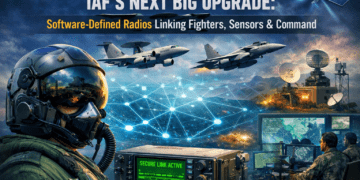
The Indian Air Force is not just modernising its fleet. It is rewiring how it fights. The move toward software defined radios marks a transition that is easy to understate if viewed as a communication upgrade. The Indian Air Force plans to procure around 2,500 indigenous software defined radios, a number that signals not just scale but intent. This is not a niche upgrade confined to a few squadrons. It is a force-wide restructuring of how information moves across the battlespace.

“The Indian Air Force has signed a contract with Bharat Electronics Limited, for procurement of Light Weight Man Portable modern communication Sets. These Indigenous Software Designed Radio (SDR) technology-based sets will provide a boost to the IAF’s Communication Network,”

The Air Force posted via its official handle on social media platform X (formerly Twitter).

This transition is now moving from concept to execution. The Indian Air Force has signed a contract with Bharat Electronics Limited for the procurement of lightweight, man-portable communication systems built on software defined radios architecture.

This is not a peripheral acquisition. It reflects an effort to standardise communication capability from the cockpit down to the tactical edge, ensuring that ground units and forward-deployed elements operate within the same networked framework as frontline aircraft.

Bharat Electronics Limited, a Navratna public sector undertaking under the Ministry of Defence, has a track record that includes systems such as the Akash air defence weapon system, coastal surveillance networks, weapon locating radars, and tactical control radars.

Its role in the SDR programme extends beyond manufacturing. It represents a shift toward domestic control over encryption, waveform design, and software lifecycle management. In a domain where communication integrity defines operational success, that control carries long-term strategic significance.

For decades, the IAF has operated with what can only be described as a fragmented nervous system. A Su-30MKI, a Rafale, and a Tejas flying in the same battlespace have relied on human-mediated coordination to share targeting data.

Voice relays, controller interventions, and sequential decision chains have been treated as operational friction rather than structural limitations.

The push toward software defined radios signals that this era is ending. The IAF’s next big upgrade is an attempt to compress decision cycles, unify disparate platforms, and compete in a battlespace where the electromagnetic spectrum is as contested as the airspace itself.

The strategic implication is not incremental. A force that can move data faster than its adversary can process it will consistently arrive at the engagement decision first. In modern air combat, that timing advantage translates directly into survivability and lethality.

The effectiveness of software defined radios depends on the network they feed into. The IAF’s Integrated Air Command and Control System serves as the central fusion layer, aggregating inputs from radars, airborne early warning platforms, UAVs, and other sensors. This system operates over AFNET, a secure digital backbone that enables real-time data exchange across the force.

What has historically been missing is a resilient link between this network and the individual aircraft. Without software defined radios, the operational picture generated by command systems cannot be consistently transmitted to frontline platforms in contested conditions. The SDR layer closes this gap.

Software Defined Radios and the Collapse of the Kill Chain

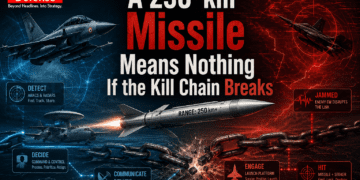
What software defined radios fundamentally change is the structure of the kill chain. Legacy systems rely on a linear sequence where a sensor detects, a controller interprets, a pilot receives, and the pilot engages. Each step introduces latency, and in high-tempo engagements, that latency becomes decisive.

With software defined radios, the kill chain begins to collapse into a networked loop. Sensors, whether airborne or ground-based, can transmit targeting data directly to shooters. Fighters become both consumers and contributors of the operational picture. Decision-making shifts from a centralised model to a distributed one, where multiple nodes act simultaneously rather than sequentially.

This transformation is not theoretical. A squadron operating legacy communication systems may struggle to share high-resolution sensor data in real time due to bandwidth limitations and protocol incompatibilities.

With software defined radios, the same formation can exchange high-volume data streams with low latency, enabling near-simultaneous situational awareness across all nodes. The implication is clear. The IAF is not simply upgrading radios. It is reducing the time between detection and engagement in a measurable way.

Software Defined Radios in the Indian Air Force: From Balakot to Bandwidth

The doctrinal shift toward software defined radios did not emerge in abstraction. It was shaped by operational experience. The 2019 Balakot episode and the subsequent aerial engagements exposed vulnerabilities that were not visible in peacetime exercises.

Communication disruption under electronic interference revealed how dependent the IAF remained on legacy voice-based coordination.

Reports and post-engagement analysis pointed to jamming of communication links at critical moments. Whether decisive or not in isolation, the episode forced a reassessment of assumptions.

An aircraft with advanced sensors and weapons is only as effective as the network it operates within. When that network is degraded, even a capable platform becomes isolated, reacting rather than shaping the fight.

The immediate response was pragmatic.

Interim systems introduced software defined radios into parts of the fleet. But the deeper shift was conceptual. The IAF concluded that communication architecture is not a support function. It is combat infrastructure.

The move toward software defined radios reflects a recognition that bandwidth, not just platform capability, defines combat effectiveness.

Comparative Shift: From Hardware-Limited Radios to Software-Driven Networks

The structural transformation becomes clearer when viewed comparatively:

Capability Dimension Legacy Systems Software Defined Radios
Communication Model Voice-centric, sequential Data-centric, parallel
Interoperability Platform-specific Cross-platform, protocol-flexible
Upgrade Cycle Hardware-bound Software-driven
EW Resilience Predictable, static Adaptive, reconfigurable
Data Throughput Limited High-bandwidth capable

This is not a marginal improvement. It is a change in how airpower is generated. Legacy systems constrain coordination. Software defined radios enable it at scale.

The Electromagnetic Battlefield: Why Adaptability Matters More Than Range

Air combat is increasingly shaped by control of the electromagnetic spectrum. Jamming, spoofing, and signal interception are now routine components of military operations. In this environment, static communication systems become predictable targets.

Software defined radios introduce adaptability into this contest. They can modify frequencies, alter waveforms, and employ dynamic encryption in response to threats. This makes them inherently more resilient against electronic warfare tactics.

For the IAF, operating in proximity to advanced electronic warfare capabilities, this adaptability is not optional. It is foundational. The ability to maintain communication under active disruption directly affects mission success. In this context, software defined radios are not just communication tools. They are survival systems.

The Vulnerability Few Acknowledge: When the Network Lies

The advantages of software defined radios are significant, but they introduce a new class of vulnerability. As the network becomes the primary source of situational awareness, the integrity of that network becomes critical.

A sophisticated adversary does not need to destroy the network to degrade it. Injecting false data, spoofing signals, or manipulating inputs can create a distorted operational picture. In such scenarios, pilots may act on information that appears credible but is fundamentally incorrect.

Legacy systems required human validation at multiple stages. Networked systems reduce that friction. The authority of the network increases, but so does the risk of deception.

Encryption protects against interception, but it does not guarantee authenticity. Verifying the origin and integrity of data becomes a complex operational challenge.

The IAF’s transition to software defined radios must therefore be accompanied by robust authentication mechanisms and training that prepares operators to question automated inputs. The future battlespace will test not only communication resilience but also cognitive resilience.

Indigenous Capability and the Strategic Autonomy Question

The software defined radios programme is closely tied to India’s broader push for defence indigenisation. Developing domestic SDR capabilities allows control over encryption standards, software updates, and system architecture. This reduces dependence on foreign suppliers and mitigates strategic vulnerabilities.

The technical architecture of these systems reflects that ambition. Designed primarily by the Defence Research and Development Organisation, SDR variants such as the manpack system were initially developed for specialised operations, including amphibious missions and Marine Commandos deployments.

These systems support communication across ship-to-ground, ground-to-ground, and ground-to-air scenarios, indicating a design philosophy built around flexibility and resilience.

At the system level, these software defined radios incorporate digital secure voice transmission, frequency modulation, and enhanced concurrent communication capabilities, allowing multiple communication streams to operate simultaneously.

Support for both narrowband and wideband communication across VHF and UHF bands ensures adaptability across operational environments. Features such as jam-resistant frequency hopping, mobile ad hoc networking, secure authentication, and embedded positioning capabilities indicate a shift toward decentralised, self-healing communication networks.

Even compact handheld variants are designed to function as nodes within a broader network rather than as standalone devices. In practical terms, this means voice, data, video, and messaging can flow seamlessly across platforms, including legacy systems that were never designed for such integration. The ability to bridge old and new architectures is what allows the IAF’s network-centric approach to scale.

Scenario 2030: A Networked Air Battle Under Electronic Attack

Consider a high-altitude engagement along the northern frontier in 2030. Both sides deploy electronic warfare assets to disrupt communication. The battlespace is saturated with jamming and deceptive signals.

In this environment, an IAF formation equipped with software defined radios operates as a distributed network. Airborne sensors detect threats and share data directly with fighters. Ground-based systems contribute additional inputs. Decisions are made across multiple nodes simultaneously, reducing reliance on centralised command structures.

The advantage lies in resilience and speed. Even if parts of the network are degraded, communication pathways adapt and reroute. However, the scenario also highlights a critical dependency. The integrity of data becomes as important as its availability. False inputs, if not detected, can propagate rapidly across the network.

The outcome depends not only on the presence of software defined radios but on how effectively they are integrated, secured, and operationalised. Technology enables the network. Execution determines whether it delivers advantage or creates new vulnerabilities.

The Real Shift: From Platforms to Networks

The IAF’s next big upgrade is not defined by aircraft acquisition. It is defined by how those aircraft are connected. Software defined radios represent a shift from viewing platforms as isolated assets to treating them as nodes within a networked system.

This transition challenges traditional metrics of military capability. Platform numbers and weapon ranges remain relevant, but they are no longer sufficient. The ability to connect, share, and act on information becomes equally important.

Ultimately, software defined radios are not just an upgrade. They are the foundation on which future airpower will be built. The force that masters the network will shape the battle before the first missile is fired.

FAQs

What are software defined radios and how do they differ from traditional military radios?

Software defined radios are communication systems where functions like frequency selection, waveform generation, and encryption are controlled by software rather than fixed hardware. This allows them to adapt dynamically to different operational environments and threats. Traditional military radios operate on predefined configurations that cannot be easily modified in real time. For the Indian Air Force, this shift enables interoperability across different aircraft and systems, turning isolated platforms into a unified communication network.


Why is the Indian Air Force investing in software defined radios?

The Indian Air Force is investing in software defined radios to transition toward network-centric warfare, where information sharing is as critical as firepower. Legacy communication systems limit real-time coordination and are vulnerable to electronic interference. SDRs enable secure, high-bandwidth, and low-latency data exchange across platforms, improving situational awareness and response times. This investment reflects a broader shift toward faster, more integrated operations in contested environments.


How do software defined radios improve performance in electronic warfare conditions?

Software defined radios improve performance in electronic warfare by adapting their operating parameters in real time. They can change frequencies, modify waveforms, and use advanced encryption to maintain communication under jamming or interference. This makes them more resilient than traditional systems, which operate on predictable and fixed patterns. For the IAF, this adaptability ensures communication continuity even in heavily contested electromagnetic environments.


What risks are associated with networked communication systems like SDRs?

Networked communication systems like SDRs introduce risks related to data integrity and cyber security. If an adversary can inject false data or manipulate communication channels, it can distort the operational picture and affect decision-making. Unlike legacy systems, which relied more on human validation, networked systems increase dependence on automated inputs. This makes authentication and verification mechanisms critical to ensure that the network remains trustworthy under adversarial conditions.


Will software defined radios support joint operations with other Indian military services?

Yes, software defined radios are designed to enable interoperability across the Air Force, Army, and Navy. By using compatible communication protocols, SDRs allow real-time data sharing between different services. This improves coordination during joint operations and helps create a unified operational picture across domains. Over time, this integration is expected to enhance overall combat effectiveness and reduce response times in multi-domain scenarios.

Tags: Most Read
Previous Post

From Smoke to Strike: India’s Indigenous Loitering Munitions for T-72, T-90, and Arjun Tanks

Next Post

End of Naxalism in India: Inside the Fall of the Red Corridor

IndoAsia Defense

IndoAsia Defense

IndoAsia Defense Team is a specialist research and analysis group focused on India’s military modernization and Indo-Pacific strategic dynamics. The platform delivers structured, data-driven insights on doctrine, force posture, defense technology, and regional power balance.

Next Post
The end of Naxalism in India

End of Naxalism in India: Inside the Fall of the Red Corridor

Leave a Reply Cancel reply

Login with your Social ID

Your email address will not be published. Required fields are marked *

Category

  • Air
  • Global
  • Indo-Pacific
  • Industry
  • Joint
  • Land
  • Navy
  • Tech

Defence Capabilities

  • Air Defence
  • Drones
  • Fighters
  • ISR & Mobility
  • China Military
  • Emerging Tech
  • Regional Trends
  • U.S. Posture

Strategy

  • 2035 Outlook
  • China Strategy
  • India Strategy
  • Pakistan Outlook
  • Budget
  • Exports
  • Make in India
  • Supply Chains

Operations

  • Integrated Ops
  • Procurement Reform
  • Theater Commands
  • Armour & Artillery
  • China Front
  • Future Combat
  • Pakistan Front
  • Fleet Expansion

Resources

  • India vs China Military Balance
  • Indo-Pacific Military Power Map
  • Global Military Balance Dashboard
  • Global Weapons Systems Database
  • Global Missile Systems Database
  • Indo-Pacific Defense Timeline
  • India Military Capability Index
  • About
  • Contact
  • Privacy & Policy
  • Editorial Policy
  • Cookie Policy
  • Disclaimer
  • Terms And Conditions
Facebook Linkedin X-twitter
© 2026 IndoAsia Defense. All Rights Reserved.
No Result
View All Result
  • Home
  • Air
    • Air Defence
    • Drones
    • Fighters
    • ISR & Mobility
  • Land
    • Armour & Artillery
    • China Front
    • Future Combat
    • Pakistan Front
  • Navy
    • Fleet Expansion
    • Indian Ocean
    • Maritime Security
    • Submarines
  • Indo-Pacific
    • 2035 Outlook
    • China Strategy
    • India Strategy
    • Pakistan Outlook
  • Joint
    • Integrated Ops
    • Procurement Reform
    • Theater Commands
  • Tech
    • AI & Autonomous Systems
    • Cyber
    • Electronic Warfare
    • Space
  • Industry
    • Budget
    • Exports
    • Make in India
    • Supply Chains
  • Global
    • China-Pak
    • Emerging Tech
    • Regional Trends
    • US-India