









Context
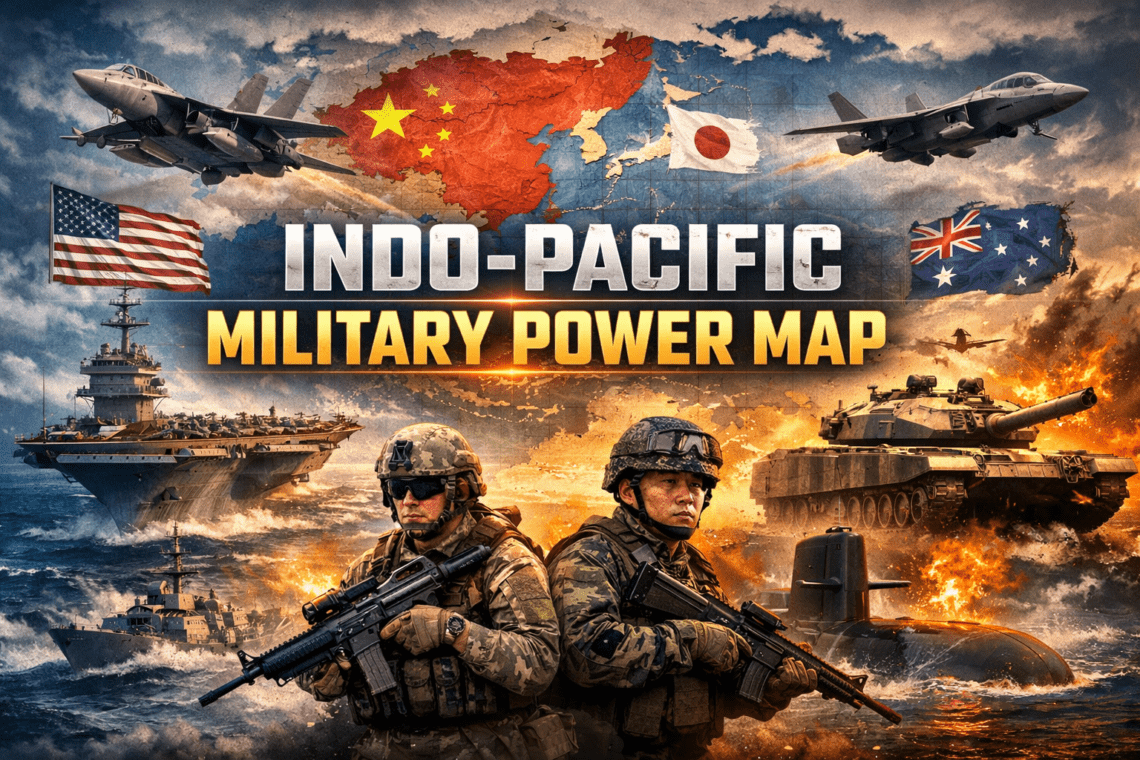
The Indo-Pacific has emerged as the central arena of global strategic competition. The region contains several of the world’s largest militaries, critical maritime trade routes, and some of the most contested territorial disputes.
Military modernization across the Indo-Pacific is accelerating as countries expand naval fleets, deploy advanced missile systems, and invest in next-generation military technologies.
This strategic overview maps the major military powers shaping the Indo-Pacific balance of power and highlights the evolving dynamics of deterrence, maritime competition, and regional security.
India
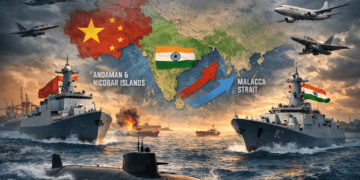
India sits at the geographic center of the Indian Ocean, giving it a unique strategic advantage in controlling major sea lanes connecting the Middle East, Africa, and East Asia.
India’s military posture is shaped by the possibility of simultaneous pressure from China and Pakistan, requiring both continental and maritime deterrence capability.
Key Military Capabilities:
- Large standing army with mountain warfare experience
- Expanding missile forces including long-range ballistic missiles
- Growing naval presence across the Indian Ocean
- Aircraft carriers and nuclear submarine program
Strategic Focus
Maintaining regional balance against China while deterring Pakistan and protecting Indian Ocean trade routes.
China
China has undergone the most rapid military expansion in modern history. The People’s Liberation Army is transforming from a continental defense force into a technologically advanced military capable of regional power projection.
Naval expansion and missile modernization are central to China’s strategy of denying adversaries operational access to the Western Pacific.
Key Military Capabilities:
- World’s largest navy by number of ships
- Extensive missile arsenal including anti-ship ballistic missiles
- Rapidly expanding air force with stealth fighters
- Integrated air defense networks
Strategic Focus
Establishing military dominance in the Western Pacific and strengthening territorial claims in the South China Sea.
United States
The United States remains the dominant external military power in the Indo-Pacific, maintaining a network of alliances and forward-deployed forces across the region.
Carrier strike groups, strategic bombers, and advanced stealth aircraft enable rapid power projection.
Key Military Capabilities:
- Carrier strike groups operating across the Pacific
- Global network of military bases
- Advanced stealth aircraft and long-range strike systems
- Integrated missile defense networks
Strategic Focus
Maintaining regional stability, supporting allies, and deterring Chinese military expansion.
Japan
Japan is undergoing the most significant transformation of its defense posture since the end of World War II.
Rising regional tensions and missile threats have driven Tokyo to expand defense spending and develop long-range strike capability.
Key Military Capabilities:
- Advanced naval fleet including helicopter carriers
- Modern air force with F-35 stealth fighters
- Missile defense systems
Strategic Focus
Defending the East China Sea and strengthening alliance coordination with the United States.
Australia
Australia plays an increasingly important role in Indo-Pacific security architecture, particularly through strategic partnerships such as the AUKUS agreement.
Canberra is investing heavily in submarine capability, long-range missiles, and advanced defense technologies.
Key Military Capabilities:
- Advanced naval and air forces
- Strategic submarine modernization program
- Growing long-range strike capability
Strategic Focus
Enhancing maritime deterrence and strengthening alliance networks.
Pakistan
Pakistan remains a central factor in South Asian security dynamics. Its military strategy focuses on maintaining deterrence against India through both conventional and nuclear capabilities.
Key Military Capabilities:
- Large standing army
- Ballistic missile arsenal
- Nuclear deterrent
Strategic Focus
Maintaining strategic balance with India and countering regional security threats.
Southeast Asia
Several Southeast Asian nations are modernizing their militaries in response to rising maritime tensions in the South China Sea.
Countries such as Vietnam, Indonesia, and Singapore are expanding naval forces and investing in air defense systems.
Key Military Capabilities:
- Growing submarine fleets
- Modern fighter aircraft acquisitions
- Coastal missile defense systems
Strategic Focus
Protecting maritime sovereignty and maintaining regional stability.
Strategic Flashpoints
The Indo-Pacific contains several potential conflict zones that shape military planning across the region.
Taiwan Strait
One of the most sensitive geopolitical flashpoints. A conflict over Taiwan would have global strategic consequences.
South China Sea
Territorial disputes between China and several Southeast Asian states continue to generate tensions in this strategically important maritime region.
India–China Border
Periodic military standoffs along the Himalayan frontier have increased the risk of escalation between two nuclear-armed powers.
Korean Peninsula
The presence of nuclear weapons and persistent tensions between North and South Korea remain a major security concern.
Future Trends in Indo-Pacific Military Competition
Military competition in the region is increasingly shaped by emerging technologies.
Key trends include:
- Hypersonic missile development
- Drone warfare and autonomous systems
- Space-based military infrastructure
- Cyber warfare capabilities
- Artificial intelligence in military operations
These technologies are likely to reshape deterrence dynamics across the Indo-Pacific in the coming decades.

