












IndoAsia Defense
  • Home
  • Air
    • All
    • Air Defence
    • Drones
    • Fighters
    • ISR & Mobility
    Ghatak UCAV stealth, autonomy, integration

    Inside India’s Ghatak UCAV Program: Stealth, Autonomy, and the Integration Gap

    The F414 engine co-production agreement between Hindustan Aeronautics Limited and GE Aerospace

    India-US F414 Engine Deal Explained: Technology Transfer, Tejas Mk2, and AMCA

    What is the Su-57M1 India deal

    Su-57M1 for India: A Fifth-Generation Shortcut or a Strategic Dependency Trap?

    India indigenous long range surveillance radar with X-band drone detection capability

    450km Eyes, Machine-Speed Decisions: How India’s Indigenous Long Range Surveillance Radar Is Rewriting Air Defence

    Why Software Defined Radios Are the IAF’s Most Consequential Upgrade

    IAF Signs BEL Deal for Software Defined Radios: Rewiring India’s Air Combat Network

    How the Ghatak UCAV Stealth Design Redefines India’s Drone Warfare Doctrine

    Ghatak UCAV: India’s Carbon Composite Stealth Strategy Dissected

    Ballistic Missile Defense system intercepting incoming missile during midcourse phase

    How Ballistic Missile Defense Works: Inside Modern Missile Interception Systems

    Swarm logistics drones delivering military supplies in high-altitude Himalayan terrain with Indian Army presence

    Swarm Logistics Drones in Himalayan Warfare: Can India Close the Supply Gap with China?

    India’s 6th-Gen Fighter Strategy FCAS vs GCAP Explained

    India’s 6th-Gen Fighter Strategy: FCAS vs GCAP Explained

  • Land
    • All
    • Armour & Artillery
    • China Front
    • Future Combat
    • Pakistan Front
    The Indo-Pacific Is Fragmenting, Not Uniting Against China

    Why the Indo-Pacific Will Not Unite Against China

    The India-South Korea defence deal

    The India-South Korea Defence Deal Through China’s Operational Lens

    Railways as War Arteries Can India Match China’s Military Mobility Before the Next Crisis

    Railways as War Arteries: Can India Match China’s Military Mobility Before the Next Crisis?

    China maritime front in Indian Ocean

    What If China Opens a Maritime Front in the Indian Ocean During a LAC Conflict?

    What is Indian military modernization strategy in 2026?

    Indian Military Modernization: Systems, Doctrine, and Capability Architecture (2026-27)

    Tank launching loitering munition in battle

    From Smoke to Strike: India’s Indigenous Loitering Munitions for T-72, T-90, and Arjun Tanks

    How China Mobilizes Forces Along the LAC Speed, Systems, and Strategic Control

    How China Mobilizes Forces Along the LAC: Systems, Speed, and Strategic Signaling

    Ballistic Missile Defense system intercepting incoming missile during midcourse phase

    How Ballistic Missile Defense Works: Inside Modern Missile Interception Systems

    Swarm logistics drones delivering military supplies in high-altitude Himalayan terrain with Indian Army presence

    Swarm Logistics Drones in Himalayan Warfare: Can India Close the Supply Gap with China?

  • Navy
    • All
    • Fleet Expansion
    • Indian Ocean
    • Maritime Security
    • Submarines
    Mogami-class frigate deal overview

    Japan’s Mogami-Class Frigate Offer to India: What the Transfer Terms Reveal About Tokyo’s Indo-Pacific Calculus

    China maritime front in Indian Ocean

    What If China Opens a Maritime Front in the Indian Ocean During a LAC Conflict?

    The Strait of Hormuz Crisis

    India’s Oil Artery Under Threat: Strategic Implications of a Hormuz Crisis

    India’s VL-Shtil Missile Deal with Russia

    India’s VL-Shtil Missile Deal with Russia: Strengthening Naval Air Defense in the Indo-Pacific

    Andaman & Nicobar Command Sleeping Giant of India’s Maritime Strategy

    Andaman & Nicobar Command: Sleeping Giant of India’s Maritime Strategy

    Maritime Surveillance 2.0: Why EO/IR Modernisation Matters for India’s Ocean Security

    Maritime Surveillance 2.0: Why EO/IR Modernisation Matters for India’s Ocean Security

    2030 Will Decide the India ASEAN Maritime Equation

    2030 Will Decide the India ASEAN Maritime Equation

    India Military Transformation Series — Part 3: Maritime Power and the Indian Ocean Imperative

    India Military Transformation Series — Part 3: Maritime Power and the Indian Ocean Imperative

    Indian Navy TEDBF PPP Model: China Factor and 2030–2040 Carrier Strategy

    Indian Navy TEDBF PPP Model: China Factor and 2030–2040 Carrier Strategy

  • Indo-Pacific
    • All
    • 2035 Outlook
    • China Strategy
    • India Strategy
    • Pakistan Outlook
    DRDO-developed Guided Pinaka

    At ₹70 Lakh Per Rocket, DRDO-developed Guided Pinaka May Represent India’s Shift Toward Scalable Precision Warfare

    The Indo-Pacific Is Fragmenting, Not Uniting Against China

    Why the Indo-Pacific Will Not Unite Against China

    Mogami-class frigate deal overview

    Japan’s Mogami-Class Frigate Offer to India: What the Transfer Terms Reveal About Tokyo’s Indo-Pacific Calculus

    The India-South Korea defence deal

    The India-South Korea Defence Deal Through China’s Operational Lens

    Railways as War Arteries Can India Match China’s Military Mobility Before the Next Crisis

    Railways as War Arteries: Can India Match China’s Military Mobility Before the Next Crisis?

    india military integration gap

    Is India Building Military Power Faster Than It Can Integrate It?

    China maritime front in Indian Ocean

    What If China Opens a Maritime Front in the Indian Ocean During a LAC Conflict?

    Can India Fight Beyond 30 Days? Inside India’s War Sustainment Reality

    Can India Fight Beyond 30 Days? Inside India’s War Sustainment Reality

    What is Indian military modernization strategy in 2026?

    Indian Military Modernization: Systems, Doctrine, and Capability Architecture (2026-27)

  • Joint
    • All
    • Integrated Ops
    • Procurement Reform
    • Theater Commands
    India's strategic challenge sustainability first

    India Can Strike in 22 Minutes. Can It Sustain for 22 Weeks?

    Ballistic Missile Defense system intercepting incoming missile during midcourse phase

    How Ballistic Missile Defense Works: Inside Modern Missile Interception Systems

    India defence proposals Rs 2.38 trillion showing S-400 system, strike drones, fighter jets and military architecture shift

    India Defence Proposals Rs 2.38 Trillion: Why This Approval Changes How India Will Fight, Not Just What It Buys

    DAP 2026 India’s Quiet Revolution in Defence Procurement

    DAP 2026: India’s Quiet Revolution in Defence Procurement

    Integrated Battle Groups vs China’s Western Theater Command

    Integrated Battle Groups vs China’s Western Theater Command: Can Doctrine Survive the Himalayan Reality?

    Andaman & Nicobar Command Sleeping Giant of India’s Maritime Strategy

    Andaman & Nicobar Command: Sleeping Giant of India’s Maritime Strategy

    India Military Transformation Series — Part 2: The Theatre Command Reckoning

    India Military Transformation Series — Part 2: The Theatre Command Reckoning

    India AI C4ISR modernization

    India Military Transformation Series — Part 1: India AI C4ISR Modernization

    India’s Two-Front Theatre Command: Preparing for Simultaneous Conflict

    India’s Two-Front Theatre Command: Preparing for Simultaneous Conflict

  • Tech
    • All
    • AI & Autonomous Systems
    • Cyber
    • Electronic Warfare
    • Space
    Why Software Defined Radios Are the IAF’s Most Consequential Upgrade

    IAF Signs BEL Deal for Software Defined Radios: Rewiring India’s Air Combat Network

    Source Code or ICD India’s Source Code Negotiation Explained

    Source Code or ICD: India’s Source Code Negotiation Explained

    Supply Chain Weaponization

    Supply Chain Weaponization: Strategic Autonomy Meets Semiconductor Reality

    AI-driven battlefield in India's military

    The Algorithm of Borders: What India’s Military AI Push Actually Looks Like on the Ground

    India AI C4ISR modernization

    India Military Transformation Series — Part 1: India AI C4ISR Modernization

    PRAHAR Explained India Counter Terror Policy Prahaar

    PRAHAAR Explained: Why ‘PRAHAAR’ India’s National Counter-terrorism Doctrine, Signals the End of Traditional Warfare

    The Weapons Making the AMCA Unbeatable

    The Weapons Making the AMCA Unbeatable

    India’s Aerospace Ecosystem After Rafale: The 2026–2030 Industrial Test

    India’s Aerospace Ecosystem After Rafale: The 2026–2030 Industrial Test

    PLA’s Cyber Warfare Units and the Question of Indian Critical Infrastructure Resilience

    PLA’s Cyber Warfare Units and the Question of Indian Critical Infrastructure Resilience

  • Industry
    • All
    • Budget
    • Exports
    • Make in India
    • Supply Chains
    India's strategic challenge sustainability first

    India Can Strike in 22 Minutes. Can It Sustain for 22 Weeks?

    India-UAE defence pact and Gulf strategy

    India-UAE Defence Pact: Why Abu Dhabi Is Becoming India’s Western Strategic Depth

    Ghatak UCAV stealth, autonomy, integration

    Inside India’s Ghatak UCAV Program: Stealth, Autonomy, and the Integration Gap

    The India-South Korea defence deal

    The India-South Korea Defence Deal Through China’s Operational Lens

    The F414 engine co-production agreement between Hindustan Aeronautics Limited and GE Aerospace

    India-US F414 Engine Deal Explained: Technology Transfer, Tejas Mk2, and AMCA

    Why Software Defined Radios Are the IAF’s Most Consequential Upgrade

    IAF Signs BEL Deal for Software Defined Radios: Rewiring India’s Air Combat Network

    How the Ghatak UCAV Stealth Design Redefines India’s Drone Warfare Doctrine

    Ghatak UCAV: India’s Carbon Composite Stealth Strategy Dissected

    Swarm logistics drones delivering military supplies in high-altitude Himalayan terrain with Indian Army presence

    Swarm Logistics Drones in Himalayan Warfare: Can India Close the Supply Gap with China?

    India defence proposals Rs 2.38 trillion showing S-400 system, strike drones, fighter jets and military architecture shift

    India Defence Proposals Rs 2.38 Trillion: Why This Approval Changes How India Will Fight, Not Just What It Buys

  • Global
    • All
    • China-Pak
    • Emerging Tech
    • Middle Eeast
    • Regional Trends
    • US-India
    • US-Israel
    India-UAE defence pact and Gulf strategy

    India-UAE Defence Pact: Why Abu Dhabi Is Becoming India’s Western Strategic Depth

    The Indo-Pacific Is Fragmenting, Not Uniting Against China

    Why the Indo-Pacific Will Not Unite Against China

    Ghatak UCAV stealth, autonomy, integration

    Inside India’s Ghatak UCAV Program: Stealth, Autonomy, and the Integration Gap

    The F414 engine co-production agreement between Hindustan Aeronautics Limited and GE Aerospace

    India-US F414 Engine Deal Explained: Technology Transfer, Tejas Mk2, and AMCA

    india military integration gap

    Is India Building Military Power Faster Than It Can Integrate It?

    India indigenous long range surveillance radar with X-band drone detection capability

    450km Eyes, Machine-Speed Decisions: How India’s Indigenous Long Range Surveillance Radar Is Rewriting Air Defence

    What is Indian military modernization strategy in 2026?

    Indian Military Modernization: Systems, Doctrine, and Capability Architecture (2026-27)

    India defence proposals Rs 2.38 trillion showing S-400 system, strike drones, fighter jets and military architecture shift

    India Defence Proposals Rs 2.38 Trillion: Why This Approval Changes How India Will Fight, Not Just What It Buys

    India’s 6th-Gen Fighter Strategy FCAS vs GCAP Explained

    India’s 6th-Gen Fighter Strategy: FCAS vs GCAP Explained

  • Resources
    • India Military Capability Index
    • India vs China Military Balance
    • China Western Theater Command Guide
    • Pakistan Military Tracker 2026-27
    • India’s Military Doctrine Library
    • India vs China vs Pakistan Missile Arsenal Comparison
    • India’s Missile List
    • India Missile Range Map
    • Indo-Pacific Military Power Map
    • Indo-Pacific Defense Timeline
    • Global Military Balance Dashboard
    • Global Weapons Systems Database
    • Global Missile Systems Database
  • What If
    • China India Naval Conflict
No Result
View All Result
  • Home
  • Air
    • All
    • Air Defence
    • Drones
    • Fighters
    • ISR & Mobility
    Ghatak UCAV stealth, autonomy, integration

    Inside India’s Ghatak UCAV Program: Stealth, Autonomy, and the Integration Gap

    The F414 engine co-production agreement between Hindustan Aeronautics Limited and GE Aerospace

    India-US F414 Engine Deal Explained: Technology Transfer, Tejas Mk2, and AMCA

    What is the Su-57M1 India deal

    Su-57M1 for India: A Fifth-Generation Shortcut or a Strategic Dependency Trap?

    India indigenous long range surveillance radar with X-band drone detection capability

    450km Eyes, Machine-Speed Decisions: How India’s Indigenous Long Range Surveillance Radar Is Rewriting Air Defence

    Why Software Defined Radios Are the IAF’s Most Consequential Upgrade

    IAF Signs BEL Deal for Software Defined Radios: Rewiring India’s Air Combat Network

    How the Ghatak UCAV Stealth Design Redefines India’s Drone Warfare Doctrine

    Ghatak UCAV: India’s Carbon Composite Stealth Strategy Dissected

    Ballistic Missile Defense system intercepting incoming missile during midcourse phase

    How Ballistic Missile Defense Works: Inside Modern Missile Interception Systems

    Swarm logistics drones delivering military supplies in high-altitude Himalayan terrain with Indian Army presence

    Swarm Logistics Drones in Himalayan Warfare: Can India Close the Supply Gap with China?

    India’s 6th-Gen Fighter Strategy FCAS vs GCAP Explained

    India’s 6th-Gen Fighter Strategy: FCAS vs GCAP Explained

  • Land
    • All
    • Armour & Artillery
    • China Front
    • Future Combat
    • Pakistan Front
    The Indo-Pacific Is Fragmenting, Not Uniting Against China

    Why the Indo-Pacific Will Not Unite Against China

    The India-South Korea defence deal

    The India-South Korea Defence Deal Through China’s Operational Lens

    Railways as War Arteries Can India Match China’s Military Mobility Before the Next Crisis

    Railways as War Arteries: Can India Match China’s Military Mobility Before the Next Crisis?

    China maritime front in Indian Ocean

    What If China Opens a Maritime Front in the Indian Ocean During a LAC Conflict?

    What is Indian military modernization strategy in 2026?

    Indian Military Modernization: Systems, Doctrine, and Capability Architecture (2026-27)

    Tank launching loitering munition in battle

    From Smoke to Strike: India’s Indigenous Loitering Munitions for T-72, T-90, and Arjun Tanks

    How China Mobilizes Forces Along the LAC Speed, Systems, and Strategic Control

    How China Mobilizes Forces Along the LAC: Systems, Speed, and Strategic Signaling

    Ballistic Missile Defense system intercepting incoming missile during midcourse phase

    How Ballistic Missile Defense Works: Inside Modern Missile Interception Systems

    Swarm logistics drones delivering military supplies in high-altitude Himalayan terrain with Indian Army presence

    Swarm Logistics Drones in Himalayan Warfare: Can India Close the Supply Gap with China?

  • Navy
    • All
    • Fleet Expansion
    • Indian Ocean
    • Maritime Security
    • Submarines
    Mogami-class frigate deal overview

    Japan’s Mogami-Class Frigate Offer to India: What the Transfer Terms Reveal About Tokyo’s Indo-Pacific Calculus

    China maritime front in Indian Ocean

    What If China Opens a Maritime Front in the Indian Ocean During a LAC Conflict?

    The Strait of Hormuz Crisis

    India’s Oil Artery Under Threat: Strategic Implications of a Hormuz Crisis

    India’s VL-Shtil Missile Deal with Russia

    India’s VL-Shtil Missile Deal with Russia: Strengthening Naval Air Defense in the Indo-Pacific

    Andaman & Nicobar Command Sleeping Giant of India’s Maritime Strategy

    Andaman & Nicobar Command: Sleeping Giant of India’s Maritime Strategy

    Maritime Surveillance 2.0: Why EO/IR Modernisation Matters for India’s Ocean Security

    Maritime Surveillance 2.0: Why EO/IR Modernisation Matters for India’s Ocean Security

    2030 Will Decide the India ASEAN Maritime Equation

    2030 Will Decide the India ASEAN Maritime Equation

    India Military Transformation Series — Part 3: Maritime Power and the Indian Ocean Imperative

    India Military Transformation Series — Part 3: Maritime Power and the Indian Ocean Imperative

    Indian Navy TEDBF PPP Model: China Factor and 2030–2040 Carrier Strategy

    Indian Navy TEDBF PPP Model: China Factor and 2030–2040 Carrier Strategy

  • Indo-Pacific
    • All
    • 2035 Outlook
    • China Strategy
    • India Strategy
    • Pakistan Outlook
    DRDO-developed Guided Pinaka

    At ₹70 Lakh Per Rocket, DRDO-developed Guided Pinaka May Represent India’s Shift Toward Scalable Precision Warfare

    The Indo-Pacific Is Fragmenting, Not Uniting Against China

    Why the Indo-Pacific Will Not Unite Against China

    Mogami-class frigate deal overview

    Japan’s Mogami-Class Frigate Offer to India: What the Transfer Terms Reveal About Tokyo’s Indo-Pacific Calculus

    The India-South Korea defence deal

    The India-South Korea Defence Deal Through China’s Operational Lens

    Railways as War Arteries Can India Match China’s Military Mobility Before the Next Crisis

    Railways as War Arteries: Can India Match China’s Military Mobility Before the Next Crisis?

    india military integration gap

    Is India Building Military Power Faster Than It Can Integrate It?

    China maritime front in Indian Ocean

    What If China Opens a Maritime Front in the Indian Ocean During a LAC Conflict?

    Can India Fight Beyond 30 Days? Inside India’s War Sustainment Reality

    Can India Fight Beyond 30 Days? Inside India’s War Sustainment Reality

    What is Indian military modernization strategy in 2026?

    Indian Military Modernization: Systems, Doctrine, and Capability Architecture (2026-27)

  • Joint
    • All
    • Integrated Ops
    • Procurement Reform
    • Theater Commands
    India's strategic challenge sustainability first

    India Can Strike in 22 Minutes. Can It Sustain for 22 Weeks?

    Ballistic Missile Defense system intercepting incoming missile during midcourse phase

    How Ballistic Missile Defense Works: Inside Modern Missile Interception Systems

    India defence proposals Rs 2.38 trillion showing S-400 system, strike drones, fighter jets and military architecture shift

    India Defence Proposals Rs 2.38 Trillion: Why This Approval Changes How India Will Fight, Not Just What It Buys

    DAP 2026 India’s Quiet Revolution in Defence Procurement

    DAP 2026: India’s Quiet Revolution in Defence Procurement

    Integrated Battle Groups vs China’s Western Theater Command

    Integrated Battle Groups vs China’s Western Theater Command: Can Doctrine Survive the Himalayan Reality?

    Andaman & Nicobar Command Sleeping Giant of India’s Maritime Strategy

    Andaman & Nicobar Command: Sleeping Giant of India’s Maritime Strategy

    India Military Transformation Series — Part 2: The Theatre Command Reckoning

    India Military Transformation Series — Part 2: The Theatre Command Reckoning

    India AI C4ISR modernization

    India Military Transformation Series — Part 1: India AI C4ISR Modernization

    India’s Two-Front Theatre Command: Preparing for Simultaneous Conflict

    India’s Two-Front Theatre Command: Preparing for Simultaneous Conflict

  • Tech
    • All
    • AI & Autonomous Systems
    • Cyber
    • Electronic Warfare
    • Space
    Why Software Defined Radios Are the IAF’s Most Consequential Upgrade

    IAF Signs BEL Deal for Software Defined Radios: Rewiring India’s Air Combat Network

    Source Code or ICD India’s Source Code Negotiation Explained

    Source Code or ICD: India’s Source Code Negotiation Explained

    Supply Chain Weaponization

    Supply Chain Weaponization: Strategic Autonomy Meets Semiconductor Reality

    AI-driven battlefield in India's military

    The Algorithm of Borders: What India’s Military AI Push Actually Looks Like on the Ground

    India AI C4ISR modernization

    India Military Transformation Series — Part 1: India AI C4ISR Modernization

    PRAHAR Explained India Counter Terror Policy Prahaar

    PRAHAAR Explained: Why ‘PRAHAAR’ India’s National Counter-terrorism Doctrine, Signals the End of Traditional Warfare

    The Weapons Making the AMCA Unbeatable

    The Weapons Making the AMCA Unbeatable

    India’s Aerospace Ecosystem After Rafale: The 2026–2030 Industrial Test

    India’s Aerospace Ecosystem After Rafale: The 2026–2030 Industrial Test

    PLA’s Cyber Warfare Units and the Question of Indian Critical Infrastructure Resilience

    PLA’s Cyber Warfare Units and the Question of Indian Critical Infrastructure Resilience

  • Industry
    • All
    • Budget
    • Exports
    • Make in India
    • Supply Chains
    India's strategic challenge sustainability first

    India Can Strike in 22 Minutes. Can It Sustain for 22 Weeks?

    India-UAE defence pact and Gulf strategy

    India-UAE Defence Pact: Why Abu Dhabi Is Becoming India’s Western Strategic Depth

    Ghatak UCAV stealth, autonomy, integration

    Inside India’s Ghatak UCAV Program: Stealth, Autonomy, and the Integration Gap

    The India-South Korea defence deal

    The India-South Korea Defence Deal Through China’s Operational Lens

    The F414 engine co-production agreement between Hindustan Aeronautics Limited and GE Aerospace

    India-US F414 Engine Deal Explained: Technology Transfer, Tejas Mk2, and AMCA

    Why Software Defined Radios Are the IAF’s Most Consequential Upgrade

    IAF Signs BEL Deal for Software Defined Radios: Rewiring India’s Air Combat Network

    How the Ghatak UCAV Stealth Design Redefines India’s Drone Warfare Doctrine

    Ghatak UCAV: India’s Carbon Composite Stealth Strategy Dissected

    Swarm logistics drones delivering military supplies in high-altitude Himalayan terrain with Indian Army presence

    Swarm Logistics Drones in Himalayan Warfare: Can India Close the Supply Gap with China?

    India defence proposals Rs 2.38 trillion showing S-400 system, strike drones, fighter jets and military architecture shift

    India Defence Proposals Rs 2.38 Trillion: Why This Approval Changes How India Will Fight, Not Just What It Buys

  • Global
    • All
    • China-Pak
    • Emerging Tech
    • Middle Eeast
    • Regional Trends
    • US-India
    • US-Israel
    India-UAE defence pact and Gulf strategy

    India-UAE Defence Pact: Why Abu Dhabi Is Becoming India’s Western Strategic Depth

    The Indo-Pacific Is Fragmenting, Not Uniting Against China

    Why the Indo-Pacific Will Not Unite Against China

    Ghatak UCAV stealth, autonomy, integration

    Inside India’s Ghatak UCAV Program: Stealth, Autonomy, and the Integration Gap

    The F414 engine co-production agreement between Hindustan Aeronautics Limited and GE Aerospace

    India-US F414 Engine Deal Explained: Technology Transfer, Tejas Mk2, and AMCA

    india military integration gap

    Is India Building Military Power Faster Than It Can Integrate It?

    India indigenous long range surveillance radar with X-band drone detection capability

    450km Eyes, Machine-Speed Decisions: How India’s Indigenous Long Range Surveillance Radar Is Rewriting Air Defence

    What is Indian military modernization strategy in 2026?

    Indian Military Modernization: Systems, Doctrine, and Capability Architecture (2026-27)

    India defence proposals Rs 2.38 trillion showing S-400 system, strike drones, fighter jets and military architecture shift

    India Defence Proposals Rs 2.38 Trillion: Why This Approval Changes How India Will Fight, Not Just What It Buys

    India’s 6th-Gen Fighter Strategy FCAS vs GCAP Explained

    India’s 6th-Gen Fighter Strategy: FCAS vs GCAP Explained

  • Resources
    • India Military Capability Index
    • India vs China Military Balance
    • China Western Theater Command Guide
    • Pakistan Military Tracker 2026-27
    • India’s Military Doctrine Library
    • India vs China vs Pakistan Missile Arsenal Comparison
    • India’s Missile List
    • India Missile Range Map
    • Indo-Pacific Military Power Map
    • Indo-Pacific Defense Timeline
    • Global Military Balance Dashboard
    • Global Weapons Systems Database
    • Global Missile Systems Database
  • What If
    • China India Naval Conflict
No Result
View All Result
IndoAsia Defense
No Result
View All Result
Home Land China Front

Swarm Logistics Drones in Himalayan Warfare: Can India Close the Supply Gap with China?

India’s greatest vulnerability in the Himalayas is not firepower but sustainment. As China builds a logistics architecture designed for speed and resilience, India is exploring swarm logistics drones to overcome the constraints of terrain, weather, and exposure. This analysis examines whether autonomous supply networks can close the gap or merely redefine it.

IndoAsia Defense by IndoAsia Defense
April 8, 2026
in China Front, Drones, India Strategy, Supply Chains
0
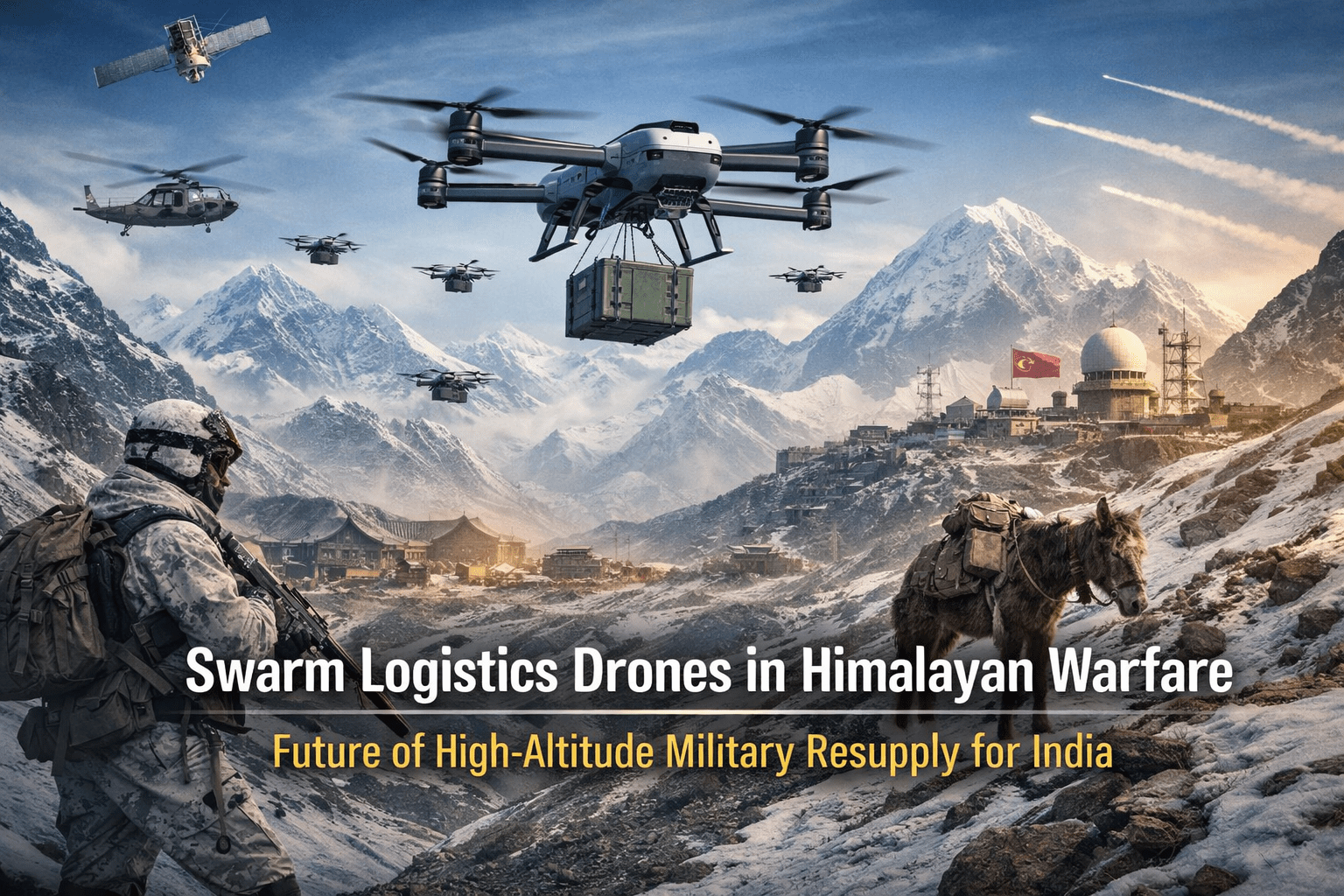
Swarm logistics drones delivering military supplies in high-altitude Himalayan terrain with Indian Army presence

Drone swarms could redefine how India sustains troops in high-altitude conflict zones along the China border

0
SHARES
12
VIEWS
Share on LinkedinShare on FacebookShare on Twitter

The Structural Weakness in India’s High-Altitude Warfighting Model

The debate around swarm logistics drones in Himalayan warfare begins with a fundamental asymmetry that remains under-acknowledged in most public discourse. India’s challenge in the Himalayas is not primarily about firepower or troop strength, but about sustaining combat power over time in an environment that systematically degrades logistics efficiency.

Despite significant improvements in border infrastructure, the last-mile segment of India’s logistics chain continues to depend on manual transport, animal caravans, and weather-constrained helicopter sorties. This creates a friction-heavy system where throughput remains inconsistent and vulnerable to disruption.

In contrast, the People’s Liberation Army Western Theater Command operates within a logistics architecture that is structurally more resilient. Road and rail integration into Tibet, combined with forward storage nodes and increasing UAV usage, allows the PLA to compress supply timelines and reduce dependence on manpower-intensive delivery systems.

The result is not merely faster logistics, but more predictable logistics under contested conditions. That distinction becomes critical in high-altitude warfare, where predictability enables operational planning and unpredictability invites risk.

The introduction of swarm logistics drones in Himalayan warfare must therefore be understood not as a technological upgrade, but as an attempt to address a systemic constraint. The objective is to shift from a linear and exposed supply chain toward a distributed and adaptive network.

This transition, if executed effectively, would alter the relationship between terrain and sustainment, which has historically favored the side with superior infrastructure. It also reframes logistics as a contested domain rather than a background function.

From Linear Supply Chains to Distributed Logistics Networks

Traditional military logistics in mountainous terrain is built on linearity. Supplies move from base depots to forward positions through a sequence of nodes, each dependent on the integrity of the previous link. This structure creates identifiable choke points that can be targeted through surveillance and precision fires.

In the Himalayan context, where routes are limited and terrain restricts maneuver, such choke points are not incidental but inherent to the geography. The implication is that any disruption can cascade across the entire supply chain.

Swarm logistics drones in Himalayan warfare introduce a fundamentally different model based on distribution and redundancy. Instead of relying on a single convoy or route, multiple autonomous platforms can deliver payloads simultaneously through varied trajectories.

These drones can exploit terrain masking, adjust routes dynamically, and operate from dispersed launch points. The loss of individual units does not collapse the system, which enhances survivability under contested conditions. This is not simply about replacing trucks or mules with drones, but about redesigning the architecture of logistics itself.

The strategic implication of this shift is significant. A distributed logistics network reduces the effectiveness of enemy targeting by increasing uncertainty and lowering the value of individual strikes. It also enables more flexible deployment patterns for frontline units, since resupply is no longer tied to fixed routes.

However, this model depends heavily on communication networks, navigation systems, and algorithmic decision-making, which introduces new vulnerabilities. The transition from linear to distributed logistics is therefore not an unqualified advantage, but a trade-off between physical resilience and digital dependence.

The Physics of Altitude and the Limits of Drone Logistics

Any serious assessment of swarm logistics drones in Himalayan warfare must confront the constraints imposed by altitude. Thin air reduces lift, limits payload capacity, and affects propulsion efficiency, particularly for rotary-wing platforms.

Battery performance degrades in low temperatures, which directly impacts range and endurance. These are not marginal issues but core engineering challenges that determine whether drone logistics can scale beyond experimental deployments.

India’s requirement for 200 kilogram-class logistics drones reflects an attempt to push the upper limits of current technology. At such payload levels, the trade-offs between range, altitude ceiling, and energy consumption become acute. Fixed-wing designs offer better efficiency but require launch and recovery infrastructure, while rotary systems provide flexibility at the cost of endurance.

Hybrid configurations may offer a compromise, but they add complexity to maintenance and deployment. The question is not whether drones can operate in the Himalayas, but whether they can do so reliably and repeatedly under operational conditions.

The strategic implication is that swarm logistics drones in Himalayan warfare will likely evolve as a layered system rather than a single-platform solution. Smaller drones may handle critical supplies such as ammunition and medical equipment, while larger platforms support bulk resupply over shorter distances.

This layered approach mirrors developments in other domains such as air defence, where no single system addresses all threats. It also suggests that expectations of drones replacing traditional logistics entirely are misplaced. Instead, they will augment and reshape existing systems, with performance varying across sectors and conditions.

Cost, Risk, and the Changing Economics of Sustainment

The economic dimension of swarm logistics drones in Himalayan warfare is often simplified to a comparison of per-kilogram delivery costs. While this metric is relevant, it does not capture the full picture. Traditional logistics methods such as helicopter sorties involve high operating costs but offer flexibility and payload capacity.

Manual transport is cheaper in financial terms but imposes significant physical strain on personnel and limits throughput. Drones occupy an intermediate space, where costs are moderate but scalability and survivability offer distinct advantages.

A more meaningful comparison emerges when cost is evaluated alongside risk and resilience. Helicopters present high-value targets and are constrained by weather and altitude. Convoys and animal caravans are exposed to surveillance and interdiction.

Swarm drones distribute risk across multiple platforms, reducing the impact of individual losses. This creates a different economic logic, where the objective is not to minimize cost per sortie but to maximize the probability of sustained supply under contested conditions.

Mode of Logistics Relative Cost per 100 kg Operational Risk Scalability
Manual and animal transport Low High Limited
Helicopter resupply Very high Medium Constrained
Swarm drone delivery Moderate Low to medium High

The strategic implication is that swarm logistics drones in Himalayan warfare enable a form of cost imposition. By complicating targeting and reducing the effectiveness of interdiction, they force the adversary to expend more resources for diminishing returns.

This aligns with broader trends in modern warfare, where distributed systems are used to offset conventional disadvantages. However, the sustainability of this model depends on domestic production capacity and lifecycle costs, which remain areas of uncertainty for India.

Integrating Drone Logistics into India’s Emerging Warfighting Doctrine

Swarm logistics drones in Himalayan warfare cannot be evaluated in isolation from broader doctrinal shifts within the Indian military. The concept of Integrated Battle Groups emphasizes rapid mobilization, flexible force structures, and shorter decision cycles.

These objectives place additional pressure on logistics systems, which must keep pace with more dynamic operational patterns. Without corresponding changes in sustainment, the advantages of IBGs risk being undermined by supply constraints.

Integration with air defence and surveillance networks further complicates the picture. Systems such as S-400 Triumf and the indigenous Project Kusha are designed to protect critical nodes and deny airspace to adversaries.

Swarm drones operating within this umbrella could benefit from reduced threat exposure, but they also require coordination to avoid interference and fratricide. This highlights the need for integrated command and control architectures that can manage multiple domains simultaneously.

The strategic implication is that swarm logistics drones in Himalayan warfare will test India’s ability to integrate technology across domains rather than within silos. Success will depend on interoperability, data sharing, and doctrinal coherence. This is an area where progress has been uneven, as highlighted in previous analyses.

The risk is that drones are deployed as standalone assets without fully leveraging their potential within a networked force structure.

China’s Parallel Trajectory and the Question of Relative Advantage

Any advantage derived from swarm logistics drones in Himalayan warfare must be assessed relative to China’s capabilities. The People’s Liberation Army has already invested in logistics UAVs and autonomous systems, particularly in the Tibetan plateau.

These efforts are supported by a broader ecosystem that integrates infrastructure, surveillance, and digital networks. The result is a logistics architecture that is not only robust but also adaptable.

This raises the question of whether drone-based logistics will provide India with a lasting edge or merely narrow an existing gap. If both sides adopt similar technologies, the focus shifts from platforms to integration and execution.

Factors such as network resilience, electronic warfare capabilities, and industrial capacity become decisive. In this context, drones are not a differentiator in themselves but part of a larger system that determines operational effectiveness.

The strategic implication is that swarm logistics drones in Himalayan warfare should be viewed as a necessary adaptation rather than a decisive advantage. They address specific vulnerabilities but do not eliminate structural disparities.

India’s challenge is to ensure that these systems are embedded within a coherent strategy that leverages geographic, operational, and technological factors in combination. Without this integration, the benefits of drones may be incremental rather than transformative.

A 2030 Scenario: Autonomous Logistics Under Persistent Surveillance

Looking ahead to 2030, swarm logistics drones in Himalayan warfare are likely to operate within an environment characterized by persistent surveillance and contested electromagnetic spectrum. Both India and China are expanding their satellite constellations, UAV fleets, and electronic warfare capabilities.

This creates a battlespace where movement is continuously monitored and communication networks are under constant pressure.

In such a scenario, logistics systems will need to function with limited connectivity and high levels of autonomy. Drones may operate using pre-programmed routes with minimal external input, relying on onboard sensors and algorithms to navigate and avoid threats.

At the same time, adversaries will attempt to disrupt these systems through jamming, spoofing, and cyber attacks. The result is a dynamic contest between autonomy and interference, where the effectiveness of logistics depends on the resilience of underlying technologies.

A useful visual concept for this section would be a layered map showing drone corridors, ISR coverage, and electronic warfare zones across a representative sector of the Line of Actual Control. This would illustrate how swarm logistics drones in Himalayan warfare intersect with other operational domains.

The strategic implication is that logistics is becoming increasingly data-driven, with success determined by the ability to process, protect, and act on information in real time. This represents a shift from physical to informational dominance in sustainment.

Reassessing Endurance as the Core Metric of Victory

The emphasis on swarm logistics drones in Himalayan warfare ultimately reflects a broader reassessment of what determines success in high-altitude conflict. Firepower and maneuver remain important, but they are constrained by the ability to sustain forces over time.

In an environment where every kilogram of supply carries a cost in effort and risk, efficiency becomes a decisive factor.

India’s exploration of drone-based logistics indicates an awareness of this reality. By reducing dependence on manpower-intensive systems and introducing redundancy into supply chains, swarm drones have the potential to extend operational endurance.

However, this potential will only be realized if technological innovation is matched by doctrinal clarity and institutional adaptation. The challenge is not simply to deploy drones, but to rethink how logistics is organized and executed.

Swarm logistics drones in Himalayan warfare therefore represent both an opportunity and a test. They offer a pathway to mitigate longstanding vulnerabilities, but they also expose gaps in integration and capability. The outcome will depend on how effectively India can align technology, doctrine, and infrastructure within a coherent framework.

In the final analysis, endurance remains the central metric, and the side that sustains combat power more effectively will shape the outcome of any future conflict in the Himalayas.


FAQs

What are swarm logistics drones in Himalayan warfare?

Swarm logistics drones in Himalayan warfare refer to coordinated groups of autonomous or semi-autonomous UAVs used to deliver supplies to frontline units in high-altitude environments. They operate as distributed networks rather than individual platforms, improving resilience and flexibility.

Why are swarm logistics drones important for India?

They address critical weaknesses in last-mile logistics by reducing dependence on manual transport and vulnerable supply routes. This enhances sustainment in difficult terrain and under contested conditions.

Can drones replace traditional logistics in the Himalayas?

No, they are more likely to complement existing systems. Limitations related to payload, altitude, and energy mean that drones will augment rather than fully replace helicopters and ground transport.

How does China compare in drone logistics capabilities?

China has already integrated UAVs into its logistics systems, supported by strong infrastructure and digital networks. This reduces India’s potential advantage and makes execution and integration more important.

What is the biggest challenge for implementing drone logistics?

The key challenges include high-altitude performance, secure communication in contested environments, and the need for large-scale indigenous production to sustain operations over time.

Previous Post

India Defence Proposals Rs 2.38 Trillion: Why This Approval Changes How India Will Fight, Not Just What It Buys

Next Post

How Ballistic Missile Defense Works: Inside Modern Missile Interception Systems

IndoAsia Defense

IndoAsia Defense

IndoAsia Defense Team is a specialist research and analysis group focused on India’s military modernization and Indo-Pacific strategic dynamics. The platform delivers structured, data-driven insights on doctrine, force posture, defense technology, and regional power balance.

Next Post
Ballistic Missile Defense system intercepting incoming missile during midcourse phase

How Ballistic Missile Defense Works: Inside Modern Missile Interception Systems

Leave a Reply Cancel reply

Login with your Social ID

Your email address will not be published. Required fields are marked *

Category

  • Air
  • Global
  • Indo-Pacific
  • Industry
  • Joint
  • Land
  • Navy
  • Tech

Defence Capabilities

  • Air Defence
  • Drones
  • Fighters
  • ISR & Mobility
  • China Military
  • Emerging Tech
  • Regional Trends
  • U.S. Posture

Strategy

  • 2035 Outlook
  • China Strategy
  • India Strategy
  • Pakistan Outlook
  • Budget
  • Exports
  • Make in India
  • Supply Chains

Operations

  • Integrated Ops
  • Procurement Reform
  • Theater Commands
  • Armour & Artillery
  • China Front
  • Future Combat
  • Pakistan Front
  • Fleet Expansion

Resources

  • India vs China Military Balance
  • Indo-Pacific Military Power Map
  • Global Military Balance Dashboard
  • Global Weapons Systems Database
  • Global Missile Systems Database
  • Indo-Pacific Defense Timeline
  • India Military Capability Index
  • About
  • Contact
  • Privacy & Policy
  • Editorial Policy
  • Cookie Policy
  • Disclaimer
  • Terms And Conditions
Facebook Linkedin X-twitter
© 2026 IndoAsia Defense. All Rights Reserved.
No Result
View All Result
  • Home
  • Air
    • Air Defence
    • Drones
    • Fighters
    • ISR & Mobility
  • Land
    • Armour & Artillery
    • China Front
    • Future Combat
    • Pakistan Front
  • Navy
    • Fleet Expansion
    • Indian Ocean
    • Maritime Security
    • Submarines
  • Indo-Pacific
    • 2035 Outlook
    • China Strategy
    • India Strategy
    • Pakistan Outlook
  • Joint
    • Integrated Ops
    • Procurement Reform
    • Theater Commands
  • Tech
    • AI & Autonomous Systems
    • Cyber
    • Electronic Warfare
    • Space
  • Industry
    • Budget
    • Exports
    • Make in India
    • Supply Chains
  • Global
    • China-Pak
    • Emerging Tech
    • Regional Trends
    • US-India