










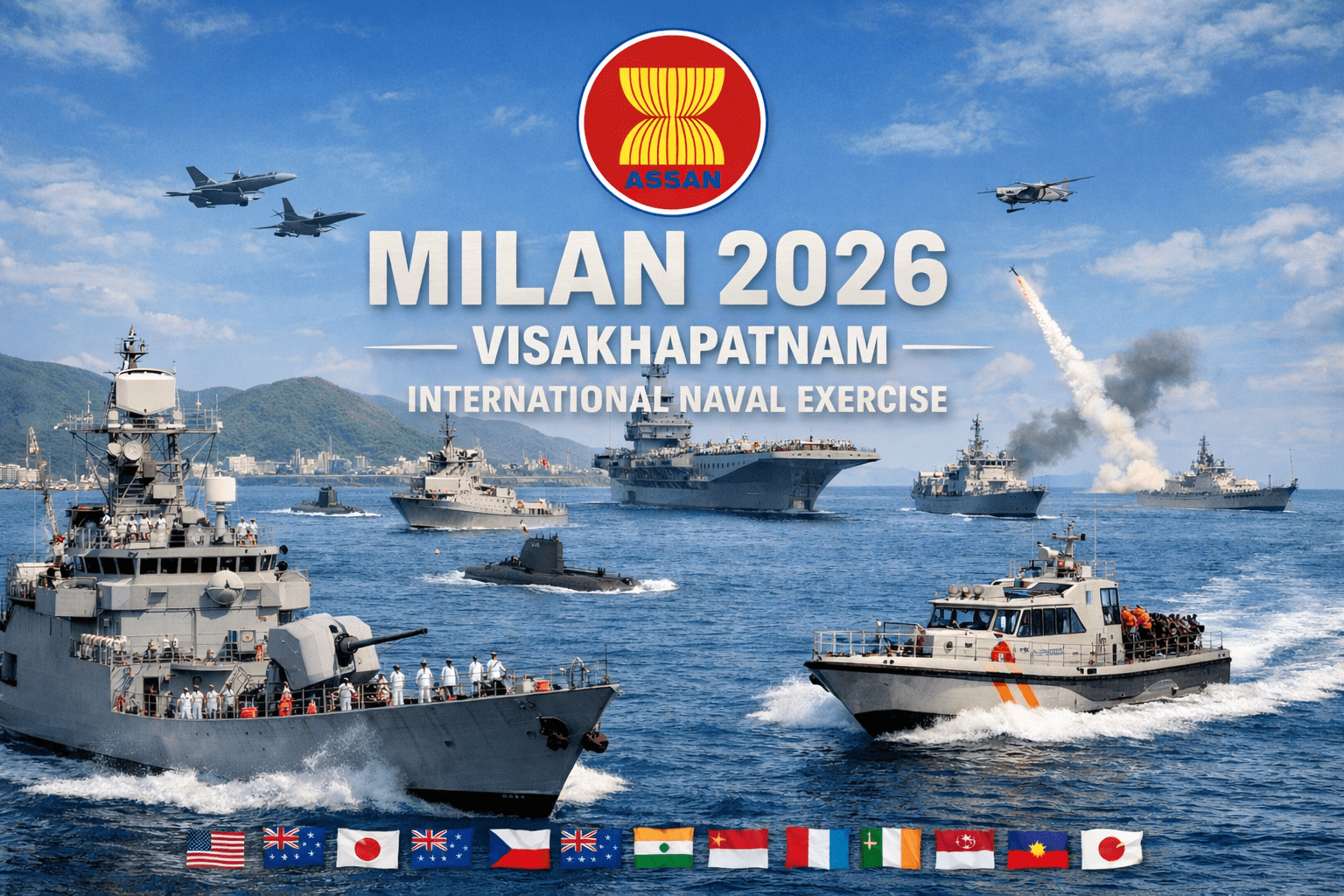
By the time MILAN 2026 wrapped up in Visakhapatnam, the imagery had done its job. Warships from across the Indo-Pacific lined the eastern seaboard. Helicopters traced arcs over the Bay of Bengal. Admirals shook hands beneath carefully choreographed backdrops.
But beneath the ceremony, something more consequential was unfolding.
When Defence Minister Rajnath Singh met navy chiefs from nine ASEAN member states and invited them to engage with India’s defence technology ecosystem under Aatmanirbhar Bharat, it was framed as partnership. In reality, it was a strategic proposition aimed squarely at the geopolitical decade ahead.
The Indo-Pacific is entering a more brittle phase. And by 2030, India’s maritime relationship with Southeast Asia will either be structurally embedded in the region’s security architecture — or strategically peripheral.
There is unlikely to be a comfortable middle.
The Indo-Pacific Is Hardening
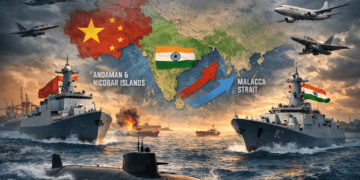
The maritime theatre stretching from the eastern Indian Ocean to the South China Sea is no longer just an arena of naval diplomacy. It is a zone of persistent contestation. Grey-zone tactics have blurred civilian and military lines. Submarine deployments are increasing. Maritime surveillance networks are expanding. Coastal states are recalibrating procurement plans.
ASEAN countries face a delicate equation. They must strengthen maritime domain awareness and deterrence capabilities while preserving strategic autonomy. They want to diversify defence partnerships, but they are cautious about being drawn into rigid alignments.
In that environment, India’s outreach at MILAN 2026 was not accidental. It was calibrated.
India did not present itself as a treaty ally or security guarantor. It positioned itself as a co-developer — a country willing to collaborate on defence production, share technology, and expand maritime capabilities without demanding alignment.
That model has political resonance in Southeast Asia.
Beyond Exercises: The Industrial Turn
For years, India’s engagement with ASEAN navies revolved around joint exercises, coordinated patrols, and confidence-building measures. These activities built familiarity. They did not build interdependence.
Industrial integration changes that.
India’s defence ecosystem has evolved significantly over the past decade. Indigenous shipbuilding capacity has matured. Missile development programmes have stabilised. Electronic warfare and sensor systems are increasingly integrated domestically. Private-sector participation in defence manufacturing has deepened. Export approvals have become more structured and predictable.
The invitation extended at Visakhapatnam was therefore not symbolic. It was an assertion that India’s defence industrial base is ready to serve as a partner in Southeast Asia’s maritime modernisation.
If that partnership takes root, the relationship moves from episodic engagement to structural linkage.
The 2026–2030 Window
The next five years will determine whether this shift materialises.
In the most plausible trajectory, incremental integration unfolds quietly. By 2030, several ASEAN navies could be operating Indian-origin radar systems, missile components, electronic warfare modules, or patrol vessel subsystems. Defence exports from India to Southeast Asia may cross one to one-and-a-half billion dollars cumulatively over five years. Training exchanges deepen, technical officers rotate through Indian facilities, and interoperability increases gradually.
This would not produce dramatic headlines. But it would produce embedded relevance.
A more consequential trajectory is possible if regional tensions intensify. Should South China Sea dynamics escalate further, diversification pressures within ASEAN could accelerate. In that case, India’s defence exports might exceed two billion dollars over the 2026–2030 period. A co-development arrangement for patrol vessels or unmanned maritime systems could emerge with one ASEAN state. Shared surveillance integration — linking radar or data fusion systems — could materialise between India and select Southeast Asian partners.
That would represent genuine structural convergence.
Yet there is also a plateau scenario. Economic compression, political caution, or industrial delays could limit engagement to exercises and modest export contracts. Cooperation would remain visible but shallow.
The difference between these futures hinges less on diplomatic enthusiasm and more on execution credibility.
The China Factor
No serious forecast can ignore Beijing’s role.
If India expands its defence footprint in Southeast Asia, competitive responses are inevitable. These could take the form of aggressive pricing strategies, intensified naval diplomacy, or diplomatic pressure in ASEAN capitals. China has both industrial scale and geographic proximity in its favour.
India’s comparative advantage lies in differentiation. It offers diversification without coercion, collaboration without treaty entanglement. Whether that advantage endures will depend on consistency and restraint.
Should great-power rivalry harden into rigid blocs, ASEAN’s strategic manoeuvring space narrows. In that scenario, India must preserve its identity as a flexible partner rather than appearing as a proxy in larger power competition.
The balance will be delicate.
The Domestic Test
Geopolitical strategy often collapses under industrial underperformance.
By 2030, ASEAN procurement officials will judge India less by its rhetoric and more by its delivery record. Shipbuilding timelines must be met. Maintenance pipelines must function. Export licensing must remain efficient. After-sales support must be credible.
Reliability builds trust. Delays erode it quickly.
India’s defence diplomacy will ultimately succeed or fail based on supply chain discipline as much as strategic messaging.
ASEAN’s Internal Calculus
ASEAN is not monolithic. Threat perceptions differ. Procurement priorities vary. Domestic political cycles influence defence budgets. Some states may lean toward deeper integration with India; others may hedge more cautiously.
New Delhi cannot treat ASEAN as a bloc in industrial terms. Engagement will need to be tailored state by state, sector by sector.
The 2030 maritime equation will therefore be shaped by bilateral depth rather than multilateral symbolism.
The Strategic Verdict
MILAN 2026 may not immediately be remembered as transformative. But it may prove to be directional.
If incremental integration proceeds, India becomes an embedded maritime capability partner across Southeast Asia by the end of the decade — neither dominant nor peripheral, but structurally relevant.
If accelerated convergence materialises, India could anchor a new arc of industrial maritime cooperation stretching from the eastern Indian Ocean into contested Southeast Asian waters.
If execution falters, the moment passes.
The Indo-Pacific security architecture of 2030 will not be determined solely by superpower rivalry. It will also be shaped by which regional actors successfully build resilient capability networks that respect autonomy while strengthening deterrence.
India has signalled its intent.
Whether Southeast Asia responds with integration — or caution — will define the India–ASEAN Maritime equation of the next decade.

