















China will view the India-South Korea defence deal through a wider strategic lens, not as an isolated transaction but as part of a developing pattern. This is not about optics, summit diplomacy, or Indo-Pacific rhetoric. It is about Ladakh, production lines, and a quiet shift in how India is learning to convert defence partnerships into sustained battlefield capability.
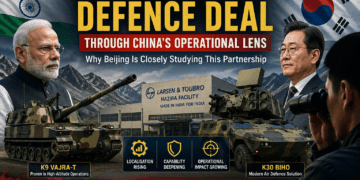
South Korean President Lee Jae-myung’s April 2026 visit to New Delhi produced a broad slate of agreements, but Beijing’s attention will narrow quickly to a specific cluster. The K9 Vajra-T self-propelled artillery system is entering its second procurement cycle, and the K30 Biho air defence system appears to be moving out of its long procurement limbo.
On paper, these look like two separate acquisitions. In practice, they form a single trajectory. The India-South Korea defence deal is evolving from procurement into an industrial and operational framework that directly intersects with China-facing contingencies.
That is what makes it sensitive. Not what India is buying, but how it is learning to build, adapt, and sustain it.
The Factory Floor That Turned Procurement into Strategy
To understand why the India-South Korea defence deal carries weight, the starting point is not the battlefield. It is the factory floor in Hazira, Gujarat, where Larsen and Toubro manufactures the K9 Vajra-T.
This is no longer an assembly story. Indigenous content has crossed roughly 60 percent and is trending upward, turning what began as a licensed production programme into a scalable industrial base.
The significance lies in replication. The proposed K30 Biho air defence system is expected to follow the same localisation pathway, using overlapping supply chains, shared engineering familiarity, and an already trained workforce.
The two platforms are not just compatible in operational terms. They are compatible in industrial logic. One facility, two systems, and a growing ecosystem of domestic suppliers create a compounding effect that is difficult to disrupt once established.
A simple structural snapshot illustrates how this relationship is evolving:
| Phase | Platform | Core Shift | Strategic Effect |
|---|---|---|---|
| Phase 1 | K9 Vajra-T (initial order) | Licensed production | Capability acquisition |
| Phase 2 | K9 expansion | Higher localisation | Industrial learning |
| Phase 3 | Biho + future systems | Shared production ecosystem | Scalable defence base |
Each phase deepens the partnership. Each phase reduces friction in executing the next. Beijing is unlikely to see these as isolated steps. It will see a ratchet effect, where every contract locks in the next layer of cooperation.
Why China Maps This Deal to Ladakh, Not the Indo-Pacific
China’s sensitivity to the India-South Korea defence deal is anchored in geography. The reference point is Ladakh, where Indian and Chinese forces have faced sustained friction since 2020. The K9 Vajra-T is already deployed in high-altitude sectors, and its expansion signals not just increased numbers but standardisation of mobile artillery capability across sensitive fronts.
Standardisation matters because it compresses response time. Training cycles become uniform, maintenance becomes predictable, and logistics chains become more efficient. In high-altitude warfare, where environmental stress already slows operations, these efficiencies translate directly into operational tempo. For the PLA Western Theater Command, the concern is not the presence of artillery. It is the reduction of friction in how that artillery is used.
Mobility compounds this effect. Tracked self-propelled systems improve survivability through shoot-and-move tactics, reducing exposure to counter-battery fire. When integrated with ISR inputs such as drones and surveillance systems, they enable faster targeting cycles. China’s planners will assess this not as incremental improvement, but as a shift in how quickly India can translate information into firepower along the LAC.
The Biho Revival and the Changing Logic of Air Defence
The revival of the K30 Biho system adds a different dimension to the India-South Korea defence deal. While the K9 addresses mobility and firepower, the Biho addresses survivability against emerging threats. Its relevance has increased significantly in the current threat environment, where drones and low-altitude platforms have become central to battlefield dynamics.
The Biho’s electro-optical targeting system is particularly important. Unlike radar-dependent systems, it operates passively, reducing detectability in contested electromagnetic environments. This changes the survivability equation. Radar emissions can be tracked and targeted. Passive systems are harder to suppress quickly, which complicates adversary planning.
For China, this introduces friction into suppression strategies. A layered Indian air defence network that includes passive systems would require more effort to degrade, especially in high-altitude conditions where operational margins are already tight.
The India-South Korea defence deal, if extended into this domain, begins to close a critical loop. Artillery provides offensive capability, while air defence protects it from aerial threats, creating a more resilient forward posture.
What Beijing Is Actually Tracking: Systems, Not Platforms
Public Chinese responses to the India-South Korea defence deal will likely remain measured. However, internal assessments will focus on three variables that determine long-term impact.
The first is localisation. As domestic content increases, India reduces its dependence on external supply chains. This weakens the leverage that disruption or delay once provided to external actors.
The second is integration. China will closely monitor whether India can link artillery, air defence, ISR, and logistics into a coherent operational system. Fragmented capability is manageable. Integrated capability is not.
The third is replication. If the India-South Korea defence deal becomes a template for future partnerships, its impact multiplies. A single programme can be contained. A repeatable industrial model reshapes capability development across sectors.
These variables form the internal lens through which Beijing will assess the deal. The concern is not immediate imbalance. It is trajectory.
The Overlooked Constraint: India’s Integration Gap
Despite its strengths, the India-South Korea defence deal does not automatically resolve India’s long-standing integration challenge. India has historically acquired platforms faster than it has integrated them into unified operational systems. This gap remains a critical constraint.
Artillery, air defence, surveillance systems, and communication networks must operate as a cohesive whole to deliver maximum effect. This requires interoperable systems, real-time data sharing, and coordinated command structures. Without these, even advanced platforms deliver limited strategic value.
China is aware of this gap and will factor it into its assessments. The key question is whether India can close this integration lag while expanding its industrial base. If integration improves alongside localisation, the deal’s impact increases significantly.
If not, its effects remain incremental. This uncertainty is central to how Beijing will evaluate the trajectory.
Seoul’s Strategic Calculation and the Risk It Accepts
South Korea’s role in the India-South Korea defence deal is often treated as purely commercial, but it reflects a broader strategic calculation. China remains South Korea’s largest trading partner, and past experiences, particularly the economic response to the THAAD deployment, have demonstrated Beijing’s willingness to use economic pressure.
However, Seoul’s calculus is evolving. The limits of balancing economic engagement with China and security alignment with the United States are becoming more visible. Partnerships with countries like India offer a way to diversify strategic exposure without formal alliance commitments.
The India South Korea Joint Strategic Vision 2026–2030 reflects this approach, emphasising supply chain resilience, industrial cooperation, and economic security.
For Beijing, this adds another layer of sensitivity. The deal is not only about India strengthening its capabilities. It is also about South Korea gradually expanding its strategic partnerships in ways that reduce dependence on China.
Networked Resilience: The Indo-Pacific Layer Beneath the Surface
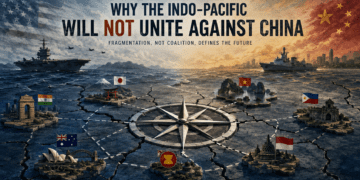
The Indo-Pacific implications of the India-South Korea defence deal are indirect but significant. The partnership is part of a broader pattern where countries build resilience through diversified industrial and technological relationships rather than formal alliances.
This model does not produce a traditional bloc structure. Instead, it creates overlapping networks of capability. India’s partnerships with South Korea, the United States, France, and others contribute to a distributed system where no single disruption can easily degrade overall capability.
For China, this model is difficult to counter. It lacks a central node that can be pressured or isolated. Instead, it gradually reduces vulnerability across multiple domains. The India-South Korea defence deal fits into this pattern as one node in a wider network, linking industrial capability with strategic resilience.
A useful visual concept would be a network map showing India connected to multiple defence-industrial partners across different capability domains. The strength lies not in any single connection, but in the redundancy across the system.
What Most Analyses Miss: This Is About Time, Not Just Capability
The deeper significance of the India-South Korea defence deal lies in time. India is not only acquiring systems. It is accelerating the timeline between acquisition, deployment, and operational integration. This compression of time is critical in modern conflict, where the speed of adaptation often determines outcomes.
By leveraging South Korean industrial expertise and localisation pathways, India reduces the delay between contract signing and battlefield readiness. This is particularly important in a dynamic threat environment where capabilities must evolve quickly.
China will recognise this shift. The concern is not that India is matching China platform for platform. It is that India is improving its ability to adapt, sustain, and scale capability over time. That is a more complex challenge to counter.
A Sticky Conclusion: Sensitive Because It Compounds
The India-South Korea defence deal is inevitably sensitive because it compounds. It strengthens capability, reduces vulnerability, and creates a pathway for further cooperation that becomes easier with each step. It does not rely on dramatic shifts or visible alignment. Its impact is cumulative.
For India, the strategic value lies in using such partnerships to close structural gaps, particularly in integration and industrial depth. For China, the concern is not immediate parity. It is the direction of travel.
Beijing will not react loudly to this deal. It does not need to. It will track it, model it, and factor it into long-term planning. That quiet attention is itself an indicator of significance.
FAQs
Why is the India-South Korea defence deal sensitive for China?
China sees the India-South Korea defence deal as sensitive because it improves India’s military capability in areas directly relevant to the Himalayan frontier. It also reduces India’s dependence on external suppliers by increasing localisation. This combination strengthens both operational readiness and long-term resilience.
Does this deal significantly change the India-China military balance?
The deal does not immediately alter the overall balance, where China retains advantages in infrastructure and missile forces. However, it strengthens specific Indian capabilities such as mobile artillery and potential air defence systems. Over time, these improvements can narrow operational gaps.
What role does South Korea play in India’s defence strategy?
South Korea acts as a technology and industrial partner rather than a military ally. Its contribution lies in providing advanced systems along with localisation pathways. This helps India build capability while reducing dependence on traditional suppliers.
What is the importance of localisation in this deal?
Localisation allows India to manufacture, maintain, and upgrade systems domestically. This reduces vulnerability to supply disruptions and improves sustainment during conflict. It also accelerates adaptation to local operational requirements.
Could this partnership expand beyond artillery and air defence?
Yes, the partnership has the potential to expand into missile systems, advanced technologies, and co-development projects. If this happens, the strategic impact would increase significantly by strengthening multiple layers of India’s defence architecture.

