











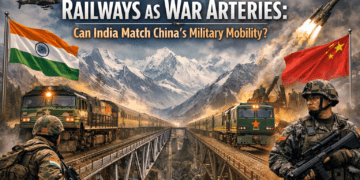
















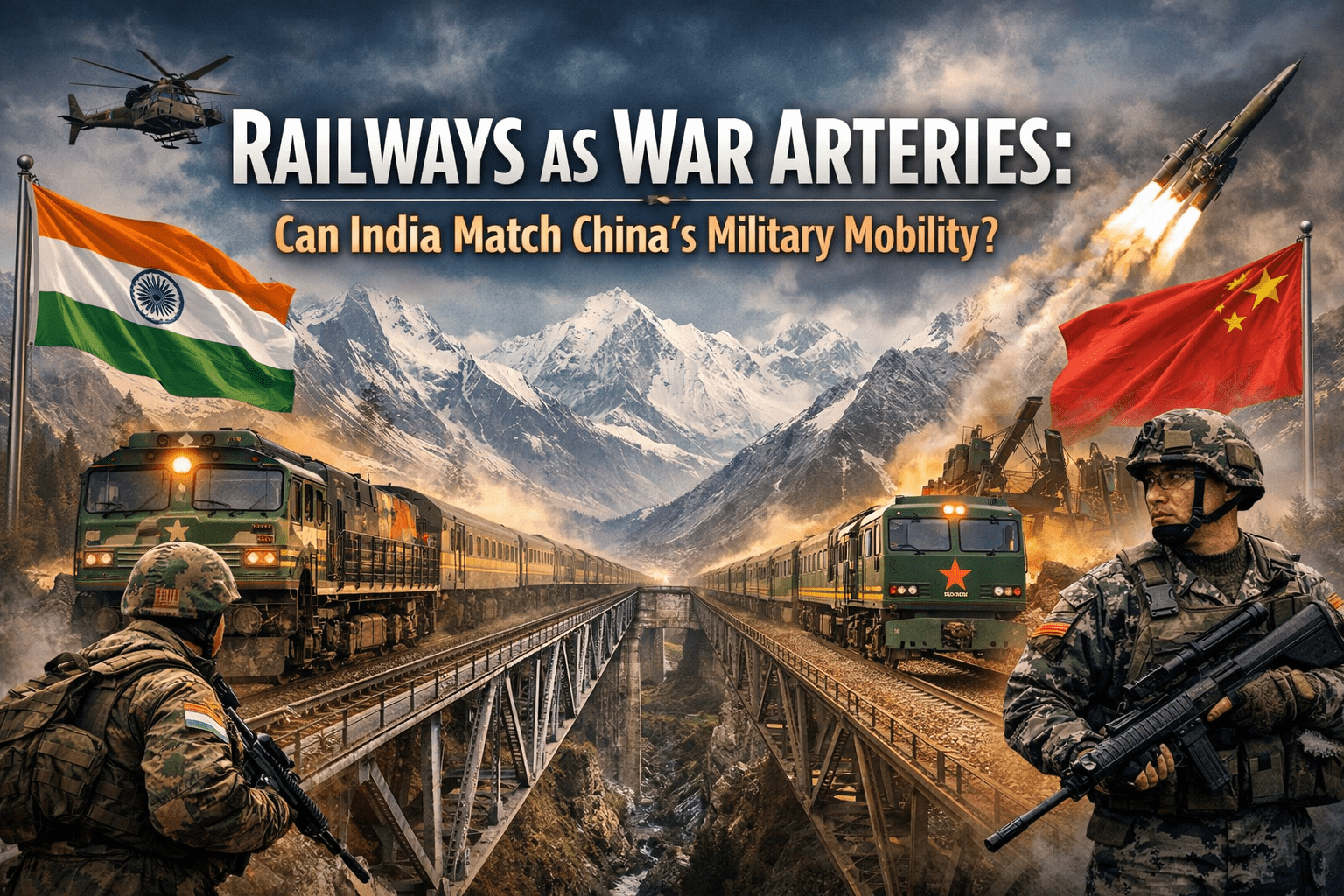
Railways as war arteries are no longer a supporting function in modern warfare. They are the backbone that determines how quickly combat power can be generated, sustained, and repositioned across theatres. In the India–China context, this is not an abstract comparison of infrastructure. It is a question of whether India can translate force structure into usable combat power at the speed required by contemporary conflict. The gap is not simply about tracks and trains. It is about time, integration, and survivability under pressure.
China has already internalised this reality. Its railway network in Tibet and Xinjiang is not just an economic project but a warfighting system designed to compress mobilization timelines and sustain high-intensity operations. India, despite recent infrastructure acceleration, still treats railways as a secondary enabler rather than a primary determinant of military mobility. That difference is structural. It shapes how each side would fight, escalate, and sustain conflict along the Line of Actual Control.
The real question, therefore, is not whether India has railways. It is whether India’s railways function as war arteries in a system designed for conflict, or whether they remain a peacetime network stretched into wartime use.
China’s Railway Logic: Building a Warfighting Grid, Not Just Tracks
China’s approach to railways as war arteries is rooted in deliberate system design. The railway network feeding the Tibetan Plateau is not a linear corridor. It is a layered grid built with redundancy, throughput, and survivability in mind. The Qinghai–Tibet Railway, extended toward Shigatse and Nyingchi, forms the spine, but its real strength lies in parallel development through the Sichuan–Tibet axis, expected to operationalise around 2030.
This network is engineered for military loading requirements. High axle loads allow the transport of heavy armour. Pre-configured loading bays reduce turnaround time. Dedicated logistics nodes enable rapid assembly and dispersal of formations. According to open-source assessments of the People’s Liberation Army logistics system, China can move brigade-scale forces to the plateau within 48 to 72 hours under prepared conditions. That is not just speed. It is predictability, and predictability is what compresses an adversary’s decision window.
What most analyses understate is how this network alters the geography of Tibet itself. The plateau is no longer a buffer. It is a launch platform with depth. Railways as war arteries convert distance into a manageable variable rather than a constraint. This fundamentally changes the operational equation for India, especially in sectors where Chinese railheads are steadily moving closer to the Line of Actual Control.
India’s Railway Reality: Scale Without Strategic Configuration
India’s railway network is vast, but it is not configured as a warfighting system. The distinction matters. Railways as war arteries require integration across infrastructure, doctrine, and operational planning. In India’s case, these elements exist but are not fully synchronized.
Historically, the Indian Army has relied on railways for large-scale mobilization, including during Operation Parakram. That experience exposed a core limitation. India could mobilize, but not rapidly enough to exploit surprise or respond to compressed timelines. In today’s surveillance-heavy environment, where movements are visible almost in real time, slow mobilization is not just inefficient. It is strategically constraining.
Recent infrastructure projects indicate progress. The Udhampur–Srinagar–Baramulla line, the Sela Tunnel, and ongoing work toward Ladakh connectivity signal intent. However, these remain largely developmental projects with military utility layered on top. Railways as war arteries demand the reverse. Military requirements must shape design from the outset.
The deeper issue is last-mile integration. Railheads remain distant from forward sectors, forcing reliance on road convoys and airlift. This creates a discontinuity between strategic mobility and tactical deployment. Without seamless integration, railways cannot function as true war arteries.
The Real Gap: Time, Not Distance
The most consequential difference between India and China lies in mobilization timelines. Distance matters, but time decides outcomes. Railways as war arteries are fundamentally about reducing time between decision and deployment.
| Parameter | China (Western Theater) | India (Northern Sector) |
|---|---|---|
| Brigade Mobilization Time | 48–72 hours | 5–7 days (variable) |
| Railhead Proximity to LAC | 100–200 km | 200–400 km |
| Daily Sustainment Capacity | High-volume rail throughput | Road + air dependent |
| Network Redundancy | Multiple corridors | Limited |
These figures illustrate more than a capability gap. They reveal a decision-making asymmetry. China can generate force faster than India can respond, which creates a structural advantage in crisis initiation and escalation control.
What is often overlooked is the second-order effect. Faster mobilization reduces political deliberation time. When railways as war arteries enable rapid force concentration, the window for diplomacy narrows. This is not just a military issue. It is a strategic stability issue.
The Missing Dimension: Lateral Mobility Across Theatres
Most discussions focus on moving forces to the border. That is only part of the problem. The more complex challenge is lateral mobility between sectors. Can India shift forces from Ladakh to Arunachal quickly enough to respond to multi-axis pressure?
China’s railway network allows internal maneuver across theatres with relative efficiency. Multiple corridors enable redistribution of forces without overloading a single axis. India’s network, by contrast, is optimized for civilian traffic with limited surge flexibility for cross-theatre military movement.
This creates a constraint in a two-front scenario. Railways as war arteries are not just about reaching the frontline. They are about reshaping force posture dynamically. Without lateral mobility, India risks being locked into sector-specific deployments, reducing operational flexibility.
The Integration Problem: When Infrastructure Exists But Systems Do Not
A critical but under-discussed issue is integration. Railways as war arteries require tight coordination between civilian operators and military planners. In China, this is institutionalized through civil-military fusion. In India, coordination exists but remains episodic rather than systemic.
The absence of unified theatre commands compounds this challenge. Without integrated planning structures, railway utilization becomes reactive rather than pre-configured. Loading protocols, scheduling priorities, and logistics sequencing are not optimized for wartime scenarios.
This creates friction at the worst possible moment. Infrastructure may exist, but without integration, it cannot deliver its full potential. This is the difference between capacity and capability.
Vulnerability and Survivability: The Other Side of Rail Power
Railways as war arteries create speed and volume, but they also create targets. In an era of persistent surveillance and precision strikes, rail infrastructure is inherently vulnerable. Bridges, tunnels, and junctions are high-value nodes that can be disrupted with relatively limited effort.
China mitigates this through redundancy and hardening. Multiple routes reduce dependency on any single corridor. Tunnel systems are designed with survivability in mind. Rapid repair units ensure continuity even under attack.
India’s network, particularly in border areas, lacks this level of redundancy. A single disrupted node can have cascading effects on logistics flow. This vulnerability is not just tactical. It is systemic.
The implication is clear. Building railways is not sufficient. They must be designed to operate under contested conditions. Railways as war arteries must be resilient, not just efficient.
Geography Is Not Destiny: The Cost Argument Revisited
India’s railway deficit is often attributed to terrain. The Himalayas present genuine engineering challenges. Steep gradients, seismic instability, and extreme weather increase construction complexity and cost. However, geography alone does not explain the gap.
China has invested heavily in overcoming similar challenges on the Tibetan Plateau. The difference lies in prioritization. China treats infrastructure as a strategic asset, even when economic returns are limited. India has historically applied commercial logic to strategic projects.
The Bilaspur–Manali–Leh railway exemplifies this tension. Its cost is high, and its engineering demands are significant. Yet its strategic value is equally high. Railways as war arteries cannot be evaluated purely through cost-benefit analysis. They must be assessed in terms of deterrence and operational capability.
What Most Analyses Miss: The Logistics-ISR Feedback Loop
A deeper shift is underway in how logistics interacts with surveillance. Railways as war arteries enable rapid movement, but they also create observable patterns. Satellites and drones can track train movements, loading activity, and logistics buildup.
This creates a feedback loop. Faster logistics increases visibility, which increases vulnerability. China addresses this through deception, dispersion, and redundancy. India’s approach remains underdeveloped in this domain.
The implication is that logistics is no longer a backend function. It is part of the battlespace. Railways must be integrated with ISR countermeasures, camouflage, and deception strategies. Without this, mobility advantages can be offset by targeting vulnerabilities.
Beyond the Himalayas: Rail Mobility and Indo-Pacific Signaling
Railways as war arteries have implications beyond the immediate India-China border. In the Indo-Pacific context, infrastructure is increasingly a tool of strategic signaling. China’s internal railway network enhances its ability to project power outward by stabilizing its continental base.
For India, improved railway mobility could strengthen its strategic posture in multiple ways. Faster mobilization enhances deterrence credibility. Efficient logistics reduces the cost of sustained deployments. Integrated infrastructure supports rapid response to regional contingencies.
There is also a signaling dimension. Visible improvements in mobility infrastructure communicate readiness. In a region where perception shapes behavior, this matters.
Railways as War Arteries and India’s Strategic Choice
Railways as war arteries will define the tempo of future conflicts in the Himalayas and beyond. India’s challenge is not a lack of infrastructure, but a lack of integration and prioritization. The gap with China is real, but it is not immutable.
Closing this gap requires a shift in thinking. Railways must be treated as core military infrastructure, not ancillary assets. This means aligning design, doctrine, and operational planning around mobility as a central pillar of deterrence.
India does not need to replicate China’s model exactly. But it does need to build a system that is responsive, resilient, and integrated. Without this, mobility will remain a constraint, shaping outcomes in ways that cannot be corrected once a crisis begins.
The question is not whether India can build railways. It is whether it can transform them into true war arteries before the next crisis tests the system.
FAQs
What does “railways as war arteries” mean in military strategy?
Railways as war arteries refer to rail networks functioning as primary channels for moving troops, equipment, and supplies during conflict. They enable rapid mobilization and sustained logistics at scale. Without them, large-scale military operations become slower, costlier, and harder to sustain.
Why is China ahead in railway-based military mobility?
China has designed its railway network with military integration from the outset, including high-capacity lines, dedicated logistics nodes, and redundancy. This allows faster and more predictable mobilization. India’s network is extensive but less optimized for military use.
Can India close the railway mobility gap with China?
India can narrow the gap through targeted investments in border rail connectivity, improved integration with military planning, and enhanced redundancy. However, matching China’s scale will take time due to terrain and cost constraints. The focus should be on responsiveness and resilience.
Are railways vulnerable in modern warfare?
Yes, railways can be targeted using precision strikes and surveillance systems. Key nodes such as bridges and tunnels are particularly vulnerable. To mitigate this, countries invest in redundancy, hardening, and rapid repair capabilities.
Why are railways more important than roads for military logistics?
Railways can move significantly larger volumes of equipment and supplies at lower cost and with greater reliability. Roads are essential for last-mile connectivity but cannot match the throughput required for sustained high-intensity operations.

