










The emerging contours of the Su-57M1 India deal suggest that the Indian Air Force is no longer debating whether it needs a fifth generation fighter. That question has effectively been settled by force structure realities and the accelerating pace of Chinese airpower development.
The real issue now is far more consequential. Can India compress its capability timeline without compromising the autonomy it has spent decades trying to build?
Recent signals from Russia’s defence export ecosystem indicate that the Su-57 program is moving beyond limited domestic induction into a broader international phase. While official confirmation from New Delhi remains absent, the pattern is familiar.
High-value defence negotiations of this scale are rarely acknowledged publicly until they reach formal contractual stages.
What matters more is the convergence of indicators suggesting that discussions have moved beyond exploratory dialogue into engineering and production planning.
The Su-57M1 India deal is therefore not a speculative concept. It is taking shape as a structured pathway that combines immediate capability induction with long-term industrial positioning. The implications go far beyond aircraft acquisition. They extend into doctrine, industrial policy, and India’s role in the Indo-Pacific balance of power.
What makes this moment different is the depth of access reportedly on the table. Offers of source code access and joint development pathways signal a shift from a buyer-seller relationship to something closer to program participation. That distinction will define whether this deal enhances autonomy or quietly constrains it.
The Timeline Trap: Why Waiting for AMCA Is No Longer a Neutral Option
For most of the past decade, India’s quest for a fifth-generation combat aircraft was defined by what it could not have:
- the F-35 remained encumbered by American operational controls and ITAR-related restrictions that made sovereign integration of indigenous systems effectively impossible;
- the jointly developed FGFA program with Russia collapsed in 2018 after years of irreconcilable disputes over technology transfer and cost apportionment;
- and the homegrown AMCA, while technically ambitious, will not reach operational squadrons until the mid-2030s at the earliest.
India’s fighter fleet is entering a period of structural stress. Squadron strength remains below sanctioned levels, and upcoming retirements will deepen this gap. However, the more serious challenge is qualitative rather than numerical.
China’s J-20 fleet is no longer a symbolic capability. It is being produced at scale and integrated into a broader networked warfare architecture. Pakistan is expected to follow with its own fifth generation pathway through Chinese collaboration, potentially within the same timeframe that India is still awaiting AMCA induction.
This creates a compressed operational window between now and the mid-2030s. The AMCA remains central to India’s long-term vision, but it cannot address near-term requirements.
The Su-57M1 India deal is designed to bridge this gap, but in doing so, it introduces long-term structural consequences that must be understood clearly.
Timelines are not just about when capability arrives. They determine which ecosystems, doctrines, and industrial dependencies become embedded in the force.
The Two-Phase Model: Replaying the Su-30MKI Playbook With Higher Stakes
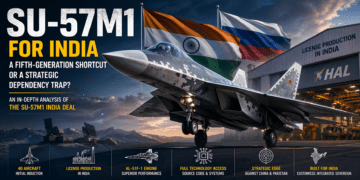
A defining feature of the Su-57M1 India deal is its phased structure. It closely mirrors India’s Su-30 acquisition model, but with far higher technological stakes.
The first phase involves acquiring roughly 40 fully built aircraft. This allows rapid induction. It enables pilot training, maintenance familiarisation, and real-world operational evaluation. It also tests Russian logistics performance under Indian conditions.
The second phase transitions to licensed production of the Su-57M1 within India. This is where procurement becomes industrial strategy.
HAL’s existing infrastructure, built during the Su-30MKI program, provides a partial base. Estimates suggest around 50 percent compatibility. The remaining gap will require new investment, especially in advanced materials, stealth manufacturing, and precision assembly.
This sequencing is deliberate. It reduces early risk while enabling long-term scale. But it also creates a point of no return. Once production begins domestically, financial and institutional commitment becomes deeply embedded.
Why the Su-57 M1 Variant Is the Real Objective
The focus on the Su-57M1 rather than the baseline aircraft reflects a calculated decision to avoid technological obsolescence at the point of induction.
At the center of the upgrade is the AL-51F-1 engine, which represents a generational shift in Russian propulsion capability. Compared to earlier engines, it delivers higher thrust, improved fuel efficiency, and lower maintenance demands.
More importantly, it enables sustained high-speed flight without afterburner, expanding both operational reach and survivability.
From a comparative standpoint, the engine places the Su-57M1 in a competitive bracket with leading fifth generation fighters:
| Aircraft | Engine | Afterburner Thrust (kN) | Supercruise Speed | Generation Status |
|---|---|---|---|---|
| Su-57 (baseline) | AL-41F-1 | 147 kN (x2) | Mach 1.6–1.7 | In service (RuAF) |
| Su-57M1 | AL-51F-1 | 167 kN (x2) | Mach 1.9–2.1 (assessed) | Entry by 2026–2027 |
| F-22 Raptor | F119-PW-100 | 156 kN (x2) | Mach 1.8 | In service (USAF) |
| J-20 (Block III+) | WS-15 | ~181 kN (x2, est.) | Mach 1.8+ (assessed) | In service (PLAAF) |
| Rafale F4 | M88-9 | 75 kN (x2) | None (no supercruise) | In service (IAF, FAF) |
The table above illustrates a point that much commentary on the IAF’s fighter modernisation misses entirely. The Su-57M1’s engine upgrade does not merely close the gap with peers; it positions the platform at or near the top of current fifth-generation propulsion performance, particularly in the raw kinematic domain.
IAF Group Captain M.J. Augustine Vinod articulated the underlying logic with unusual directness, stating publicly that “when you combine the exceptional aerodynamics of Su-57 and the Indian avionics and software to it, you have an airplane much better than the F-35.”
Setting aside the competitive hyperbole, the substantive point is analytically sound: India’s interest in the M1 specifically, rather than accepting an early production Su-57, reflects a sophisticated reading of where the technology is heading and a willingness to absorb a short-term capability delay in exchange for a qualitatively superior long-term position.
Moreover, propulsion is only one dimension. The M1 variant also incorporates structural refinements, including a reshaped airframe for improved aerodynamic efficiency and reduced radar signature. Internal weapons bays have been optimized for stealth, while a new sensor suite is expected to replace earlier radar systems, improving detection range and electronic resilience.
That calculus becomes even more apparent when one considers the Virupaksha AESA radar program, a miniaturised gallium-nitride-based sensor with a 950mm aperture and approximately 2,400 transmitter-receiver modules currently being developed for the Su-30MKI upgrade.
Indian defence sources have extensively speculated that the Virupaksha could be adapted for integration into a domestically produced Su-57 variant, a prospect made practically achievable by Russia’s unprecedented offer of full source code access.
The implication is clear. India is not interested in the Su-57 as it exists today. It is targeting a future-ready configuration that can remain relevant into the 2040s.
The Software Question: Control Determines Capability
This is where the Su-57M1 India deal becomes strategically decisive.
Modern air combat is no longer defined by airframes alone. It is defined by software. Sensor fusion, electronic warfare, weapons integration, and mission planning all depend on software architecture.
Russia’s reported willingness to provide deeper access to source code changes the equation. If implemented fully, it allows India to integrate indigenous systems such as:
- Virupaksha AESA radar
- Astra Mk.2 and future BVR missiles
- Indigenous electronic warfare suites
This creates the possibility of a hybrid platform. A Russian airframe combined with Indian systems.
But this is also the core risk.
Access on paper does not guarantee control in practice. Integration complexity and dependency on foreign subsystems can still constrain autonomy. This is the contradiction India cannot ignore. It may gain hardware independence while inheriting software dependencies.
The Operational Trigger: Why the IAF Is Moving Faster Now
Much of the public discussion frames the Su-57M1 India deal in terms of long-term competition with China. While valid, this perspective overlooks a more immediate driver.
Recent operational experiences have highlighted the limits of current fourth-generation platforms in environments increasingly defined by long-range sensors, advanced missiles, and electronic warfare.
These encounters have accelerated institutional recognition that incremental upgrades are no longer sufficient.
The shift is not about replacing existing aircraft. It is about ensuring that India retains the ability to operate effectively in contested airspace where fifth generation platforms are becoming the norm.
This explains the urgency behind the current timeline. The decision is being driven as much by operational learning as by strategic forecasting.
How does HAL’s existing capacity support the Su-57M1 production program?
HAL has assessed that approximately 50 percent of its existing infrastructure, much of it built up through decades of Su-30MKI production at Nasik, can be applied directly to Su-57M1 manufacturing.
The remaining gap requires new capital investment, the precise scale of which is part of ongoing Russian-Indian negotiations.
HAL Chairman D.K. Sunil confirmed publicly that Russia had commissioned a committee to evaluate facility compatibility, and the assessment has moved into the stage of awaiting Russian investment cost proposals before finalising the production framework.
Industrial Strategy: A Bridge to AMCA or a Parallel Track?
The Su-57M1 India deal intersects directly with the AMCA program. The relationship is both complementary and competitive.
On one side, license production builds critical industrial capability. It develops expertise in advanced materials, precision engineering, and systems integration. These are exactly the capabilities AMCA will require.
On the other side, it risks diverting resources. Funding, engineering talent, and institutional focus are finite. A large Su-57M1 program could absorb capacity that AMCA depends on.
This is where the real strategic tension lies.
If structured correctly, the Su-57M1 becomes a stepping stone. If not, it becomes a parallel ecosystem. In that case, India risks solving a 2030 problem while complicating a 2040 one.
The main risks in the Su-57M1 license production deal for India?
Three risks stand out.
First, the AL-51F-1 engine and the full Su-57M1 configuration remain in the final stages of Russian development, meaning delays at the Russian end could push India’s license production baseline further into the 2030s than currently planned.
Second, the deal will attract CAATSA-related diplomatic pressure from the United States, which has consistently sought to constrain India’s Russian defence procurement, though India’s track record suggests it will manage rather than capitulate to that pressure.
Third, supply chain concentration in Russian components for systems not covered by technology transfer creates the same vulnerability India has experienced with its Su-30MKI fleet, where spare parts availability has periodically affected operational readiness rates.
The China-Pakistan Axis: Narrowing the Gap Without Closing It
The regional balance is shifting toward a dual-front reality. China’s J-20 fleet continues to expand. Pakistan’s acquisition of advanced Chinese platforms reflects increasing convergence.
The U.S. Department of Defense has repeatedly highlighted the scale of China’s integrated air combat ecosystem. The J-20 operates within a network that combines sensors, data links, and long-range strike systems.
The Su-57M1 India deal can narrow the qualitative gap. It cannot close the systemic gap.
That distinction matters. Future air superiority will depend less on individual aircraft and more on system integration.
Against Pakistan, the impact is more immediate. The introduction of a fifth-generation platform would create a clear technological edge in contested airspace and deep strike operations.
HAL, Industrial Capacity, and the Second-Order Effects Nobody Is Tracking
The license production component of the Su-57M1 deal deserves significantly more analytical attention than it typically receives, because its implications extend well beyond the IAF’s order of battle. The Su-30MKI production program at HAL’s Nasik facility took an Indian industrial base that had modest aerospace manufacturing experience and, over roughly two decades, built it into one of the world’s more capable producers of complex combat aircraft.
More than 270 Su-30MKIs were produced under that arrangement, with indigenous content gradually increasing as the program matured.
A comparable trajectory for the Su-57M1 would not simply deliver fighters to the IAF; it would fundamentally upgrade India’s aerospace industrial competency at precisely the moment HAL needs to be preparing for AMCA production in the late 2030s.
The technologies, quality control frameworks, and precision manufacturing processes required to produce a fifth-generation aircraft in volume are exactly the capabilities AMCA will demand, making the Su-57M1 program an industrial stepping stone of considerable strategic value quite apart from its direct military contribution.
There is also a dimension of this program that almost no Indo-Pacific analysis has properly examined: its potential export implications. India’s current defence export ambitions, while growing, remain constrained by the fact that its most capable systems are either Russian-origin or Western-origin, neither of which India can re-export freely.
A deeply Indianised Su-57M1 variant, built under a license agreement that grants source code access and potentially co-ownership of key technologies, could in principle be exported to countries that for geopolitical reasons cannot acquire either the Russian baseline or Western fifth-generation alternatives.
Southeast Asian air forces, several of which are actively seeking fifth-generation or advanced fourth-generation platforms, represent a non-trivial potential market.
This would mark a qualitative shift in India’s defence industrial posture: from a sophisticated importer that occasionally re-exports Russian systems to a genuine co-developer capable of offering licensed capability to third parties under Indian terms.
That structural shift, if realised, would carry implications for India’s strategic influence that extend far beyond the immediate tactical question of IAF squadron strength.
The Overlooked Upside: Could an Indianised Su-57M1 variant eventually be exported to third countries?
One of the least examined dimensions of the Su-57M1 India deal is its potential impact on India’s defence export trajectory.
If India secures sufficient control over the platform, including software and systems integration, it could eventually develop an Indianized variant tailored to its own requirements. There are already indications that such customization could extend to structural modifications, including the possibility of a two-seat configuration designed for specific operational roles.
This opens a longer-term possibility. India could emerge as a supplier of advanced air combat platforms to countries that are unable or unwilling to procure Western or Chinese systems.
Southeast Asia, in particular, represents a potential market. Several countries are seeking advanced capabilities but face geopolitical constraints in sourcing them.
This is not an immediate outcome. It depends on the depth of technology transfer and India’s ability to build independent upgrade pathways. However, it represents a strategic opportunity that extends beyond the immediate scope of the deal.
How does the Su-57M1 procurement fit within India’s broader AMCA fifth-generation fighter program?
The Su-57M1 India deal is often framed as a response to immediate capability gaps. In reality, it is a strategic decision that will shape India’s airpower trajectory for decades.
Beyond its direct military contribution, Su-57M1 license production at HAL would develop the precision manufacturing competencies, quality control systems, and workforce expertise that AMCA production will require at an industrial scale.
At the same time, it introduces risks related to dependence, integration, and resource allocation.
The central question is not whether India should pursue the Su-57M1. It is whether the deal can be structured in a way that preserves long-term autonomy while delivering near-term capability.
If executed with depth of technology transfer, software control, and alignment with indigenous programs, the Su-57M1 India deal could serve as a bridge to a more self-reliant future. If not, it risks becoming another instance of capability acquisition without strategic control.
FAQs
What is the Su-57M1 India deal?
The Su-57M1 India deal refers to a proposed acquisition and license production of Russia’s upgraded fifth generation fighter by the Indian Air Force. It combines immediate procurement with long-term domestic manufacturing and customization.
Why is India considering buying 40 Su-57s first?
The initial purchase allows the IAF to quickly induct fifth generation capability, train personnel, and establish maintenance systems. It also provides operational experience before committing to large-scale domestic production.
What makes the Su-57M1 different from the base Su-57?
The Su-57M1 features a new engine, improved stealth design, upgraded avionics, and better sensor integration. These enhancements significantly improve performance, survivability, and operational flexibility.
How does this deal affect India’s AMCA program?
The deal could support AMCA by developing industrial capabilities needed for fifth generation production. However, it could also divert resources if not aligned properly with indigenous development efforts.
Can India customize or modify the Su-57M1?
If the agreement includes sufficient technology transfer and software access, India could integrate its own radar, weapons, and systems. This would allow the development of an Indian-specific variant.
Will this deal change the balance of power in South Asia?
Yes, particularly in the near term. The induction of a fifth generation fighter would enhance India’s ability to operate in contested airspace and provide a technological edge over regional adversaries, though broader systemic factors will still determine long-term balance.

