

















India’s 6th-generation fighter strategy is not being shaped in a vacuum. It is being forced into existence by a number that rarely anchors this conversation, yet defines it more than any technological debate.
29
That is roughly the number of operational fighter squadrons the Indian Air Force currently fields against a sanctioned strength of 42. This gap has widened over decades, not narrowed, and it now collides directly with the timeline of sixth-generation air combat systems.
The result is a structural contradiction. India is attempting to enter a future combat ecosystem while still managing deficits rooted in legacy force planning. This is not a position of technological ambition alone. It is a position shaped by time pressure and capability imbalance.
The India 6th-generation fighter strategy must therefore be understood as more than a procurement decision. It is a compressed response to three simultaneous pressures. The first is the immediate requirement to maintain credible airpower across two fronts.
The second is the long-term need to escape cycles of technological dependency. The third is the rapid transformation of air warfare into a network-centric domain where aircraft are only one component of a larger system. Most analyses treat FCAS vs GCAP as a choice between platforms. That framing is already outdated. The real decision is about which ecosystem India plugs into, and how much control it retains within that ecosystem.
India 6th-generation fighter strategy and the shift from aircraft to architecture
The most important shift in sixth-generation airpower is not aerodynamic or even stealth-related. It is architectural. A sixth-generation fighter is not primarily a platform. It is a node within a distributed combat network that integrates manned aircraft, unmanned systems, satellites, and real-time data processing. The aircraft is visible. The system it belongs to is what determines combat effectiveness.
This has direct implications for India 6th-generation fighter strategy. India’s legacy approach to airpower development was platform-centric. Acquire advanced aircraft, integrate them domestically, and incrementally build supporting capabilities. That model worked in a fourth-generation environment and partially in a fifth-generation transition. It does not scale into a system-of-systems paradigm where data fusion, AI-assisted decision-making, and network resilience define outcomes.
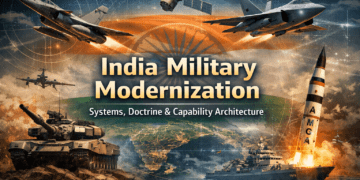
India’s ongoing Advanced Medium Combat Aircraft program provides a foundation, but it operates largely within a fifth-generation framework. Even if delivered on schedule, it enters an operational environment where competitors are building integrated combat clouds rather than standalone platforms.
According to assessments referenced in Indian Ministry of Defence discussions, critical gaps remain in engine development, sensor fusion, and secure data architectures. These are not peripheral issues. They are core to sixth-generation viability. The strategic implication is clear. India cannot simply build its way into sixth-generation capability through airframe development alone. It must decide how to access and control the underlying architecture.
FCAS vs GCAP: access, leverage, and structural constraints
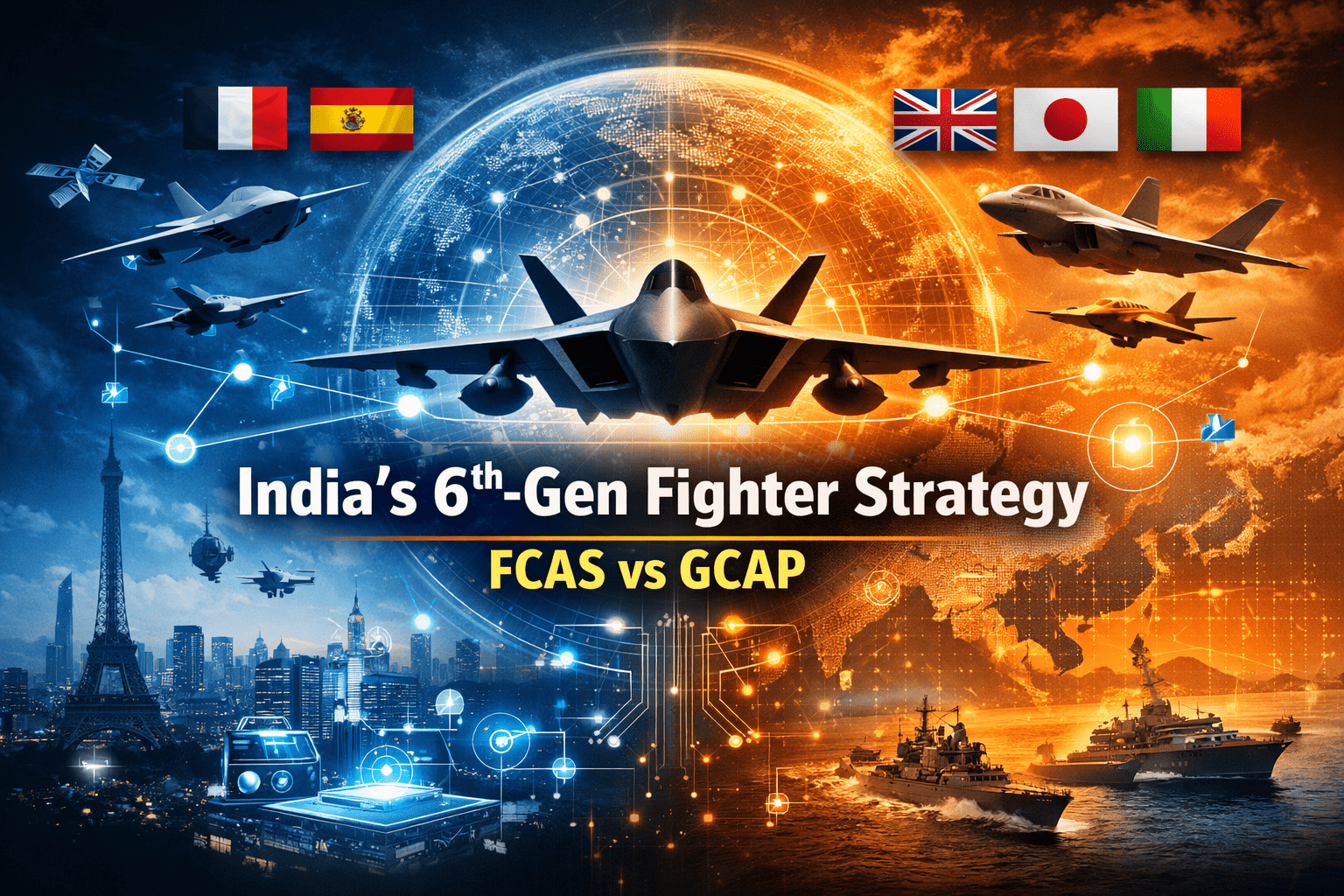
The FCAS vs GCAP debate appears straightforward on the surface but becomes more complex when examined through the lens of access and leverage. Both programs offer pathways into sixth-generation ecosystems, but neither offers full control, and both impose structural constraints that shape India’s options.
| Parameter | FCAS | GCAP |
|---|---|---|
| Core Participants | France, Germany, Spain | UK, Japan, Italy |
| Collaboration Model | Deep integration, shared IP | Modular participation, predefined roles |
| Internal Stability | Politically contested | Structurally stable |
| Timeline Target | Around 2040 | Around 2035 |
| Entry Reality for India | Negotiable but uncertain | Stable but limited access |
GCAP represents a stable but tightly structured program. The United Kingdom, Japan, and Italy have already defined industrial roles and intellectual property frameworks. This stability reduces program risk but limits late-entry flexibility.
For India, this means likely participation as a customer or limited partner rather than a co-developer. The advantage is timeline certainty and alignment with an Indo-Pacific security framework that includes Japan. The constraint is reduced influence over core design and architecture.
FCAS presents the inverse dynamic. It is more open to new partners, particularly as France seeks financial and industrial reinforcement, but it is also internally fragmented. Disagreements between France and Germany over design authority and industrial control have slowed progress.
For India 6th-generation fighter strategy, this creates a high-risk, high-leverage scenario. India could potentially secure deeper technological access, especially given its existing defense relationship with France, but it also risks entering a program that may face prolonged instability.
The strategic choice is therefore not between better and worse programs. It is between limited access in a stable system and greater leverage in a fragile one. This trade-off sits at the heart of India 6th-generation fighter strategy.
The engine constraint and the hidden negotiation strategy
Beneath the FCAS vs GCAP debate lies a more fundamental constraint. India does not yet possess a mature, high-thrust fighter engine capability. This limitation shapes every possible pathway into sixth-generation development.
| Program Path | Engine Ecosystem | Strategic Outcome |
|---|---|---|
| GCAP | Rolls-Royce | Potential co-development leverage |
| FCAS | Safran / MTU | Negotiable access, politically sensitive |
| Independent | Indigenous | Long timelines, high uncertainty |
This is not simply a technical gap. It is a strategic bottleneck. Control over propulsion technology influences design flexibility, upgrade cycles, and operational sovereignty. India’s engagement with both FCAS and GCAP can therefore be interpreted as a form of competitive signaling. By exploring multiple partnerships, India increases its leverage in negotiating meaningful engine collaboration.
The implication is that India 6th-generation fighter strategy is not a binary decision process. It is a multi-vector negotiation. The objective is not only to join a program but to extract critical technologies that can feed into domestic capability development. This is where most surface-level analyses fall short. They treat consortium participation as an endpoint rather than as a means within a broader strategy.
Combat clouds and escalation at machine speed
One of the least examined consequences of sixth-generation systems is the transformation of escalation dynamics. As combat shifts into networked environments, decision cycles compress dramatically. The transition from human-paced engagement to algorithm-influenced decision-making introduces new forms of instability.
In a fourth-generation environment, engagements unfolded over minutes, allowing for human interpretation and political signaling. Fifth-generation systems reduced these timelines to seconds but retained human oversight within the decision loop. Sixth-generation architectures begin to erode that boundary.
When a combat cloud integrates sensors, drones, and AI-driven analysis, the system itself can initiate engagement sequences based on pattern recognition.
In an India-China context, this creates a distinct risk profile. A high-altitude standoff could evolve rapidly if automated systems misclassify signals or interpret ambiguous data as hostile intent. The resulting engagement may occur before human operators can intervene effectively.
This introduces three risks. Misclassification under electronic warfare conditions becomes more likely. Traditional signaling mechanisms lose clarity as actions become instantaneous. Decision authority shifts toward algorithms, reducing transparency at the political level.
The strategic implication for India 6th-generation fighter strategy is profound. Speed becomes both an advantage and a liability. The ability to operate at machine speed enhances combat effectiveness but reduces the space for controlled escalation. In a geographically constrained theater such as the Himalayas, this compression is even more pronounced.
Industrial consequences and the autonomy paradox
India’s decision on sixth-generation participation will shape its aerospace industry for decades. This is not just about acquiring advanced systems. It is about determining whether India can transition from licensed production to genuine design capability.
Historical experience suggests caution. Programs involving technology transfer have often resulted in manufacturing capacity without corresponding design autonomy. The gap between assembling systems and designing them remains significant. Sixth-generation systems, with their reliance on software, AI, and integrated networks, widen this gap further.
This leads to a central contradiction in India 6th-generation fighter strategy. Strategic autonomy remains a core principle of Indian defense policy. Yet participation in multinational programs inherently introduces dependency, particularly in software architecture and data systems.
| Layer | Strategic Role | Dependency Risk |
|---|---|---|
| AI decision systems | Engagement logic | High |
| Mission software | Operational control | Critical |
| Data links | Network integration | Medium |
| Sensor fusion | Situational awareness | High |
Owning aircraft without controlling their software stack creates a form of operational dependence that is less visible but more consequential than traditional hardware reliance. The Advanced Medium Combat Aircraft program was intended to address this gap, but external collaboration risks diverting resources and attention. The challenge is not whether to collaborate, but how to ensure that collaboration contributes to sovereign capability rather than substituting for it.
Indo-Pacific alignment and the unseen geopolitical layer
The choice between FCAS and GCAP carries implications beyond technology and industry. It signals alignment within emerging geopolitical structures. GCAP, with Japan as a central partner, links India to a broader Indo-Pacific security network. This does not constitute a formal alliance, but it creates interoperability and shared technological frameworks that influence regional balance.
FCAS, by contrast, aligns India more closely with European strategic autonomy efforts. This offers diversification but less direct integration into Indo-Pacific security architectures. The distinction matters because future airpower effectiveness will depend not only on individual capability but also on network compatibility with partners.
China’s trajectory adds urgency to this dimension. Its development of integrated combat systems, combined with expanding naval and air capabilities, creates a layered challenge for India. Participation in a networked ecosystem could offset some of this pressure, but only if it enhances India’s ability to operate independently within that network.
Scenario pathways: how India 6th-generation fighter strategy could unfold
Looking ahead, three pathways define the plausible evolution of India 6th-generation fighter strategy.
The first is alignment with GCAP. This offers faster access to sixth-generation capabilities and integration into an Indo-Pacific framework, but limits India’s influence over core technologies. The second is deeper engagement with FCAS, where India could secure greater industrial participation at the cost of higher program risk. The third is a hybrid approach, combining selective collaboration with accelerated development of indigenous systems.
The hybrid pathway appears the most realistic. It allows India to leverage external programs for specific technologies while maintaining focus on domestic initiatives such as the AMCA. This approach also aligns with India’s broader defense strategy of diversifying partnerships while preserving autonomy.
Choosing speed, control, or balance
India’s 6th-generation fighter strategy ultimately revolves around a fundamental trade-off between speed and control. External collaboration offers faster access to advanced capabilities but introduces dependency. Indigenous development preserves autonomy but risks delays that could widen capability gaps.
The most effective approach is likely a calibrated balance. India must engage externally to bridge critical technological gaps while ensuring that such engagement feeds into long-term domestic capability building. This requires clear strategic intent, disciplined resource allocation, and sustained institutional focus.
The real question is not which fighter India chooses. It is how much control it is willing to retain over the systems that define future air combat. In a world where warfare is increasingly shaped by networks and algorithms, that choice will determine not just capability, but sovereignty itself.
—————-
FAQs
What is the main difference between FCAS and GCAP?
FCAS focuses on deep industrial integration among European partners, while GCAP operates as a more structured and stable consortium with predefined roles. For India, this translates into a trade-off between potential influence and program stability.
Why is India exploring sixth-generation fighter programs now?
India faces a widening gap in fighter squadron strength and a rapidly evolving regional threat environment. Sixth-generation systems represent the next phase of air combat capability, making early engagement necessary despite existing constraints.
Can India achieve full strategic autonomy in sixth-generation systems?
Full autonomy is difficult due to dependencies in engines, software, and network architectures. However, a hybrid approach combining collaboration and indigenous development can reduce long-term reliance.
Which option aligns better with India’s Indo-Pacific strategy?
GCAP aligns more closely with Indo-Pacific security dynamics due to Japan’s involvement, while FCAS offers diversification through European partnerships.
How will sixth-generation systems change air warfare?
They will shift combat from platform-centric operations to network-centric systems, integrating manned and unmanned assets with AI-driven decision-making, significantly compressing engagement timelines.

