













IndoAsia Defense
  • Home
  • Air
    • All
    • Air Defence
    • Drones
    • Fighters
    • ISR & Mobility
    Ghatak UCAV stealth, autonomy, integration

    Inside India’s Ghatak UCAV Program: Stealth, Autonomy, and the Integration Gap

    The F414 engine co-production agreement between Hindustan Aeronautics Limited and GE Aerospace

    India-US F414 Engine Deal Explained: Technology Transfer, Tejas Mk2, and AMCA

    What is the Su-57M1 India deal

    Su-57M1 for India: A Fifth-Generation Shortcut or a Strategic Dependency Trap?

    India indigenous long range surveillance radar with X-band drone detection capability

    450km Eyes, Machine-Speed Decisions: How India’s Indigenous Long Range Surveillance Radar Is Rewriting Air Defence

    Why Software Defined Radios Are the IAF’s Most Consequential Upgrade

    IAF Signs BEL Deal for Software Defined Radios: Rewiring India’s Air Combat Network

    How the Ghatak UCAV Stealth Design Redefines India’s Drone Warfare Doctrine

    Ghatak UCAV: India’s Carbon Composite Stealth Strategy Dissected

    Ballistic Missile Defense system intercepting incoming missile during midcourse phase

    How Ballistic Missile Defense Works: Inside Modern Missile Interception Systems

    Swarm logistics drones delivering military supplies in high-altitude Himalayan terrain with Indian Army presence

    Swarm Logistics Drones in Himalayan Warfare: Can India Close the Supply Gap with China?

    India’s 6th-Gen Fighter Strategy FCAS vs GCAP Explained

    India’s 6th-Gen Fighter Strategy: FCAS vs GCAP Explained

  • Land
    • All
    • Armour & Artillery
    • China Front
    • Future Combat
    • Pakistan Front
    The India-South Korea defence deal

    The India-South Korea Defence Deal Through China’s Operational Lens

    Railways as War Arteries Can India Match China’s Military Mobility Before the Next Crisis

    Railways as War Arteries: Can India Match China’s Military Mobility Before the Next Crisis?

    China maritime front in Indian Ocean

    What If China Opens a Maritime Front in the Indian Ocean During a LAC Conflict?

    What is Indian military modernization strategy in 2026?

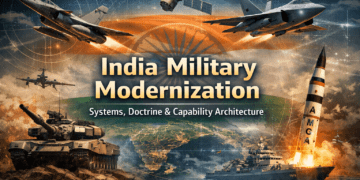
    Indian Military Modernization: Systems, Doctrine, and Capability Architecture (2026-27)

    Tank launching loitering munition in battle

    From Smoke to Strike: India’s Indigenous Loitering Munitions for T-72, T-90, and Arjun Tanks

    How China Mobilizes Forces Along the LAC Speed, Systems, and Strategic Control

    How China Mobilizes Forces Along the LAC: Systems, Speed, and Strategic Signaling

    Ballistic Missile Defense system intercepting incoming missile during midcourse phase

    How Ballistic Missile Defense Works: Inside Modern Missile Interception Systems

    Swarm logistics drones delivering military supplies in high-altitude Himalayan terrain with Indian Army presence

    Swarm Logistics Drones in Himalayan Warfare: Can India Close the Supply Gap with China?

    India defence proposals Rs 2.38 trillion showing S-400 system, strike drones, fighter jets and military architecture shift

    India Defence Proposals Rs 2.38 Trillion: Why This Approval Changes How India Will Fight, Not Just What It Buys

  • Navy
    • All
    • Fleet Expansion
    • Indian Ocean
    • Maritime Security
    • Submarines
    China maritime front in Indian Ocean

    What If China Opens a Maritime Front in the Indian Ocean During a LAC Conflict?

    The Strait of Hormuz Crisis

    India’s Oil Artery Under Threat: Strategic Implications of a Hormuz Crisis

    India’s VL-Shtil Missile Deal with Russia

    India’s VL-Shtil Missile Deal with Russia: Strengthening Naval Air Defense in the Indo-Pacific

    Andaman & Nicobar Command Sleeping Giant of India’s Maritime Strategy

    Andaman & Nicobar Command: Sleeping Giant of India’s Maritime Strategy

    Maritime Surveillance 2.0: Why EO/IR Modernisation Matters for India’s Ocean Security

    Maritime Surveillance 2.0: Why EO/IR Modernisation Matters for India’s Ocean Security

    2030 Will Decide the India ASEAN Maritime Equation

    2030 Will Decide the India ASEAN Maritime Equation

    India Military Transformation Series — Part 3: Maritime Power and the Indian Ocean Imperative

    India Military Transformation Series — Part 3: Maritime Power and the Indian Ocean Imperative

    Indian Navy TEDBF PPP Model: China Factor and 2030–2040 Carrier Strategy

    Indian Navy TEDBF PPP Model: China Factor and 2030–2040 Carrier Strategy

    India’s Maritime Strategy: India’s Blue-Water Ambition in a Contested Indo-Pacific

    India’s Maritime Strategy: India’s Blue-Water Ambition in a Contested Indo-Pacific

  • Indo-Pacific
    • All
    • 2035 Outlook
    • China Strategy
    • India Strategy
    • Pakistan Outlook
    The India-South Korea defence deal

    The India-South Korea Defence Deal Through China’s Operational Lens

    Railways as War Arteries Can India Match China’s Military Mobility Before the Next Crisis

    Railways as War Arteries: Can India Match China’s Military Mobility Before the Next Crisis?

    india military integration gap

    Is India Building Military Power Faster Than It Can Integrate It?

    China maritime front in Indian Ocean

    What If China Opens a Maritime Front in the Indian Ocean During a LAC Conflict?

    Can India Fight Beyond 30 Days? Inside India’s War Sustainment Reality

    Can India Fight Beyond 30 Days? Inside India’s War Sustainment Reality

    What is Indian military modernization strategy in 2026?

    Indian Military Modernization: Systems, Doctrine, and Capability Architecture (2026-27)

    The end of Naxalism in India

    End of Naxalism in India: Inside the Fall of the Red Corridor

    Ballistic Missile Defense system intercepting incoming missile during midcourse phase

    How Ballistic Missile Defense Works: Inside Modern Missile Interception Systems

    Swarm logistics drones delivering military supplies in high-altitude Himalayan terrain with Indian Army presence

    Swarm Logistics Drones in Himalayan Warfare: Can India Close the Supply Gap with China?

  • Joint
    • All
    • Integrated Ops
    • Procurement Reform
    • Theater Commands
    Ballistic Missile Defense system intercepting incoming missile during midcourse phase

    How Ballistic Missile Defense Works: Inside Modern Missile Interception Systems

    India defence proposals Rs 2.38 trillion showing S-400 system, strike drones, fighter jets and military architecture shift

    India Defence Proposals Rs 2.38 Trillion: Why This Approval Changes How India Will Fight, Not Just What It Buys

    DAP 2026 India’s Quiet Revolution in Defence Procurement

    DAP 2026: India’s Quiet Revolution in Defence Procurement

    Integrated Battle Groups vs China’s Western Theater Command

    Integrated Battle Groups vs China’s Western Theater Command: Can Doctrine Survive the Himalayan Reality?

    Andaman & Nicobar Command Sleeping Giant of India’s Maritime Strategy

    Andaman & Nicobar Command: Sleeping Giant of India’s Maritime Strategy

    India Military Transformation Series — Part 2: The Theatre Command Reckoning

    India Military Transformation Series — Part 2: The Theatre Command Reckoning

    India AI C4ISR modernization

    India Military Transformation Series — Part 1: India AI C4ISR Modernization

    India’s Two-Front Theatre Command: Preparing for Simultaneous Conflict

    India’s Two-Front Theatre Command: Preparing for Simultaneous Conflict

    The Networked Force: India’s Transition to Integrated Warfare Systems

    The Networked Force: India’s Transition to Integrated Warfare Systems

  • Tech
    • All
    • AI & Autonomous Systems
    • Cyber
    • Electronic Warfare
    • Space
    Why Software Defined Radios Are the IAF’s Most Consequential Upgrade

    IAF Signs BEL Deal for Software Defined Radios: Rewiring India’s Air Combat Network

    Source Code or ICD India’s Source Code Negotiation Explained

    Source Code or ICD: India’s Source Code Negotiation Explained

    Supply Chain Weaponization

    Supply Chain Weaponization: Strategic Autonomy Meets Semiconductor Reality

    AI-driven battlefield in India's military

    The Algorithm of Borders: What India’s Military AI Push Actually Looks Like on the Ground

    India AI C4ISR modernization

    India Military Transformation Series — Part 1: India AI C4ISR Modernization

    PRAHAR Explained India Counter Terror Policy Prahaar

    PRAHAAR Explained: Why ‘PRAHAAR’ India’s National Counter-terrorism Doctrine, Signals the End of Traditional Warfare

    The Weapons Making the AMCA Unbeatable

    The Weapons Making the AMCA Unbeatable

    India’s Aerospace Ecosystem After Rafale: The 2026–2030 Industrial Test

    India’s Aerospace Ecosystem After Rafale: The 2026–2030 Industrial Test

    PLA’s Cyber Warfare Units and the Question of Indian Critical Infrastructure Resilience

    PLA’s Cyber Warfare Units and the Question of Indian Critical Infrastructure Resilience

  • Industry
    • All
    • Budget
    • Exports
    • Make in India
    • Supply Chains
    Ghatak UCAV stealth, autonomy, integration

    Inside India’s Ghatak UCAV Program: Stealth, Autonomy, and the Integration Gap

    The India-South Korea defence deal

    The India-South Korea Defence Deal Through China’s Operational Lens

    The F414 engine co-production agreement between Hindustan Aeronautics Limited and GE Aerospace

    India-US F414 Engine Deal Explained: Technology Transfer, Tejas Mk2, and AMCA

    Why Software Defined Radios Are the IAF’s Most Consequential Upgrade

    IAF Signs BEL Deal for Software Defined Radios: Rewiring India’s Air Combat Network

    How the Ghatak UCAV Stealth Design Redefines India’s Drone Warfare Doctrine

    Ghatak UCAV: India’s Carbon Composite Stealth Strategy Dissected

    Swarm logistics drones delivering military supplies in high-altitude Himalayan terrain with Indian Army presence

    Swarm Logistics Drones in Himalayan Warfare: Can India Close the Supply Gap with China?

    India defence proposals Rs 2.38 trillion showing S-400 system, strike drones, fighter jets and military architecture shift

    India Defence Proposals Rs 2.38 Trillion: Why This Approval Changes How India Will Fight, Not Just What It Buys

    Helicopter-Mounted Counter-Drone Systems

    Helicopter-Mounted Counter-Drone Systems: The Indian Army’s Answer to Kamikaze Drone Warfare

    India vs China Defence Industrial Base Explained

    India vs China Defence Industrial Base: Scale vs Strategic Depth

  • Global
    • All
    • China-Pak
    • Emerging Tech
    • Middle Eeast
    • Regional Trends
    • US-India
    • US-Israel
    Ghatak UCAV stealth, autonomy, integration

    Inside India’s Ghatak UCAV Program: Stealth, Autonomy, and the Integration Gap

    The F414 engine co-production agreement between Hindustan Aeronautics Limited and GE Aerospace

    India-US F414 Engine Deal Explained: Technology Transfer, Tejas Mk2, and AMCA

    india military integration gap

    Is India Building Military Power Faster Than It Can Integrate It?

    India indigenous long range surveillance radar with X-band drone detection capability

    450km Eyes, Machine-Speed Decisions: How India’s Indigenous Long Range Surveillance Radar Is Rewriting Air Defence

    What is Indian military modernization strategy in 2026?

    Indian Military Modernization: Systems, Doctrine, and Capability Architecture (2026-27)

    India defence proposals Rs 2.38 trillion showing S-400 system, strike drones, fighter jets and military architecture shift

    India Defence Proposals Rs 2.38 Trillion: Why This Approval Changes How India Will Fight, Not Just What It Buys

    India’s 6th-Gen Fighter Strategy FCAS vs GCAP Explained

    India’s 6th-Gen Fighter Strategy: FCAS vs GCAP Explained

    India’s Two-Front War Doctrine When and Why It Emerged

    When India’s Two-Front War Doctrine Emerged

    From Non-Alignment to Multi-Alignment India’s New Strategy

    Is India Quietly Shifting from Non-Alignment to Multi-Alignment 2.0?

  • Resources
    • India Military Capability Index
    • India vs China Military Balance
    • China Western Theater Command Guide
    • Pakistan Military Tracker 2026-27
    • India’s Military Doctrine Library
    • India vs China vs Pakistan Missile Arsenal Comparison
    • India’s Missile List
    • India Missile Range Map
    • Indo-Pacific Military Power Map
    • Indo-Pacific Defense Timeline
    • Global Military Balance Dashboard
    • Global Weapons Systems Database
    • Global Missile Systems Database
  • What If
    • China India Naval Conflict
No Result
View All Result
  • Home
  • Air
    • All
    • Air Defence
    • Drones
    • Fighters
    • ISR & Mobility
    Ghatak UCAV stealth, autonomy, integration

    Inside India’s Ghatak UCAV Program: Stealth, Autonomy, and the Integration Gap

    The F414 engine co-production agreement between Hindustan Aeronautics Limited and GE Aerospace

    India-US F414 Engine Deal Explained: Technology Transfer, Tejas Mk2, and AMCA

    What is the Su-57M1 India deal

    Su-57M1 for India: A Fifth-Generation Shortcut or a Strategic Dependency Trap?

    India indigenous long range surveillance radar with X-band drone detection capability

    450km Eyes, Machine-Speed Decisions: How India’s Indigenous Long Range Surveillance Radar Is Rewriting Air Defence

    Why Software Defined Radios Are the IAF’s Most Consequential Upgrade

    IAF Signs BEL Deal for Software Defined Radios: Rewiring India’s Air Combat Network

    How the Ghatak UCAV Stealth Design Redefines India’s Drone Warfare Doctrine

    Ghatak UCAV: India’s Carbon Composite Stealth Strategy Dissected

    Ballistic Missile Defense system intercepting incoming missile during midcourse phase

    How Ballistic Missile Defense Works: Inside Modern Missile Interception Systems

    Swarm logistics drones delivering military supplies in high-altitude Himalayan terrain with Indian Army presence

    Swarm Logistics Drones in Himalayan Warfare: Can India Close the Supply Gap with China?

    India’s 6th-Gen Fighter Strategy FCAS vs GCAP Explained

    India’s 6th-Gen Fighter Strategy: FCAS vs GCAP Explained

  • Land
    • All
    • Armour & Artillery
    • China Front
    • Future Combat
    • Pakistan Front
    The India-South Korea defence deal

    The India-South Korea Defence Deal Through China’s Operational Lens

    Railways as War Arteries Can India Match China’s Military Mobility Before the Next Crisis

    Railways as War Arteries: Can India Match China’s Military Mobility Before the Next Crisis?

    China maritime front in Indian Ocean

    What If China Opens a Maritime Front in the Indian Ocean During a LAC Conflict?

    What is Indian military modernization strategy in 2026?

    Indian Military Modernization: Systems, Doctrine, and Capability Architecture (2026-27)

    Tank launching loitering munition in battle

    From Smoke to Strike: India’s Indigenous Loitering Munitions for T-72, T-90, and Arjun Tanks

    How China Mobilizes Forces Along the LAC Speed, Systems, and Strategic Control

    How China Mobilizes Forces Along the LAC: Systems, Speed, and Strategic Signaling

    Ballistic Missile Defense system intercepting incoming missile during midcourse phase

    How Ballistic Missile Defense Works: Inside Modern Missile Interception Systems

    Swarm logistics drones delivering military supplies in high-altitude Himalayan terrain with Indian Army presence

    Swarm Logistics Drones in Himalayan Warfare: Can India Close the Supply Gap with China?

    India defence proposals Rs 2.38 trillion showing S-400 system, strike drones, fighter jets and military architecture shift

    India Defence Proposals Rs 2.38 Trillion: Why This Approval Changes How India Will Fight, Not Just What It Buys

  • Navy
    • All
    • Fleet Expansion
    • Indian Ocean
    • Maritime Security
    • Submarines
    China maritime front in Indian Ocean

    What If China Opens a Maritime Front in the Indian Ocean During a LAC Conflict?

    The Strait of Hormuz Crisis

    India’s Oil Artery Under Threat: Strategic Implications of a Hormuz Crisis

    India’s VL-Shtil Missile Deal with Russia

    India’s VL-Shtil Missile Deal with Russia: Strengthening Naval Air Defense in the Indo-Pacific

    Andaman & Nicobar Command Sleeping Giant of India’s Maritime Strategy

    Andaman & Nicobar Command: Sleeping Giant of India’s Maritime Strategy

    Maritime Surveillance 2.0: Why EO/IR Modernisation Matters for India’s Ocean Security

    Maritime Surveillance 2.0: Why EO/IR Modernisation Matters for India’s Ocean Security

    2030 Will Decide the India ASEAN Maritime Equation

    2030 Will Decide the India ASEAN Maritime Equation

    India Military Transformation Series — Part 3: Maritime Power and the Indian Ocean Imperative

    India Military Transformation Series — Part 3: Maritime Power and the Indian Ocean Imperative

    Indian Navy TEDBF PPP Model: China Factor and 2030–2040 Carrier Strategy

    Indian Navy TEDBF PPP Model: China Factor and 2030–2040 Carrier Strategy

    India’s Maritime Strategy: India’s Blue-Water Ambition in a Contested Indo-Pacific

    India’s Maritime Strategy: India’s Blue-Water Ambition in a Contested Indo-Pacific

  • Indo-Pacific
    • All
    • 2035 Outlook
    • China Strategy
    • India Strategy
    • Pakistan Outlook
    The India-South Korea defence deal

    The India-South Korea Defence Deal Through China’s Operational Lens

    Railways as War Arteries Can India Match China’s Military Mobility Before the Next Crisis

    Railways as War Arteries: Can India Match China’s Military Mobility Before the Next Crisis?

    india military integration gap

    Is India Building Military Power Faster Than It Can Integrate It?

    China maritime front in Indian Ocean

    What If China Opens a Maritime Front in the Indian Ocean During a LAC Conflict?

    Can India Fight Beyond 30 Days? Inside India’s War Sustainment Reality

    Can India Fight Beyond 30 Days? Inside India’s War Sustainment Reality

    What is Indian military modernization strategy in 2026?

    Indian Military Modernization: Systems, Doctrine, and Capability Architecture (2026-27)

    The end of Naxalism in India

    End of Naxalism in India: Inside the Fall of the Red Corridor

    Ballistic Missile Defense system intercepting incoming missile during midcourse phase

    How Ballistic Missile Defense Works: Inside Modern Missile Interception Systems

    Swarm logistics drones delivering military supplies in high-altitude Himalayan terrain with Indian Army presence

    Swarm Logistics Drones in Himalayan Warfare: Can India Close the Supply Gap with China?

  • Joint
    • All
    • Integrated Ops
    • Procurement Reform
    • Theater Commands
    Ballistic Missile Defense system intercepting incoming missile during midcourse phase

    How Ballistic Missile Defense Works: Inside Modern Missile Interception Systems

    India defence proposals Rs 2.38 trillion showing S-400 system, strike drones, fighter jets and military architecture shift

    India Defence Proposals Rs 2.38 Trillion: Why This Approval Changes How India Will Fight, Not Just What It Buys

    DAP 2026 India’s Quiet Revolution in Defence Procurement

    DAP 2026: India’s Quiet Revolution in Defence Procurement

    Integrated Battle Groups vs China’s Western Theater Command

    Integrated Battle Groups vs China’s Western Theater Command: Can Doctrine Survive the Himalayan Reality?

    Andaman & Nicobar Command Sleeping Giant of India’s Maritime Strategy

    Andaman & Nicobar Command: Sleeping Giant of India’s Maritime Strategy

    India Military Transformation Series — Part 2: The Theatre Command Reckoning

    India Military Transformation Series — Part 2: The Theatre Command Reckoning

    India AI C4ISR modernization

    India Military Transformation Series — Part 1: India AI C4ISR Modernization

    India’s Two-Front Theatre Command: Preparing for Simultaneous Conflict

    India’s Two-Front Theatre Command: Preparing for Simultaneous Conflict

    The Networked Force: India’s Transition to Integrated Warfare Systems

    The Networked Force: India’s Transition to Integrated Warfare Systems

  • Tech
    • All
    • AI & Autonomous Systems
    • Cyber
    • Electronic Warfare
    • Space
    Why Software Defined Radios Are the IAF’s Most Consequential Upgrade

    IAF Signs BEL Deal for Software Defined Radios: Rewiring India’s Air Combat Network

    Source Code or ICD India’s Source Code Negotiation Explained

    Source Code or ICD: India’s Source Code Negotiation Explained

    Supply Chain Weaponization

    Supply Chain Weaponization: Strategic Autonomy Meets Semiconductor Reality

    AI-driven battlefield in India's military

    The Algorithm of Borders: What India’s Military AI Push Actually Looks Like on the Ground

    India AI C4ISR modernization

    India Military Transformation Series — Part 1: India AI C4ISR Modernization

    PRAHAR Explained India Counter Terror Policy Prahaar

    PRAHAAR Explained: Why ‘PRAHAAR’ India’s National Counter-terrorism Doctrine, Signals the End of Traditional Warfare

    The Weapons Making the AMCA Unbeatable

    The Weapons Making the AMCA Unbeatable

    India’s Aerospace Ecosystem After Rafale: The 2026–2030 Industrial Test

    India’s Aerospace Ecosystem After Rafale: The 2026–2030 Industrial Test

    PLA’s Cyber Warfare Units and the Question of Indian Critical Infrastructure Resilience

    PLA’s Cyber Warfare Units and the Question of Indian Critical Infrastructure Resilience

  • Industry
    • All
    • Budget
    • Exports
    • Make in India
    • Supply Chains
    Ghatak UCAV stealth, autonomy, integration

    Inside India’s Ghatak UCAV Program: Stealth, Autonomy, and the Integration Gap

    The India-South Korea defence deal

    The India-South Korea Defence Deal Through China’s Operational Lens

    The F414 engine co-production agreement between Hindustan Aeronautics Limited and GE Aerospace

    India-US F414 Engine Deal Explained: Technology Transfer, Tejas Mk2, and AMCA

    Why Software Defined Radios Are the IAF’s Most Consequential Upgrade

    IAF Signs BEL Deal for Software Defined Radios: Rewiring India’s Air Combat Network

    How the Ghatak UCAV Stealth Design Redefines India’s Drone Warfare Doctrine

    Ghatak UCAV: India’s Carbon Composite Stealth Strategy Dissected

    Swarm logistics drones delivering military supplies in high-altitude Himalayan terrain with Indian Army presence

    Swarm Logistics Drones in Himalayan Warfare: Can India Close the Supply Gap with China?

    India defence proposals Rs 2.38 trillion showing S-400 system, strike drones, fighter jets and military architecture shift

    India Defence Proposals Rs 2.38 Trillion: Why This Approval Changes How India Will Fight, Not Just What It Buys

    Helicopter-Mounted Counter-Drone Systems

    Helicopter-Mounted Counter-Drone Systems: The Indian Army’s Answer to Kamikaze Drone Warfare

    India vs China Defence Industrial Base Explained

    India vs China Defence Industrial Base: Scale vs Strategic Depth

  • Global
    • All
    • China-Pak
    • Emerging Tech
    • Middle Eeast
    • Regional Trends
    • US-India
    • US-Israel
    Ghatak UCAV stealth, autonomy, integration

    Inside India’s Ghatak UCAV Program: Stealth, Autonomy, and the Integration Gap

    The F414 engine co-production agreement between Hindustan Aeronautics Limited and GE Aerospace

    India-US F414 Engine Deal Explained: Technology Transfer, Tejas Mk2, and AMCA

    india military integration gap

    Is India Building Military Power Faster Than It Can Integrate It?

    India indigenous long range surveillance radar with X-band drone detection capability

    450km Eyes, Machine-Speed Decisions: How India’s Indigenous Long Range Surveillance Radar Is Rewriting Air Defence

    What is Indian military modernization strategy in 2026?

    Indian Military Modernization: Systems, Doctrine, and Capability Architecture (2026-27)

    India defence proposals Rs 2.38 trillion showing S-400 system, strike drones, fighter jets and military architecture shift

    India Defence Proposals Rs 2.38 Trillion: Why This Approval Changes How India Will Fight, Not Just What It Buys

    India’s 6th-Gen Fighter Strategy FCAS vs GCAP Explained

    India’s 6th-Gen Fighter Strategy: FCAS vs GCAP Explained

    India’s Two-Front War Doctrine When and Why It Emerged

    When India’s Two-Front War Doctrine Emerged

    From Non-Alignment to Multi-Alignment India’s New Strategy

    Is India Quietly Shifting from Non-Alignment to Multi-Alignment 2.0?

  • Resources
    • India Military Capability Index
    • India vs China Military Balance
    • China Western Theater Command Guide
    • Pakistan Military Tracker 2026-27
    • India’s Military Doctrine Library
    • India vs China vs Pakistan Missile Arsenal Comparison
    • India’s Missile List
    • India Missile Range Map
    • Indo-Pacific Military Power Map
    • Indo-Pacific Defense Timeline
    • Global Military Balance Dashboard
    • Global Weapons Systems Database
    • Global Missile Systems Database
  • What If
    • China India Naval Conflict
No Result
View All Result
IndoAsia Defense
No Result
View All Result
Home Indo-Pacific India Strategy

Indian Military Modernization: Systems, Doctrine, and Capability Architecture (2026-27)

Indian military modernization is shifting from platform acquisition to system-level warfare. This analysis breaks down India’s evolving architecture across sensors, AI-driven decision systems, strike capabilities, logistics, and industrial base—along with the structural gaps shaping its future.

IndoAsia Defense by IndoAsia Defense
April 8, 2026
in Emerging Tech, Future Combat, India Strategy, Indo-Pacific, Land
0
What is Indian military modernization strategy in 2026?

Inside India’s Military Modernization: Architecture, Gaps & Future Warfare

0
SHARES
13
VIEWS
Share on LinkedinShare on FacebookShare on Twitter

India is no longer modernizing platforms. It is attempting to build a warfighting system.

For years, Indian military modernization has been interpreted through procurement headlines. Fighter jets inducted, missile ranges extended, submarines commissioned. That framing is now insufficient. By 2026, the central variable is no longer the quantity or even the quality of hardware. It is the ability to connect sensors, decision systems, and shooters into a coherent, responsive architecture.

India is entering a phase where the velocity of data matters more than the volume of platforms. The armed forces are attempting to compress the time between detection and action across multiple domains. This is a transition from a platform-centric military to a system-of-systems force. It is also a transition being executed under constraints, where institutional friction, industrial limitations, and doctrinal lag coexist with genuine technological progress.

Understanding this transformation requires moving beyond individual programs and examining the architecture that binds them together.

The five-layer architecture that defines India’s military modernization

Indian modernization can be understood through five interdependent layers. These layers do not operate in isolation. Their interaction determines whether capability translates into combat effectiveness.

The sensor layer forms the foundation. It includes satellites, drones, airborne early warning systems, and ground-based surveillance assets that generate situational awareness. India’s expanding ISR grid reflects a recognition that future conflicts will be decided by who sees first and understands faster. This layer connects directly to India’s evolving ISR architecture and integrated surveillance efforts.

The decision layer sits above it, where data is processed, fused, and converted into operational choices. AI-enabled C4ISR systems, network-centric warfare frameworks, and emerging data fusion platforms define this layer. India’s investments in AI-enabled military systems and communication networks are attempts to compress decision cycles.

The shooter layer represents kinetic power. It includes missile systems, combat aircraft, artillery, naval platforms, and precision strike capabilities. India’s expansion of missile forces and development of next-generation aircraft such as AMCA reflect a shift toward stand-off warfare and precision engagement.

The mobility layer determines endurance. Logistics networks, airlift capability, ammunition stockpiles, fuel supply chains, and repair infrastructure collectively define how long a force can sustain operations. This layer is less visible but decisive in prolonged conflict scenarios, particularly in a two-front contingency.

The industrial layer underpins all others. Domestic production capacity, private sector participation, and foreign dependencies shape whether modernization can be sustained or stalls under pressure. India’s push for defence self-reliance sits at the center of this layer, but structural dependencies persist.

India is attempting to build all five layers simultaneously. That simultaneity is both a strength and a risk.

The sensor layer is expanding faster than the system that must use it

India’s surveillance capabilities have grown significantly across space, air, and ground domains. Satellite constellations, drone deployments, and maritime surveillance networks are expanding India’s visibility across its borders and surrounding waters.

Yet the expansion of sensors has outpaced integration. Data remains fragmented across services, and real-time fusion is still evolving. The Army, Navy, and Air Force continue to operate overlapping but not fully interoperable ISR systems. This creates a paradox where India can see more than ever before, but cannot always act on that information at the speed required.

The effectiveness of the sensor layer depends less on the number of platforms and more on the coherence of the network connecting them. Without unified data architecture, ISR remains an advantage that is only partially realized.

Decision dominance is emerging as the decisive battlefield variable

The decision layer is where modern wars are increasingly determined. The ability to process data, generate insight, and act faster than an adversary defines operational advantage.

India’s investments in AI-enabled C4ISR, software-defined communication systems, and network-centric warfare indicate a shift toward decision-centric operations. The objective is clear: reduce latency between detection and engagement.

However, decision dominance requires institutional transformation as much as technological adoption. Theatre command restructuring, joint operational planning, and doctrinal evolution are all part of this transition. Progress has been uneven. Service-specific architectures continue to coexist with attempts at integration, slowing the emergence of a unified decision framework.

The risk is not the absence of technology. It is the persistence of fragmentation in how that technology is used.

The shooter layer is advancing, but coherence remains uneven

India’s strike capabilities are expanding across domains. Missile systems such as BrahMos, advancements in long-range artillery, and the development of next-generation aircraft signal a shift toward precision and stand-off engagement.

At the same time, multiple pathways are being pursued simultaneously. Indigenous programs, foreign collaborations, and legacy upgrades coexist within the same force structure. This creates capability depth but also raises questions about alignment.

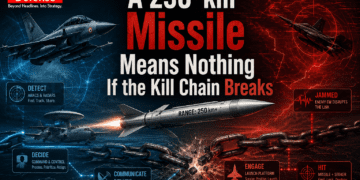
The shooter layer is no longer limited by hardware availability. It is constrained by the quality of targeting data, the speed of decision-making, and the degree of integration with other layers. A missile without real-time targeting is a delayed response. An aircraft without networked support operates below its potential.

The challenge is not building shooters. It is integrating them into a coherent kill chain.

The mobility layer will determine whether India can sustain conflict

Modern warfare is not decided in the opening phase. It is decided by endurance. The mobility layer defines whether a military can sustain operations over time, across multiple fronts, and under continuous pressure.

India has improved its strategic airlift capacity and border infrastructure. However, sustainment remains uneven. Ammunition reserves, repair cycles, logistics coordination, and fuel supply chains continue to present constraints.

In a prolonged conflict scenario, particularly a two-front contingency, these constraints become decisive. A force that cannot sustain its operational tempo will see its initial advantages erode.

The mobility layer is not a supporting function. It is a determinant of strategic outcome.

Communication systems are the nervous system of India’s warfighting architecture

Communication networks connect every layer of the system. They enable sensors to feed data into decision systems and allow commands to translate into coordinated action.

India’s adoption of software-defined radios and modern communication systems is a critical step toward building this network. These systems enable interoperability, flexibility, and secure communication across platforms.

However, their impact depends on scale and standardization. Fragmented communication networks limit joint operations and slow decision cycles. In system-level warfare, communication is not an enabler. It is the architecture itself.

Industrial depth will determine whether modernization sustains or stalls

India’s defence industrial base has expanded, with increased private sector participation and efforts toward self-reliance. Indigenous programs and international collaborations are both contributing to capability development.

Yet critical dependencies remain. Engine technology, advanced electronics, and specialized materials continue to rely on foreign sources. These dependencies introduce strategic vulnerabilities, particularly in prolonged conflict or geopolitical disruption.

The industrial layer determines whether modernization is episodic or sustained. Without depth in critical technologies, even advanced capabilities remain constrained.

India’s military modernization is defined as much by its gaps as its capabilities

A realistic assessment requires identifying structural gaps that shape the limits of India’s military architecture.

Engine dependency remains the most critical technological vulnerability, particularly for next-generation aircraft. ISR fragmentation continues to limit the effectiveness of the sensor layer, reducing decision speed. Jointness delays constrain integration, with theatre command structures still evolving. Industrial bottlenecks affect production scale and technological depth.

These gaps are not temporary inefficiencies. They are structural constraints that define the trajectory of modernization. Addressing them will determine whether India transitions into a fully integrated force.

India’s military system is interdependent, not additive

India’s modernization cannot be understood as a series of independent upgrades. It is an interconnected system where each layer shapes the effectiveness of the others.

Communication networks enable ISR integration. ISR integration enables precision strike. Precision strike influences doctrine. Doctrine drives procurement and industrial priorities.

A weakness in one layer constrains the entire system. Conversely, improvements in integration amplify overall capability. This interdependence is what transforms modernization from accumulation to architecture.

India’s modernization is unfolding across three distinct time horizons

The trajectory of Indian military transformation can be understood across three phases.

The period from 2025 to 2030 represents the integration phase. The focus is on connecting existing capabilities through theatre commands, ISR networks, and communication systems. Success in this phase depends on reducing fragmentation and improving operational coherence.

The period from 2030 to 2035 is likely to see the expansion of autonomous warfare capabilities. AI-driven decision systems, loitering munitions, and electronic warfare integration will play a larger role. The challenge will be balancing technological capability with doctrinal adaptation.

Beyond 2035, India’s military is expected to evolve toward a system-of-systems architecture. In this phase, sensors, decision systems, and shooters operate as a unified network across domains. Human-machine teaming, space integration, and cyber capabilities will define the battlefield.

Each phase depends on the success of the previous one. Delays in integration today will limit the possibilities of tomorrow.

The next battlefield will be shaped by domains India is only beginning to integrate

Electronic warfare, space capabilities, and cyber operations are emerging as critical domains. These domains influence every layer of the system by shaping visibility, communication, and decision-making.

India has initiated efforts in these areas, but integration remains limited. Control of the electromagnetic spectrum, resilience of satellite networks, and cyber defence capabilities will increasingly determine operational outcomes.

These are not future considerations. They are present variables that are not yet fully integrated into India’s military architecture.

India is building a system, but it is not yet a system

Indian military modernization is best understood as a transition in progress. The components of a system-of-systems architecture are visible. The integration required to make them function as a unified force is still evolving.

This creates a dual reality. India is significantly more capable than it was a decade ago, yet its full potential remains constrained by structural gaps and incomplete integration.

The defining question is no longer what India is acquiring. It is how effectively India can connect what it already has.

Frequently Asked Questions (FAQs)

What is Indian military modernization strategy in 2026?

Indian military modernization strategy in 2026 is focused on transitioning from a platform-centric force to a networked, system-of-systems architecture. This involves integrating five core layers: sensors for intelligence and surveillance, decision systems driven by AI-enabled C4ISR, precision strike platforms, logistics and mobility infrastructure, and a domestic industrial base. The objective is to reduce decision latency and enable coordinated operations across land, air, sea, space, and cyber domains.


What are the biggest gaps in India’s military modernization?

Indian military modernization is constrained by four structural gaps. Engine dependency limits autonomy in fighter aircraft programs due to reliance on foreign powerplants. ISR fragmentation prevents seamless data fusion across services, reducing decision speed. Jointness delays, particularly in implementing theatre commands, slow operational integration. Industrial bottlenecks, including limited depth in advanced technologies and production scale, affect long-term sustainability.


Why is integration more important than acquiring new weapons?

Modern warfare depends on how effectively systems are connected rather than how many platforms are deployed. A missile, aircraft, or drone delivers optimal performance only when supported by real-time intelligence and rapid decision-making. Without integration between sensors, decision systems, and shooters, advanced platforms operate below their potential. Integration determines whether capability translates into operational advantage.


What is the role of AI in India’s military modernization?

Artificial intelligence plays a central role in the decision layer of India’s military architecture. It enables faster data processing, predictive analysis, and decision support in complex operational environments. AI is expected to reduce the sensor-to-shooter loop, improve targeting accuracy, and enhance situational awareness. However, its effectiveness depends on integration with existing systems and the development of doctrinal frameworks for its use.


How does India’s military modernization compare to China?

China is currently ahead in system-level integration, particularly in AI-enabled command systems, ISR fusion, and network-centric warfare. India has made significant progress in specific capabilities such as missile systems and maritime surveillance, but its architecture remains more fragmented. India’s challenge is not to match China platform-for-platform but to build a coherent multi-domain system that can impose costs and deny operational advantages.


What is the significance of theatre commands in India’s military reform?

Theatre commands are designed to integrate the Army, Navy, and Air Force under unified operational structures. Their purpose is to enable joint planning, faster decision-making, and coordinated execution across domains. While the concept is central to India’s modernization, implementation has been delayed due to institutional and doctrinal differences among the services.


Why is the logistics and mobility layer critical in modern warfare?

The logistics and mobility layer determines how long a military can sustain operations. It includes airlift capability, ammunition supply, fuel logistics, maintenance, and infrastructure. In prolonged or multi-front conflicts, sustainment becomes more important than initial strike capability. A force that cannot maintain operational tempo will lose effectiveness regardless of its technological advantages.


What role does India’s defence industry play in modernization?

India’s defence industry is central to sustaining modernization over the long term. Indigenous production, private sector participation, and technology development are critical for reducing dependency on imports. However, India still relies on foreign sources for key technologies such as aero-engines and advanced electronics. Strengthening the industrial base is essential for achieving strategic autonomy.


What is meant by “system-of-systems warfare”?

System-of-systems warfare refers to an integrated military architecture where sensors, decision systems, and strike capabilities operate as a unified network across multiple domains. Instead of isolated platforms, every asset becomes part of a connected system that shares data and coordinates actions in real time. This approach increases speed, precision, and overall combat effectiveness.


What are the key phases of India’s military modernization timeline?

Indian military modernization can be divided into three phases. The 2025–2030 period focuses on integration, including theatre commands and ISR connectivity. The 2030–2035 phase introduces greater use of autonomous systems and AI-driven operations. Beyond 2035, the goal is to achieve a fully integrated system-of-systems architecture with multi-domain coordination and human-machine teaming.


Why does engine dependency remain a major strategic concern?

India’s inability to produce high-performance military jet engines domestically creates long-term dependence on foreign suppliers. This affects fighter aircraft programs such as LCA Mk-2 and AMCA. In a conflict scenario or geopolitical crisis, supply restrictions or delays can directly impact operational readiness and modernization timelines.

Tags: Explainer
Previous Post

End of Naxalism in India: Inside the Fall of the Red Corridor

Next Post

Can India Fight Beyond 30 Days? Inside India’s War Sustainment Reality

IndoAsia Defense

IndoAsia Defense

IndoAsia Defense Team is a specialist research and analysis group focused on India’s military modernization and Indo-Pacific strategic dynamics. The platform delivers structured, data-driven insights on doctrine, force posture, defense technology, and regional power balance.

Next Post
Can India Fight Beyond 30 Days? Inside India’s War Sustainment Reality

Can India Fight Beyond 30 Days? Inside India’s War Sustainment Reality

Leave a Reply Cancel reply

Login with your Social ID

Your email address will not be published. Required fields are marked *

Category

  • Air
  • Global
  • Indo-Pacific
  • Industry
  • Joint
  • Land
  • Navy
  • Tech

Defence Capabilities

  • Air Defence
  • Drones
  • Fighters
  • ISR & Mobility
  • China Military
  • Emerging Tech
  • Regional Trends
  • U.S. Posture

Strategy

  • 2035 Outlook
  • China Strategy
  • India Strategy
  • Pakistan Outlook
  • Budget
  • Exports
  • Make in India
  • Supply Chains

Operations

  • Integrated Ops
  • Procurement Reform
  • Theater Commands
  • Armour & Artillery
  • China Front
  • Future Combat
  • Pakistan Front
  • Fleet Expansion

Resources

  • India vs China Military Balance
  • Indo-Pacific Military Power Map
  • Global Military Balance Dashboard
  • Global Weapons Systems Database
  • Global Missile Systems Database
  • Indo-Pacific Defense Timeline
  • India Military Capability Index
  • About
  • Contact
  • Privacy & Policy
  • Editorial Policy
  • Cookie Policy
  • Disclaimer
  • Terms And Conditions
Facebook Linkedin X-twitter
© 2026 IndoAsia Defense. All Rights Reserved.
No Result
View All Result
  • Home
  • Air
    • Air Defence
    • Drones
    • Fighters
    • ISR & Mobility
  • Land
    • Armour & Artillery
    • China Front
    • Future Combat
    • Pakistan Front
  • Navy
    • Fleet Expansion
    • Indian Ocean
    • Maritime Security
    • Submarines
  • Indo-Pacific
    • 2035 Outlook
    • China Strategy
    • India Strategy
    • Pakistan Outlook
  • Joint
    • Integrated Ops
    • Procurement Reform
    • Theater Commands
  • Tech
    • AI & Autonomous Systems
    • Cyber
    • Electronic Warfare
    • Space
  • Industry
    • Budget
    • Exports
    • Make in India
    • Supply Chains
  • Global
    • China-Pak
    • Emerging Tech
    • Regional Trends
    • US-India