





























Ghatak UCAV and India’s Autonomous Strike Ambition: The Real Test Is Integration, Not Stealth
India’s unmanned combat aviation effort has entered a more serious phase of articulation. Recent remarks by Samir V. Kamat have reinforced that the Ghatak UCAV is no longer a distant concept, but a programme taking shape around a stealth-oriented, jet-powered, autonomous strike platform. What matters is not just the configuration being discussed, but what it reveals about India’s broader approach to future air warfare.
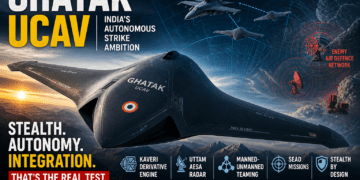
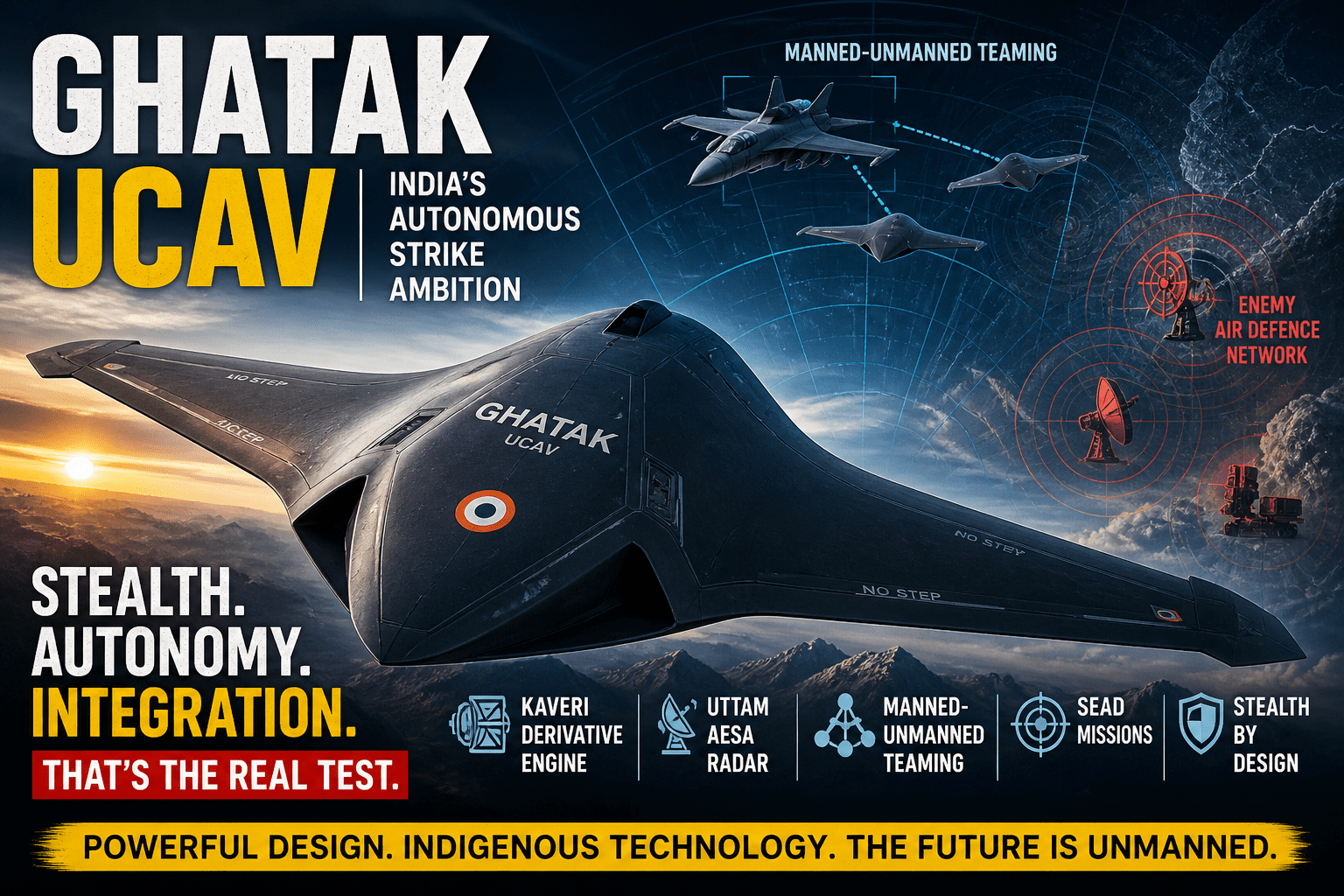
The Ghatak UCAV is increasingly positioned as a medium-weight stealth system built around a flying-wing configuration and powered by a derivative of the Kaveri engine. That combination reflects a deliberate attempt to align platform design with mission intent.
The objective is not speed or air dominance in the conventional sense, but survivable penetration into contested airspace as part of a broader strike architecture. The programme is moving beyond the experimental phase, but the transition from demonstrator to operational system introduces a different class of challenges.
The central question is no longer whether India can build the platform. It is whether it can integrate it into a credible combat system.
The Kaveri Derivative Engine and the Logic of Constraint
At the propulsion layer, the reliance on a derivative of the Kaveri engine reflects both necessity and strategy. The original Kaveri programme, led by the Gas Turbine Research Establishment, was delinked from the HAL Tejas fighter programme after failing to meet thrust and reliability requirements for manned operations.
Redirecting that effort toward an unmanned platform is not a retreat from ambition. It is a pragmatic attempt to extract operational value from a long-running investment.
A non-afterburning turbofan configuration aligns with the Ghatak’s intended mission profile. Subsonic stealth operations prioritise endurance and reduced infrared signature over high-speed performance. In that context, a dry thrust configuration is technically coherent.
It reduces thermal signature and simplifies aspects of engine integration. It also imposes constraints. Thrust margins are tighter, and payload-performance trade-offs become more pronounced in operational planning.
More importantly, propulsion now represents a critical dependency for the programme. Development timelines for the Kaveri Derivative Engine will shape the pace at which the Ghatak transitions from prototype to operational system.
While ongoing testing efforts indicate progress, the maturity of the propulsion system remains one of the key variables that will determine whether the programme can sustain momentum.
This is not unique to India. Propulsion has historically been the pacing element in combat aviation programmes. The difference here is that the entire platform concept is built around an engine lineage that has yet to prove itself in operational service.
Stealth Design Meets the Reality of Contested Airspace
The Ghatak’s flying-wing configuration places it in a category of platforms optimised for low observability. The absence of vertical stabilisers reduces radar reflection surfaces, while internal weapons carriage preserves the aircraft’s signature profile during strike missions.
These are established design principles in stealth aviation. Their adoption in an indigenous unmanned system is a meaningful step forward for India’s aerospace ecosystem.
But survivability in contested airspace is not defined by radar cross-section alone. The Ghatak is expected to operate in environments shaped by layered air defence networks, potentially including systems comparable to the S-400 and Chinese long-range surface-to-air missile architectures.
In such environments, detection is only one part of the survivability equation. The ability to operate without exposing one’s own position through emissions becomes equally critical.
This is where the discussion shifts from platform design to system integration. Sensors, data-links, and onboard processing define whether a stealth aircraft can function effectively without becoming electronically visible. Indigenous developments such as the Uttam AESA radar suggest that India is building the necessary sensor base. But the integration of those systems into an autonomous platform introduces a different level of complexity.
A UCAV operating without a pilot must process, prioritise, and act on data in real time, often under degraded communication conditions. The question is not whether the aircraft can avoid detection. It is whether it can make decisions when the network that supports it begins to fail.
Manned-Unmanned Teaming and the Friction of Coordination
The doctrinal framework emerging around the Ghatak UCAV aligns with global trends toward manned-unmanned teaming. In this model, unmanned systems operate as forward elements, absorbing risk while manned platforms remain outside the most heavily defended zones. The logic is straightforward. It preserves pilot survivability while extending the reach of strike missions.
India is expected to pursue a similar construct, with future fighters such as those under development by the Aeronautical Development Agency acting as command nodes for unmanned assets. But doctrine is only as strong as the systems that enable it. Secure, resilient communication links are the backbone of any MUM-T architecture. In a contested electromagnetic environment, those links are among the first targets of adversary disruption.
This is not a problem unique to India. Even advanced programmes such as the Collaborative Combat Aircraft effort have encountered challenges in defining autonomy boundaries and maintaining control under degraded conditions.
The implication is clear. The Ghatak programme cannot assume that connectivity will be reliable in combat. It must define how the platform behaves when connectivity is lost. That definition is not purely technical. It sits at the intersection of doctrine, rules of engagement, and system design.
Industrial Capacity and the Question of Scale
Beyond propulsion and autonomy, the industrial dimension of the Ghatak programme introduces another layer of complexity. Building a stealth UCAV is not simply a matter of assembling components. It requires manufacturing precision, material science maturity, and quality control processes that are still evolving within India’s aerospace sector.
The involvement of private industry alongside DRDO laboratories reflects an attempt to distribute capability development across a broader base. This is a necessary shift. Complex aerospace programmes cannot be sustained by a single institutional actor.
At the same time, distributed development introduces interface challenges. Each subsystem must integrate seamlessly with others. In practice, this is where many programmes encounter delays.
Stealth manufacturing imposes tight tolerances. Autonomous systems require extensive validation. Sustainment infrastructure must be built alongside production capability. These are not incremental challenges. They represent a transition from prototype development to industrial-scale execution.
India’s experience with previous programmes suggests that this transition is often where timelines stretch and costs escalate. The Ghatak programme will need to address these issues early if it is to avoid repeating that pattern.
Autonomy, Survivability, and the Decision Layer Problem
The most underexamined dimension of the Ghatak UCAV is not its airframe or its engine. It is its decision layer. Autonomous combat systems must function in environments where communication is degraded, navigation signals may be contested, and adversary electronic warfare actively targets networked systems.
In such conditions, the platform must be able to operate with a degree of independence. That independence is governed by algorithms, rules of engagement, and onboard processing capability. It determines whether the aircraft continues its mission, aborts, or adapts to changing conditions. The design of this decision layer is as critical as any physical component of the platform.
China’s investments in electronic warfare and integrated air defence, particularly in regions of direct strategic relevance to India, are specifically oriented toward disrupting network-dependent systems. A UCAV that relies excessively on external control risks becoming ineffective in precisely the environments it is intended to operate in.
This is not an argument against the Ghatak programme. It is an argument for prioritising autonomy architecture as a core element of development, rather than a secondary feature.
The Question That Will Define the Programme
The Ghatak UCAV represents a meaningful step in India’s effort to build an indigenous, networked, stealth-capable strike architecture. The platform design is coherent. The propulsion strategy, while constrained, is logical. The doctrinal direction aligns with global trends in air warfare.
What remains unresolved is whether the systems that enable the platform to operate in a contested environment will mature at the same pace as the platform itself. Platform readiness and system readiness are not the same. One can be demonstrated in testing. The other is proven only in operational conditions.
The Ghatak programme will ultimately be judged not by whether it flies, but by whether it can function as part of a larger combat system under conditions where that system is under stress. That is the integration challenge at the heart of the programme. And it is the one challenge that cannot be deferred.
FAQs (Frequently Asked Questions)
What has been confirmed about the Ghatak UCAV’s design?
The Ghatak UCAV is expected to be a stealth-oriented unmanned combat aircraft built around a flying-wing configuration. It is designed for autonomous strike missions in contested environments, with a focus on low observability, internal weapons carriage, and survivability against modern air defence systems.
Why is the Kaveri derivative engine significant?
The Kaveri derivative represents an effort to operationalise an indigenous engine programme within a mission profile where its limitations are more manageable. In a non-afterburning configuration, it supports endurance-focused missions and reduced infrared signature, aligning with the UCAV’s role in stealth penetration rather than high-speed interception.
Why was the Kaveri engine not used in the Tejas fighter?
The Kaveri engine, developed by the Gas Turbine Research Establishment, was delinked from the HAL Tejas programme after it did not meet the thrust and reliability benchmarks required for manned fighter operations. However, its core architecture remains usable for unmanned systems where performance demands differ.
What role will the Ghatak play in combat operations?
The platform is expected to function as a forward strike asset within a manned-unmanned teaming framework. Its primary mission set would include suppression and destruction of enemy air defences, enabling manned aircraft to operate with reduced risk in contested environments.
What is manned-unmanned teaming and why does it matter?
Manned-unmanned teaming refers to the integration of piloted aircraft with autonomous or remotely operated systems. In this model, manned platforms act as command nodes while unmanned systems execute high-risk missions. This approach extends operational reach while reducing pilot exposure in heavily defended airspace.
How does stealth help the Ghatak UCAV survive in combat?
Stealth reduces the aircraft’s radar visibility, making detection and tracking more difficult for enemy air defence systems. The flying-wing design, internal weapons bays, and radar-absorbent materials all contribute to lowering its radar cross-section. However, stealth alone is not sufficient without strong electronic warfare resilience and data discipline.
Can the Ghatak operate without communication links?
This is one of the central challenges facing the programme. In a contested environment, communication links may be jammed or degraded. The Ghatak will need a robust onboard decision-making architecture to continue, adapt, or abort missions autonomously when connectivity is lost.
What is the “decision layer” in an autonomous UCAV?
The decision layer refers to the onboard systems that determine how the aircraft behaves during a mission. This includes target selection logic, threat response, navigation under degraded conditions, and rules of engagement. It is a combination of software, algorithms, and doctrinal constraints.
How does the Ghatak compare to global UCAV programmes?
Globally, similar efforts are underway, including the Collaborative Combat Aircraft initiative in the United States. While each programme differs in scale and maturity, all face similar challenges around autonomy, communication resilience, and integration with manned platforms.
What are the biggest technical challenges in the Ghatak programme?
The key challenges include propulsion maturity, stealth manufacturing precision, secure data-link development, and autonomous decision-making under contested conditions. Among these, systems integration—ensuring all components function together seamlessly—is likely to be the most complex.
Is India capable of producing stealth UCAVs at scale?
India is building the industrial capacity required for such programmes, with both public and private sector participation. However, scaling from prototype development to sustained production involves significant challenges in manufacturing precision, supply chain stability, and quality assurance.
How does Ghatak fit into India’s broader airpower strategy?
The Ghatak UCAV is part of a broader shift toward networked, multi-layered airpower. It complements manned platforms by extending strike reach, absorbing risk, and enabling operations in high-threat environments where conventional aircraft would face greater vulnerability.
What is the expected timeline for Ghatak induction?
While no official induction date has been confirmed, realistic assessments suggest that operational deployment would occur in the early 2030s, depending on progress in propulsion, autonomy, and systems integration.
Why is autonomy more important than stealth in modern UCAVs?
Stealth helps the aircraft avoid detection, but autonomy determines how it behaves once inside contested airspace. In environments where communication is unreliable, a UCAV must rely on onboard intelligence to complete its mission. Without this capability, even a stealth platform may fail to achieve its objectives.
What makes the Ghatak programme strategically important for India?
The programme represents a shift toward indigenous development of advanced combat systems, including stealth, autonomy, and networked warfare capabilities. It is not just about building a platform, but about developing the technological and doctrinal foundations for future warfare.

