











The doctrine India never formally announced
India rarely announces doctrinal shifts in dramatic language. Strategic change in New Delhi tends to unfold quietly, through incremental decisions that only reveal their full meaning over time.
Yet when viewed collectively, India’s recent diplomatic, military, and technological partnerships suggest something deeper than routine hedging.
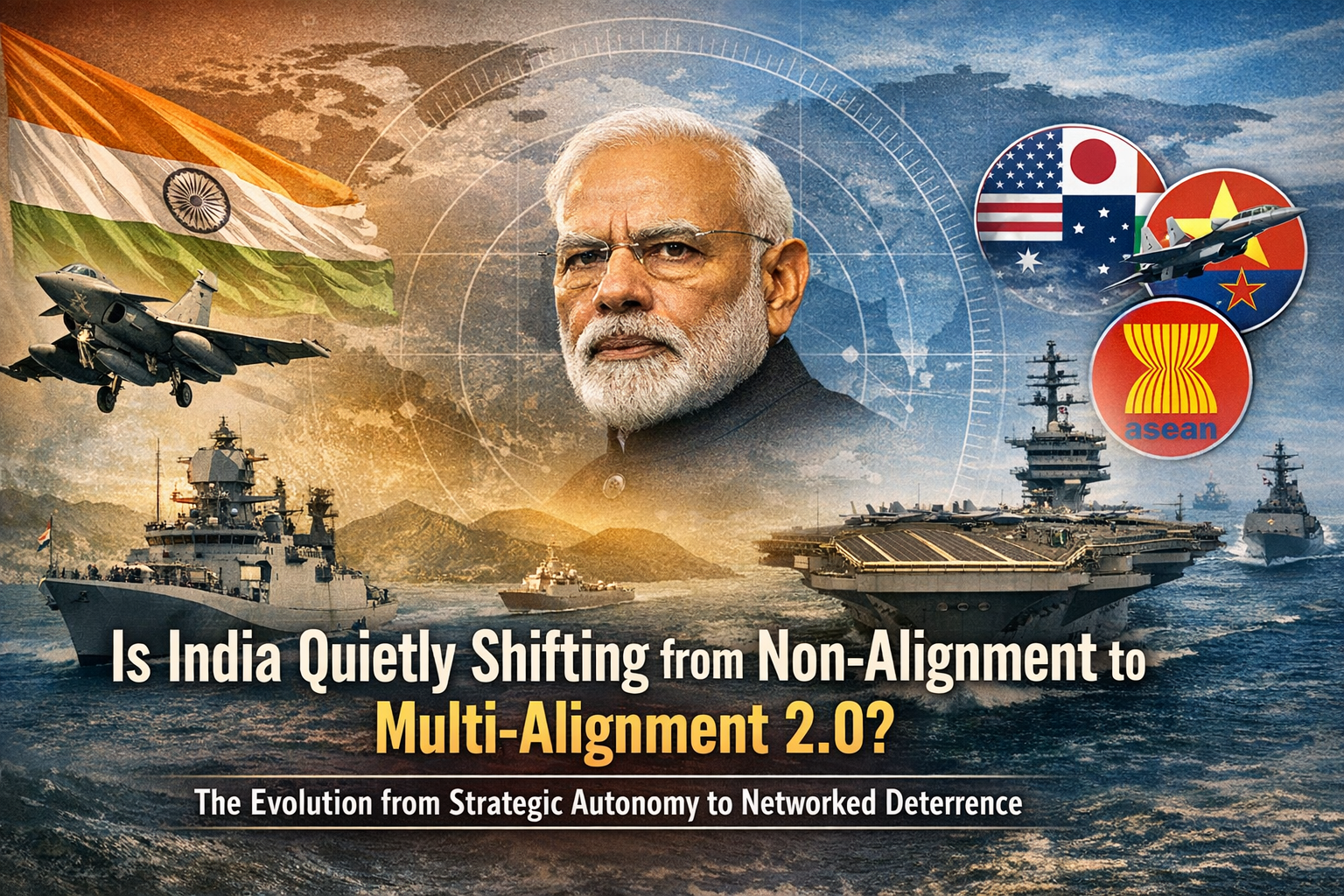
The country appears to be moving beyond the traditional idea of strategic autonomy toward a more complex framework that might be described as Multi-Alignment 2.0.
This is not a rejection of autonomy. Rather, it is a reinterpretation of how autonomy functions in a world where power increasingly flows through networks.
The Cold War logic of Non-Alignment assumed that distance from power blocs protected independence. The emerging Indo-Pacific system works differently.
Influence now emerges through logistics agreements, defence industrial ecosystems, intelligence cooperation, and maritime coordination networks.
India seems to be adapting to this reality by embedding itself inside multiple strategic systems simultaneously. The objective is simple but ambitious. Maintain independence while expanding deterrence through connectivity.
Non-alignment was never pure neutrality
India’s foreign policy has always been more flexible than the label of Non-Alignment suggests.
During the Cold War, New Delhi maintained close defence ties with the Soviet Union while continuing diplomatic engagement with Western countries and developing nations.
Soviet military technology formed the backbone of India’s armed forces, yet India avoided formal alliance commitments.
Non-Alignment was therefore less about neutrality and more about strategic maneuver.
That instinct remains deeply embedded in Indian strategic culture. However, the geopolitical environment surrounding India has transformed dramatically since the end of the Cold War.
China’s military rise has altered Asia’s balance of power. Maritime competition now stretches across the Indo-Pacific. Technology supply chains have become instruments of geopolitical influence.
Under these conditions, the traditional model of strategic autonomy faces new constraints.
A country that remains entirely outside major security networks risks strategic isolation. Conversely, a country locked into rigid alliances sacrifices diplomatic flexibility.
India’s emerging answer appears to be multi-alignment.
The architecture of multi-alignment
The architecture of this new approach is already visible across several overlapping layers of cooperation.
India participates in the Quad alongside the United States, Japan, and Australia. The grouping focuses on maritime security, technology coordination, and regional infrastructure resilience.
India has signed logistics exchange agreements with multiple partners including the United States, France, Australia, Japan, and Singapore. These arrangements allow reciprocal access to military bases for refueling, maintenance, and operational support.
Naval exercises with Indo-Pacific partners have expanded in scale and complexity. The Malabar exercises now include advanced anti-submarine warfare operations and carrier coordination.
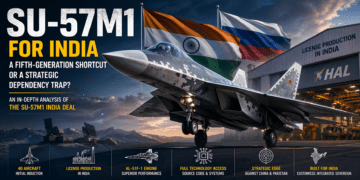
At the same time, India continues to maintain significant defence ties with Russia. Russian platforms remain central to several segments of India’s military inventory.
Meanwhile, India is deepening defence industrial cooperation with Europe, Israel, and several Asian countries.
Each of these partnerships appears pragmatic when viewed individually. But collectively they reveal a structural shift.
India is gradually weaving itself into multiple strategic networks that expand its operational reach without binding it to a single alliance system.
Strategic autonomy is becoming strategic interdependence
One of the most interesting aspects of this transformation is the evolving meaning of autonomy itself.
True independence in modern warfare increasingly depends on participation in technological ecosystems that no single country can fully control.
Advanced military capabilities rely on semiconductor supply chains, satellite networks, artificial intelligence systems, cyber infrastructure, and complex electronics manufacturing.
Even major powers depend on international networks to sustain these capabilities.
India therefore faces a paradox. Absolute technological independence is unrealistic. But dependence on a single partner would create strategic vulnerability.
Multi-alignment offers a solution.
By participating in multiple technological and defence ecosystems simultaneously, India can reduce reliance on any one partner while still accessing critical capabilities.
Autonomy in this context becomes the ability to navigate between networks rather than standing outside them.
Maritime power is the real driver
Although India’s security concerns are often framed through the lens of its contested border with China, the most visible manifestation of multi-alignment is actually maritime.
The Indian Ocean is becoming a central arena of strategic competition.
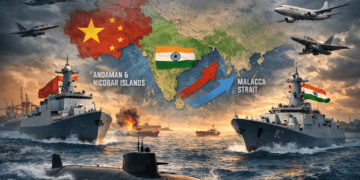
China’s expanding naval presence in the region has altered the maritime balance. Chinese submarines and research vessels now operate more frequently in Indian Ocean waters. Infrastructure projects linked to the Belt and Road Initiative have extended China’s logistical footprint across several coastal states.
India’s response has been gradual but deliberate.
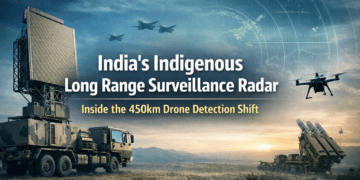
Naval deployments across the Indian Ocean have increased. Maritime domain awareness initiatives now connect India with several regional partners. Surveillance data sharing arrangements have expanded across the Indo-Pacific.
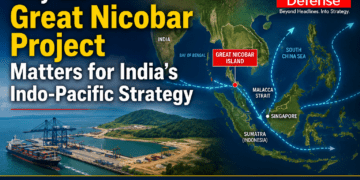
India is also strengthening its island infrastructure and forward operating capabilities, particularly through the Andaman and Nicobar Command.
These developments suggest that India increasingly sees itself not only as a continental power but also as the primary stabilizing force in the Indian Ocean maritime system.
Multi-alignment enhances this maritime role by connecting India to broader surveillance and logistics networks.
Defence industrial diplomacy
Another underappreciated dimension of India’s strategy lies in defence industrial cooperation.
For decades, India relied heavily on a single defence supplier. That experience created vulnerabilities in supply chains, maintenance infrastructure, and technological access.
Today, India is pursuing a far more diversified approach.
The United States has become an important partner in areas such as aerospace technology, drones, and advanced engines.
France plays a central role in naval aviation and submarine development.
Israel provides advanced electronics, sensors, and unmanned systems.
Russia continues to support legacy platforms and strategic systems.
European partners are expanding collaboration in aerospace and defence electronics.
This diversified procurement ecosystem reflects the same strategic logic that underpins India’s diplomacy.
Multi-alignment in geopolitics is mirrored by multi-sourcing in defence industry.
Both reduce dependency while preserving flexibility.
China as the structural catalyst
China’s rapid military modernization remains the most significant external driver behind India’s evolving strategy.
The People’s Liberation Army Navy has expanded at a remarkable pace. Chinese military infrastructure across the South China Sea continues to grow. Beijing’s economic influence has also extended across much of Asia and the Indian Ocean region.
India cannot match China’s military expansion in the short term.
However, India can offset Chinese power by embedding itself within broader regional security networks.
Multi-alignment therefore serves as a form of distributed balancing.
Instead of confronting China alone, India becomes part of a wider web of strategic relationships that complicates Beijing’s strategic calculations.
The technology bloc challenge
One of the most difficult challenges for India’s multi-alignment strategy will emerge in the technology domain.
Global technological ecosystems are increasingly fragmenting into competing blocs.
The United States and its partners dominate advanced semiconductor design, aerospace technologies, and several digital standards.
China has developed alternative digital infrastructure ecosystems and industrial supply chains.
Europe is shaping regulatory frameworks in areas such as data governance and artificial intelligence.
India must interact with all of these ecosystems without becoming fully dependent on any single one.
Maintaining this balance will require careful management of technology partnerships, export controls, and industrial policy.
How India navigates this landscape may determine whether multi-alignment remains sustainable over the long term.
Indo-Pacific ripple effects
India’s evolving posture is already reshaping regional perceptions.
Many smaller Indo-Pacific states now see India as a stabilizing maritime actor rather than simply a South Asian power focused on continental security.
India’s naval presence across the Indian Ocean has expanded steadily through patrol missions, humanitarian operations, and maritime security initiatives.
For countries concerned about supply chain vulnerabilities or maritime coercion, India offers a partner that is neither a formal ally of the United States nor aligned with China’s geopolitical vision.
This ambiguous positioning actually enhances India’s diplomatic appeal.
India can cooperate with Western security initiatives while retaining credibility across much of the Global South.
Crisis scenarios
Understanding how multi-alignment might function in practice requires examining potential crisis scenarios.
A South China Sea confrontation could see India providing maritime surveillance data and logistical support to regional partners while avoiding direct military involvement.
A Taiwan Strait crisis might lead India to focus on securing Indian Ocean sea lanes while intensifying intelligence cooperation with Indo-Pacific partners.
In a conflict affecting the Indian Ocean itself, India would likely emerge as the central naval power responsible for maintaining maritime stability.
These scenarios illustrate how multi-alignment allows India to contribute to regional security without becoming entangled in rigid alliance commitments.
The contradictions ahead
Despite its advantages, the multi-alignment model contains inherent tensions.
Major powers increasingly expect strategic clarity from partners. As geopolitical competition intensifies, pressure on India to align more explicitly with particular blocs may increase.
Technology ecosystems could also become more compartmentalized, complicating India’s ability to operate across multiple networks.
Finally, the credibility of multi-alignment ultimately depends on India’s own national capabilities.
Networks amplify power, but they cannot substitute for it.
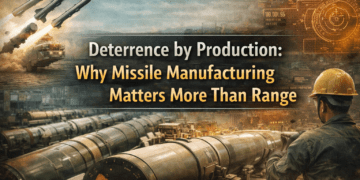
India’s naval expansion, defence industrial development, missile capabilities, and technological innovation will therefore remain central to sustaining this strategy.
The deeper strategic insight
The most significant shift may lie in how India conceptualizes power itself.
In the era of classical Non-Alignment, independence meant distance from competing blocs.
In the emerging Indo-Pacific system, independence may instead mean the ability to connect with multiple networks without becoming captive to any of them.
India appears to be building precisely that capability.
If successful, this approach could redefine how large middle powers navigate a fragmented global order.
Rather than balancing between rival blocs, India would function as a strategic connector that links multiple systems together.
In that sense, India may not simply be adapting to the new Indo-Pacific order.
It may be helping to define how that order will actually work.

