











TEDBF and the Industrial Crossroads: Why the Indian Navy’s PPP Push Is Bigger Than One Fighter
The real debate around the Twin Engine Deck Based Fighter (TEDBF) is no longer aerodynamic. It is architectural.
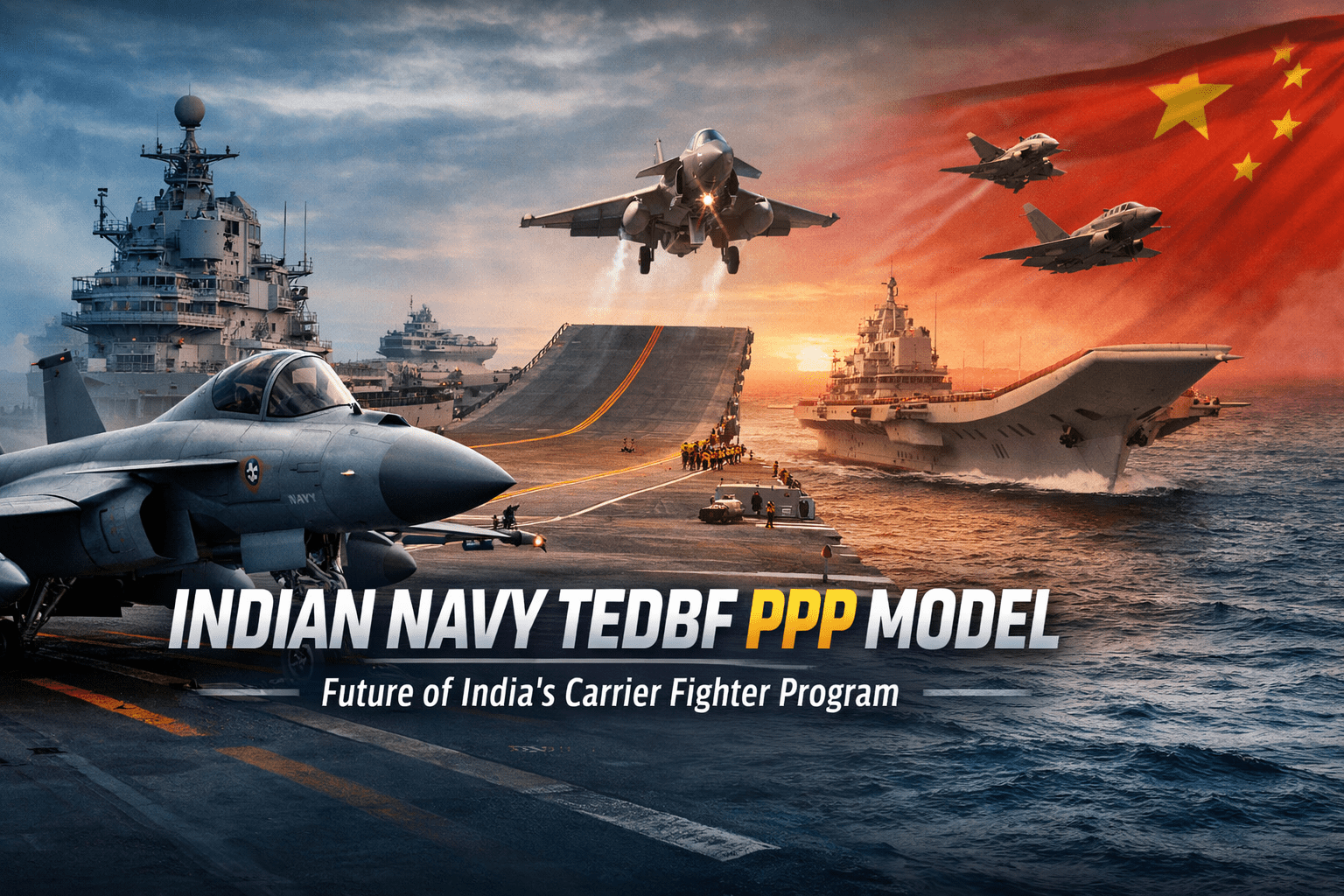
On paper, TEDBF is straightforward: a twin-engine, carrier-capable fighter designed to operate from INS Vikramaditya and INS Vikrant, replacing the MiG-29K fleet through the 2030s. In practice, it represents a much larger question — how India intends to structure high-end defence manufacturing in an era of maritime competition.
Because by the time Indian Navy TEDBF is operational, the Indian Ocean will not resemble today’s operating environment.
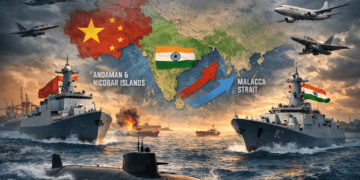
China’s naval expansion is not speculative anymore. The People’s Liberation Army Navy already operates multiple carriers and is progressing toward more advanced launch systems and air wings. Its deployments into the Indian Ocean Region are increasingly routine. That means Indian carrier aviation cannot afford extended uncertainty. Replacement cycles must align with strategic pacing, not bureaucratic convenience.
And this is where the PPP discussion enters.
The Capacity Constraint No One Can Ignore
Hindustan Aeronautics Limited remains the backbone of India’s aerospace sector. It is also managing simultaneous commitments: Tejas Mk1A ramp-up, Mk2 development, Sukhoi upgrades, helicopter programmes, and early work linked to AMCA.
Carrier fighters are not incremental derivatives. They require structural reinforcement, navalised avionics protection, deck-handling geometry, folding wing integration, and intensive testing for arrested landings. That development pipeline competes for engineering bandwidth.
The Navy’s interest in a Public-Private Partnership model is therefore less about ideology and more about concurrency risk. If production bottlenecks delay induction beyond the early-to-mid 2030s, operational hedging becomes permanent.
India has already moved to induct Rafale-M as a bridging capability. That decision provides continuity — but it also sets a clock. If TEDBF slips too far right, import dependence becomes entrenched.
PPP Is Not Outsourcing — It Is Structural Reform
The superficial reading of the debate frames PPP as “private sector assembly.” That misses the deeper point.
A mature PPP model would divide responsibilities across design authority, systems integration, airframe fabrication, and lifecycle sustainment. The Aeronautical Development Agency would retain sovereign design control. Naval Air Staff Requirements would remain binding. But manufacturing scale and supply chain management could shift toward a consortium structure.
India’s private aerospace firms are no longer peripheral vendors. They produce complex aerostructures for global primes. They manage precision composites. They operate advanced machining ecosystems. The technical floor has risen.
The real test is governance clarity. Who owns configuration control? Who manages certification risk? Who absorbs cost overruns? Without disciplined programme architecture, PPP becomes fragmentation. With it, PPP becomes force multiplication.
And that distinction will determine whether TEDBF accelerates or stalls.
The China Factor Changes the Risk Calculation
Between 2030 and 2040, China’s carrier doctrine will mature significantly. The PLAN is moving toward higher sortie generation, integrated air defence coverage, and extended-range strike profiles. If Beijing sustains iterative fighter development cycles while India struggles with industrial throughput, asymmetry compounds.
Carrier aviation is not static capability. It is iterative capability.
If China can field successive naval fighter improvements every decade while India takes two decades per generation, the strategic gap widens even if initial parity exists.
That is why the TEDBF timeline is strategic — not just technical.
2030–2040 Outlook: What Success or Delay Would Mean
The 2030s will reveal whether India consolidated indigenous carrier doctrine or deferred it.
– If TEDBF flies by the early 2030s
An early-2030s first flight followed by mid-decade induction would stabilise India’s naval aviation ecosystem. Carrier strike groups would operate aircraft designed for India’s maritime theatre, with upgrade cycles controlled domestically. Weapons integration would be politically unconstrained.
More importantly, India would signal industrial credibility in a domain mastered by only a handful of countries. That credibility affects deterrence perception.
– If delayed beyond 2035
A slip into the late 2030s changes the structural outcome. Additional imported fighters become rational. Logistics deepen. Training ecosystems adapt permanently.
Operational capability remains intact — but sovereignty narrows. Upgrades depend on external negotiations. Crisis-era supply chain vulnerability increases. Indigenous carrier doctrine is postponed into the 2040s, precisely when China’s expeditionary reach may be most mature.
In long-term competition, delay compounds.
– If the PPP model succeeds
Success would validate a hybrid aerospace model for India — sovereign design authority paired with distributed industrial execution. That template could directly inform AMCA production structuring.
It would also signal to global partners that India can manage complex combat aviation programmes without over-centralisation. Industrial agility becomes strategic capital.
In a prolonged maritime rivalry, production speed is deterrence.
– If the PPP model fails
Failure would likely trigger reversion to a fully state-dominant model. Authority would consolidate, but scalability may suffer. Future programmes would become more cautious.
The risk is not embarrassment. The risk is pacing asymmetry. If China iterates faster than India, strategic friction tilts over time.
The Unresolved Engine Variable
No discussion of TEDBF is complete without propulsion realism.
If the programme relies on foreign engines deep into its lifecycle, sovereignty remains partial. Engine co-development, indigenous turbine metallurgy, and long-term propulsion autonomy will determine whether TEDBF is fully strategic or partially dependent.
PPP cannot compensate for propulsion vulnerability.
The Decision Ahead
The Indian Navy is not merely selecting an industrial partner. It is choosing a manufacturing philosophy for the 2030s and 2040s.
Does India concentrate high-end aerospace exclusively within public sector walls?
Or does it construct a hybrid model capable of scaling under competitive pressure?
TEDBF is the first real stress test of that choice in the carrier aviation domain.
Because by the time the aircraft is deck-ready, the Indian Ocean will be more crowded, more contested, and less forgiving of delay.
And in that environment, industrial structure is strategy.

