














The F414 engine co-production deal between Hindustan Aeronautics Limited and GE Aerospace, finalised in April 2026, is the most consequential propulsion agreement India has ever secured. That claim is easy to make. The harder question is what this deal actually delivers, on what timeline, and what constraints remain embedded within it. That is where most analysis stops short.
India is not buying engines. It is buying time. The F414 engine co-production deal must be understood as a structured attempt to convert external dependence into internal capability over a defined industrial cycle. It does not resolve India’s propulsion challenge overnight. It creates the first credible pathway to solving it.
India’s Propulsion Dependency Was Structural. The F414 Engine Co-Production Deal Begins to Unwind It.
For decades, Indian airpower has operated on propulsion systems it did not control. Russian-origin engines, French-linked manufacturing arrangements, and American imports created a layered dependency that remained manageable in peacetime but fragile under stress. The disruption of Russian supply chains after 2022 exposed that fragility with unusual clarity. Maintenance cycles slowed, spare availability tightened, and operational flexibility narrowed.
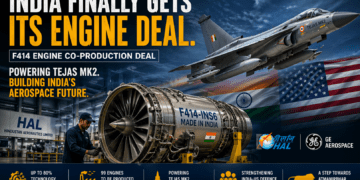
The F414 engine co-production deal is India’s pre-emptive response to that vulnerability. It covers the F414-INS6 turbofan, producing roughly 98 kilonewtons of thrust, and commits to the domestic manufacture of 99 engines with up to 80 percent technology transfer. This threshold was not incidental. The Ministry of Defence held it as a baseline requirement, rejecting assembly-only models that offer optics without capability. What India demanded was manufacturing depth, not symbolic localisation.
The progression matters. A 2012 framework transferred roughly 58 percent technology under a limited development understanding. The current F414 engine co-production deal expands that to 80 percent and attaches it to a real production pipeline. That shift is not incremental. It moves India from a participant in supply chains to a contributor within them. The first domestically manufactured engine is expected around 2029, with facility development already underway near Bengaluru.
Manufacturing Power Without Design Control: The Illusion of Full Sovereignty
Criticism that the F414 engine co-production deal does not deliver full engine autonomy is correct but incomplete. No country receives unrestricted access to core propulsion design technologies. Critical domains such as turbine blade geometry, high-pressure compressor aerodynamics, and advanced coatings remain tightly controlled across the global aeroengine industry.
What the deal provides instead is manufacturing sovereignty. This includes high-precision casting, machining, and coating processes that define production capability. These are not peripheral competencies. They are the foundation upon which any future indigenous engine programme must be built. India’s earlier struggles with the Kaveri engine were not simply about funding or design. They reflected a deeper absence of production maturity.
The strategic mistake is to treat manufacturing and design sovereignty as parallel goals. They are sequential. Without mastering production tolerances, quality control, and lifecycle engineering, design independence remains theoretical. The F414 engine co-production deal establishes the industrial base required for that transition. It is not the endpoint. It is the apprenticeship.
Tejas Mk2 Has a Timing Problem. The Engine Deal Does Not Fully Fix It.
The HAL Tejas Mk2 sits at the centre of this agreement, but its timeline introduces friction that cannot be ignored. Prototype flights begin with engines already delivered, while domestic production ramps up toward 2029. Series production is expected in the early 2030s, creating a narrow overlap between demand and local supply.
This gap will be bridged through direct imports from GE, which is operationally viable but strategically revealing. The F414 engine co-production deal reduces dependency. It does not eliminate it within the first production cycle. That transition takes time, and the Tejas Mk2 timeline sits uncomfortably close to that transition window.
The Indian Air Force’s squadron strength amplifies the pressure. With numbers falling below sanctioned levels, the need for rapid induction is real. The Mk2, powered by the F414, offers a meaningful upgrade in thrust, payload, and range compared to earlier variants. It is designed to operate credibly against aircraft such as the J-10C and JF-17 Block III. However, capability that arrives late still carries opportunity cost. The issue is not whether the Mk2 is capable. It is whether it arrives at the right moment.
HAL’s Industrial Burden: The Constraint No One Wants to Address
The F414 engine co-production deal assumes an industrial execution environment that India has historically struggled to sustain. Hindustan Aeronautics Limited is simultaneously managing multiple high-demand programmes, from Tejas variants to helicopter platforms and future combat systems. Adding engine manufacturing to that portfolio introduces a level of concurrency that stretches organisational capacity.
Jet engine production is not an incremental addition. It requires specialised workforce training, high-end tooling, certification ecosystems, and rigorous quality control processes. These demands compete directly with existing programmes for talent and capital. The risk is not failure. The risk is delay and dilution of focus.
The F414 engine co-production deal solves the technology access problem. It does not automatically solve the execution problem. That depends on programme discipline, industrial scaling, and sustained investment. Without those, the transfer of technology risks outpacing the ability to absorb it.
ITAR Reality: India Builds the Engine, But Not the Market
One of the most consequential constraints in the F414 engine co-production deal sits outside India. The International Traffic in Arms Regulations framework ensures that the United States retains control over where these engines, and aircraft powered by them, can be exported.
This introduces a structural limitation on India’s defence export ambitions. The Tejas Mk2 cannot be freely marketed without US approval. This is not theoretical. The United States has previously blocked exports involving the same engine family in order to protect its own defence market interests. India now operates within that same framework.
However, the deal creates a countervailing dynamic. GE Aerospace now has a direct commercial stake in HAL’s success. This alignment creates incentives within the US defence industrial ecosystem to support Indian export ambitions where possible. Over time, this could evolve into a negotiation space where India leverages industrial interdependence to expand export flexibility. It is not guaranteed. But it is a lever India did not previously possess.
Indo-Pacific Industrial Architecture: India Enters the Network
The F414 engine co-production deal must be placed within a wider Indo-Pacific pattern. The United States is increasingly distributing defence production capacity across partner nations. Japan, South Korea, and Australia are all expanding their industrial roles within this framework. India’s entry into this network reflects a strategic calculation that industrial depth among partners strengthens collective deterrence.
For India, this integration offers both opportunity and constraint. It accelerates capability development and embeds India within a broader security architecture. At the same time, it introduces dependencies tied to alignment with US export controls and industrial standards.
For China, the implications are incremental but meaningful. An Indian Air Force that can sustain its fleet through domestic production reduces one layer of vulnerability that has historically limited its operational credibility. It does not change the balance overnight. It changes how that balance evolves over time.
The AMCA Question: Can This Momentum Be Sustained?
The Advanced Medium Combat Aircraft programme represents the next stage of India’s propulsion ambition. The initial variants are expected to use the F414 engine, with a transition to a domestically developed engine around 2035. That timeline is ambitious and carries inherent risk.
Without the industrial base created by the F414 engine co-production deal, that timeline would likely extend significantly further. Engine development is not simply a design challenge. It is an industrial one. The ability to manufacture, test, and refine components at scale determines whether design concepts translate into operational systems.
The F414 programme provides that industrial foundation. It does not guarantee success for future engines. It reduces the uncertainty that has historically defined India’s propulsion efforts.
India Crossed a Threshold. What Happens Next Will Define the Outcome.
The F414 engine co-production deal represents a rare moment where negotiation discipline, industrial planning, and strategic alignment have converged. It gives India manufacturing depth, supports the Tejas Mk2, and creates a pathway toward future engine development.
But it also leaves critical questions unresolved. Export constraints remain. Industrial execution risks persist. Future engine timelines are ambitious. None of these undermine the deal. They define its context.
The F414 engine co-production deal does not make India self-reliant. It makes self-reliance possible. Whether that possibility is realised will depend not on the agreement itself, but on how India builds on it over the next decade.
——————————————————————–
FAQs
What is the F414 engine co-production deal between India and GE Aerospace?
The F414 engine co-production deal is a defence manufacturing agreement where Hindustan Aeronautics Limited will produce 99 F414-INS6 jet engines in India. GE Aerospace transfers up to 80 percent of the manufacturing technology required for production. The deal supports the Tejas Mk2 programme and future aircraft development.
Does the F414 engine co-production deal give India full engine independence?
No. The agreement provides manufacturing capability but not complete design control. Critical technologies related to core engine architecture remain with GE. However, the deal significantly strengthens India’s ability to produce and maintain advanced engines domestically.
How does this deal impact the Tejas Mk2 fighter programme?
The Tejas Mk2 depends on the F414 engine for improved thrust and performance. Local production ensures more reliable supply and supports long-term maintenance. It also reduces vulnerability to external supply disruptions.
Can India export Tejas Mk2 freely under this deal?
No. The engines fall under US export control regulations, meaning India requires US approval for exports. This creates a constraint on defence exports but also opens room for negotiation through industrial partnerships.
Why is jet engine technology so difficult to develop?
Jet engines require extreme precision, advanced materials, and complex aerodynamic design. Small inefficiencies can impact performance and safety. This makes engine development one of the most challenging areas in aerospace engineering.
How does this deal affect India’s long-term defence strategy?
The deal strengthens India’s industrial base and reduces dependency on external suppliers. It also supports future programmes like AMCA. Over time, it contributes to a more self-sustaining defence ecosystem.

