








IndoAsia Defense
  • Home
  • Air
    • All
    • Air Defence
    • Drones
    • Fighters
    • ISR & Mobility
    Ghatak UCAV stealth, autonomy, integration

    Inside India’s Ghatak UCAV Program: Stealth, Autonomy, and the Integration Gap

    The F414 engine co-production agreement between Hindustan Aeronautics Limited and GE Aerospace

    India-US F414 Engine Deal Explained: Technology Transfer, Tejas Mk2, and AMCA

    What is the Su-57M1 India deal

    Su-57M1 for India: A Fifth-Generation Shortcut or a Strategic Dependency Trap?

    India indigenous long range surveillance radar with X-band drone detection capability

    450km Eyes, Machine-Speed Decisions: How India’s Indigenous Long Range Surveillance Radar Is Rewriting Air Defence

    Why Software Defined Radios Are the IAF’s Most Consequential Upgrade

    IAF Signs BEL Deal for Software Defined Radios: Rewiring India’s Air Combat Network

    How the Ghatak UCAV Stealth Design Redefines India’s Drone Warfare Doctrine

    Ghatak UCAV: India’s Carbon Composite Stealth Strategy Dissected

    Ballistic Missile Defense system intercepting incoming missile during midcourse phase

    How Ballistic Missile Defense Works: Inside Modern Missile Interception Systems

    Swarm logistics drones delivering military supplies in high-altitude Himalayan terrain with Indian Army presence

    Swarm Logistics Drones in Himalayan Warfare: Can India Close the Supply Gap with China?

    India’s 6th-Gen Fighter Strategy FCAS vs GCAP Explained

    India’s 6th-Gen Fighter Strategy: FCAS vs GCAP Explained

  • Land
    • All
    • Armour & Artillery
    • China Front
    • Future Combat
    • Pakistan Front
    The Indo-Pacific Is Fragmenting, Not Uniting Against China

    Why the Indo-Pacific Will Not Unite Against China

    The India-South Korea defence deal

    The India-South Korea Defence Deal Through China’s Operational Lens

    Railways as War Arteries Can India Match China’s Military Mobility Before the Next Crisis

    Railways as War Arteries: Can India Match China’s Military Mobility Before the Next Crisis?

    China maritime front in Indian Ocean

    What If China Opens a Maritime Front in the Indian Ocean During a LAC Conflict?

    What is Indian military modernization strategy in 2026?

    Indian Military Modernization: Systems, Doctrine, and Capability Architecture (2026-27)

    Tank launching loitering munition in battle

    From Smoke to Strike: India’s Indigenous Loitering Munitions for T-72, T-90, and Arjun Tanks

    How China Mobilizes Forces Along the LAC Speed, Systems, and Strategic Control

    How China Mobilizes Forces Along the LAC: Systems, Speed, and Strategic Signaling

    Ballistic Missile Defense system intercepting incoming missile during midcourse phase

    How Ballistic Missile Defense Works: Inside Modern Missile Interception Systems

    Swarm logistics drones delivering military supplies in high-altitude Himalayan terrain with Indian Army presence

    Swarm Logistics Drones in Himalayan Warfare: Can India Close the Supply Gap with China?

  • Navy
    • All
    • Fleet Expansion
    • Indian Ocean
    • Maritime Security
    • Submarines
    Mogami-class frigate deal overview

    Japan’s Mogami-Class Frigate Offer to India: What the Transfer Terms Reveal About Tokyo’s Indo-Pacific Calculus

    China maritime front in Indian Ocean

    What If China Opens a Maritime Front in the Indian Ocean During a LAC Conflict?

    The Strait of Hormuz Crisis

    India’s Oil Artery Under Threat: Strategic Implications of a Hormuz Crisis

    India’s VL-Shtil Missile Deal with Russia

    India’s VL-Shtil Missile Deal with Russia: Strengthening Naval Air Defense in the Indo-Pacific

    Andaman & Nicobar Command Sleeping Giant of India’s Maritime Strategy

    Andaman & Nicobar Command: Sleeping Giant of India’s Maritime Strategy

    Maritime Surveillance 2.0: Why EO/IR Modernisation Matters for India’s Ocean Security

    Maritime Surveillance 2.0: Why EO/IR Modernisation Matters for India’s Ocean Security

    2030 Will Decide the India ASEAN Maritime Equation

    2030 Will Decide the India ASEAN Maritime Equation

    India Military Transformation Series — Part 3: Maritime Power and the Indian Ocean Imperative

    India Military Transformation Series — Part 3: Maritime Power and the Indian Ocean Imperative

    Indian Navy TEDBF PPP Model: China Factor and 2030–2040 Carrier Strategy

    Indian Navy TEDBF PPP Model: China Factor and 2030–2040 Carrier Strategy

  • Indo-Pacific
    • All
    • 2035 Outlook
    • China Strategy
    • India Strategy
    • Pakistan Outlook
    DRDO-developed Guided Pinaka

    At ₹70 Lakh Per Rocket, DRDO-developed Guided Pinaka May Represent India’s Shift Toward Scalable Precision Warfare

    The Indo-Pacific Is Fragmenting, Not Uniting Against China

    Why the Indo-Pacific Will Not Unite Against China

    Mogami-class frigate deal overview

    Japan’s Mogami-Class Frigate Offer to India: What the Transfer Terms Reveal About Tokyo’s Indo-Pacific Calculus

    The India-South Korea defence deal

    The India-South Korea Defence Deal Through China’s Operational Lens

    Railways as War Arteries Can India Match China’s Military Mobility Before the Next Crisis

    Railways as War Arteries: Can India Match China’s Military Mobility Before the Next Crisis?

    india military integration gap

    Is India Building Military Power Faster Than It Can Integrate It?

    China maritime front in Indian Ocean

    What If China Opens a Maritime Front in the Indian Ocean During a LAC Conflict?

    Can India Fight Beyond 30 Days? Inside India’s War Sustainment Reality

    Can India Fight Beyond 30 Days? Inside India’s War Sustainment Reality

    What is Indian military modernization strategy in 2026?

    Indian Military Modernization: Systems, Doctrine, and Capability Architecture (2026-27)

  • Joint
    • All
    • Integrated Ops
    • Procurement Reform
    • Theater Commands
    India's strategic challenge sustainability first

    India Can Strike in 22 Minutes. Can It Sustain for 22 Weeks?

    Ballistic Missile Defense system intercepting incoming missile during midcourse phase

    How Ballistic Missile Defense Works: Inside Modern Missile Interception Systems

    India defence proposals Rs 2.38 trillion showing S-400 system, strike drones, fighter jets and military architecture shift

    India Defence Proposals Rs 2.38 Trillion: Why This Approval Changes How India Will Fight, Not Just What It Buys

    DAP 2026 India’s Quiet Revolution in Defence Procurement

    DAP 2026: India’s Quiet Revolution in Defence Procurement

    Integrated Battle Groups vs China’s Western Theater Command

    Integrated Battle Groups vs China’s Western Theater Command: Can Doctrine Survive the Himalayan Reality?

    Andaman & Nicobar Command Sleeping Giant of India’s Maritime Strategy

    Andaman & Nicobar Command: Sleeping Giant of India’s Maritime Strategy

    India Military Transformation Series — Part 2: The Theatre Command Reckoning

    India Military Transformation Series — Part 2: The Theatre Command Reckoning

    India AI C4ISR modernization

    India Military Transformation Series — Part 1: India AI C4ISR Modernization

    India’s Two-Front Theatre Command: Preparing for Simultaneous Conflict

    India’s Two-Front Theatre Command: Preparing for Simultaneous Conflict

  • Tech
    • All
    • AI & Autonomous Systems
    • Cyber
    • Electronic Warfare
    • Space
    Why Software Defined Radios Are the IAF’s Most Consequential Upgrade

    IAF Signs BEL Deal for Software Defined Radios: Rewiring India’s Air Combat Network

    Source Code or ICD India’s Source Code Negotiation Explained

    Source Code or ICD: India’s Source Code Negotiation Explained

    Supply Chain Weaponization

    Supply Chain Weaponization: Strategic Autonomy Meets Semiconductor Reality

    AI-driven battlefield in India's military

    The Algorithm of Borders: What India’s Military AI Push Actually Looks Like on the Ground

    India AI C4ISR modernization

    India Military Transformation Series — Part 1: India AI C4ISR Modernization

    PRAHAR Explained India Counter Terror Policy Prahaar

    PRAHAAR Explained: Why ‘PRAHAAR’ India’s National Counter-terrorism Doctrine, Signals the End of Traditional Warfare

    The Weapons Making the AMCA Unbeatable

    The Weapons Making the AMCA Unbeatable

    India’s Aerospace Ecosystem After Rafale: The 2026–2030 Industrial Test

    India’s Aerospace Ecosystem After Rafale: The 2026–2030 Industrial Test

    PLA’s Cyber Warfare Units and the Question of Indian Critical Infrastructure Resilience

    PLA’s Cyber Warfare Units and the Question of Indian Critical Infrastructure Resilience

  • Industry
    • All
    • Budget
    • Exports
    • Make in India
    • Supply Chains
    India's strategic challenge sustainability first

    India Can Strike in 22 Minutes. Can It Sustain for 22 Weeks?

    India-UAE defence pact and Gulf strategy

    India-UAE Defence Pact: Why Abu Dhabi Is Becoming India’s Western Strategic Depth

    Ghatak UCAV stealth, autonomy, integration

    Inside India’s Ghatak UCAV Program: Stealth, Autonomy, and the Integration Gap

    The India-South Korea defence deal

    The India-South Korea Defence Deal Through China’s Operational Lens

    The F414 engine co-production agreement between Hindustan Aeronautics Limited and GE Aerospace

    India-US F414 Engine Deal Explained: Technology Transfer, Tejas Mk2, and AMCA

    Why Software Defined Radios Are the IAF’s Most Consequential Upgrade

    IAF Signs BEL Deal for Software Defined Radios: Rewiring India’s Air Combat Network

    How the Ghatak UCAV Stealth Design Redefines India’s Drone Warfare Doctrine

    Ghatak UCAV: India’s Carbon Composite Stealth Strategy Dissected

    Swarm logistics drones delivering military supplies in high-altitude Himalayan terrain with Indian Army presence

    Swarm Logistics Drones in Himalayan Warfare: Can India Close the Supply Gap with China?

    India defence proposals Rs 2.38 trillion showing S-400 system, strike drones, fighter jets and military architecture shift

    India Defence Proposals Rs 2.38 Trillion: Why This Approval Changes How India Will Fight, Not Just What It Buys

  • Global
    • All
    • China-Pak
    • Emerging Tech
    • Middle Eeast
    • Regional Trends
    • US-India
    • US-Israel
    India-UAE defence pact and Gulf strategy

    India-UAE Defence Pact: Why Abu Dhabi Is Becoming India’s Western Strategic Depth

    The Indo-Pacific Is Fragmenting, Not Uniting Against China

    Why the Indo-Pacific Will Not Unite Against China

    Ghatak UCAV stealth, autonomy, integration

    Inside India’s Ghatak UCAV Program: Stealth, Autonomy, and the Integration Gap

    The F414 engine co-production agreement between Hindustan Aeronautics Limited and GE Aerospace

    India-US F414 Engine Deal Explained: Technology Transfer, Tejas Mk2, and AMCA

    india military integration gap

    Is India Building Military Power Faster Than It Can Integrate It?

    India indigenous long range surveillance radar with X-band drone detection capability

    450km Eyes, Machine-Speed Decisions: How India’s Indigenous Long Range Surveillance Radar Is Rewriting Air Defence

    What is Indian military modernization strategy in 2026?

    Indian Military Modernization: Systems, Doctrine, and Capability Architecture (2026-27)

    India defence proposals Rs 2.38 trillion showing S-400 system, strike drones, fighter jets and military architecture shift

    India Defence Proposals Rs 2.38 Trillion: Why This Approval Changes How India Will Fight, Not Just What It Buys

    India’s 6th-Gen Fighter Strategy FCAS vs GCAP Explained

    India’s 6th-Gen Fighter Strategy: FCAS vs GCAP Explained

  • Resources
    • India Military Capability Index
    • India vs China Military Balance
    • China Western Theater Command Guide
    • Pakistan Military Tracker 2026-27
    • India’s Military Doctrine Library
    • India vs China vs Pakistan Missile Arsenal Comparison
    • India’s Missile List
    • India Missile Range Map
    • Indo-Pacific Military Power Map
    • Indo-Pacific Defense Timeline
    • Global Military Balance Dashboard
    • Global Weapons Systems Database
    • Global Missile Systems Database
  • What If
    • China India Naval Conflict
No Result
View All Result
  • Home
  • Air
    • All
    • Air Defence
    • Drones
    • Fighters
    • ISR & Mobility
    Ghatak UCAV stealth, autonomy, integration

    Inside India’s Ghatak UCAV Program: Stealth, Autonomy, and the Integration Gap

    The F414 engine co-production agreement between Hindustan Aeronautics Limited and GE Aerospace

    India-US F414 Engine Deal Explained: Technology Transfer, Tejas Mk2, and AMCA

    What is the Su-57M1 India deal

    Su-57M1 for India: A Fifth-Generation Shortcut or a Strategic Dependency Trap?

    India indigenous long range surveillance radar with X-band drone detection capability

    450km Eyes, Machine-Speed Decisions: How India’s Indigenous Long Range Surveillance Radar Is Rewriting Air Defence

    Why Software Defined Radios Are the IAF’s Most Consequential Upgrade

    IAF Signs BEL Deal for Software Defined Radios: Rewiring India’s Air Combat Network

    How the Ghatak UCAV Stealth Design Redefines India’s Drone Warfare Doctrine

    Ghatak UCAV: India’s Carbon Composite Stealth Strategy Dissected

    Ballistic Missile Defense system intercepting incoming missile during midcourse phase

    How Ballistic Missile Defense Works: Inside Modern Missile Interception Systems

    Swarm logistics drones delivering military supplies in high-altitude Himalayan terrain with Indian Army presence

    Swarm Logistics Drones in Himalayan Warfare: Can India Close the Supply Gap with China?

    India’s 6th-Gen Fighter Strategy FCAS vs GCAP Explained

    India’s 6th-Gen Fighter Strategy: FCAS vs GCAP Explained

  • Land
    • All
    • Armour & Artillery
    • China Front
    • Future Combat
    • Pakistan Front
    The Indo-Pacific Is Fragmenting, Not Uniting Against China

    Why the Indo-Pacific Will Not Unite Against China

    The India-South Korea defence deal

    The India-South Korea Defence Deal Through China’s Operational Lens

    Railways as War Arteries Can India Match China’s Military Mobility Before the Next Crisis

    Railways as War Arteries: Can India Match China’s Military Mobility Before the Next Crisis?

    China maritime front in Indian Ocean

    What If China Opens a Maritime Front in the Indian Ocean During a LAC Conflict?

    What is Indian military modernization strategy in 2026?

    Indian Military Modernization: Systems, Doctrine, and Capability Architecture (2026-27)

    Tank launching loitering munition in battle

    From Smoke to Strike: India’s Indigenous Loitering Munitions for T-72, T-90, and Arjun Tanks

    How China Mobilizes Forces Along the LAC Speed, Systems, and Strategic Control

    How China Mobilizes Forces Along the LAC: Systems, Speed, and Strategic Signaling

    Ballistic Missile Defense system intercepting incoming missile during midcourse phase

    How Ballistic Missile Defense Works: Inside Modern Missile Interception Systems

    Swarm logistics drones delivering military supplies in high-altitude Himalayan terrain with Indian Army presence

    Swarm Logistics Drones in Himalayan Warfare: Can India Close the Supply Gap with China?

  • Navy
    • All
    • Fleet Expansion
    • Indian Ocean
    • Maritime Security
    • Submarines
    Mogami-class frigate deal overview

    Japan’s Mogami-Class Frigate Offer to India: What the Transfer Terms Reveal About Tokyo’s Indo-Pacific Calculus

    China maritime front in Indian Ocean

    What If China Opens a Maritime Front in the Indian Ocean During a LAC Conflict?

    The Strait of Hormuz Crisis

    India’s Oil Artery Under Threat: Strategic Implications of a Hormuz Crisis

    India’s VL-Shtil Missile Deal with Russia

    India’s VL-Shtil Missile Deal with Russia: Strengthening Naval Air Defense in the Indo-Pacific

    Andaman & Nicobar Command Sleeping Giant of India’s Maritime Strategy

    Andaman & Nicobar Command: Sleeping Giant of India’s Maritime Strategy

    Maritime Surveillance 2.0: Why EO/IR Modernisation Matters for India’s Ocean Security

    Maritime Surveillance 2.0: Why EO/IR Modernisation Matters for India’s Ocean Security

    2030 Will Decide the India ASEAN Maritime Equation

    2030 Will Decide the India ASEAN Maritime Equation

    India Military Transformation Series — Part 3: Maritime Power and the Indian Ocean Imperative

    India Military Transformation Series — Part 3: Maritime Power and the Indian Ocean Imperative

    Indian Navy TEDBF PPP Model: China Factor and 2030–2040 Carrier Strategy

    Indian Navy TEDBF PPP Model: China Factor and 2030–2040 Carrier Strategy

  • Indo-Pacific
    • All
    • 2035 Outlook
    • China Strategy
    • India Strategy
    • Pakistan Outlook
    DRDO-developed Guided Pinaka

    At ₹70 Lakh Per Rocket, DRDO-developed Guided Pinaka May Represent India’s Shift Toward Scalable Precision Warfare

    The Indo-Pacific Is Fragmenting, Not Uniting Against China

    Why the Indo-Pacific Will Not Unite Against China

    Mogami-class frigate deal overview

    Japan’s Mogami-Class Frigate Offer to India: What the Transfer Terms Reveal About Tokyo’s Indo-Pacific Calculus

    The India-South Korea defence deal

    The India-South Korea Defence Deal Through China’s Operational Lens

    Railways as War Arteries Can India Match China’s Military Mobility Before the Next Crisis

    Railways as War Arteries: Can India Match China’s Military Mobility Before the Next Crisis?

    india military integration gap

    Is India Building Military Power Faster Than It Can Integrate It?

    China maritime front in Indian Ocean

    What If China Opens a Maritime Front in the Indian Ocean During a LAC Conflict?

    Can India Fight Beyond 30 Days? Inside India’s War Sustainment Reality

    Can India Fight Beyond 30 Days? Inside India’s War Sustainment Reality

    What is Indian military modernization strategy in 2026?

    Indian Military Modernization: Systems, Doctrine, and Capability Architecture (2026-27)

  • Joint
    • All
    • Integrated Ops
    • Procurement Reform
    • Theater Commands
    India's strategic challenge sustainability first

    India Can Strike in 22 Minutes. Can It Sustain for 22 Weeks?

    Ballistic Missile Defense system intercepting incoming missile during midcourse phase

    How Ballistic Missile Defense Works: Inside Modern Missile Interception Systems

    India defence proposals Rs 2.38 trillion showing S-400 system, strike drones, fighter jets and military architecture shift

    India Defence Proposals Rs 2.38 Trillion: Why This Approval Changes How India Will Fight, Not Just What It Buys

    DAP 2026 India’s Quiet Revolution in Defence Procurement

    DAP 2026: India’s Quiet Revolution in Defence Procurement

    Integrated Battle Groups vs China’s Western Theater Command

    Integrated Battle Groups vs China’s Western Theater Command: Can Doctrine Survive the Himalayan Reality?

    Andaman & Nicobar Command Sleeping Giant of India’s Maritime Strategy

    Andaman & Nicobar Command: Sleeping Giant of India’s Maritime Strategy

    India Military Transformation Series — Part 2: The Theatre Command Reckoning

    India Military Transformation Series — Part 2: The Theatre Command Reckoning

    India AI C4ISR modernization

    India Military Transformation Series — Part 1: India AI C4ISR Modernization

    India’s Two-Front Theatre Command: Preparing for Simultaneous Conflict

    India’s Two-Front Theatre Command: Preparing for Simultaneous Conflict

  • Tech
    • All
    • AI & Autonomous Systems
    • Cyber
    • Electronic Warfare
    • Space
    Why Software Defined Radios Are the IAF’s Most Consequential Upgrade

    IAF Signs BEL Deal for Software Defined Radios: Rewiring India’s Air Combat Network

    Source Code or ICD India’s Source Code Negotiation Explained

    Source Code or ICD: India’s Source Code Negotiation Explained

    Supply Chain Weaponization

    Supply Chain Weaponization: Strategic Autonomy Meets Semiconductor Reality

    AI-driven battlefield in India's military

    The Algorithm of Borders: What India’s Military AI Push Actually Looks Like on the Ground

    India AI C4ISR modernization

    India Military Transformation Series — Part 1: India AI C4ISR Modernization

    PRAHAR Explained India Counter Terror Policy Prahaar

    PRAHAAR Explained: Why ‘PRAHAAR’ India’s National Counter-terrorism Doctrine, Signals the End of Traditional Warfare

    The Weapons Making the AMCA Unbeatable

    The Weapons Making the AMCA Unbeatable

    India’s Aerospace Ecosystem After Rafale: The 2026–2030 Industrial Test

    India’s Aerospace Ecosystem After Rafale: The 2026–2030 Industrial Test

    PLA’s Cyber Warfare Units and the Question of Indian Critical Infrastructure Resilience

    PLA’s Cyber Warfare Units and the Question of Indian Critical Infrastructure Resilience

  • Industry
    • All
    • Budget
    • Exports
    • Make in India
    • Supply Chains
    India's strategic challenge sustainability first

    India Can Strike in 22 Minutes. Can It Sustain for 22 Weeks?

    India-UAE defence pact and Gulf strategy

    India-UAE Defence Pact: Why Abu Dhabi Is Becoming India’s Western Strategic Depth

    Ghatak UCAV stealth, autonomy, integration

    Inside India’s Ghatak UCAV Program: Stealth, Autonomy, and the Integration Gap

    The India-South Korea defence deal

    The India-South Korea Defence Deal Through China’s Operational Lens

    The F414 engine co-production agreement between Hindustan Aeronautics Limited and GE Aerospace

    India-US F414 Engine Deal Explained: Technology Transfer, Tejas Mk2, and AMCA

    Why Software Defined Radios Are the IAF’s Most Consequential Upgrade

    IAF Signs BEL Deal for Software Defined Radios: Rewiring India’s Air Combat Network

    How the Ghatak UCAV Stealth Design Redefines India’s Drone Warfare Doctrine

    Ghatak UCAV: India’s Carbon Composite Stealth Strategy Dissected

    Swarm logistics drones delivering military supplies in high-altitude Himalayan terrain with Indian Army presence

    Swarm Logistics Drones in Himalayan Warfare: Can India Close the Supply Gap with China?

    India defence proposals Rs 2.38 trillion showing S-400 system, strike drones, fighter jets and military architecture shift

    India Defence Proposals Rs 2.38 Trillion: Why This Approval Changes How India Will Fight, Not Just What It Buys

  • Global
    • All
    • China-Pak
    • Emerging Tech
    • Middle Eeast
    • Regional Trends
    • US-India
    • US-Israel
    India-UAE defence pact and Gulf strategy

    India-UAE Defence Pact: Why Abu Dhabi Is Becoming India’s Western Strategic Depth

    The Indo-Pacific Is Fragmenting, Not Uniting Against China

    Why the Indo-Pacific Will Not Unite Against China

    Ghatak UCAV stealth, autonomy, integration

    Inside India’s Ghatak UCAV Program: Stealth, Autonomy, and the Integration Gap

    The F414 engine co-production agreement between Hindustan Aeronautics Limited and GE Aerospace

    India-US F414 Engine Deal Explained: Technology Transfer, Tejas Mk2, and AMCA

    india military integration gap

    Is India Building Military Power Faster Than It Can Integrate It?

    India indigenous long range surveillance radar with X-band drone detection capability

    450km Eyes, Machine-Speed Decisions: How India’s Indigenous Long Range Surveillance Radar Is Rewriting Air Defence

    What is Indian military modernization strategy in 2026?

    Indian Military Modernization: Systems, Doctrine, and Capability Architecture (2026-27)

    India defence proposals Rs 2.38 trillion showing S-400 system, strike drones, fighter jets and military architecture shift

    India Defence Proposals Rs 2.38 Trillion: Why This Approval Changes How India Will Fight, Not Just What It Buys

    India’s 6th-Gen Fighter Strategy FCAS vs GCAP Explained

    India’s 6th-Gen Fighter Strategy: FCAS vs GCAP Explained

  • Resources
    • India Military Capability Index
    • India vs China Military Balance
    • China Western Theater Command Guide
    • Pakistan Military Tracker 2026-27
    • India’s Military Doctrine Library
    • India vs China vs Pakistan Missile Arsenal Comparison
    • India’s Missile List
    • India Missile Range Map
    • Indo-Pacific Military Power Map
    • Indo-Pacific Defense Timeline
    • Global Military Balance Dashboard
    • Global Weapons Systems Database
    • Global Missile Systems Database
  • What If
    • China India Naval Conflict
No Result
View All Result
IndoAsia Defense
No Result
View All Result
Home Tech AI & Autonomous Systems

The Algorithm of Borders: What India’s Military AI Push Actually Looks Like on the Ground

The soldier with the tablet at 2 AM in Ladakh has capabilities his predecessor couldn't imagine. The submarine commander has a picture of the underwater battlespace that was literally impossible five years ago. The pilot's maintenance crew knows which parts will fail before they fail.

IndoAsia Defense by IndoAsia Defense
April 11, 2026
in AI & Autonomous Systems, Electronic Warfare, Emerging Tech, India Strategy, Land, Tech
0
AI-driven battlefield in India's military
0
SHARES
12
VIEWS
Share on LinkedinShare on FacebookShare on Twitter

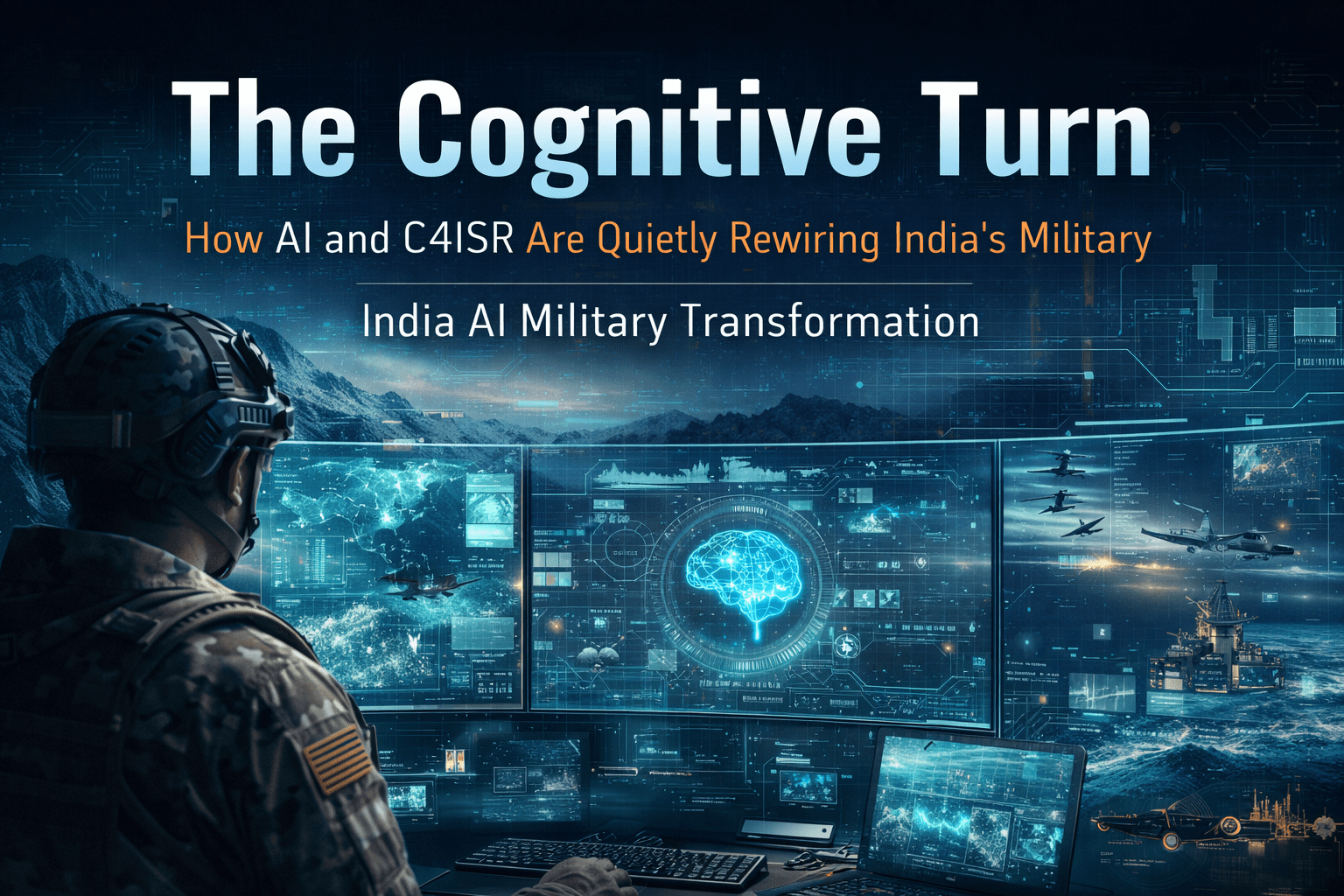
Let me paint you a picture that isn’t in any official PowerPoint.

It’s 2 AM somewhere in Eastern Ladakh. The temperature has dropped to minus twenty. A young officer sits in a bunker, not staring through binoculars at the frozen no-man’s land, but at a tablet screen. On that screen, data is flowing from a dozen different sources—acoustic sensors planted along the ridgeline, thermal drones orbiting silently at fifteen thousand feet, ground movement radars sweeping the valleys, and satellite imagery that updated forty minutes ago.

Ten years ago, this officer would have been making sense of all this alone, piecing together radio reports, paper maps, and his own instincts. Tonight, an AI model has already flagged three anomalous patterns, correlated them with known Chinese troop movement signatures from the past six months, and suggested two possible interpretations. The officer’s job isn’t to gather information anymore. It’s to ask the right questions.

This is the ground reality of India’s military AI transformation. Not some futuristic vision of robot armies, but the quiet, relentless work of connecting dots that were never connected before.

The Pinch Points That Drive Innovation

To understand why India is moving so urgently on AI, you have to understand the specific pain points that have plagued its military for decades. These aren’t abstract strategic concepts. They’re daily frustrations that have cost soldiers their lives.

The Northern Grid Problem

In the high Himalayas, terrain denies line of sight. Communication towers get destroyed by artillery or avalanches. Units operating in adjacent valleys might as well be on different planets.

The Indian Army’s push for “AI at the edge” isn’t about cool technology—it’s about ensuring that a battalion commander in Daulat Beg Oldi knows what a patrol in the Shyok Valley just saw, even when satellites are overhead and jammers are active.

AI models that compress data, prioritize critical information, and route it through the only available bandwidth aren’t a luxury. They’re a survival mechanism.

The Drone Blindness

Since the Balakot airstrikes in 2019, both India and Pakistan have flooded the border with drones. Small quadcopters, larger surveillance platforms, even commercial off-the-shelf units modified for reconnaissance. The human eye can’t track them all. Radar struggles with small signatures.

So the Army has deployed AI-powered acoustic sensors that identify drones by their sound signature, track them across multiple overlapping fields, and automatically cue counter-drone systems.

This is happening right now, along the International Border in Jammu, along the Line of Control in Kashmir.

The Translation Burden

Here’s a reality that never makes it into strategic analyses. The Chinese People’s Liberation Army publishes thousands of tactical documents, doctrinal manuals, and unit newsletters.

They’re in Mandarin. India has a limited pool of Mandarin translators. AI-powered translation systems now scan PLA publications in real-time, flag doctrinal shifts, new equipment mentions, and changes in training patterns.

An analyst in Delhi who used to read three documents a day can now have three hundred summarized and prioritized by breakfast.

These are the pinch points. And they’re driving a transformation that looks very different from the Pentagon’s glossy roadmaps.

The Three-Legged Stool That Actually Exists

India’s military AI ecosystem isn’t a single grand program. It’s a three-legged stool, and each leg is being built by different people with different timelines and different constraints.

Leg One: The Defence AI Council

This is the top-down piece. Chaired by the Defence Minister, it includes the three service chiefs, the Defence Secretary, and the head of the DRDO. Their job is to identify priority areas, approve funding, and—crucially—knock heads together when the Army wants one thing, the Navy wants another, and the Air Force wants a third.

In the past, these disagreements would have paralyzed progress for years. Now, with a clear threat timeline, the Council has started imposing solutions. “You will use this data format. You will share this frequency band. Your systems will talk to each other or they won’t get funded.” It’s not pretty, but it’s working.

Leg Two: The Service-Level AI Cells

Every service now has dedicated AI teams embedded in operational directorates. These aren’t techies in lab coats. They’re colonels and brigadiers who have commanded troops in the field, who know what questions actually need answering, and who now have a small budget and a mandate to experiment.

The Navy’s cell is focused on underwater domain awareness—because Chinese submarines are operating in the Indian Ocean with increasing frequency. The Air Force’s cell is obsessed with maintenance prediction—because MiG-29s and Su-30MKIs are complex machines, and unscheduled maintenance grounds squadrons at exactly the wrong moment.

The Army’s cell is working on logistics—because supplying high-altitude posts requires predicting weather, road conditions, fuel consumption, and ammunition expenditure simultaneously.

Leg Three: The Startup Bridge

This is the most interesting piece, and the one that connects most directly to ground realities. The Innovations for Defence Excellence (iDEX) framework has created a direct pipeline between military problems and startup solutions.

A company in Bengaluru built a tiny AI module that attaches to existing thermal imagers and automatically classifies what the imager sees—human, vehicle, animal, nothing.

A company in Pune built a predictive maintenance system for T-90 tanks that analyzes engine vibration patterns and flags components about to fail.

A company in Gurugram built a facial recognition system optimized for drone footage, so that a loitering drone can identify a specific individual from a kilometer away.

These aren’t contracts awarded to legacy defence giants. They’re fifty-lakh-rupee projects delivered in six months by twenty-five-year-olds who code through the night. And they’re being fielded now, not after a decade of trials.

The Chinese Shadow That Shapes Every Decision

Now we have to talk about what everyone in uniform is thinking but few will say publicly: every Indian AI decision is made in the shadow of China.

When the Army pushes for autonomous surveillance drones along the LAC, it’s because PLA patrols move in ways that are deliberately unpredictable, testing response times, probing for gaps. An AI that learns PLA movement patterns can predict where they’ll probe next.

When the Navy invests in AI-powered sonar processing, it’s because Chinese submarines have become quieter, stay submerged longer, and operate closer to Indian shores. An AI that filters out ocean noise and highlights anomalous acoustic signatures buys minutes that matter.

When the Strategic Forces Command quietly embeds AI in its command and control architecture, it’s because China’s nuclear forces are modernizing faster than anyone expected.

Mobile launchers, hardened silos, a growing submarine fleet. The targeting problem has become exponentially more complex. Human planners can’t keep up.

This isn’t paranoia. It’s the logical response to an adversary that has invested heavily in its own AI capabilities.

The PLA’s drone swarm demonstrations aren’t just for show. They’re a direct challenge to India’s ability to defend its borders with finite resources.

A single Chinese soldier controlling two hundred drones means that India can’t just match soldier for soldier, post for post, battalion for battalion.

The math doesn’t work. AI is the multiplier that might make the math work again.

The Bureaucratic Friction That Won’t Go Away

Let me be honest about the parts that aren’t working.

Unlike authoritarian systems that can impose rapid top-down integration, India’s military transformation unfolds within democratic constraints.

Procurement transparency, parliamentary oversight, civil-military boundaries, and public accountability all shape pace and design.

The tri-service integration that everyone talks about—the Indian equivalent of JADC2—is happening, but it’s happening at the speed of bureaucracy. The Army uses one radio frequency band. The Air Force uses another. The Navy has its own satellite bandwidth allocation.

Making them talk to each other requires hardware changes, software changes, and—most difficult of all—cultural changes. There are officers who have spent thirty years guarding their service’s information. Asking them to share it freely with another service violates every instinct they’ve developed.

The procurement system remains a nightmare. Even with iDEX and faster approvals, the gap between a successful prototype and a battalion-level deployment is measured in years, not months.

Startups run out of money waiting for the next payment. Soldiers run out of patience waiting for gear that was promised last year.

The talent retention problem is acute. A brilliant AI engineer can join the armed forces as a civilian scientist, get paid a fraction of what they’d earn at a multinational corporation, work on problems they can’t discuss with anyone, and be told that their project is low priority because some colonel doesn’t understand machine learning.

Many leave.

The ones who stay are either deeply patriotic or deeply frustrated. Sometimes both.

And then there’s the data problem.

AI needs data. Lots of it. Clean, labeled, representative data. The Indian military has data—acres of it, from decades of operations.

But it’s on hard drives in different locations, in different formats, with different classification levels, and no single person knows where it all is.

The push to create a unified defence data architecture isn’t just technical. It’s archaeological.

Teams are literally excavating old storage rooms, digitizing tapes, and trying to make sense of what they find.

This may slow integration. But it also builds legitimacy.

Despite all these challenges and more, a digitized military architecture embedded in democratic norms carries a different kind of credibility. It signals technological sophistication without strategic opacity.

India’s model will therefore never mirror China’s. It will be iterative, negotiated, and institutionally debated.

That is not weakness. It is structural character.

The Soldier’s View of the Algorithm

I want to end with a conversation I had with a young officer who had just returned from a tenure in the Siachen Glacier. He’d been testing some of the new AI-powered surveillance gear, and I asked him what he thought.

He said: “Sir, the machine is smart. It sees things I don’t see. But it also misses things I see. The difference is, I know when I’m guessing. The machine never knows.”

That’s the profound truth that all the roadmaps and strategies and council meetings have to grapple with. AI is a tool. A powerful tool, a transformative tool, but a tool nonetheless. It extends human senses, augments human judgment, speeds human decisions. It doesn’t replace them.

The soldier on the glacier, the submarine commander in the Andaman Sea, the fighter pilot scrambling at dawn—they will always be the ones who bear the final responsibility. The algorithm can warn, suggest, predict. Only the human can choose.

And that’s why India’s path matters. Not because it will produce perfect AI or flawless integration or seamless tri-service cooperation. It won’t. The friction will remain. The gaps will persist. The bureaucracy will frustrate.

But the direction is clear. The soldier with the tablet at 2 AM in Ladakh has capabilities his predecessor couldn’t imagine. The submarine commander has a picture of the underwater battlespace that was literally impossible five years ago. The pilot’s maintenance crew knows which parts will fail before they fail.

This is the ground reality. Not a revolution, but an evolution. Not a finished product, but a work in progress. Not a guarantee of victory, but a better chance of survival.

In the algorithm of borders, that’s all anyone can ask for.

Looking Toward 2030

The success of this transformation will not be measured by announcements but by outcomes:

When theatre commands operate on genuinely integrated digital networks.
When logistics dashboards predict shortages before they occur.
When AI-assisted analysis reduces surprise along contested borders.
When joint operations are digitally seamless rather than manually coordinated.

If those milestones are visible by 2030, India will have completed its cognitive transition.

If not, the hardware will exist without the architecture.


FAQs: India’s Military AI Transformation

What is driving India’s push toward AI in military operations?

India’s military AI push is driven by operational friction points rather than abstract technological ambition. These include surveillance gaps in high-altitude terrain, the proliferation of drones along contested borders, intelligence overload from adversary data, and the need for faster decision-making cycles. AI is being adopted as a practical tool to solve battlefield inefficiencies and improve situational awareness under real combat conditions.

How is AI being used on India’s borders today?

AI is already being deployed in active operational environments. Examples include acoustic sensors that detect and classify drones, AI-assisted ISR systems that fuse satellite and ground data, and edge-based AI models that prioritize and transmit critical information in bandwidth-constrained areas like Ladakh. These systems are enhancing real-time threat detection and response.

What is the structure of India’s military AI ecosystem?

India’s military AI ecosystem operates through a three-tier structure. At the top is the Defence AI Council, which sets priorities and enforces integration. At the service level, dedicated AI cells within the Army, Navy, and Air Force focus on mission-specific applications. At the execution layer, startups and private firms contribute rapid, problem-focused solutions through frameworks like iDEX.

How does China influence India’s military AI strategy?

China acts as the primary strategic benchmark shaping India’s AI trajectory. The PLA’s advancements in drone swarms, autonomous systems, and AI-enabled command networks have forced India to accelerate its own adoption. Indian investments in AI surveillance, sonar processing, and targeting systems are directly linked to countering China’s evolving capabilities across land, sea, and strategic domains.

What are the biggest challenges slowing AI integration in the Indian military?

Key challenges include bureaucratic procurement processes, lack of unified data architecture, inter-service interoperability issues, and talent retention gaps. Additionally, legacy systems and fragmented data repositories make AI deployment more complex. Cultural resistance to data sharing across services also slows integration.

Is India building an equivalent of the US JADC2 system?

India is moving toward a similar concept of integrated, network-centric warfare, but without a single unified program like JADC2. Instead, integration is evolving incrementally through joint data-sharing protocols, AI-enabled ISR systems, and cross-service coordination efforts. Progress is real but uneven due to institutional and technical constraints.

Can AI replace human decision-making in combat scenarios?

No. AI in the Indian military is designed to augment, not replace, human judgment. It enhances perception, speeds up analysis, and provides predictive insights. However, final decisions remain human-driven, especially in high-stakes combat environments where context, intuition, and accountability are critical.

What would success look like for India’s military AI transformation by 2030?

Success will not be defined by technology deployment alone but by operational outcomes. This includes seamless digital integration across theatre commands, predictive logistics systems, reduced strategic surprise along contested borders, and faster, coordinated joint operations. If these capabilities are achieved, India will have completed a meaningful cognitive shift in warfare.

Tags: Most Read
Previous Post

India Military Transformation Series — Part 1: India AI C4ISR Modernization

Next Post

India Military Transformation Series — Part 2: The Theatre Command Reckoning

IndoAsia Defense

IndoAsia Defense

IndoAsia Defense Team is a specialist research and analysis group focused on India’s military modernization and Indo-Pacific strategic dynamics. The platform delivers structured, data-driven insights on doctrine, force posture, defense technology, and regional power balance.

Next Post
India Military Transformation Series — Part 2: The Theatre Command Reckoning

India Military Transformation Series — Part 2: The Theatre Command Reckoning

Leave a Reply Cancel reply

Login with your Social ID

Your email address will not be published. Required fields are marked *

Category

  • Air
  • Global
  • Indo-Pacific
  • Industry
  • Joint
  • Land
  • Navy
  • Tech

Defence Capabilities

  • Air Defence
  • Drones
  • Fighters
  • ISR & Mobility
  • China Military
  • Emerging Tech
  • Regional Trends
  • U.S. Posture

Strategy

  • 2035 Outlook
  • China Strategy
  • India Strategy
  • Pakistan Outlook
  • Budget
  • Exports
  • Make in India
  • Supply Chains

Operations

  • Integrated Ops
  • Procurement Reform
  • Theater Commands
  • Armour & Artillery
  • China Front
  • Future Combat
  • Pakistan Front
  • Fleet Expansion

Resources

  • India vs China Military Balance
  • Indo-Pacific Military Power Map
  • Global Military Balance Dashboard
  • Global Weapons Systems Database
  • Global Missile Systems Database
  • Indo-Pacific Defense Timeline
  • India Military Capability Index
  • About
  • Contact
  • Privacy & Policy
  • Editorial Policy
  • Cookie Policy
  • Disclaimer
  • Terms And Conditions
Facebook Linkedin X-twitter
© 2026 IndoAsia Defense. All Rights Reserved.
No Result
View All Result
  • Home
  • Air
    • Air Defence
    • Drones
    • Fighters
    • ISR & Mobility
  • Land
    • Armour & Artillery
    • China Front
    • Future Combat
    • Pakistan Front
  • Navy
    • Fleet Expansion
    • Indian Ocean
    • Maritime Security
    • Submarines
  • Indo-Pacific
    • 2035 Outlook
    • China Strategy
    • India Strategy
    • Pakistan Outlook
  • Joint
    • Integrated Ops
    • Procurement Reform
    • Theater Commands
  • Tech
    • AI & Autonomous Systems
    • Cyber
    • Electronic Warfare
    • Space
  • Industry
    • Budget
    • Exports
    • Make in India
    • Supply Chains
  • Global
    • China-Pak
    • Emerging Tech
    • Regional Trends
    • US-India