









Context
The strategic competition between India and China represents one of the most consequential military rivalries in the Indo-Pacific. Both countries possess large armed forces, expanding defense industries, and nuclear deterrent capabilities.
However, their military structures, strategic priorities, and geographic constraints differ significantly. China’s military modernization is driven by ambitions for regional dominance in the Western Pacific, while India’s defense posture is shaped by the need to manage both continental threats and maritime security in the Indian Ocean.
This analysis compares the military capabilities of India and China across land, air, naval, and strategic domains to assess how the balance of power is evolving.
Land Forces
China maintains the world’s largest standing military and has invested heavily in mechanized warfare, missile forces, and advanced artillery systems.
India’s Army, however, operates in extremely demanding terrain conditions along the Himalayan frontier and possesses extensive experience in mountain warfare.
China has reorganized its ground forces under theater commands designed to enable joint operations, while India is gradually moving toward integrated theater commands.
Key comparison factors include armored forces, artillery modernization, missile deployment, and high-altitude warfare capability.
While China holds numerical superiority, India maintains geographic advantages in certain sectors of the border due to terrain familiarity and defensive positioning.
Air Power
The People’s Liberation Army Air Force has undergone rapid modernization and now fields a large fleet of advanced aircraft including stealth fighters and long-range strike systems.
India’s Air Force, though smaller, emphasizes multirole flexibility and precision strike capability.
China has expanded its stealth fighter program with aircraft such as the J-20, while India operates platforms such as the Su-30MKI and Rafale equipped with advanced missile systems.
Airpower competition also depends heavily on airbase infrastructure, airborne surveillance systems, and integrated air defense networks.
China’s advantage lies in fleet size and indigenous aircraft production, while India’s advantage lies in combat experience and strategic positioning along the Himalayas.
Naval Power
China’s navy has expanded rapidly and now operates the world’s largest fleet by number of ships. Beijing’s maritime strategy focuses on controlling the Western Pacific and protecting sea lines of communication.
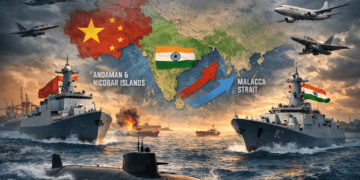
India’s naval strategy is centered on dominance in the Indian Ocean Region, which remains geographically distant from China’s main naval bases.
India operates aircraft carriers and is expanding its submarine fleet, while China is developing carrier strike groups and long-range naval aviation. Although China possesses a larger navy overall, India enjoys geographic advantages in the Indian Ocean that complicate Chinese maritime operations.
Missile Forces
Missile technology has become a central component of the India–China strategic balance. China possesses a vast missile arsenal capable of targeting regional bases and naval forces.
India has expanded its ballistic missile program and deployed long-range systems capable of reaching deep into Chinese territory.
Both countries are also developing hypersonic missile technology, which could alter future deterrence dynamics. Missile forces play a crucial role in deterrence by enabling rapid long-range strike capability.
Nuclear Deterrence
Both India and China possess nuclear weapons and maintain doctrines centered on deterrence rather than warfighting. China maintains a larger nuclear arsenal and is expanding its missile silos and submarine-based deterrent capability.
India follows a doctrine of credible minimum deterrence and maintains a nuclear triad designed to ensure second-strike capability. The presence of nuclear weapons adds a layer of strategic stability while also complicating escalation dynamics during crises.
Defence Industrial Capacity
China possesses one of the world’s most advanced defense industrial ecosystems, capable of producing aircraft, missiles, naval vessels, and advanced electronics at scale.
India is expanding domestic defense manufacturing under its strategic autonomy and industrial modernization initiatives.
Although China currently enjoys greater industrial scale, India’s defense industry is gradually expanding through public-private partnerships and international collaboration. Industrial capacity will likely play an increasingly decisive role in the long-term military balance.
Geography and Strategic Constraints
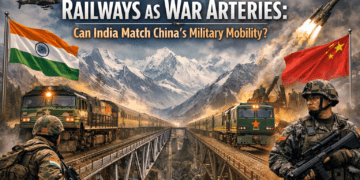
Geography significantly shapes the military balance between the two countries. China must project military power across the Tibetan Plateau to sustain operations along the border.
India, meanwhile, must maintain large troop deployments across difficult mountain terrain.
Logistics, infrastructure, and airfield availability are key factors that influence operational capability in high-altitude environments. The Himalayan terrain limits large-scale mechanized warfare, increasing the importance of infantry, artillery, and air mobility.
Future Military Competition
Several emerging trends will shape the future military balance between India and China.
- Artificial intelligence in warfare
- Space-based military systems
- Hypersonic missile development
- Drone and autonomous combat systems
- Electronic warfare capabilities
Competition in these domains will likely define the next phase of military modernization in Asia.
Final Word
The India–China military balance is complex and multi-dimensional. China currently enjoys advantages in industrial capacity, missile forces, and overall military scale.
India, however, possesses geographic advantages in certain sectors, significant combat experience, and a strategic position that allows it to influence the security environment across the Indian Ocean.
Rather than a simple numerical comparison, the balance between the two countries is shaped by geography, doctrine, industrial capacity, and alliance dynamics.
As both militaries continue to modernize, the strategic competition between India and China will remain one of the defining security challenges of the Indo-Pacific.

