


















A Threat Geography That Refused to Stay Theoretical
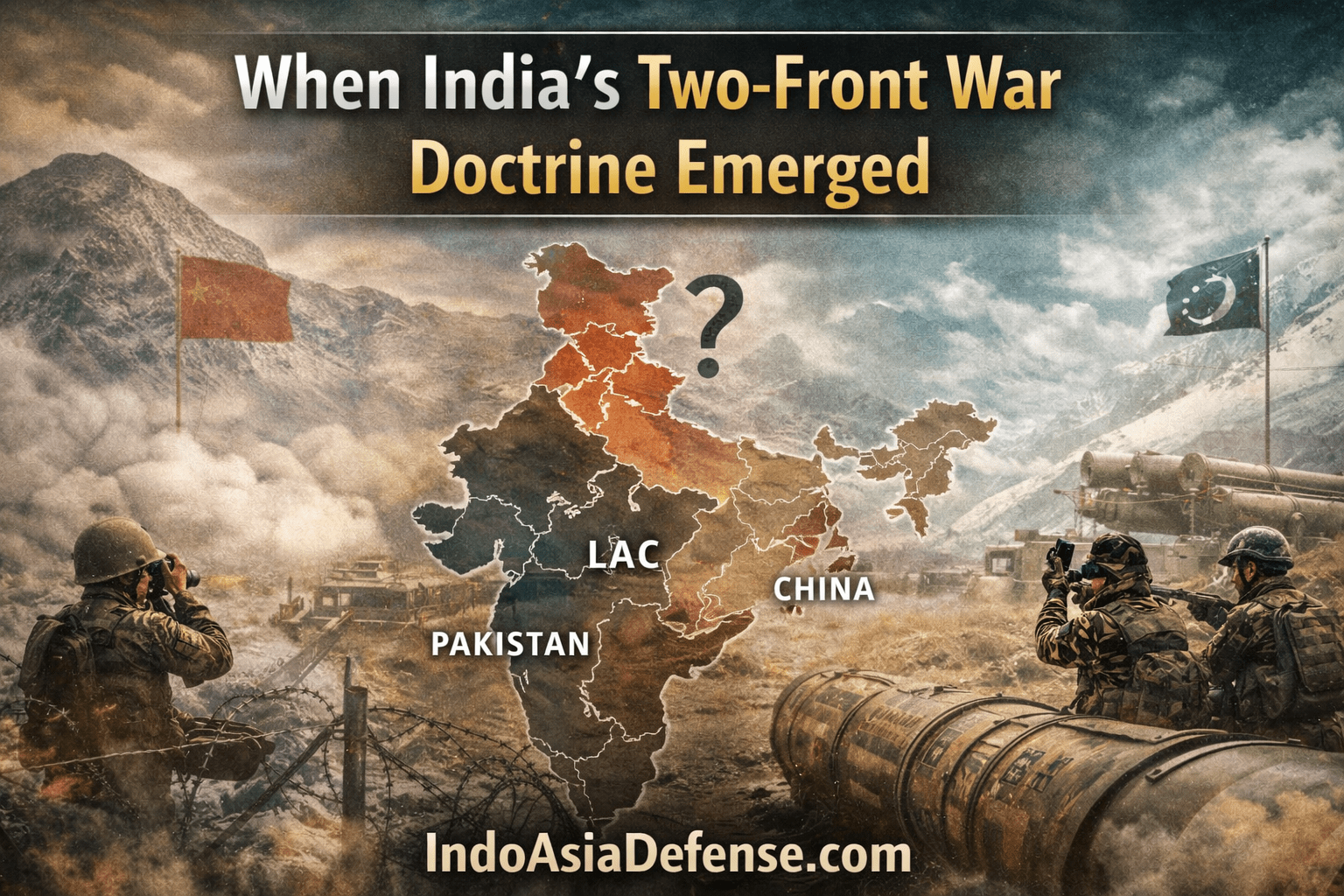
India’s security environment has long been defined by the presence of two major strategic rivals along its borders. Pakistan lies to the west, while China occupies the vast northern frontier across the Himalayas. The possibility of facing military pressure from both directions simultaneously has therefore shaped Indian strategic thinking for decades.
What is now widely described as the India two-front war doctrine reflects this structural reality rather than a sudden conceptual breakthrough. It is a recognition that geography, when combined with adversarial intent, imposes its own logic on military planning.
The India two-front war doctrine refers to India’s preparation for a scenario in which military confrontation with China and Pakistan unfolds at the same time, forcing the armed forces to divide attention, resources, and operational planning across two distinct theaters.
While the phrase itself has gained prominence only in recent years, the strategic logic behind it has evolved gradually through several phases of India’s post-independence history.
Understanding when the India two-front war doctrine emerged requires moving beyond labels and examining the layered process through which it took shape.
This includes the geopolitical context that produced it, the military reforms that reinforced it, and the operational pressures that continue to redefine it.
The implication is that the doctrine is not an abstract contingency plan but a structural response to India’s strategic environment.
It reflects an enduring tension between geography and capability, where the challenge is not simply defending borders but doing so simultaneously under conditions of uncertainty.
This framing sets the stage for understanding why the doctrine emerged slowly but now dominates India’s defense planning.
One War at a Time: The Strategic Comfort of the Early Decades
India’s earliest security concerns were shaped by the wars that followed independence, but these conflicts did not immediately produce a two-front mindset. The first conflict with Pakistan in 1947–48 established the enduring volatility of the western frontier, while the northern border with China remained relatively quiet.
This asymmetry allowed Indian planners to think in terms of sequential conflicts rather than simultaneous ones. The strategic assumption was that threats would emerge one at a time, allowing resources to be concentrated accordingly.
This assumption began to unravel with the Sino-Indian War of 1962, which exposed serious weaknesses in India’s preparedness along the Himalayan frontier. The conflict forced New Delhi to reassess its posture toward China, but it did not immediately produce a dual-front doctrine.
Instead, India continued to fight wars with Pakistan in 1965 and 1971 under conditions where China remained largely on the sidelines militarily. The absence of simultaneous escalation reinforced the belief that conflicts could be compartmentalized.
During the Cold War period, China and Pakistan maintained close diplomatic and military ties, yet the geopolitical environment rarely produced conditions that would force India to prepare for concurrent wars. Indian military planning therefore remained threat-specific rather than threat-integrated.
The strategic implication of this phase is that the India two-front war doctrine did not emerge earlier because the external environment did not demand it. It was not a failure of foresight but a reflection of the operational realities of the time.
The Nuclear Shadow and the End of Strategic Sequencing
The emergence of nuclear weapons in South Asia during the late 1990s fundamentally altered the logic of conflict. India and Pakistan’s nuclear tests in 1998 introduced a layer of deterrence that constrained large-scale conventional warfare. This did not eliminate the possibility of conflict, but it changed its character.
Military planners began to explore limited war concepts that could operate below the nuclear threshold, while still achieving political and military objectives.
Within this environment, the possibility of simultaneous pressure from China and Pakistan acquired new urgency. Nuclear deterrence reduced the likelihood of decisive, large-scale wars, but it increased the plausibility of coordinated or opportunistic actions across multiple fronts.
China’s rapid military modernization, combined with its expanding infrastructure in Tibet and Xinjiang, enhanced its ability to mobilize forces along the Line of Actual Control. At the same time, Pakistan retained the capacity to escalate tensions along the Line of Control.
The India two-front war doctrine began to take clearer shape in this period as planners confronted a critical question.
If nuclear deterrence limited escalation on one front, could the other front be activated to stretch India’s defenses? The answer increasingly appeared to be yes.
The implication was that strategic sequencing, the assumption that wars would occur one after another, was no longer reliable. The doctrine therefore emerged as a response to a more complex and less predictable deterrence environment.
When Parallel Threats Turned Into a Collusive Risk
By the early 2000s, Indian defense planners began incorporating two-front scenarios into military exercises and war games. These were no longer theoretical constructs but operational problems that required concrete solutions.
The focus shifted toward how the armed forces would allocate troops, air power, and logistics across multiple theaters under conditions of simultaneous stress.
The India two-front war doctrine thus transitioned from conceptual discussion to planning assumption.
What accelerated this transition was the growing perception of collusion between China and Pakistan. This was not necessarily about formal military coordination, but about strategic alignment that could produce overlapping crises.
The expansion of infrastructure projects linking the two countries, along with deepening defense cooperation, reinforced this perception. Indian planners began to treat the two fronts not as separate challenges, but as interconnected elements of a single strategic problem.
This shift can be understood through a comparative lens:
| Phase | Threat Structure | Planning Model | Strategic Outcome |
|---|---|---|---|
| Early decades | Independent adversaries | Sequential response | Localized force concentration |
| Post-nuclear era | Parallel pressures | Partial overlap planning | Limited dual-front readiness |
| Contemporary phase | Collusive risk | Simultaneous conflict assumption | Integrated two-front doctrine |
The implication is that India is no longer preparing for two separate wars, but for a single conflict environment with multiple axes of pressure. This fundamentally alters how deterrence, mobilization, and escalation are understood within Indian military strategy.
Ladakh 2020: The Moment Assumptions Were Stress-Tested
The crisis along the Line of Actual Control in 2020 marked a turning point in how the India two-front war doctrine was perceived within the strategic community.
For the first time in decades, India faced sustained military pressure from China while continuing to manage an active Line of Control with Pakistan.
Although a full-scale two-front conflict did not materialize, the situation forced Indian planners to operate under precisely such conditions.
The Ladakh deployment demonstrated improvements in India’s ability to mobilize forces quickly, particularly in high-altitude environments. However, it also exposed the strain of sustaining large troop deployments over extended periods.
Maintaining readiness in extreme terrain requires not only manpower but also robust logistical support, including fuel, ammunition, and medical infrastructure. These demands become significantly more complex when multiplied across two fronts.
A useful analytical extension would be a deployment density map showing how Indian forces were distributed across northern and western sectors during the crisis. Such a visualization would highlight the trade-offs involved in resource allocation and the pressure points that emerge when forces are stretched.
The broader implication is that the India two-front war doctrine is not just about preparing for simultaneous conflict, but about sustaining it over time without degrading overall readiness.
Fighting Two Wars or Avoiding Both: The Real Strategic Dilemma
The India two-front war doctrine introduces a set of trade-offs that go beyond military planning and extend into broader defense policy. One of the most significant challenges is resource allocation.
Preparing for simultaneous conflict requires investments in advanced capabilities, including air defense systems, surveillance platforms, and precision strike assets. These investments must be balanced against other priorities such as personnel costs and infrastructure development.
Another challenge lies in deterrence signaling. India must demonstrate credible capability against both China and Pakistan without triggering escalation. This requires careful calibration of military deployments and strategic messaging.
Actions taken to strengthen deterrence on one front may be interpreted as escalation on the other, creating a complex signaling environment. The doctrine therefore operates within a narrow margin where miscalculation can have significant consequences.
An often overlooked dimension is the impact on force specialization. The operational requirements of high-altitude warfare against China differ significantly from those of plains and desert warfare against Pakistan. Balancing these requirements within a single force structure raises questions about efficiency and effectiveness.
The India two-front war doctrine thus forces Indian planners to confront a fundamental dilemma. Is it better to optimize for specific threats or to build a flexible force capable of operating across diverse environments?
The Next Conflict Will Not Respect Geography or Sequence
Looking ahead, the India two-front war doctrine will increasingly be shaped by technological change and evolving patterns of conflict. Future scenarios are unlikely to unfold along neatly defined geographic lines. Instead, they may involve simultaneous pressure across land, cyber, space, and information domains. This requires a shift from traditional theater-based thinking to a more integrated, multi-domain approach.
One plausible scenario involves a limited conflict along the western front that coincides with heightened tensions along the northern border. Another involves coordinated pressure from China and Pakistan across multiple domains, including cyber operations and information warfare.
In both cases, the challenge for India is not simply to respond, but to do so in a way that preserves strategic stability while maintaining operational effectiveness.
The implication is that the India two-front war doctrine must continue to evolve. It cannot remain confined to conventional military planning but must incorporate emerging technologies and new forms of conflict.
This includes the integration of cyber capabilities, space assets, and autonomous systems into the broader strategic framework. The doctrine’s future will depend on how effectively India can adapt to these changes while maintaining coherence in its overall defense strategy.
A Doctrine Still Being Written Under Pressure
The India two-front war doctrine is not a fixed concept but an evolving response to a complex security environment. It has emerged gradually through decades of conflict, crisis, and strategic reassessment.
From its early foundations in post-independence wars to its current role in shaping military planning, the doctrine reflects India’s attempt to reconcile geography with capability.
In its current form, the doctrine is less about fighting two wars simultaneously and more about preventing such a scenario from materializing. It serves as a framework for deterrence, resource allocation, and strategic signaling.
Its effectiveness will depend not only on military capability but also on the ability to manage escalation and maintain stability across multiple fronts.
Ultimately, the India two-front war doctrine represents a recognition that future conflicts will be more complex, more interconnected, and less predictable than those of the past. It is still being written, not in documents, but in deployments, reforms, and strategic decisions made in real time.
FAQs
What is the India two-front war doctrine?
It is India’s strategic framework for preparing for simultaneous military conflict with China and Pakistan, shaping force structure and operational planning.
When did the India two-front war doctrine emerge?
It evolved gradually from the late Cold War period but became more defined after the 2000s and especially after the 2020 Ladakh crisis.
Why is the doctrine important for India’s strategy?
It addresses the risk of simultaneous threats and ensures that India’s military remains prepared for complex, multi-front conflict scenarios.
What challenges does the doctrine create?
It introduces trade-offs in resource allocation, force specialization, and deterrence signaling across two very different operational environments.
Is the doctrine a formal policy?
No, it is not officially codified but exists as a guiding strategic and operational assumption within India’s defense planning.

