













Force Structure, Modernization, and Strategic Posture
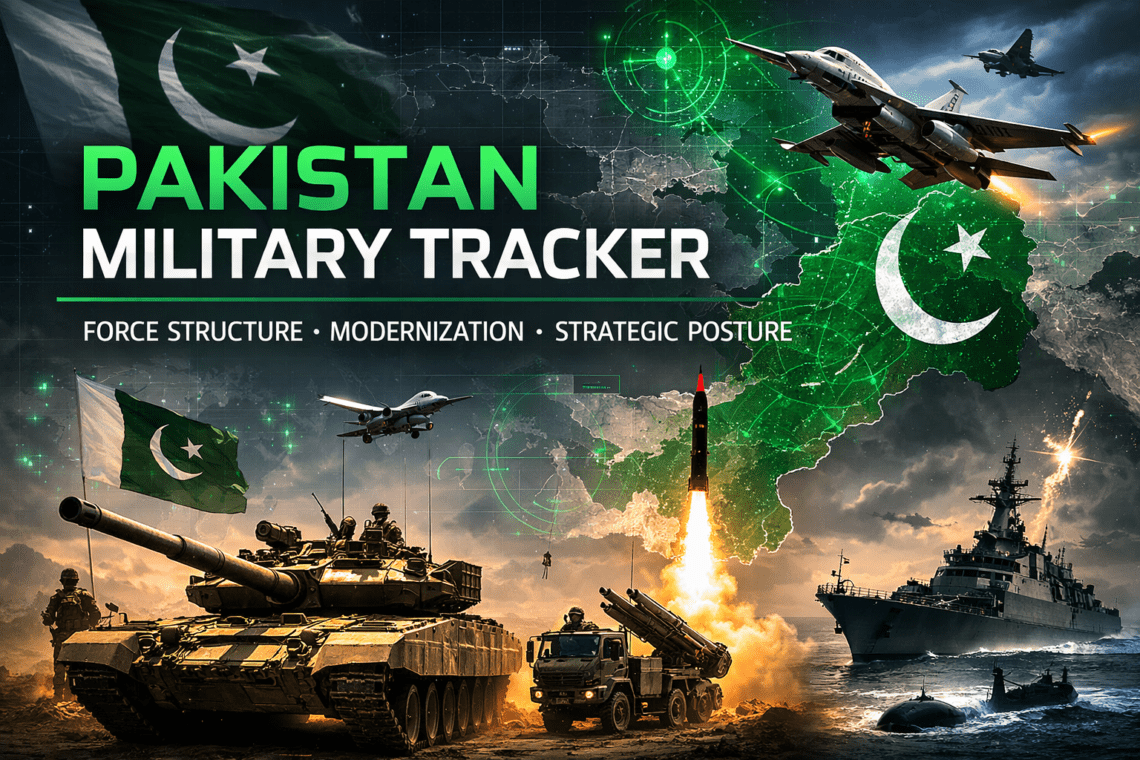
The Pakistan Military Tracker is a dedicated resource for monitoring the structure, capabilities, and modernization trajectory of the Pakistan Armed Forces.
Here we compile open-source intelligence (OSINT), defense research, and strategic analysis to provide an objective overview of Pakistan’s military posture across its Army, Air Force, Navy, and strategic nuclear forces.
Pakistan maintains one of the largest military establishments in the Islamic world. With approximately 650,000 active personnel and more than half a million reservists, the armed forces remain the central institution shaping the country’s national security strategy.
The military structure is historically Army-centric, but recent modernization programs indicate increasing emphasis on air power, missile forces, and maritime deterrence.
This tracker is designed as a reference resource for analysts, researchers, and policymakers seeking to understand the evolving balance of power in South Asia.
Pakistan Armed Forces Overview
Category |
Estimate |
|---|---|
Active Personnel |
~654,000 |
Reserve Personnel |
~550,000 |
Paramilitary Forces |
~480,000 |
Defense Budget |
~$10–11 billion (official estimate) |
Nuclear Warheads |
~165–170 |
Strategic Command Authority |
National Command Authority (NCA) |
Pakistan’s military establishment plays a significant role in national decision-making, particularly in areas related to India policy, nuclear deterrence, and internal security operations.
Service Branch Composition
Service Branch |
Estimated Strength |
Strategic Role |
|---|---|---|
Pakistan Army |
~560,000 personnel |
Primary land warfare force focused on India-centric defense |
Pakistan Air Force (PAF) |
~70,000 personnel |
Air superiority, precision strike, and air defense |
Pakistan Navy (PN) |
~25,000–30,000 personnel |
Maritime security and sea-denial strategy in the Arabian Sea |
Strategic Forces Command |
Classified |
Nuclear deterrence and missile operations |
Although the Pakistan Army remains the most powerful institutional actor, the Pakistan Air Force has increasingly become the most technologically advanced branch of the armed forces.
Pakistan Army
The Pakistan Army forms the backbone of the country’s military power and is structured around large mechanized formations designed for high-intensity conventional conflict.
Key Capabilities
Category |
Estimate |
|---|---|
Active Personnel |
~560,000 |
Main Battle Tanks |
~2,500+ |
Armored Fighting Vehicles |
~6,000+ |
Artillery Systems |
~4,500+ |
Major Tank Platforms
Tank |
Origin |
Status |
|---|---|---|
Al-Khalid |
Pakistan/China |
Primary indigenous MBT |
Al-Khalid II |
Pakistan/China |
Next-generation variant |
Al-Zarrar |
Pakistan |
Upgraded Type-59 |
T-80UD |
Ukraine |
Imported |
Type-85 / Type-90 |
China |
Older fleet |
Operational Structure
The Pakistan Army operates nine corps-level formations, responsible for different operational theaters across the country.
Corps |
Location |
|---|---|
I Corps |
Mangla |
II Corps |
Multan |
IV Corps |
Lahore |
V Corps |
Karachi |
X Corps |
Rawalpindi |
XI Corps |
Peshawar |
XII Corps |
Quetta |
XXX Corps |
Gujranwala |
XXXI Corps |
Bahawalpur |
Most of these formations are oriented toward the eastern border with India, reflecting Pakistan’s core strategic priority.
Pakistan Air Force
The Pakistan Air Force has focused heavily on technological modernization, particularly in multirole fighters, long-range missiles, and network-centric warfare capabilities.
Personnel and Fleet
Category |
Estimate |
|---|---|
Personnel |
~70,000 |
Combat Aircraft |
~400+ |
AEW&C Aircraft |
8+ |
UAV Fleet |
Growing rapidly |
Major Combat Aircraft
Aircraft |
Role |
Origin |
|---|---|---|
JF-17 Thunder |
Multi-role fighter |
Pakistan/China |
F-16 Fighting Falcon |
Multi-role fighter |
United States |
J-10C Vigorous Dragon |
Advanced fighter |
China |
Mirage III / V |
Strike aircraft |
France |
F-7 |
Interceptor |
China |
Modernization Focus
Pakistan’s air force modernization strategy includes:
-
JF-17 Block III fighter induction
-
Integration of PL-15 long-range air-to-air missiles
-
Expanded airborne early warning capability
-
Improved electronic warfare and data-link networking
Pakistan Navy
The Pakistan Navy focuses on sea denial and maritime security in the Arabian Sea, particularly around the strategic ports of Karachi and Gwadar.
China has become the primary partner in Pakistan’s naval modernization.
Naval Assets
Category |
Estimate |
|---|---|
Personnel |
~25,000 |
Submarines |
8 |
Frigates |
10+ |
Patrol Vessels |
20+ |
Submarine Fleet
Class |
Origin |
Status |
|---|---|---|
Agosta 90B |
France |
Operational |
Agosta 70 |
France |
Aging |
Hangor-class (Type 039B) |
China |
Under construction |
The Hangor-class program is expected to significantly expand Pakistan’s underwater strike capability.
Strategic Nuclear Forces
Pakistan operates one of the fastest growing nuclear arsenals in the world. The nuclear command structure is overseen by the National Command Authority (NCA) and managed through the Strategic Plans Division (SPD).
Estimated Nuclear Arsenal
Category |
Estimate |
|---|---|
Nuclear Warheads |
~165–170 |
Delivery Systems |
Ballistic missiles, cruise missiles, aircraft |
Nuclear Doctrine |
Full Spectrum Deterrence |
Unlike India’s No First Use policy, Pakistan maintains strategic ambiguity regarding the first use of nuclear weapons.
Pakistan Missile Arsenal
Pakistan’s missile forces provide the backbone of its nuclear deterrent.
Ballistic Missiles
Missile |
Range |
|---|---|
Abdali |
~200 km |
Ghaznavi |
~300 km |
Shaheen-I |
~750 km |
Shaheen-II |
~1,500 km |
Shaheen-III |
~2,750 km |
Cruise Missiles
Missile |
Type |
Range |
|---|---|---|
Babur |
Ground-launched |
~700 km |
Babur-3 |
Submarine-launched |
~450 km |
Ra’ad |
Air-launched |
~350 km |
The Babur-3 submarine-launched cruise missile provides Pakistan with a limited sea-based nuclear deterrent capability.
Paramilitary Forces
Pakistan maintains several large paramilitary organizations responsible for border security and internal stability.
Force |
Role |
|---|---|
Frontier Corps |
Border security |
Pakistan Rangers |
Internal security |
Pakistan Coast Guards |
Maritime law enforcement |
Gilgit-Baltistan Scouts |
Mountain security |
Collectively, these forces exceed 450,000 personnel.
Defense Industry
Pakistan’s domestic defense industry supports indigenous production and technology partnerships.
Organization |
Role |
|---|---|
Pakistan Aeronautical Complex (PAC) |
Aircraft manufacturing |
Heavy Industries Taxila (HIT) |
Armored vehicle production |
Karachi Shipyard & Engineering Works |
Naval shipbuilding |
National Engineering & Scientific Commission |
Missile development |
China remains Pakistan’s most significant defense technology partner.
Regional Military Comparison
Category |
Pakistan |
India |
|---|---|---|
Active Personnel |
~654,000 |
~1.45 million |
Tanks |
~2,500 |
~4,700 |
Combat Aircraft |
~400+ |
~600+ |
Submarines |
8 |
17 |
Nuclear Warheads |
~170 |
~164 |
India maintains a significant conventional advantage, while Pakistan relies on nuclear deterrence and asymmetric military strategies to offset this imbalance.
Why the Pakistan Military Tracker Matters
Pakistan’s military posture plays a central role in shaping South Asian security dynamics. The balance between India and Pakistan remains one of the world’s most sensitive nuclear deterrence relationships.
Monitoring Pakistan’s military capabilities helps analysts better understand:
-
India–Pakistan crisis stability
-
South Asian nuclear deterrence dynamics
-
Afghanistan-related security developments
-
China–Pakistan defense cooperation
As regional military modernization accelerates, tracking Pakistan’s armed forces remains essential for assessing the evolving balance of power in South Asia.

