











IndoAsia Defense
  • Home
  • Air
    • All
    • Air Defence
    • Drones
    • Fighters
    • ISR & Mobility
    Ghatak UCAV stealth, autonomy, integration

    Inside India’s Ghatak UCAV Program: Stealth, Autonomy, and the Integration Gap

    The F414 engine co-production agreement between Hindustan Aeronautics Limited and GE Aerospace

    India-US F414 Engine Deal Explained: Technology Transfer, Tejas Mk2, and AMCA

    What is the Su-57M1 India deal

    Su-57M1 for India: A Fifth-Generation Shortcut or a Strategic Dependency Trap?

    India indigenous long range surveillance radar with X-band drone detection capability

    450km Eyes, Machine-Speed Decisions: How India’s Indigenous Long Range Surveillance Radar Is Rewriting Air Defence

    Why Software Defined Radios Are the IAF’s Most Consequential Upgrade

    IAF Signs BEL Deal for Software Defined Radios: Rewiring India’s Air Combat Network

    How the Ghatak UCAV Stealth Design Redefines India’s Drone Warfare Doctrine

    Ghatak UCAV: India’s Carbon Composite Stealth Strategy Dissected

    Ballistic Missile Defense system intercepting incoming missile during midcourse phase

    How Ballistic Missile Defense Works: Inside Modern Missile Interception Systems

    Swarm logistics drones delivering military supplies in high-altitude Himalayan terrain with Indian Army presence

    Swarm Logistics Drones in Himalayan Warfare: Can India Close the Supply Gap with China?

    India’s 6th-Gen Fighter Strategy FCAS vs GCAP Explained

    India’s 6th-Gen Fighter Strategy: FCAS vs GCAP Explained

  • Land
    • All
    • Armour & Artillery
    • China Front
    • Future Combat
    • Pakistan Front
    The Indo-Pacific Is Fragmenting, Not Uniting Against China

    Why the Indo-Pacific Will Not Unite Against China

    The India-South Korea defence deal

    The India-South Korea Defence Deal Through China’s Operational Lens

    Railways as War Arteries Can India Match China’s Military Mobility Before the Next Crisis

    Railways as War Arteries: Can India Match China’s Military Mobility Before the Next Crisis?

    China maritime front in Indian Ocean

    What If China Opens a Maritime Front in the Indian Ocean During a LAC Conflict?

    What is Indian military modernization strategy in 2026?

    Indian Military Modernization: Systems, Doctrine, and Capability Architecture (2026-27)

    Tank launching loitering munition in battle

    From Smoke to Strike: India’s Indigenous Loitering Munitions for T-72, T-90, and Arjun Tanks

    How China Mobilizes Forces Along the LAC Speed, Systems, and Strategic Control

    How China Mobilizes Forces Along the LAC: Systems, Speed, and Strategic Signaling

    Ballistic Missile Defense system intercepting incoming missile during midcourse phase

    How Ballistic Missile Defense Works: Inside Modern Missile Interception Systems

    Swarm logistics drones delivering military supplies in high-altitude Himalayan terrain with Indian Army presence

    Swarm Logistics Drones in Himalayan Warfare: Can India Close the Supply Gap with China?

  • Navy
    • All
    • Fleet Expansion
    • Indian Ocean
    • Maritime Security
    • Submarines
    Mogami-class frigate deal overview

    Japan’s Mogami-Class Frigate Offer to India: What the Transfer Terms Reveal About Tokyo’s Indo-Pacific Calculus

    China maritime front in Indian Ocean

    What If China Opens a Maritime Front in the Indian Ocean During a LAC Conflict?

    The Strait of Hormuz Crisis

    India’s Oil Artery Under Threat: Strategic Implications of a Hormuz Crisis

    India’s VL-Shtil Missile Deal with Russia

    India’s VL-Shtil Missile Deal with Russia: Strengthening Naval Air Defense in the Indo-Pacific

    Andaman & Nicobar Command Sleeping Giant of India’s Maritime Strategy

    Andaman & Nicobar Command: Sleeping Giant of India’s Maritime Strategy

    Maritime Surveillance 2.0: Why EO/IR Modernisation Matters for India’s Ocean Security

    Maritime Surveillance 2.0: Why EO/IR Modernisation Matters for India’s Ocean Security

    2030 Will Decide the India ASEAN Maritime Equation

    2030 Will Decide the India ASEAN Maritime Equation

    India Military Transformation Series — Part 3: Maritime Power and the Indian Ocean Imperative

    India Military Transformation Series — Part 3: Maritime Power and the Indian Ocean Imperative

    Indian Navy TEDBF PPP Model: China Factor and 2030–2040 Carrier Strategy

    Indian Navy TEDBF PPP Model: China Factor and 2030–2040 Carrier Strategy

  • Indo-Pacific
    • All
    • 2035 Outlook
    • China Strategy
    • India Strategy
    • Pakistan Outlook
    DRDO-developed Guided Pinaka

    At ₹70 Lakh Per Rocket, DRDO-developed Guided Pinaka May Represent India’s Shift Toward Scalable Precision Warfare

    The Indo-Pacific Is Fragmenting, Not Uniting Against China

    Why the Indo-Pacific Will Not Unite Against China

    Mogami-class frigate deal overview

    Japan’s Mogami-Class Frigate Offer to India: What the Transfer Terms Reveal About Tokyo’s Indo-Pacific Calculus

    The India-South Korea defence deal

    The India-South Korea Defence Deal Through China’s Operational Lens

    Railways as War Arteries Can India Match China’s Military Mobility Before the Next Crisis

    Railways as War Arteries: Can India Match China’s Military Mobility Before the Next Crisis?

    india military integration gap

    Is India Building Military Power Faster Than It Can Integrate It?

    China maritime front in Indian Ocean

    What If China Opens a Maritime Front in the Indian Ocean During a LAC Conflict?

    Can India Fight Beyond 30 Days? Inside India’s War Sustainment Reality

    Can India Fight Beyond 30 Days? Inside India’s War Sustainment Reality

    What is Indian military modernization strategy in 2026?

    Indian Military Modernization: Systems, Doctrine, and Capability Architecture (2026-27)

  • Joint
    • All
    • Integrated Ops
    • Procurement Reform
    • Theater Commands
    India's strategic challenge sustainability first

    India Can Strike in 22 Minutes. Can It Sustain for 22 Weeks?

    Ballistic Missile Defense system intercepting incoming missile during midcourse phase

    How Ballistic Missile Defense Works: Inside Modern Missile Interception Systems

    India defence proposals Rs 2.38 trillion showing S-400 system, strike drones, fighter jets and military architecture shift

    India Defence Proposals Rs 2.38 Trillion: Why This Approval Changes How India Will Fight, Not Just What It Buys

    DAP 2026 India’s Quiet Revolution in Defence Procurement

    DAP 2026: India’s Quiet Revolution in Defence Procurement

    Integrated Battle Groups vs China’s Western Theater Command

    Integrated Battle Groups vs China’s Western Theater Command: Can Doctrine Survive the Himalayan Reality?

    Andaman & Nicobar Command Sleeping Giant of India’s Maritime Strategy

    Andaman & Nicobar Command: Sleeping Giant of India’s Maritime Strategy

    India Military Transformation Series — Part 2: The Theatre Command Reckoning

    India Military Transformation Series — Part 2: The Theatre Command Reckoning

    India AI C4ISR modernization

    India Military Transformation Series — Part 1: India AI C4ISR Modernization

    India’s Two-Front Theatre Command: Preparing for Simultaneous Conflict

    India’s Two-Front Theatre Command: Preparing for Simultaneous Conflict

  • Tech
    • All
    • AI & Autonomous Systems
    • Cyber
    • Electronic Warfare
    • Space
    Why Software Defined Radios Are the IAF’s Most Consequential Upgrade

    IAF Signs BEL Deal for Software Defined Radios: Rewiring India’s Air Combat Network

    Source Code or ICD India’s Source Code Negotiation Explained

    Source Code or ICD: India’s Source Code Negotiation Explained

    Supply Chain Weaponization

    Supply Chain Weaponization: Strategic Autonomy Meets Semiconductor Reality

    AI-driven battlefield in India's military

    The Algorithm of Borders: What India’s Military AI Push Actually Looks Like on the Ground

    India AI C4ISR modernization

    India Military Transformation Series — Part 1: India AI C4ISR Modernization

    PRAHAR Explained India Counter Terror Policy Prahaar

    PRAHAAR Explained: Why ‘PRAHAAR’ India’s National Counter-terrorism Doctrine, Signals the End of Traditional Warfare

    The Weapons Making the AMCA Unbeatable

    The Weapons Making the AMCA Unbeatable

    India’s Aerospace Ecosystem After Rafale: The 2026–2030 Industrial Test

    India’s Aerospace Ecosystem After Rafale: The 2026–2030 Industrial Test

    PLA’s Cyber Warfare Units and the Question of Indian Critical Infrastructure Resilience

    PLA’s Cyber Warfare Units and the Question of Indian Critical Infrastructure Resilience

  • Industry
    • All
    • Budget
    • Exports
    • Make in India
    • Supply Chains
    India's strategic challenge sustainability first

    India Can Strike in 22 Minutes. Can It Sustain for 22 Weeks?

    India-UAE defence pact and Gulf strategy

    India-UAE Defence Pact: Why Abu Dhabi Is Becoming India’s Western Strategic Depth

    Ghatak UCAV stealth, autonomy, integration

    Inside India’s Ghatak UCAV Program: Stealth, Autonomy, and the Integration Gap

    The India-South Korea defence deal

    The India-South Korea Defence Deal Through China’s Operational Lens

    The F414 engine co-production agreement between Hindustan Aeronautics Limited and GE Aerospace

    India-US F414 Engine Deal Explained: Technology Transfer, Tejas Mk2, and AMCA

    Why Software Defined Radios Are the IAF’s Most Consequential Upgrade

    IAF Signs BEL Deal for Software Defined Radios: Rewiring India’s Air Combat Network

    How the Ghatak UCAV Stealth Design Redefines India’s Drone Warfare Doctrine

    Ghatak UCAV: India’s Carbon Composite Stealth Strategy Dissected

    Swarm logistics drones delivering military supplies in high-altitude Himalayan terrain with Indian Army presence

    Swarm Logistics Drones in Himalayan Warfare: Can India Close the Supply Gap with China?

    India defence proposals Rs 2.38 trillion showing S-400 system, strike drones, fighter jets and military architecture shift

    India Defence Proposals Rs 2.38 Trillion: Why This Approval Changes How India Will Fight, Not Just What It Buys

  • Global
    • All
    • China-Pak
    • Emerging Tech
    • Middle Eeast
    • Regional Trends
    • US-India
    • US-Israel
    India-UAE defence pact and Gulf strategy

    India-UAE Defence Pact: Why Abu Dhabi Is Becoming India’s Western Strategic Depth

    The Indo-Pacific Is Fragmenting, Not Uniting Against China

    Why the Indo-Pacific Will Not Unite Against China

    Ghatak UCAV stealth, autonomy, integration

    Inside India’s Ghatak UCAV Program: Stealth, Autonomy, and the Integration Gap

    The F414 engine co-production agreement between Hindustan Aeronautics Limited and GE Aerospace

    India-US F414 Engine Deal Explained: Technology Transfer, Tejas Mk2, and AMCA

    india military integration gap

    Is India Building Military Power Faster Than It Can Integrate It?

    India indigenous long range surveillance radar with X-band drone detection capability

    450km Eyes, Machine-Speed Decisions: How India’s Indigenous Long Range Surveillance Radar Is Rewriting Air Defence

    What is Indian military modernization strategy in 2026?

    Indian Military Modernization: Systems, Doctrine, and Capability Architecture (2026-27)

    India defence proposals Rs 2.38 trillion showing S-400 system, strike drones, fighter jets and military architecture shift

    India Defence Proposals Rs 2.38 Trillion: Why This Approval Changes How India Will Fight, Not Just What It Buys

    India’s 6th-Gen Fighter Strategy FCAS vs GCAP Explained

    India’s 6th-Gen Fighter Strategy: FCAS vs GCAP Explained

  • Resources
    • India Military Capability Index
    • India vs China Military Balance
    • China Western Theater Command Guide
    • Pakistan Military Tracker 2026-27
    • India’s Military Doctrine Library
    • India vs China vs Pakistan Missile Arsenal Comparison
    • India’s Missile List
    • India Missile Range Map
    • Indo-Pacific Military Power Map
    • Indo-Pacific Defense Timeline
    • Global Military Balance Dashboard
    • Global Weapons Systems Database
    • Global Missile Systems Database
  • What If
    • China India Naval Conflict
No Result
View All Result
  • Home
  • Air
    • All
    • Air Defence
    • Drones
    • Fighters
    • ISR & Mobility
    Ghatak UCAV stealth, autonomy, integration

    Inside India’s Ghatak UCAV Program: Stealth, Autonomy, and the Integration Gap

    The F414 engine co-production agreement between Hindustan Aeronautics Limited and GE Aerospace

    India-US F414 Engine Deal Explained: Technology Transfer, Tejas Mk2, and AMCA

    What is the Su-57M1 India deal

    Su-57M1 for India: A Fifth-Generation Shortcut or a Strategic Dependency Trap?

    India indigenous long range surveillance radar with X-band drone detection capability

    450km Eyes, Machine-Speed Decisions: How India’s Indigenous Long Range Surveillance Radar Is Rewriting Air Defence

    Why Software Defined Radios Are the IAF’s Most Consequential Upgrade

    IAF Signs BEL Deal for Software Defined Radios: Rewiring India’s Air Combat Network

    How the Ghatak UCAV Stealth Design Redefines India’s Drone Warfare Doctrine

    Ghatak UCAV: India’s Carbon Composite Stealth Strategy Dissected

    Ballistic Missile Defense system intercepting incoming missile during midcourse phase

    How Ballistic Missile Defense Works: Inside Modern Missile Interception Systems

    Swarm logistics drones delivering military supplies in high-altitude Himalayan terrain with Indian Army presence

    Swarm Logistics Drones in Himalayan Warfare: Can India Close the Supply Gap with China?

    India’s 6th-Gen Fighter Strategy FCAS vs GCAP Explained

    India’s 6th-Gen Fighter Strategy: FCAS vs GCAP Explained

  • Land
    • All
    • Armour & Artillery
    • China Front
    • Future Combat
    • Pakistan Front
    The Indo-Pacific Is Fragmenting, Not Uniting Against China

    Why the Indo-Pacific Will Not Unite Against China

    The India-South Korea defence deal

    The India-South Korea Defence Deal Through China’s Operational Lens

    Railways as War Arteries Can India Match China’s Military Mobility Before the Next Crisis

    Railways as War Arteries: Can India Match China’s Military Mobility Before the Next Crisis?

    China maritime front in Indian Ocean

    What If China Opens a Maritime Front in the Indian Ocean During a LAC Conflict?

    What is Indian military modernization strategy in 2026?

    Indian Military Modernization: Systems, Doctrine, and Capability Architecture (2026-27)

    Tank launching loitering munition in battle

    From Smoke to Strike: India’s Indigenous Loitering Munitions for T-72, T-90, and Arjun Tanks

    How China Mobilizes Forces Along the LAC Speed, Systems, and Strategic Control

    How China Mobilizes Forces Along the LAC: Systems, Speed, and Strategic Signaling

    Ballistic Missile Defense system intercepting incoming missile during midcourse phase

    How Ballistic Missile Defense Works: Inside Modern Missile Interception Systems

    Swarm logistics drones delivering military supplies in high-altitude Himalayan terrain with Indian Army presence

    Swarm Logistics Drones in Himalayan Warfare: Can India Close the Supply Gap with China?

  • Navy
    • All
    • Fleet Expansion
    • Indian Ocean
    • Maritime Security
    • Submarines
    Mogami-class frigate deal overview

    Japan’s Mogami-Class Frigate Offer to India: What the Transfer Terms Reveal About Tokyo’s Indo-Pacific Calculus

    China maritime front in Indian Ocean

    What If China Opens a Maritime Front in the Indian Ocean During a LAC Conflict?

    The Strait of Hormuz Crisis

    India’s Oil Artery Under Threat: Strategic Implications of a Hormuz Crisis

    India’s VL-Shtil Missile Deal with Russia

    India’s VL-Shtil Missile Deal with Russia: Strengthening Naval Air Defense in the Indo-Pacific

    Andaman & Nicobar Command Sleeping Giant of India’s Maritime Strategy

    Andaman & Nicobar Command: Sleeping Giant of India’s Maritime Strategy

    Maritime Surveillance 2.0: Why EO/IR Modernisation Matters for India’s Ocean Security

    Maritime Surveillance 2.0: Why EO/IR Modernisation Matters for India’s Ocean Security

    2030 Will Decide the India ASEAN Maritime Equation

    2030 Will Decide the India ASEAN Maritime Equation

    India Military Transformation Series — Part 3: Maritime Power and the Indian Ocean Imperative

    India Military Transformation Series — Part 3: Maritime Power and the Indian Ocean Imperative

    Indian Navy TEDBF PPP Model: China Factor and 2030–2040 Carrier Strategy

    Indian Navy TEDBF PPP Model: China Factor and 2030–2040 Carrier Strategy

  • Indo-Pacific
    • All
    • 2035 Outlook
    • China Strategy
    • India Strategy
    • Pakistan Outlook
    DRDO-developed Guided Pinaka

    At ₹70 Lakh Per Rocket, DRDO-developed Guided Pinaka May Represent India’s Shift Toward Scalable Precision Warfare

    The Indo-Pacific Is Fragmenting, Not Uniting Against China

    Why the Indo-Pacific Will Not Unite Against China

    Mogami-class frigate deal overview

    Japan’s Mogami-Class Frigate Offer to India: What the Transfer Terms Reveal About Tokyo’s Indo-Pacific Calculus

    The India-South Korea defence deal

    The India-South Korea Defence Deal Through China’s Operational Lens

    Railways as War Arteries Can India Match China’s Military Mobility Before the Next Crisis

    Railways as War Arteries: Can India Match China’s Military Mobility Before the Next Crisis?

    india military integration gap

    Is India Building Military Power Faster Than It Can Integrate It?

    China maritime front in Indian Ocean

    What If China Opens a Maritime Front in the Indian Ocean During a LAC Conflict?

    Can India Fight Beyond 30 Days? Inside India’s War Sustainment Reality

    Can India Fight Beyond 30 Days? Inside India’s War Sustainment Reality

    What is Indian military modernization strategy in 2026?

    Indian Military Modernization: Systems, Doctrine, and Capability Architecture (2026-27)

  • Joint
    • All
    • Integrated Ops
    • Procurement Reform
    • Theater Commands
    India's strategic challenge sustainability first

    India Can Strike in 22 Minutes. Can It Sustain for 22 Weeks?

    Ballistic Missile Defense system intercepting incoming missile during midcourse phase

    How Ballistic Missile Defense Works: Inside Modern Missile Interception Systems

    India defence proposals Rs 2.38 trillion showing S-400 system, strike drones, fighter jets and military architecture shift

    India Defence Proposals Rs 2.38 Trillion: Why This Approval Changes How India Will Fight, Not Just What It Buys

    DAP 2026 India’s Quiet Revolution in Defence Procurement

    DAP 2026: India’s Quiet Revolution in Defence Procurement

    Integrated Battle Groups vs China’s Western Theater Command

    Integrated Battle Groups vs China’s Western Theater Command: Can Doctrine Survive the Himalayan Reality?

    Andaman & Nicobar Command Sleeping Giant of India’s Maritime Strategy

    Andaman & Nicobar Command: Sleeping Giant of India’s Maritime Strategy

    India Military Transformation Series — Part 2: The Theatre Command Reckoning

    India Military Transformation Series — Part 2: The Theatre Command Reckoning

    India AI C4ISR modernization

    India Military Transformation Series — Part 1: India AI C4ISR Modernization

    India’s Two-Front Theatre Command: Preparing for Simultaneous Conflict

    India’s Two-Front Theatre Command: Preparing for Simultaneous Conflict

  • Tech
    • All
    • AI & Autonomous Systems
    • Cyber
    • Electronic Warfare
    • Space
    Why Software Defined Radios Are the IAF’s Most Consequential Upgrade

    IAF Signs BEL Deal for Software Defined Radios: Rewiring India’s Air Combat Network

    Source Code or ICD India’s Source Code Negotiation Explained

    Source Code or ICD: India’s Source Code Negotiation Explained

    Supply Chain Weaponization

    Supply Chain Weaponization: Strategic Autonomy Meets Semiconductor Reality

    AI-driven battlefield in India's military

    The Algorithm of Borders: What India’s Military AI Push Actually Looks Like on the Ground

    India AI C4ISR modernization

    India Military Transformation Series — Part 1: India AI C4ISR Modernization

    PRAHAR Explained India Counter Terror Policy Prahaar

    PRAHAAR Explained: Why ‘PRAHAAR’ India’s National Counter-terrorism Doctrine, Signals the End of Traditional Warfare

    The Weapons Making the AMCA Unbeatable

    The Weapons Making the AMCA Unbeatable

    India’s Aerospace Ecosystem After Rafale: The 2026–2030 Industrial Test

    India’s Aerospace Ecosystem After Rafale: The 2026–2030 Industrial Test

    PLA’s Cyber Warfare Units and the Question of Indian Critical Infrastructure Resilience

    PLA’s Cyber Warfare Units and the Question of Indian Critical Infrastructure Resilience

  • Industry
    • All
    • Budget
    • Exports
    • Make in India
    • Supply Chains
    India's strategic challenge sustainability first

    India Can Strike in 22 Minutes. Can It Sustain for 22 Weeks?

    India-UAE defence pact and Gulf strategy

    India-UAE Defence Pact: Why Abu Dhabi Is Becoming India’s Western Strategic Depth

    Ghatak UCAV stealth, autonomy, integration

    Inside India’s Ghatak UCAV Program: Stealth, Autonomy, and the Integration Gap

    The India-South Korea defence deal

    The India-South Korea Defence Deal Through China’s Operational Lens

    The F414 engine co-production agreement between Hindustan Aeronautics Limited and GE Aerospace

    India-US F414 Engine Deal Explained: Technology Transfer, Tejas Mk2, and AMCA

    Why Software Defined Radios Are the IAF’s Most Consequential Upgrade

    IAF Signs BEL Deal for Software Defined Radios: Rewiring India’s Air Combat Network

    How the Ghatak UCAV Stealth Design Redefines India’s Drone Warfare Doctrine

    Ghatak UCAV: India’s Carbon Composite Stealth Strategy Dissected

    Swarm logistics drones delivering military supplies in high-altitude Himalayan terrain with Indian Army presence

    Swarm Logistics Drones in Himalayan Warfare: Can India Close the Supply Gap with China?

    India defence proposals Rs 2.38 trillion showing S-400 system, strike drones, fighter jets and military architecture shift

    India Defence Proposals Rs 2.38 Trillion: Why This Approval Changes How India Will Fight, Not Just What It Buys

  • Global
    • All
    • China-Pak
    • Emerging Tech
    • Middle Eeast
    • Regional Trends
    • US-India
    • US-Israel
    India-UAE defence pact and Gulf strategy

    India-UAE Defence Pact: Why Abu Dhabi Is Becoming India’s Western Strategic Depth

    The Indo-Pacific Is Fragmenting, Not Uniting Against China

    Why the Indo-Pacific Will Not Unite Against China

    Ghatak UCAV stealth, autonomy, integration

    Inside India’s Ghatak UCAV Program: Stealth, Autonomy, and the Integration Gap

    The F414 engine co-production agreement between Hindustan Aeronautics Limited and GE Aerospace

    India-US F414 Engine Deal Explained: Technology Transfer, Tejas Mk2, and AMCA

    india military integration gap

    Is India Building Military Power Faster Than It Can Integrate It?

    India indigenous long range surveillance radar with X-band drone detection capability

    450km Eyes, Machine-Speed Decisions: How India’s Indigenous Long Range Surveillance Radar Is Rewriting Air Defence

    What is Indian military modernization strategy in 2026?

    Indian Military Modernization: Systems, Doctrine, and Capability Architecture (2026-27)

    India defence proposals Rs 2.38 trillion showing S-400 system, strike drones, fighter jets and military architecture shift

    India Defence Proposals Rs 2.38 Trillion: Why This Approval Changes How India Will Fight, Not Just What It Buys

    India’s 6th-Gen Fighter Strategy FCAS vs GCAP Explained

    India’s 6th-Gen Fighter Strategy: FCAS vs GCAP Explained

  • Resources
    • India Military Capability Index
    • India vs China Military Balance
    • China Western Theater Command Guide
    • Pakistan Military Tracker 2026-27
    • India’s Military Doctrine Library
    • India vs China vs Pakistan Missile Arsenal Comparison
    • India’s Missile List
    • India Missile Range Map
    • Indo-Pacific Military Power Map
    • Indo-Pacific Defense Timeline
    • Global Military Balance Dashboard
    • Global Weapons Systems Database
    • Global Missile Systems Database
  • What If
    • China India Naval Conflict
No Result
View All Result
IndoAsia Defense
No Result
View All Result
Home Industry Budget

India Defence Proposals Rs 2.38 Trillion: Why This Approval Changes How India Will Fight, Not Just What It Buys

India defence proposals Rs 2.38 trillion mark a shift from platform acquisition to integrated warfighting architecture. This analysis examines how S-400 expansion, strike drones, and airlift modernization are reshaping India’s two-front deterrence and Indo-Pacific posture.

IndoAsia Defense by IndoAsia Defense
April 8, 2026
in Budget, Emerging Tech, Future Combat, Industry, Make in India, Procurement Reform, Supply Chains
0
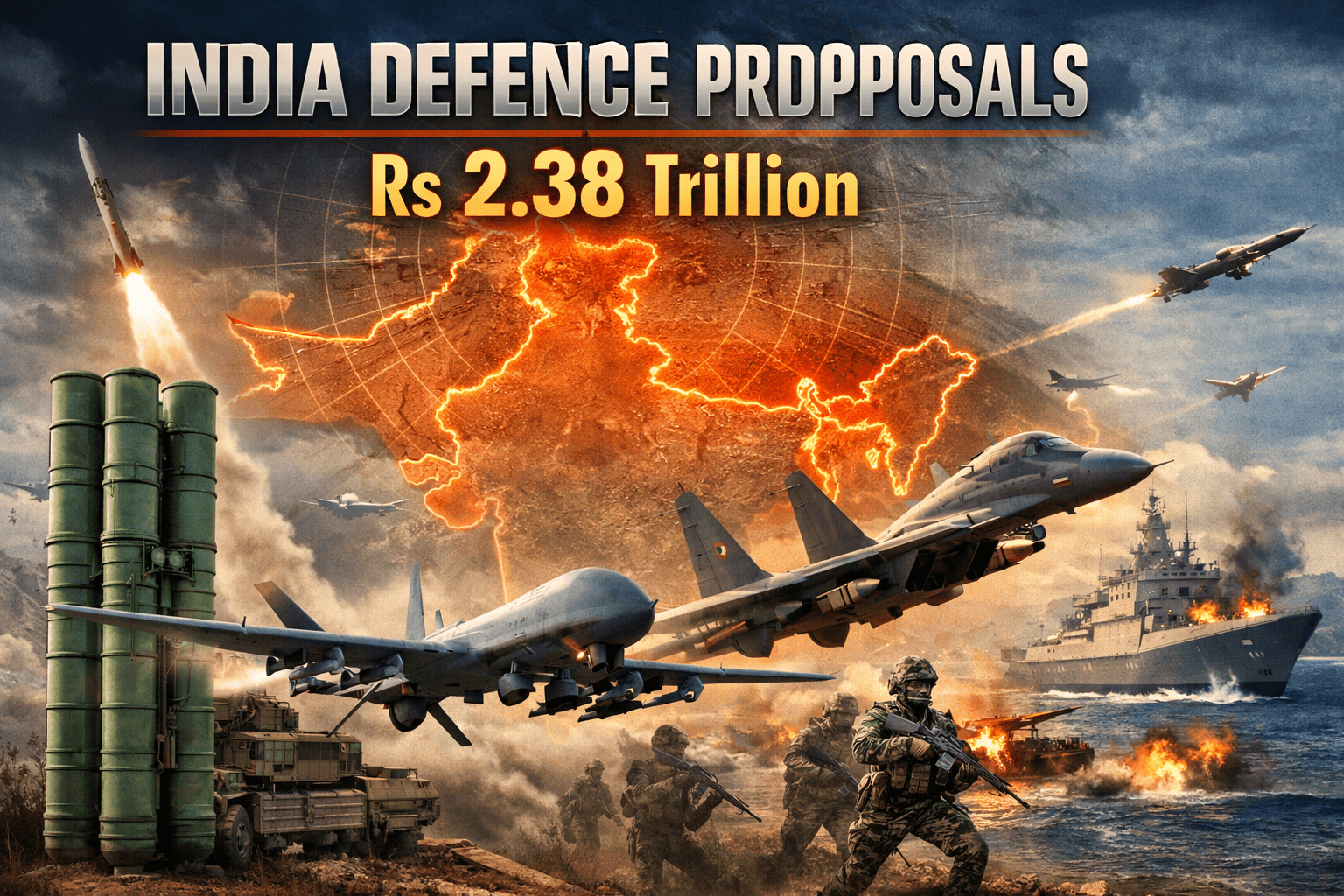
India defence proposals Rs 2.38 trillion showing S-400 system, strike drones, fighter jets and military architecture shift

India’s Rs 2.38 trillion defence approvals signal a shift toward integrated multi-domain warfare architecture

0
SHARES
19
VIEWS
Share on LinkedinShare on FacebookShare on Twitter

India Defence Proposals Rs 2.38 Trillion Is Not Procurement. It Is Architecture.

The approval of India defence proposals Rs 2.38 trillion is being widely interpreted as another large capital outlay in India’s long modernization cycle. That reading is incomplete. What was cleared on 27 March 2026 is better understood as an architectural shift in how India intends to fight, absorb, and shape conflict across two fronts. The mix of systems approved reveals intent far more clearly than the aggregate value.

What stands out immediately is the convergence of three capability layers. Long-range air defence through additional S-400 regiments, offensive reach via remotely piloted strike aircraft, and mobility through medium transport aircraft are being built in parallel.

This is not a coincidence. It reflects a move toward compressing the sensor-to-shooter loop, where detection, decision, and engagement timelines are shortened across domains. The objective is not platform superiority in isolation but decision superiority under pressure.

The deeper driver of this shift is operational experience. The 2025 Sindoor operation, widely referenced in defence circles as a real-world capability audit, exposed gaps in coverage, integration, and response speed.

India defence proposals Rs 2.38 trillion should therefore be read as a corrective layer applied to a tested system rather than a theoretical upgrade. This distinction matters because it anchors procurement in observed vulnerability rather than projected threat.

Airpower Reality: Managing Deficit Through Distributed Operations

At first glance, the aircraft component within India defence proposals Rs 2.38 trillion appears to address the Indian Air Force’s long-standing squadron shortfall. However, the structural logic runs deeper.

India is not attempting to close the numerical gap with China’s airpower. It is attempting to manage that gap through dispersion, survivability, and networked operations.

China’s People’s Liberation Army Air Force has built scale, supported by hardened infrastructure across the Tibetan plateau and long-range logistics. India cannot mirror this symmetrically.

Instead, it is shifting toward distributed air operations where aircraft are dispersed, redeployed rapidly, and integrated with ground-based air defence and ISR systems. This reduces vulnerability to pre-emptive strikes and complicates adversary targeting.

This approach introduces trade-offs. A distributed force is harder to coordinate and places greater demand on communication networks and command systems. It also increases dependence on logistics, particularly rapid resupply and maintenance cycles.

The implication is that aircraft acquisition alone does not solve the airpower equation. It must be embedded within a broader operational framework that prioritizes resilience over concentration.

S-400 Expansion: Denial as a Precondition for Offensive Freedom

The expansion of S-400 systems within India defence proposals Rs 2.38 trillion is often framed as a defensive measure. In reality, it is an enabler of offensive flexibility. By extending engagement ranges and improving tracking capability, S-400 creates protected zones within which Indian airpower and strike assets can operate with reduced risk.

Operational experience has already demonstrated both its strengths and its limitations. Initial deployments proved effective but left exploitable coverage gaps along the western front . The decision to expand toward a denser network is therefore less about redundancy and more about closing those gaps to create overlapping denial zones.

This layered structure becomes clearer when mapped:

Layer System Role Strategic Function
Long-range S-400 Aircraft, AWACS, ballistic threats Area denial
Medium-range MR-SAM / Akash NG Cruise missiles, fighters Defensive depth
Short-range VSHORADS / ADTS Drones, low-level threats Tactical protection

The strategic effect is cumulative. An adversary must now plan for penetration across multiple layers, increasing mission complexity and cost. More importantly, this allows India to reallocate offensive assets rather than tying them down to defensive roles. India defence proposals Rs 2.38 trillion thus uses defence as a force multiplier for offence, a relationship that is often underappreciated.

Strike Drones: From Tactical Utility to Doctrinal Core

The approval of remotely piloted strike aircraft marks one of the most consequential shifts embedded within India defence proposals Rs 2.38 trillion. This is not simply an expansion of surveillance capability. It is the formal integration of unmanned systems into offensive air doctrine.

Recent conflicts have demonstrated the effectiveness of drones in shaping battlefield outcomes at relatively low cost. India’s own operational experience has validated the role of loitering munitions in precision strike scenarios . The transition now is toward larger, more capable systems that can operate persistently and integrate with broader strike networks.

However, this shift carries inherent vulnerabilities. Drones depend heavily on communication links and are susceptible to electronic warfare. Adversaries such as China have invested extensively in jamming and spoofing capabilities. This creates a paradox. The very systems that enhance operational flexibility can become liabilities if not protected within a resilient network.

The industrial dimension is equally important. Unlike traditional platforms, drones offer a pathway for domestic development and rapid iteration. This aligns with India’s push for greater control over critical technologies. In this sense, India defence proposals Rs 2.38 trillion is not just adopting a capability trend. It is attempting to internalize it within its defence ecosystem.

Logistics as Strategy: The Airlift Constraint Against China

The inclusion of medium transport aircraft addresses one of the least discussed but most consequential asymmetries in the India-China military balance. Airlift capacity determines how quickly forces can be moved, sustained, and reinforced across geographically dispersed theatres.

China’s induction of the Y-20 transport aircraft has significantly enhanced its ability to project and sustain forces along the Tibetan plateau. India’s reliance on aging AN-32 and limited IL-76 fleets creates a bottleneck. This is not merely a logistical issue. It directly affects operational timelines and strategic options.

India defence proposals Rs 2.38 trillion acknowledges this constraint but does not immediately resolve it. The acquisition process for transport aircraft is long, involving vendor selection, production, and delivery cycles. This creates a temporal gap between recognition of the problem and actual capability deployment.

The implication is that logistics remains a binding constraint on India’s strategy. Even as air defence and strike capabilities improve, the ability to sustain operations across multiple fronts will depend on how quickly this gap is addressed.

Integration: India’s Real Battlefield, Not the Border

The most critical challenge embedded within India defence proposals Rs 2.38 trillion is integration. The systems being acquired span different domains, suppliers, and technological ecosystems. Their effectiveness depends on how well they can operate as part of a unified network.

At present, this remains a work in progress. Imported systems such as the S-400 operate within distinct architectures. Indigenous systems follow different standards. Bridging these requires not just technical solutions but doctrinal alignment and institutional coordination.

The concept of a sensor-shooter grid is central here. Data from radars, drones, and aircraft must be fused in real time to enable rapid decision-making. Delays or fragmentation in this process reduce the effectiveness of even the most advanced systems.

India defence proposals Rs 2.38 trillion therefore shifts the focus from acquisition to integration. The success of this investment will depend less on delivery timelines and more on the ability to create a coherent operational network.

Two-Front Scenario: How the Architecture Functions Under Pressure

To understand the operational value of India defence proposals Rs 2.38 trillion, it is necessary to examine how these systems interact in a two-front contingency.

In a northern theatre, drones provide persistent surveillance over contested zones. S-400 systems establish denial bubbles that limit adversary air operations. Aircraft operate within these protected zones, focusing on strike missions. Transport aircraft sustain forward deployments and enable rapid reinforcement.

In the western theatre, the emphasis shifts toward rapid response and precision engagement. Drones and aircraft operate in coordinated strike packages, while layered air defence protects critical infrastructure.

The key insight is that these systems are not independent. Their value emerges from interaction. A useful visual would be a two-front map showing overlapping air defence coverage, drone ISR zones, and strike corridors, illustrating how the architecture functions as a whole.

The strategic implication is that India defence proposals Rs 2.38 trillion is designed for simultaneous conflict management rather than sequential engagement.

The Contradictions: Where Strategy Meets Constraint

Despite its coherence, India defence proposals Rs 2.38 trillion reveals several underlying contradictions. The reliance on S-400 systems underscores continued dependence on Russian platforms even as India deepens partnerships with the United States and Europe. This creates potential friction in technology access and geopolitical alignment.

The push for indigenous systems, particularly in drones, introduces timeline risks. Developing advanced platforms domestically requires time, during which capability gaps persist. Similarly, the scale of procurement raises questions about execution capacity. India’s acquisition system has historically struggled with delays, and sustaining the current pace will test institutional limits.

Another contradiction lies in the balance between manned and unmanned systems. While drones offer flexibility, they cannot fully replace the capabilities of manned aircraft, particularly in contested environments. Over-reliance on one at the expense of the other could create vulnerabilities.

These contradictions do not invalidate the strategy. They define its boundaries. India defence proposals Rs 2.38 trillion is as much about navigating these trade-offs as it is about building capability.

Indo-Pacific Signal: India’s Position in a Rapidly Militarising Region

The implications of India defence proposals Rs 2.38 trillion extend beyond its immediate neighbourhood. Across the Indo-Pacific, defence spending is increasing, driven by concerns over China’s expanding military footprint.

India’s latest approvals signal that it intends to remain a credible security actor within this evolving landscape. The focus on air defence, strike capability, and mobility aligns with broader regional trends, including Japan’s defence expansion and increased military cooperation within frameworks such as the Quad.

However, India’s approach remains distinct. It combines capability development with strategic autonomy, maintaining relationships across multiple partners while avoiding alignment with any single bloc. This balancing act is reflected in procurement choices that span Russian, Western, and indigenous systems.

The result is a force structure that is both diversified and complex. Whether this complexity becomes a strength or a constraint will depend on how effectively it is managed.

Closing Assessment: A Transition Phase, Not a Final State

India defence proposals Rs 2.38 trillion represents a transition point rather than an endpoint. It reflects a shift toward integrated, multi-domain warfare, but the architecture is still evolving.

The critical variables now are execution and integration. Procurement approvals must translate into operational capability within realistic timelines. Systems must be connected into a unified network that enables rapid decision-making. Industrial capacity must scale to support sustained modernization.

If these conditions are met, India defence proposals Rs 2.38 trillion could significantly reshape India’s deterrence posture. If not, it risks becoming another example of ambitious planning constrained by implementation realities.

FAQs

What is included in India defence proposals Rs 2.38 trillion?

The proposals include additional S-400 air defence systems, remotely piloted strike aircraft, medium transport aircraft, and various army modernization programs, covering air, land, and multi-domain capabilities.


Why is the S-400 expansion strategically important?

It strengthens India’s layered air defence network, closes coverage gaps identified in operational scenarios, and enables greater freedom for offensive air operations.


How do strike drones change India’s military doctrine?

They introduce persistent surveillance and precision strike capability without risking pilots, marking a shift toward integrating unmanned systems into offensive operations.


What is the biggest challenge in implementing these proposals?

The primary challenge is integration. Diverse systems must operate within a unified network to achieve real-time coordination and maximize effectiveness.


How does this impact the India-China military balance?

It enhances India’s defensive depth and strike flexibility but does not eliminate structural asymmetries, particularly in logistics and scale.

References & Sources:
Ministry of Defence, Government of India — Official DAC Press Release, 27 March 2026. Primary source for all AoN approvals, system descriptions, and fiscal year procurement statistics.

Tags: Editor’s Pick
Previous Post

Helicopter-Mounted Counter-Drone Systems: The Indian Army’s Answer to Kamikaze Drone Warfare

Next Post

Swarm Logistics Drones in Himalayan Warfare: Can India Close the Supply Gap with China?

IndoAsia Defense

IndoAsia Defense

IndoAsia Defense Team is a specialist research and analysis group focused on India’s military modernization and Indo-Pacific strategic dynamics. The platform delivers structured, data-driven insights on doctrine, force posture, defense technology, and regional power balance.

Next Post
Swarm logistics drones delivering military supplies in high-altitude Himalayan terrain with Indian Army presence

Swarm Logistics Drones in Himalayan Warfare: Can India Close the Supply Gap with China?

Leave a Reply Cancel reply

Login with your Social ID

Your email address will not be published. Required fields are marked *

Category

  • Air
  • Global
  • Indo-Pacific
  • Industry
  • Joint
  • Land
  • Navy
  • Tech

Defence Capabilities

  • Air Defence
  • Drones
  • Fighters
  • ISR & Mobility
  • China Military
  • Emerging Tech
  • Regional Trends
  • U.S. Posture

Strategy

  • 2035 Outlook
  • China Strategy
  • India Strategy
  • Pakistan Outlook
  • Budget
  • Exports
  • Make in India
  • Supply Chains

Operations

  • Integrated Ops
  • Procurement Reform
  • Theater Commands
  • Armour & Artillery
  • China Front
  • Future Combat
  • Pakistan Front
  • Fleet Expansion

Resources

  • India vs China Military Balance
  • Indo-Pacific Military Power Map
  • Global Military Balance Dashboard
  • Global Weapons Systems Database
  • Global Missile Systems Database
  • Indo-Pacific Defense Timeline
  • India Military Capability Index
  • About
  • Contact
  • Privacy & Policy
  • Editorial Policy
  • Cookie Policy
  • Disclaimer
  • Terms And Conditions
Facebook Linkedin X-twitter
© 2026 IndoAsia Defense. All Rights Reserved.
No Result
View All Result
  • Home
  • Air
    • Air Defence
    • Drones
    • Fighters
    • ISR & Mobility
  • Land
    • Armour & Artillery
    • China Front
    • Future Combat
    • Pakistan Front
  • Navy
    • Fleet Expansion
    • Indian Ocean
    • Maritime Security
    • Submarines
  • Indo-Pacific
    • 2035 Outlook
    • China Strategy
    • India Strategy
    • Pakistan Outlook
  • Joint
    • Integrated Ops
    • Procurement Reform
    • Theater Commands
  • Tech
    • AI & Autonomous Systems
    • Cyber
    • Electronic Warfare
    • Space
  • Industry
    • Budget
    • Exports
    • Make in India
    • Supply Chains
  • Global
    • China-Pak
    • Emerging Tech
    • Regional Trends
    • US-India