
















IndoAsia Defense
  • Home
  • Air
    • All
    • Air Defence
    • Drones
    • Fighters
    • ISR & Mobility
    Ghatak UCAV stealth, autonomy, integration

    Inside India’s Ghatak UCAV Program: Stealth, Autonomy, and the Integration Gap

    The F414 engine co-production agreement between Hindustan Aeronautics Limited and GE Aerospace

    India-US F414 Engine Deal Explained: Technology Transfer, Tejas Mk2, and AMCA

    What is the Su-57M1 India deal

    Su-57M1 for India: A Fifth-Generation Shortcut or a Strategic Dependency Trap?

    India indigenous long range surveillance radar with X-band drone detection capability

    450km Eyes, Machine-Speed Decisions: How India’s Indigenous Long Range Surveillance Radar Is Rewriting Air Defence

    Why Software Defined Radios Are the IAF’s Most Consequential Upgrade

    IAF Signs BEL Deal for Software Defined Radios: Rewiring India’s Air Combat Network

    How the Ghatak UCAV Stealth Design Redefines India’s Drone Warfare Doctrine

    Ghatak UCAV: India’s Carbon Composite Stealth Strategy Dissected

    Ballistic Missile Defense system intercepting incoming missile during midcourse phase

    How Ballistic Missile Defense Works: Inside Modern Missile Interception Systems

    Swarm logistics drones delivering military supplies in high-altitude Himalayan terrain with Indian Army presence

    Swarm Logistics Drones in Himalayan Warfare: Can India Close the Supply Gap with China?

    India’s 6th-Gen Fighter Strategy FCAS vs GCAP Explained

    India’s 6th-Gen Fighter Strategy: FCAS vs GCAP Explained

  • Land
    • All
    • Armour & Artillery
    • China Front
    • Future Combat
    • Pakistan Front
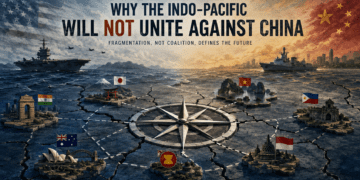
    The Indo-Pacific Is Fragmenting, Not Uniting Against China

    Why the Indo-Pacific Will Not Unite Against China

    The India-South Korea defence deal

    The India-South Korea Defence Deal Through China’s Operational Lens

    Railways as War Arteries Can India Match China’s Military Mobility Before the Next Crisis

    Railways as War Arteries: Can India Match China’s Military Mobility Before the Next Crisis?

    China maritime front in Indian Ocean

    What If China Opens a Maritime Front in the Indian Ocean During a LAC Conflict?

    What is Indian military modernization strategy in 2026?

    Indian Military Modernization: Systems, Doctrine, and Capability Architecture (2026-27)

    Tank launching loitering munition in battle

    From Smoke to Strike: India’s Indigenous Loitering Munitions for T-72, T-90, and Arjun Tanks

    How China Mobilizes Forces Along the LAC Speed, Systems, and Strategic Control

    How China Mobilizes Forces Along the LAC: Systems, Speed, and Strategic Signaling

    Ballistic Missile Defense system intercepting incoming missile during midcourse phase

    How Ballistic Missile Defense Works: Inside Modern Missile Interception Systems

    Swarm logistics drones delivering military supplies in high-altitude Himalayan terrain with Indian Army presence

    Swarm Logistics Drones in Himalayan Warfare: Can India Close the Supply Gap with China?

  • Navy
    • All
    • Fleet Expansion
    • Indian Ocean
    • Maritime Security
    • Submarines
    Mogami-class frigate deal overview

    Japan’s Mogami-Class Frigate Offer to India: What the Transfer Terms Reveal About Tokyo’s Indo-Pacific Calculus

    China maritime front in Indian Ocean

    What If China Opens a Maritime Front in the Indian Ocean During a LAC Conflict?

    The Strait of Hormuz Crisis

    India’s Oil Artery Under Threat: Strategic Implications of a Hormuz Crisis

    India’s VL-Shtil Missile Deal with Russia

    India’s VL-Shtil Missile Deal with Russia: Strengthening Naval Air Defense in the Indo-Pacific

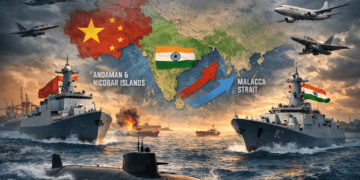
    Andaman & Nicobar Command Sleeping Giant of India’s Maritime Strategy

    Andaman & Nicobar Command: Sleeping Giant of India’s Maritime Strategy

    Maritime Surveillance 2.0: Why EO/IR Modernisation Matters for India’s Ocean Security

    Maritime Surveillance 2.0: Why EO/IR Modernisation Matters for India’s Ocean Security

    2030 Will Decide the India ASEAN Maritime Equation

    2030 Will Decide the India ASEAN Maritime Equation

    India Military Transformation Series — Part 3: Maritime Power and the Indian Ocean Imperative

    India Military Transformation Series — Part 3: Maritime Power and the Indian Ocean Imperative

    Indian Navy TEDBF PPP Model: China Factor and 2030–2040 Carrier Strategy

    Indian Navy TEDBF PPP Model: China Factor and 2030–2040 Carrier Strategy

  • Indo-Pacific
    • All
    • 2035 Outlook
    • China Strategy
    • India Strategy
    • Pakistan Outlook
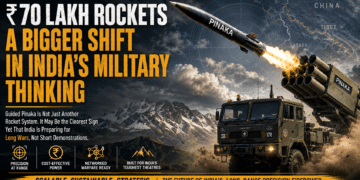
    DRDO-developed Guided Pinaka

    At ₹70 Lakh Per Rocket, DRDO-developed Guided Pinaka May Represent India’s Shift Toward Scalable Precision Warfare

    The Indo-Pacific Is Fragmenting, Not Uniting Against China

    Why the Indo-Pacific Will Not Unite Against China

    Mogami-class frigate deal overview

    Japan’s Mogami-Class Frigate Offer to India: What the Transfer Terms Reveal About Tokyo’s Indo-Pacific Calculus

    The India-South Korea defence deal

    The India-South Korea Defence Deal Through China’s Operational Lens

    Railways as War Arteries Can India Match China’s Military Mobility Before the Next Crisis

    Railways as War Arteries: Can India Match China’s Military Mobility Before the Next Crisis?

    india military integration gap

    Is India Building Military Power Faster Than It Can Integrate It?

    China maritime front in Indian Ocean

    What If China Opens a Maritime Front in the Indian Ocean During a LAC Conflict?

    Can India Fight Beyond 30 Days? Inside India’s War Sustainment Reality

    Can India Fight Beyond 30 Days? Inside India’s War Sustainment Reality

    What is Indian military modernization strategy in 2026?

    Indian Military Modernization: Systems, Doctrine, and Capability Architecture (2026-27)

  • Joint
    • All
    • Integrated Ops
    • Procurement Reform
    • Theater Commands
    India's strategic challenge sustainability first

    India Can Strike in 22 Minutes. Can It Sustain for 22 Weeks?

    Ballistic Missile Defense system intercepting incoming missile during midcourse phase

    How Ballistic Missile Defense Works: Inside Modern Missile Interception Systems

    India defence proposals Rs 2.38 trillion showing S-400 system, strike drones, fighter jets and military architecture shift

    India Defence Proposals Rs 2.38 Trillion: Why This Approval Changes How India Will Fight, Not Just What It Buys

    DAP 2026 India’s Quiet Revolution in Defence Procurement

    DAP 2026: India’s Quiet Revolution in Defence Procurement

    Integrated Battle Groups vs China’s Western Theater Command

    Integrated Battle Groups vs China’s Western Theater Command: Can Doctrine Survive the Himalayan Reality?

    Andaman & Nicobar Command Sleeping Giant of India’s Maritime Strategy

    Andaman & Nicobar Command: Sleeping Giant of India’s Maritime Strategy

    India Military Transformation Series — Part 2: The Theatre Command Reckoning

    India Military Transformation Series — Part 2: The Theatre Command Reckoning

    India AI C4ISR modernization

    India Military Transformation Series — Part 1: India AI C4ISR Modernization

    India’s Two-Front Theatre Command: Preparing for Simultaneous Conflict

    India’s Two-Front Theatre Command: Preparing for Simultaneous Conflict

  • Tech
    • All
    • AI & Autonomous Systems
    • Cyber
    • Electronic Warfare
    • Space
    Why Software Defined Radios Are the IAF’s Most Consequential Upgrade

    IAF Signs BEL Deal for Software Defined Radios: Rewiring India’s Air Combat Network

    Source Code or ICD India’s Source Code Negotiation Explained

    Source Code or ICD: India’s Source Code Negotiation Explained

    Supply Chain Weaponization

    Supply Chain Weaponization: Strategic Autonomy Meets Semiconductor Reality

    AI-driven battlefield in India's military

    The Algorithm of Borders: What India’s Military AI Push Actually Looks Like on the Ground

    India AI C4ISR modernization

    India Military Transformation Series — Part 1: India AI C4ISR Modernization

    PRAHAR Explained India Counter Terror Policy Prahaar

    PRAHAAR Explained: Why ‘PRAHAAR’ India’s National Counter-terrorism Doctrine, Signals the End of Traditional Warfare

    The Weapons Making the AMCA Unbeatable

    The Weapons Making the AMCA Unbeatable

    India’s Aerospace Ecosystem After Rafale: The 2026–2030 Industrial Test

    India’s Aerospace Ecosystem After Rafale: The 2026–2030 Industrial Test

    PLA’s Cyber Warfare Units and the Question of Indian Critical Infrastructure Resilience

    PLA’s Cyber Warfare Units and the Question of Indian Critical Infrastructure Resilience

  • Industry
    • All
    • Budget
    • Exports
    • Make in India
    • Supply Chains
    India's strategic challenge sustainability first

    India Can Strike in 22 Minutes. Can It Sustain for 22 Weeks?

    India-UAE defence pact and Gulf strategy

    India-UAE Defence Pact: Why Abu Dhabi Is Becoming India’s Western Strategic Depth

    Ghatak UCAV stealth, autonomy, integration

    Inside India’s Ghatak UCAV Program: Stealth, Autonomy, and the Integration Gap

    The India-South Korea defence deal

    The India-South Korea Defence Deal Through China’s Operational Lens

    The F414 engine co-production agreement between Hindustan Aeronautics Limited and GE Aerospace

    India-US F414 Engine Deal Explained: Technology Transfer, Tejas Mk2, and AMCA

    Why Software Defined Radios Are the IAF’s Most Consequential Upgrade

    IAF Signs BEL Deal for Software Defined Radios: Rewiring India’s Air Combat Network

    How the Ghatak UCAV Stealth Design Redefines India’s Drone Warfare Doctrine

    Ghatak UCAV: India’s Carbon Composite Stealth Strategy Dissected

    Swarm logistics drones delivering military supplies in high-altitude Himalayan terrain with Indian Army presence

    Swarm Logistics Drones in Himalayan Warfare: Can India Close the Supply Gap with China?

    India defence proposals Rs 2.38 trillion showing S-400 system, strike drones, fighter jets and military architecture shift

    India Defence Proposals Rs 2.38 Trillion: Why This Approval Changes How India Will Fight, Not Just What It Buys

  • Global
    • All
    • China-Pak
    • Emerging Tech
    • Middle Eeast
    • Regional Trends
    • US-India
    • US-Israel
    India-UAE defence pact and Gulf strategy

    India-UAE Defence Pact: Why Abu Dhabi Is Becoming India’s Western Strategic Depth

    The Indo-Pacific Is Fragmenting, Not Uniting Against China

    Why the Indo-Pacific Will Not Unite Against China

    Ghatak UCAV stealth, autonomy, integration

    Inside India’s Ghatak UCAV Program: Stealth, Autonomy, and the Integration Gap

    The F414 engine co-production agreement between Hindustan Aeronautics Limited and GE Aerospace

    India-US F414 Engine Deal Explained: Technology Transfer, Tejas Mk2, and AMCA

    india military integration gap

    Is India Building Military Power Faster Than It Can Integrate It?

    India indigenous long range surveillance radar with X-band drone detection capability

    450km Eyes, Machine-Speed Decisions: How India’s Indigenous Long Range Surveillance Radar Is Rewriting Air Defence

    What is Indian military modernization strategy in 2026?

    Indian Military Modernization: Systems, Doctrine, and Capability Architecture (2026-27)

    India defence proposals Rs 2.38 trillion showing S-400 system, strike drones, fighter jets and military architecture shift

    India Defence Proposals Rs 2.38 Trillion: Why This Approval Changes How India Will Fight, Not Just What It Buys

    India’s 6th-Gen Fighter Strategy FCAS vs GCAP Explained

    India’s 6th-Gen Fighter Strategy: FCAS vs GCAP Explained

  • Resources
    • India Military Capability Index
    • India vs China Military Balance
    • China Western Theater Command Guide
    • Pakistan Military Tracker 2026-27
    • India’s Military Doctrine Library
    • India vs China vs Pakistan Missile Arsenal Comparison
    • India’s Missile List
    • India Missile Range Map
    • Indo-Pacific Military Power Map
    • Indo-Pacific Defense Timeline
    • Global Military Balance Dashboard
    • Global Weapons Systems Database
    • Global Missile Systems Database
  • What If
    • China India Naval Conflict
No Result
View All Result
  • Home
  • Air
    • All
    • Air Defence
    • Drones
    • Fighters
    • ISR & Mobility
    Ghatak UCAV stealth, autonomy, integration

    Inside India’s Ghatak UCAV Program: Stealth, Autonomy, and the Integration Gap

    The F414 engine co-production agreement between Hindustan Aeronautics Limited and GE Aerospace

    India-US F414 Engine Deal Explained: Technology Transfer, Tejas Mk2, and AMCA

    What is the Su-57M1 India deal

    Su-57M1 for India: A Fifth-Generation Shortcut or a Strategic Dependency Trap?

    India indigenous long range surveillance radar with X-band drone detection capability

    450km Eyes, Machine-Speed Decisions: How India’s Indigenous Long Range Surveillance Radar Is Rewriting Air Defence

    Why Software Defined Radios Are the IAF’s Most Consequential Upgrade

    IAF Signs BEL Deal for Software Defined Radios: Rewiring India’s Air Combat Network

    How the Ghatak UCAV Stealth Design Redefines India’s Drone Warfare Doctrine

    Ghatak UCAV: India’s Carbon Composite Stealth Strategy Dissected

    Ballistic Missile Defense system intercepting incoming missile during midcourse phase

    How Ballistic Missile Defense Works: Inside Modern Missile Interception Systems

    Swarm logistics drones delivering military supplies in high-altitude Himalayan terrain with Indian Army presence

    Swarm Logistics Drones in Himalayan Warfare: Can India Close the Supply Gap with China?

    India’s 6th-Gen Fighter Strategy FCAS vs GCAP Explained

    India’s 6th-Gen Fighter Strategy: FCAS vs GCAP Explained

  • Land
    • All
    • Armour & Artillery
    • China Front
    • Future Combat
    • Pakistan Front
    The Indo-Pacific Is Fragmenting, Not Uniting Against China

    Why the Indo-Pacific Will Not Unite Against China

    The India-South Korea defence deal

    The India-South Korea Defence Deal Through China’s Operational Lens

    Railways as War Arteries Can India Match China’s Military Mobility Before the Next Crisis

    Railways as War Arteries: Can India Match China’s Military Mobility Before the Next Crisis?

    China maritime front in Indian Ocean

    What If China Opens a Maritime Front in the Indian Ocean During a LAC Conflict?

    What is Indian military modernization strategy in 2026?

    Indian Military Modernization: Systems, Doctrine, and Capability Architecture (2026-27)

    Tank launching loitering munition in battle

    From Smoke to Strike: India’s Indigenous Loitering Munitions for T-72, T-90, and Arjun Tanks

    How China Mobilizes Forces Along the LAC Speed, Systems, and Strategic Control

    How China Mobilizes Forces Along the LAC: Systems, Speed, and Strategic Signaling

    Ballistic Missile Defense system intercepting incoming missile during midcourse phase

    How Ballistic Missile Defense Works: Inside Modern Missile Interception Systems

    Swarm logistics drones delivering military supplies in high-altitude Himalayan terrain with Indian Army presence

    Swarm Logistics Drones in Himalayan Warfare: Can India Close the Supply Gap with China?

  • Navy
    • All
    • Fleet Expansion
    • Indian Ocean
    • Maritime Security
    • Submarines
    Mogami-class frigate deal overview

    Japan’s Mogami-Class Frigate Offer to India: What the Transfer Terms Reveal About Tokyo’s Indo-Pacific Calculus

    China maritime front in Indian Ocean

    What If China Opens a Maritime Front in the Indian Ocean During a LAC Conflict?

    The Strait of Hormuz Crisis

    India’s Oil Artery Under Threat: Strategic Implications of a Hormuz Crisis

    India’s VL-Shtil Missile Deal with Russia

    India’s VL-Shtil Missile Deal with Russia: Strengthening Naval Air Defense in the Indo-Pacific

    Andaman & Nicobar Command Sleeping Giant of India’s Maritime Strategy

    Andaman & Nicobar Command: Sleeping Giant of India’s Maritime Strategy

    Maritime Surveillance 2.0: Why EO/IR Modernisation Matters for India’s Ocean Security

    Maritime Surveillance 2.0: Why EO/IR Modernisation Matters for India’s Ocean Security

    2030 Will Decide the India ASEAN Maritime Equation

    2030 Will Decide the India ASEAN Maritime Equation

    India Military Transformation Series — Part 3: Maritime Power and the Indian Ocean Imperative

    India Military Transformation Series — Part 3: Maritime Power and the Indian Ocean Imperative

    Indian Navy TEDBF PPP Model: China Factor and 2030–2040 Carrier Strategy

    Indian Navy TEDBF PPP Model: China Factor and 2030–2040 Carrier Strategy

  • Indo-Pacific
    • All
    • 2035 Outlook
    • China Strategy
    • India Strategy
    • Pakistan Outlook
    DRDO-developed Guided Pinaka

    At ₹70 Lakh Per Rocket, DRDO-developed Guided Pinaka May Represent India’s Shift Toward Scalable Precision Warfare

    The Indo-Pacific Is Fragmenting, Not Uniting Against China

    Why the Indo-Pacific Will Not Unite Against China

    Mogami-class frigate deal overview

    Japan’s Mogami-Class Frigate Offer to India: What the Transfer Terms Reveal About Tokyo’s Indo-Pacific Calculus

    The India-South Korea defence deal

    The India-South Korea Defence Deal Through China’s Operational Lens

    Railways as War Arteries Can India Match China’s Military Mobility Before the Next Crisis

    Railways as War Arteries: Can India Match China’s Military Mobility Before the Next Crisis?

    india military integration gap

    Is India Building Military Power Faster Than It Can Integrate It?

    China maritime front in Indian Ocean

    What If China Opens a Maritime Front in the Indian Ocean During a LAC Conflict?

    Can India Fight Beyond 30 Days? Inside India’s War Sustainment Reality

    Can India Fight Beyond 30 Days? Inside India’s War Sustainment Reality

    What is Indian military modernization strategy in 2026?

    Indian Military Modernization: Systems, Doctrine, and Capability Architecture (2026-27)

  • Joint
    • All
    • Integrated Ops
    • Procurement Reform
    • Theater Commands
    India's strategic challenge sustainability first

    India Can Strike in 22 Minutes. Can It Sustain for 22 Weeks?

    Ballistic Missile Defense system intercepting incoming missile during midcourse phase

    How Ballistic Missile Defense Works: Inside Modern Missile Interception Systems

    India defence proposals Rs 2.38 trillion showing S-400 system, strike drones, fighter jets and military architecture shift

    India Defence Proposals Rs 2.38 Trillion: Why This Approval Changes How India Will Fight, Not Just What It Buys

    DAP 2026 India’s Quiet Revolution in Defence Procurement

    DAP 2026: India’s Quiet Revolution in Defence Procurement

    Integrated Battle Groups vs China’s Western Theater Command

    Integrated Battle Groups vs China’s Western Theater Command: Can Doctrine Survive the Himalayan Reality?

    Andaman & Nicobar Command Sleeping Giant of India’s Maritime Strategy

    Andaman & Nicobar Command: Sleeping Giant of India’s Maritime Strategy

    India Military Transformation Series — Part 2: The Theatre Command Reckoning

    India Military Transformation Series — Part 2: The Theatre Command Reckoning

    India AI C4ISR modernization

    India Military Transformation Series — Part 1: India AI C4ISR Modernization

    India’s Two-Front Theatre Command: Preparing for Simultaneous Conflict

    India’s Two-Front Theatre Command: Preparing for Simultaneous Conflict

  • Tech
    • All
    • AI & Autonomous Systems
    • Cyber
    • Electronic Warfare
    • Space
    Why Software Defined Radios Are the IAF’s Most Consequential Upgrade

    IAF Signs BEL Deal for Software Defined Radios: Rewiring India’s Air Combat Network

    Source Code or ICD India’s Source Code Negotiation Explained

    Source Code or ICD: India’s Source Code Negotiation Explained

    Supply Chain Weaponization

    Supply Chain Weaponization: Strategic Autonomy Meets Semiconductor Reality

    AI-driven battlefield in India's military

    The Algorithm of Borders: What India’s Military AI Push Actually Looks Like on the Ground

    India AI C4ISR modernization

    India Military Transformation Series — Part 1: India AI C4ISR Modernization

    PRAHAR Explained India Counter Terror Policy Prahaar

    PRAHAAR Explained: Why ‘PRAHAAR’ India’s National Counter-terrorism Doctrine, Signals the End of Traditional Warfare

    The Weapons Making the AMCA Unbeatable

    The Weapons Making the AMCA Unbeatable

    India’s Aerospace Ecosystem After Rafale: The 2026–2030 Industrial Test

    India’s Aerospace Ecosystem After Rafale: The 2026–2030 Industrial Test

    PLA’s Cyber Warfare Units and the Question of Indian Critical Infrastructure Resilience

    PLA’s Cyber Warfare Units and the Question of Indian Critical Infrastructure Resilience

  • Industry
    • All
    • Budget
    • Exports
    • Make in India
    • Supply Chains
    India's strategic challenge sustainability first

    India Can Strike in 22 Minutes. Can It Sustain for 22 Weeks?

    India-UAE defence pact and Gulf strategy

    India-UAE Defence Pact: Why Abu Dhabi Is Becoming India’s Western Strategic Depth

    Ghatak UCAV stealth, autonomy, integration

    Inside India’s Ghatak UCAV Program: Stealth, Autonomy, and the Integration Gap

    The India-South Korea defence deal

    The India-South Korea Defence Deal Through China’s Operational Lens

    The F414 engine co-production agreement between Hindustan Aeronautics Limited and GE Aerospace

    India-US F414 Engine Deal Explained: Technology Transfer, Tejas Mk2, and AMCA

    Why Software Defined Radios Are the IAF’s Most Consequential Upgrade

    IAF Signs BEL Deal for Software Defined Radios: Rewiring India’s Air Combat Network

    How the Ghatak UCAV Stealth Design Redefines India’s Drone Warfare Doctrine

    Ghatak UCAV: India’s Carbon Composite Stealth Strategy Dissected

    Swarm logistics drones delivering military supplies in high-altitude Himalayan terrain with Indian Army presence

    Swarm Logistics Drones in Himalayan Warfare: Can India Close the Supply Gap with China?

    India defence proposals Rs 2.38 trillion showing S-400 system, strike drones, fighter jets and military architecture shift

    India Defence Proposals Rs 2.38 Trillion: Why This Approval Changes How India Will Fight, Not Just What It Buys

  • Global
    • All
    • China-Pak
    • Emerging Tech
    • Middle Eeast
    • Regional Trends
    • US-India
    • US-Israel
    India-UAE defence pact and Gulf strategy

    India-UAE Defence Pact: Why Abu Dhabi Is Becoming India’s Western Strategic Depth

    The Indo-Pacific Is Fragmenting, Not Uniting Against China

    Why the Indo-Pacific Will Not Unite Against China

    Ghatak UCAV stealth, autonomy, integration

    Inside India’s Ghatak UCAV Program: Stealth, Autonomy, and the Integration Gap

    The F414 engine co-production agreement between Hindustan Aeronautics Limited and GE Aerospace

    India-US F414 Engine Deal Explained: Technology Transfer, Tejas Mk2, and AMCA

    india military integration gap

    Is India Building Military Power Faster Than It Can Integrate It?

    India indigenous long range surveillance radar with X-band drone detection capability

    450km Eyes, Machine-Speed Decisions: How India’s Indigenous Long Range Surveillance Radar Is Rewriting Air Defence

    What is Indian military modernization strategy in 2026?

    Indian Military Modernization: Systems, Doctrine, and Capability Architecture (2026-27)

    India defence proposals Rs 2.38 trillion showing S-400 system, strike drones, fighter jets and military architecture shift

    India Defence Proposals Rs 2.38 Trillion: Why This Approval Changes How India Will Fight, Not Just What It Buys

    India’s 6th-Gen Fighter Strategy FCAS vs GCAP Explained

    India’s 6th-Gen Fighter Strategy: FCAS vs GCAP Explained

  • Resources
    • India Military Capability Index
    • India vs China Military Balance
    • China Western Theater Command Guide
    • Pakistan Military Tracker 2026-27
    • India’s Military Doctrine Library
    • India vs China vs Pakistan Missile Arsenal Comparison
    • India’s Missile List
    • India Missile Range Map
    • Indo-Pacific Military Power Map
    • Indo-Pacific Defense Timeline
    • Global Military Balance Dashboard
    • Global Weapons Systems Database
    • Global Missile Systems Database
  • What If
    • China India Naval Conflict
No Result
View All Result
IndoAsia Defense
No Result
View All Result
Home Indo-Pacific India Strategy

PRAHAAR Explained: Why ‘PRAHAAR’ India’s National Counter-terrorism Doctrine, Signals the End of Traditional Warfare

India's first national counter-terrorism policy, PRAHAAR, signals a shift from hunting individuals to disrupting systems. We analyze what the focus on drones, crypto, and CBRNED reveals about the future of warfare and national security.

IndoAsia Defense by IndoAsia Defense
March 13, 2026
in Cyber, Electronic Warfare, Global, India Strategy
0
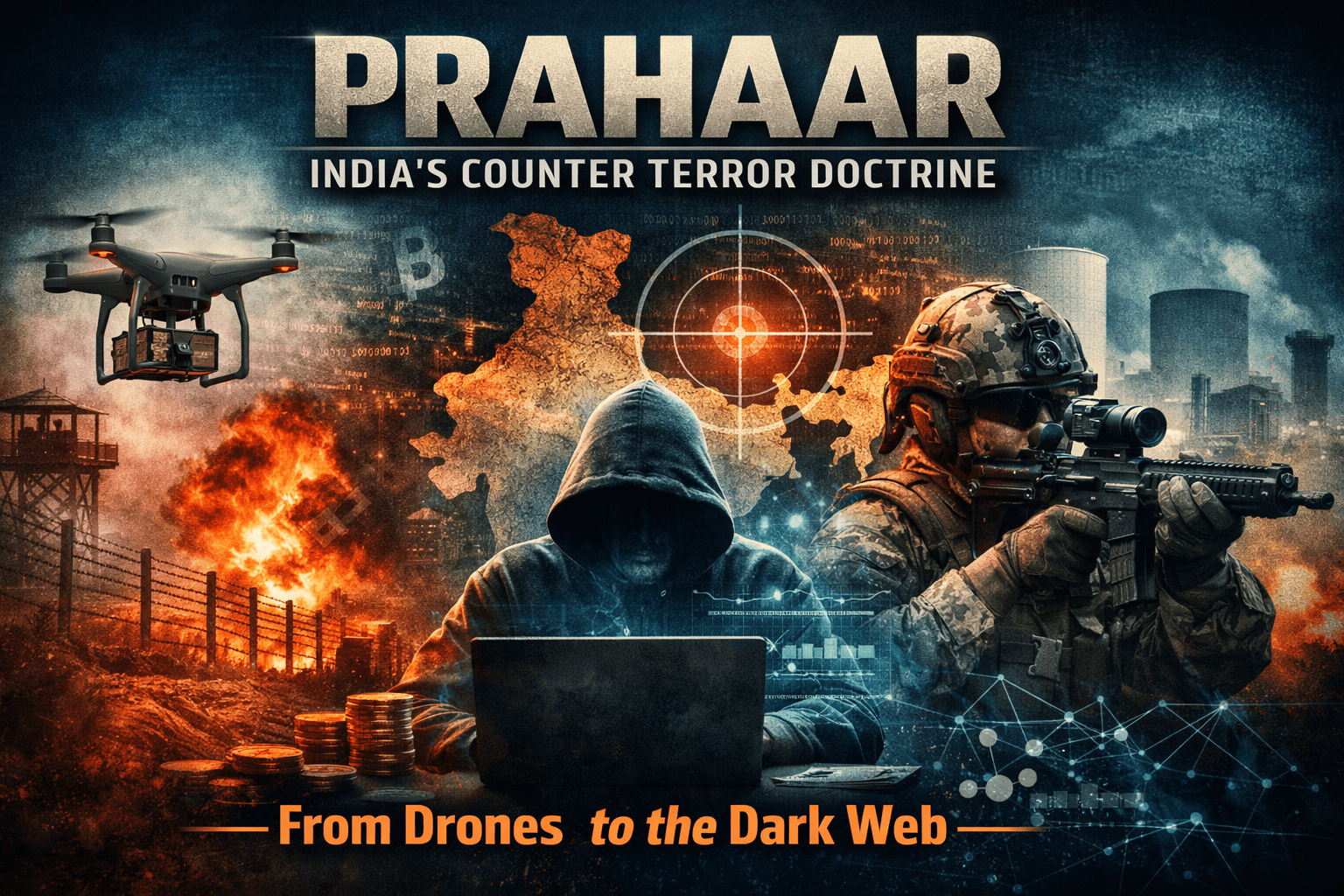
PRAHAR Explained India Counter Terror Policy Prahaar
0
SHARES
38
VIEWS
Share on LinkedinShare on FacebookShare on Twitter

When Terror Turns Algorithmic: Decoding India’s PRAHAAR Doctrine in the Age of Drones and the Dark Web

For 75+ years as an independent republic, we fought terror the way we fought everything else: we improvised.

India’s counter-terror approach was actor-centric.

Identify the group. Track the cell. Neutralise the individual. Disrupt the network.

That model assumed something fundamental: the threat had a face.

Today, it doesn’t.

A drone does not need a visa.

A crypto transfer does not cross a checkpoint.

A handler on the dark web leaves no physical trail.

And radicalisation spreads not through training camps, but through algorithms.

These are not weapons in themselves. They are delivery mechanisms. The vulnerability lies not in the tool, but in the logistical pathway the tool opens.

In this context, the release of PRAHAAR, India’s first formal counter-terror doctrine framework, marks a deeper shift than headlines suggest.

That’s the world India is operating in now. And that’s why PRAHAAR matters.

Not because it is “India’s first counter-terror policy.” But because it formally acknowledges that the battlefield has shifted from actor/group/terrain to technology.

This is not a policy about more boots. It’s about more bandwidth.

Moreover, it is an admission of something profound: the old ways of identifying an enemy no longer work.

We had brilliant laws, incredible soldiers, and an intelligence network that ran on rumor, instinct, and endless cups of tea in dingy police stations. But we never had a unified doctrine. We treated each attack as an isolated thunderstorm rather than a shifting climate pattern.

PRAHAAR is the Indian state finally admitting that the enemy is no longer a person. The enemy is a method.

And that changes absolutely everything.

It reflects a strategic recognition that terrorism has evolved from being actor-driven to architecture-driven.

Instead of focusing solely on identifying the “bad actor,” it attempts to map and disrupt the systems that enable action.

And that changes the logic of defence.

Not because it exists.

But because of what it quietly acknowledges.

In simple words, India’s threat matrix has hybridized.

The Hybrid Battlespace: Where Physical and Digital Merge

The terrorist no longer needs to get close. He can sit in a café in Lahore or London, launch a drone from across the border, pay for it with Bitcoin mined in Russia, and watch the destruction on a live feed, all while his fingerprints exist nowhere in the physical world.

Terrorism is no longer linear. It is modular.

So what does a counter-terrorism policy do when the enemy doesn’t need to be physically present?

It has to stop thinking like a policeman and start thinking like a system administrator.

PRAHAAR, at its core, is an attempt to treat these nodes not as separate threats — but as one system.

That distinction is doctrinally important.

The Shift from Arrests to Architecture in PRAHAAR

This is where PRAHAAR gets interesting, and where most analysis misses the point.

Everyone is focusing on the cool tech—the anti-drone systems, the blockchain analysis tools.

But the real revolution in this policy is buried in the boring stuff: the legal frameworks, the inter-agency coordination protocols, the emphasis on high prosecution rates.

Why does prosecution matter in an age of drones?

Because if you can’t arrest the man flying the drone, you have to make the drone itself unusable.

You have to disrupt the system that allows the attack to happen.

That means going after the supply chains for drone components.

It means working with financial institutions to flag crypto transactions that follow suspicious patterns. It means building international coalitions to pressure countries that host these operators.

It means training local police to recognize the digital breadcrumbs that precede an attack—a sudden spike in encrypted messaging in a specific neighborhood, a weird purchase of chemicals that could be precursors for explosives.

PRAHAAR is trying to build an architecture of denial.

It’s not just about catching the bad guy after he strikes. It’s about making the strike impossible in the first place by closing off every avenue he might use.

The Drone Variable: Tactical Disruption at Civilian Cost

The proliferation of small unmanned aerial systems has fundamentally altered asymmetric warfare.

The real concern is not cinematic drone swarms. It is simple, affordable platforms available off-the-shelf, modified with modest technical skill, and deployed for logistics, reconnaissance, or weapon delivery.

The economics are unsettling. A relatively inexpensive platform can impose disproportionate disruption on high-value targets. The cost curve favours the attacker.

More importantly, commercial drone technology is evolving at civilian speed, not military procurement speed. Autonomy, navigation precision, stabilisation systems — these are improving annually.

That creates a structural gap.

Countering this threat cannot remain confined to strategic installations.

District-level law enforcement must understand airspace management. Radio-frequency detection and soft-kill jamming systems must extend beyond military perimeters.

Civil aviation regulators, local police, and intelligence agencies must operate within a shared framework.

PRAHAAR implicitly recognises that low-altitude airspace is now part of counter-terror doctrine.

That is not incremental reform. It is a conceptual shift.

The Dark Web and the Encryption Challenge

The dark web is often portrayed as a shadow universe. In reality, it is an anonymity amplifier.

It enables coordination without identity trails, financing without traditional intermediaries, and propaganda dissemination without public scrutiny.

But the larger challenge lies in encryption becoming mainstream. Radicalisation pipelines now move across layers: public narrative seeding, private messaging amplification, encrypted consolidation, anonymous financing.

By the time physical intent materialises, digital traces are fragmented across jurisdictions and platforms.

Traditional reactive models struggle in this environment.

What is required instead is predictive capability — behavioural anomaly detection, financial pattern recognition, cross-platform metadata synthesis.

PRAHAAR signals recognition of this reality.

Execution will determine whether recognition translates into resilience.

The CBRNED Question: Why We Should Be Anxious

Let’s talk about that acronym.

CBRNED. Chemical, Biological, Radiological, Nuclear, Explosive, Digital.

Reading it in a government document is chilling because it represents the democratization of mass destruction.

For most of history, only states could inflict mass casualties. It took an army, a logistics chain, and industrial capacity.

What the last twenty years have shown is that non-state actors are getting smarter, more organized, and more patient.

They watch. They learn. They acquire skills.

The policy admits that disrupting terrorist efforts to access these materials “remains a challenge.” That is bureaucratic understatement for: we are terrified of what happens if they succeed.

A biological attack doesn’t require a nuclear reactor. It requires a lab, a motivated biologist, and a supply chain for pathogens.

A radiological attack—a dirty bomb—doesn’t require enriched uranium. It requires radioactive material from a hospital or an industrial site, wrapped in conventional explosives.

PRAHAAR is the government saying: we know the threat matrix has expanded beyond bullets and bombs. We know we have to secure not just our borders, but every hospital, every lab, every chemical plant.

It is an acknowledgment that the homeland security state must now extend into the most mundane corners of our infrastructure.

The Missing Piece: The Psychology of Resilience

If I had to add one dimension that the policy touches on but doesn’t fully explore, it is the civilian psychology of resilience.

Terrorism has always had two targets: the direct victims and the watching population.

The goal is to create fear, to disrupt normalcy, to make people feel unsafe in their own country. In the age of drones and cyberattacks, that fear can be generated remotely and constantly.

In an era of instant amplification, misinformation spreads faster than the truth. The terrorist’s goal is achieved if the public loses trust in the state’s ability to protect them. Public panic becomes a force multiplier for attackers.

What PRAHAAR doesn’t yet articulate is how the government plans to manage the information environment during and after an attack. In a world where every citizen has a camera and every platform amplifies outrage, the narrative of an attack is contested in real-time.

A modern counter-terror doctrine must include rapid, transparent and credible communication systems. Not propaganda — but structured information release that preserves social trust.

Civilian resilience is not a soft variable. It is a national security asset.

If citizens maintain confidence in institutional competence, the psychological objective of terrorism weakens.

Security-Industry Technical Analysis: What Implementation Demands

Policy declarations do not build capability. Systems do.

If PRAHAAR is to move beyond intent, India’s security architecture must evolve across several technical domains.

First, integrated counter-UAS capability must become layered. That means combining RF spectrum monitoring, radar calibrated for low radar cross-section targets, electro-optical tracking, and scalable soft neutralisation tools. Hard-kill solutions alone are impractical in dense urban zones. Signal disruption and controlled takeover systems will become essential.

Second, AI-assisted intelligence analytics must mature rapidly. Manual review of digital signals cannot keep pace with network velocity. Pattern recognition models trained on behavioural signatures — not just flagged keywords — will define early disruption success. Reducing false positives while preserving operational sensitivity will be the key engineering challenge.

Third, blockchain and crypto forensics require institutional depth. Digital asset tracking tools exist globally, but domestic scaling and courtroom admissibility standards must improve. Terror financing increasingly exploits fragmentation and micro-transactions. The counter-framework must be equally adaptive.

Fourth, inter-agency data architecture must modernise. Siloed intelligence remains a structural vulnerability. PRAHAAR’s long-term success depends on federated, access-controlled, real-time data integration across central and state entities.

Finally, human capital must align with technology. District police forces require technical literacy in drone protocols. Cyber units need advanced forensic skill sets. Prosecutors must understand digital evidence chains.

Counter-terrorism is no longer a purely tactical discipline. It is interdisciplinary.

Industrial Implications: A Domestic Security-Tech Opportunity

There is an under-discussed dimension here.

If implemented coherently, PRAHAAR could catalyse India’s homeland security technology ecosystem.

Startups focused on AI surveillance analytics, counter-drone systems, secure communications, and blockchain tracing now operate in a policy climate that formally validates their strategic relevance.

With structured procurement reform and sustained funding, India could witness the emergence of a mature internal security tech sector by 2030.

That would strengthen resilience while deepening industrial capacity.

Security and economic policy would converge.

2026–2030 PRAHAAR Projection: The Next Five Years Will Decide

Policies are intent. Outcomes depend on execution velocity.

Between 2026 and 2030, India’s internal security grid could transform — or stagnate.

Drone density across India is likely to expand significantly as civilian adoption accelerates. A realistic projection suggests a multi-fold increase in low-altitude UAV presence by the end of the decade. That expands the potential threat surface.

If PRAHAAR implementation scales effectively, by 2028 India could see structured counter-UAS grids across border states, RF detection coverage around critical metropolitan infrastructure, and standardised district drone-response protocols nationwide.

Without that scaling, vulnerabilities widen.

On the digital front, AI-assisted anomaly detection could realistically reduce intelligence processing lag by 30–40 percent if integrated properly. That compression of response time changes the disruption equation fundamentally.

In financial monitoring, effective blockchain analytics integration could raise traceability rates for flagged wallets significantly, eroding the invisibility advantage of crypto-based terror financing.

The most difficult transformation, however, will be institutional. Intelligence fusion remains India’s historic stress point. By 2030, success would mean federated data systems, synchronised legal workflows, and shorter prosecution timelines.

If conviction cycles compress even modestly, deterrence credibility rises.

But none of this occurs automatically.

Sustained budgetary growth in counter-terror technology — potentially in the range of consistent double-digit annual increases — would be necessary to fund AI infrastructure, counter-drone hardware, and digital forensic scaling.

Two futures are visible.

In one, PRAHAAR becomes partially implemented doctrine — uneven, fragmented, reactive.

In the other, it evolves into a layered disruption grid where the cost of organising and executing attacks inside India rises sharply.

Modern counter-terrorism is about increasing friction.

The next five years will determine whether India successfully raises that cost curve.

The Strategic Significance: Mirror Test

Ultimately, PRAHAAR eflects India’s strategic maturity. We are a nation that no longer fights wars on neat little battlefields.

Terrorism has modularised.

We fight them in the labyrinthine corridors of the dark web, in the silent flight of drones over Punjab, in the encrypted chats of radicalized youth.

Planning, financing, communication, execution — each node can now function across physical and digital layers with minimal overlap.

To counter that, India must modularise its defence architecture — and then integrate those modules seamlessly.

PRAHAAR signals that New Delhi understands this transformation.

The policy is not perfect. It will be tested, probably soon. But its very existence marks a shift in India’s strategic consciousness.

We have stopped reacting. We are trying to anticipate. We are trying to build a shield that is as adaptive as the sword that swings at us.

And in a world where the enemy is just a method, a system, a ghost in the machine, that is the only kind of defense that might actually work.

The real test will not be policy articulation. It will be integration speed. Because in the age of drones and dark networks, the decisive advantage does not belong to the strongest actor.

It belongs to the fastest integrator.

Tags: Editor’s Pick
Previous Post

What Israel’s Golden Horizon Missile Offer Means for India’s Two-Front Strategy

Next Post

India Military Transformation Series — Part 1: India AI C4ISR Modernization

IndoAsia Defense

IndoAsia Defense

IndoAsia Defense Team is a specialist research and analysis group focused on India’s military modernization and Indo-Pacific strategic dynamics. The platform delivers structured, data-driven insights on doctrine, force posture, defense technology, and regional power balance.

Next Post
India AI C4ISR modernization

India Military Transformation Series — Part 1: India AI C4ISR Modernization

Leave a Reply Cancel reply

Login with your Social ID

Your email address will not be published. Required fields are marked *

Category

  • Air
  • Global
  • Indo-Pacific
  • Industry
  • Joint
  • Land
  • Navy
  • Tech

Defence Capabilities

  • Air Defence
  • Drones
  • Fighters
  • ISR & Mobility
  • China Military
  • Emerging Tech
  • Regional Trends
  • U.S. Posture

Strategy

  • 2035 Outlook
  • China Strategy
  • India Strategy
  • Pakistan Outlook
  • Budget
  • Exports
  • Make in India
  • Supply Chains

Operations

  • Integrated Ops
  • Procurement Reform
  • Theater Commands
  • Armour & Artillery
  • China Front
  • Future Combat
  • Pakistan Front
  • Fleet Expansion

Resources

  • India vs China Military Balance
  • Indo-Pacific Military Power Map
  • Global Military Balance Dashboard
  • Global Weapons Systems Database
  • Global Missile Systems Database
  • Indo-Pacific Defense Timeline
  • India Military Capability Index
  • About
  • Contact
  • Privacy & Policy
  • Editorial Policy
  • Cookie Policy
  • Disclaimer
  • Terms And Conditions
Facebook Linkedin X-twitter
© 2026 IndoAsia Defense. All Rights Reserved.
No Result
View All Result
  • Home
  • Air
    • Air Defence
    • Drones
    • Fighters
    • ISR & Mobility
  • Land
    • Armour & Artillery
    • China Front
    • Future Combat
    • Pakistan Front
  • Navy
    • Fleet Expansion
    • Indian Ocean
    • Maritime Security
    • Submarines
  • Indo-Pacific
    • 2035 Outlook
    • China Strategy
    • India Strategy
    • Pakistan Outlook
  • Joint
    • Integrated Ops
    • Procurement Reform
    • Theater Commands
  • Tech
    • AI & Autonomous Systems
    • Cyber
    • Electronic Warfare
    • Space
  • Industry
    • Budget
    • Exports
    • Make in India
    • Supply Chains
  • Global
    • China-Pak
    • Emerging Tech
    • Regional Trends
    • US-India