















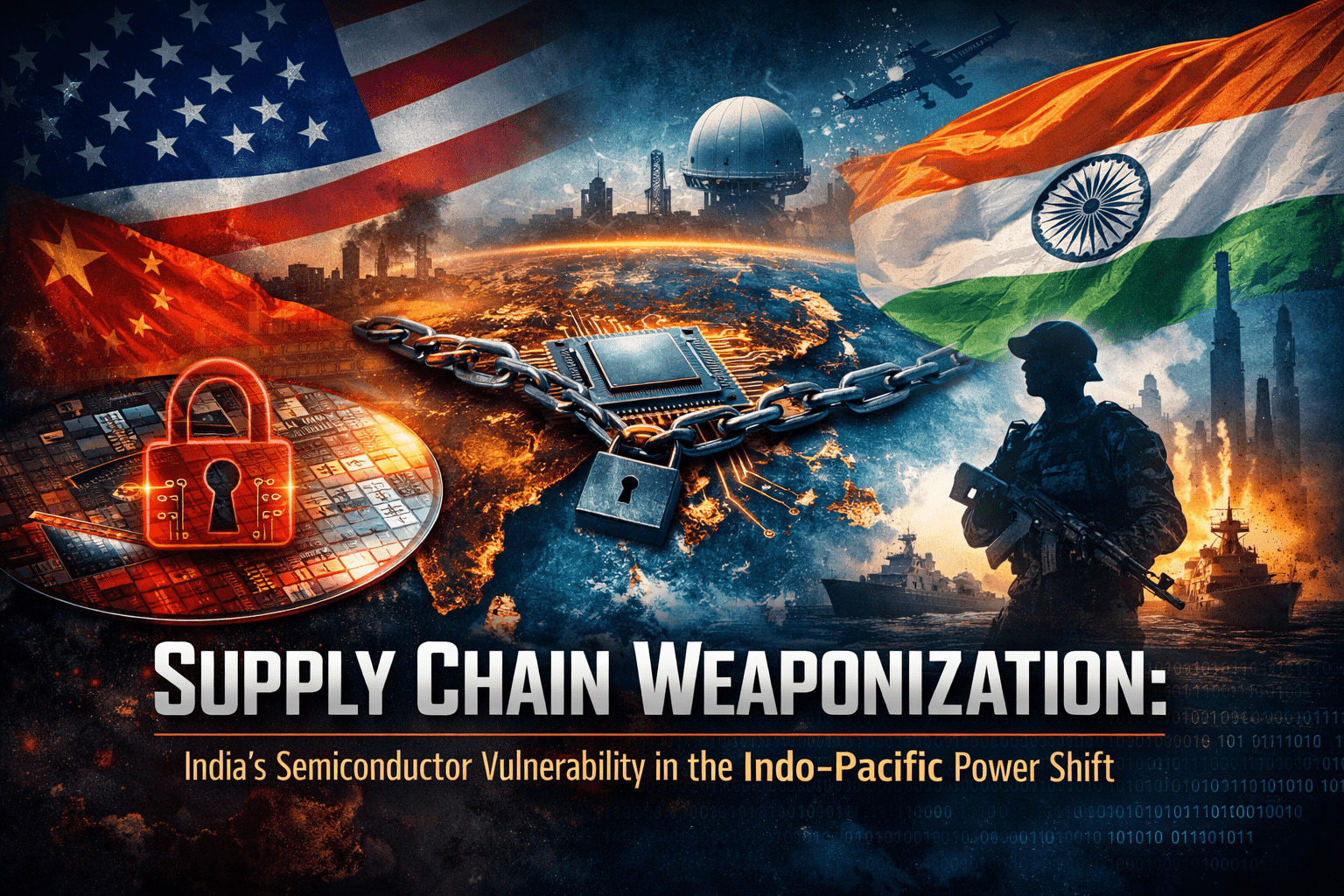
Supply Chain Weaponization Is the New Blockade
There was a time when coercion required fleets, sanctions regimes, or energy embargoes. Today, Supply Chain Weaponization operates through something far quieter: export controls, licensing thresholds, and technology access filters.
No declarations. No dramatic ultimatums. Just categories redefined, access slowed, approvals delayed.
The global semiconductor ecosystem has become the most sophisticated geopolitical lever of the 21st century. And India, despite not being targeted, sits inside a structure where access is conditional.
That distinction is the entire story.
The United States and its partners have constructed an export control architecture primarily aimed at constraining China’s military-technological acceleration. Advanced AI accelerators, high-performance chips, lithography tools, and electronic design software now move through political filters.
India is not in the sanction box. But it is in the system.
And Supply Chain Weaponization is about systems, not headlines.
The Architecture Behind Supply Chain Weaponization
To understand India’s exposure, one must first map the ecosystem.
Advanced fabrication capacity is concentrated in Taiwan under Taiwan Semiconductor Manufacturing Company and in South Korea under Samsung Electronics. Extreme ultraviolet lithography is produced almost exclusively by ASML. Core electronic design automation tools are dominated by Cadence Design Systems and Synopsys.
Every chokepoint sits within U.S.-aligned strategic frameworks.
This is not accidental. It is deliberate consolidation.
Supply Chain Weaponization works because fabrication, design software, and manufacturing tools are geographically dispersed but politically coordinated. Control does not require ownership of every node. It requires influence over critical nodes.
Access is tiered. Treaty allies sit at the core. China occupies the outer restricted ring. India occupies a favorable but conditional middle tier.
Conditionality is leverage.
Supply Chain Weaponization and India’s Strategic Autonomy Paradox
India’s defense modernization trajectory assumes uninterrupted semiconductor access. That assumption deserves scrutiny.
Modern Indian military systems are deeply silicon-dependent. AESA radars, electronic warfare pods, missile guidance units, satellite payload processors, secure communications nodes, loitering munition controllers, naval combat management systems. All depend on semiconductors sourced from global supply chains.
Importantly, vulnerability is not confined to bleeding-edge nodes. Mature nodes power defense electronics extensively. Radiation-hardened components, specialty microcontrollers, analog power chips, signal processors. These are not fabricated at scale in India.
India is a design talent hub. It is not yet a fabrication power.
This creates the paradox. India seeks strategic autonomy while operating within supply architectures shaped by others. Supply Chain Weaponization exposes that gap.
Autonomy without industrial depth is strategic optimism.
Silicon as Escalation Control
Most commentary treats export controls as economic tools. That framing misses the military implication.
In a future dual-front tension scenario, suppose India accelerates production of AI-enabled ISR platforms and smart munitions. Simultaneously, U.S.-China tensions escalate around Taiwan, prompting tighter export controls on high-performance computing components.
India is not sanctioned.
Yet compliance scrutiny intensifies. Fabrication queues lengthen. Certain dual-use components require additional licensing checks. Lead times stretch from months to over a year.
No overt coercion. No diplomatic crisis.
Still, operational timelines slip.
This is how Supply Chain Weaponization affects deterrence. It alters replenishment rates. It constrains surge capacity. It subtly reshapes escalation options.
Industrial throughput becomes part of the order of battle.
The Taiwan Contingency: When Supply Chain Weaponization Turns Global
The most severe stress test lies in a Taiwan crisis.
Taiwan Semiconductor Manufacturing Company produces the majority of advanced logic chips globally. A blockade or kinetic disruption would produce an industrial shock dwarfing recent supply disruptions.
Defense industries worldwide would scramble. High-end nodes would halt quickly. Mature node supply chains would face cascading stress due to upstream interdependencies.
For India, the implications are direct.
Indian naval strategy increasingly integrates Indo-Pacific maritime stability into its doctrine. A Taiwan Strait disruption is not geographically distant. It directly affects semiconductor continuity.
In that scenario, Supply Chain Weaponization ceases to be a policy tool and becomes a structural shock.
Maritime security and industrial security converge.
The Illusion That India Automatically Wins
A dominant narrative suggests that U.S.-China decoupling automatically benefits India. That view is incomplete.
What relocates most easily are assembly, packaging, and testing operations. High-end fabrication remains tightly guarded. Intellectual property transfer is incremental. Design ecosystems remain concentrated.
India may gain from diversification. But insulation from Supply Chain Weaponization requires ecosystem sovereignty, not incremental relocation.
That means deep materials science capability, advanced packaging leadership, semiconductor-grade chemical independence, and design tool alternatives.
Few countries possess this stack.
India does not yet.
Conditional Access: The Subtle Form of Supply Chain Weaponization
Coercion in this domain is unlikely to be dramatic.
Modern Supply Chain Weaponization operates through procedural levers. Licensing categories adjusted. Compliance reviews extended. Technology transfers linked to policy convergence.
Access becomes conditional.
India’s balancing between Western partners and legacy Russian defense procurement complicates this picture. While pragmatic, such diversification may be viewed through risk lenses in moments of heightened tension.
Strategic autonomy in a tiered technology regime is negotiated, not assumed.
Second-Order Effects Few Are Modeling
Defense procurement cycles will increasingly require export risk forecasting. Joint ventures may embed geopolitical clauses. Venture capital in Indian semiconductor startups will be screened through national security filters.
Academic collaboration in semiconductor physics may narrow.
States may respond asymmetrically. Cyber operations targeting fabrication facilities. Financial leverage over critical suppliers. Influence campaigns around rare earth processing.
Supply Chain Weaponization expands the battlefield into industrial corridors.
The clean room becomes strategic terrain.
Three Realistic Scenarios for the Next Five Years
First: Managed rivalry. Export controls remain primarily China-focused. India strengthens partnerships and builds mid-tier capacity. Vulnerability narrows but persists.
Second: Taiwan crisis. Severe global semiconductor disruption. Indian defense modernization experiences stress. Indigenous R and D accelerates under pressure.
Third: Hardened blocs. Technology ecosystems fragment decisively. Access to advanced tools becomes explicitly alignment-based. India faces sharper strategic trade-offs.
In each trajectory, Supply Chain Weaponization remains central to power politics.
The Strategic Bottom Line
Semiconductors are not components. They are the nervous system of modern military capability.
India’s fighter jets, missiles, satellites, drones, and command systems are increasingly silicon-dependent. Control over territory or sea lanes matters. But control over fabrication pipelines may matter just as much.
If India treats semiconductor policy as industrial development rather than strategic doctrine, it risks discovering that autonomy is conditional.
The era of oil chokepoints shaped the 20th century.
The era of Supply Chain Weaponization will shape the 21st.
And India’s long-term strategic resilience will depend not on how many platforms it fields, but on whether it controls, secures, or remains dependent on the silicon inside them.

