

















Executive Summary
China’s Western Theater Command (WTC) is the People’s Liberation Army formation most directly responsible for military operations along the India–China frontier.
Established on 1 February 2016 during Xi Jinping’s sweeping military reforms, the WTC replaced the former Chengdu and Lanzhou Military Regions and became one of five joint theater commands designed to improve integrated warfighting.
Headquartered in Chengdu, the command oversees China’s entire western strategic frontier including:
-
Tibet Autonomous Region
-
Xinjiang Autonomous Region
-
the Himalayan border with India
-
several Central Asian borders
Among all PLA commands, the Western Theater Command operates in the largest geographic area, covering roughly 4.6 million square kilometres of mountains, deserts, and high-altitude plateau.
For Indian strategic planners, the WTC represents the primary Chinese military structure responsible for deterrence, coercion, and potential conflict along the Line of Actual Control (LAC).
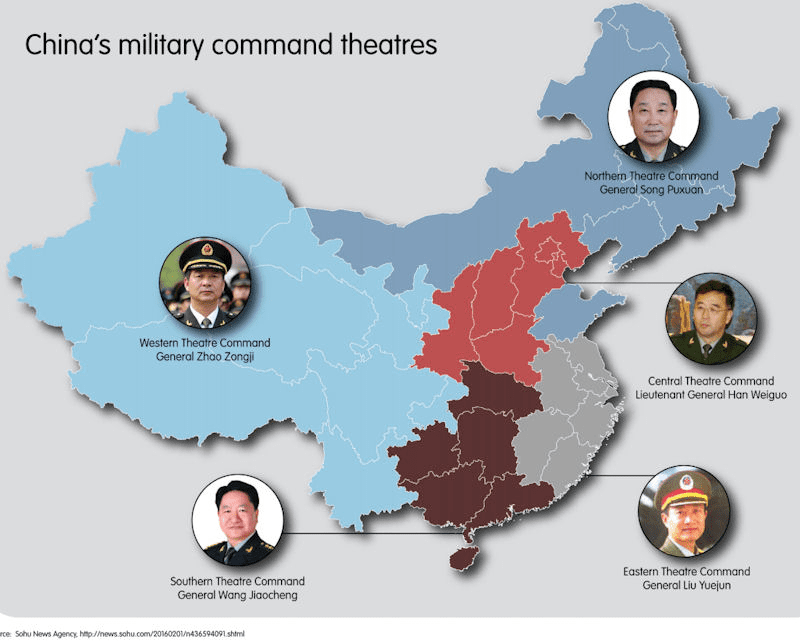
China Western Theater Command at a Glance
Category |
Details |
|---|---|
Established |
1 February 2016 |
Headquarters |
Chengdu, Sichuan Province |
Commander |
Gen. Wang Haijiang |
Political Commissar |
Gen. Li Fengbiao |
Geographic Coverage |
Tibet, Xinjiang, western China |
Primary Mission |
Border defense and high-altitude joint operations |
Why the Western Theater Command Matters for India
Among China’s five theater commands, the Western Theater Command is the only one focused primarily on land warfare against a major state adversary.
Its operational responsibilities include:
-
Managing military deployments along the 3,488 km Line of Actual Control with India
-
Maintaining military infrastructure across Tibet and Xinjiang
-
Coordinating air, missile, and ground forces for potential high-altitude conflict
Since the Galwan Valley clashes in 2020, the WTC has maintained a persistent forward military posture along the Himalayan frontier.
Origins: The 2015–2016 PLA Military Reforms
Before 2016, the PLA operated under seven Military Regions, which were largely administrative commands dominated by ground forces.
Xi Jinping’s reforms reorganized the PLA into five joint Theater Commands designed for modern multi-domain warfare.
The Five PLA Theater Commands
| Theater Command | Strategic Focus |
|---|---|
| Eastern | Taiwan Strait |
| Southern | South China Sea |
| Western | India and Central Asia frontier |
| Northern | Korean Peninsula |
| Central | Strategic reserve and capital defense |
Under the new structure:
-
Theater commands conduct operations
-
Service branches train and equip forces
This reform significantly improved China’s ability to conduct joint air-ground-missile operations.
Geographic Area of Responsibility
The Western Theater Command controls the largest operational region in the PLA.
Key Regions Under WTC Authority
| Region | Strategic Role |
|---|---|
| Tibet Autonomous Region | Central and eastern LAC sectors |
| Xinjiang | Western LAC sector and Central Asian borders |
| Sichuan | Theater headquarters and strategic depth |
| Qinghai | Plateau logistics and staging |
| Gansu | Land corridor linking interior China |
| Yunnan | Southern flank coordination |
The region includes:
-
the Tibetan Plateau
-
the Karakoram mountains
-
large sections of the Gobi desert
These environments create some of the most difficult military operating conditions in the world.
Western Theater Command Operational Map
The Himalayan frontier can be divided into three primary sectors.
Western Sector
Location: Ladakh / Aksai Chin
Characteristics:
-
High-altitude desert terrain
-
Strategic road corridor linking Xinjiang and Tibet
-
Key flashpoints including Galwan Valley, Pangong Tso, and Depsang Plains
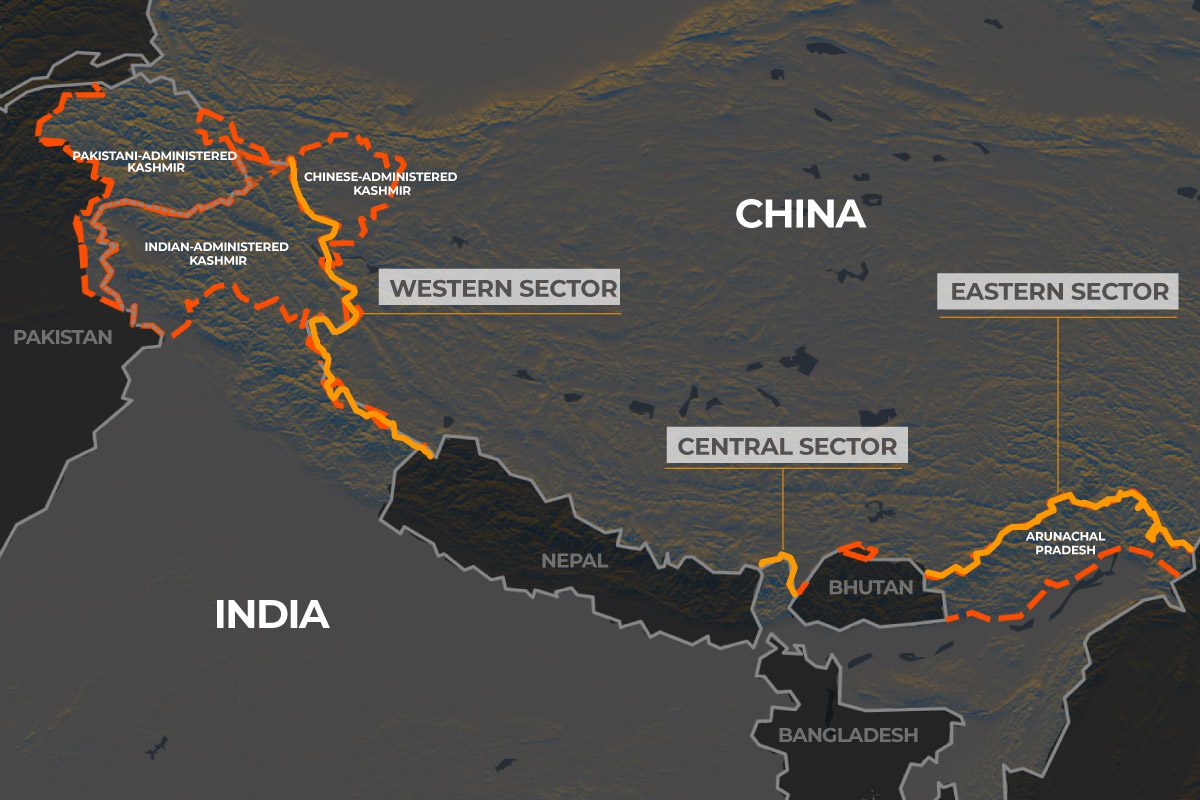
Central Sector
Location: Uttarakhand and Himachal frontier
Characteristics:
-
Comparatively stable sector
-
Smaller troop concentrations
-
Limited infrastructure relative to other sectors
Eastern Sector
Location: Arunachal Pradesh / Tibet frontier
Characteristics:
-
Mountainous terrain
-
Strategic access to Tawang
-
Expanding Chinese military infrastructure
Command Structure
The Western Theater Command operates under a dual-command leadership system.
| Position | Role |
|---|---|
| Theater Commander | Military operational command |
| Political Commissar | CCP political oversight |
Major decisions are taken collectively through a command committee, ensuring Communist Party control over military operations.
Joint Operations Command Centre
At the core of the WTC headquarters in Chengdu is a Joint Operations Command Centre (JOCC).
The JOCC integrates data from:
-
satellites
-
reconnaissance drones
-
radar systems
-
battlefield command networks
This system enables the PLA to coordinate multi-domain operations across land, air, missile, and cyber domains.
Western Theater Command Ground Forces
The backbone of the command is its ground combat formations.
Core Group Armies
| Formation | Headquarters | Role |
|---|---|---|
| 76th Group Army | Xining | Plateau warfare and Xinjiang operations |
| 77th Group Army | Chongzhou | High-altitude operations facing India |
Each group army includes:
-
combined arms brigades
-
artillery units
-
air defense formations
-
reconnaissance brigades
-
special operations units
These formations reflect the PLA’s shift toward modular brigade-based combat structures.
Tibet and Xinjiang Military Districts
Two formations operate directly along the Himalayan frontier.
Tibet Military District
Estimated strength: 40,000–50,000 troops
Responsibilities:
-
central and eastern LAC sectors
-
border patrol operations
-
mountain warfare training
Xinjiang Military District
Estimated strength: over 90,000 personnel
Responsibilities:
-
western LAC sector including Ladakh
-
counterterrorism operations
-
border defense and rapid response
PLA Rocket Force Support
The Western Theater Command is supported by PLA Rocket Force missile brigades based in Xinjiang.
Key Missile Systems
| Missile | Type | Range | Role |
|---|---|---|---|
| DF-26 | Intermediate-range ballistic missile | ~4,000 km | Conventional or nuclear strike |
| DF-21C | Medium-range ballistic missile | ~1,750 km | Precision strike |
| DF-16 | Short-range ballistic missile | ~1,000 km | Tactical strike |
| CJ-10 | Land attack cruise missile | ~1,500 km | Long-range precision strike |
These systems allow China to hold military targets deep inside India at risk.
PLA Air Force in the Western Theater
The WTC Air Force operates from multiple airbases across Tibet and western China.
Key Aircraft
| Aircraft | Role |
|---|---|
| J-16 | Multi-role strike fighter |
| J-20 | Fifth-generation stealth fighter |
| J-11B | Air superiority fighter |
| H-6K | Long-range bomber |
| Y-20 | Strategic airlift aircraft |
| KJ-500 | Airborne early warning |
Aircraft operating from plateau bases face reduced payload due to high-altitude air density limitations.
Major PLA Bases Supporting Western Theater Operations
Key Airbases
| Airbase | Location | Role |
|---|---|---|
| Hotan | Xinjiang | Western LAC operations |
| Ngari Gunsa | Western Tibet | Ladakh sector support |
| Lhasa Gonggar | Central Tibet | Logistics hub |
| Shigatse | Tibet | Fighter deployments |
| Nyingchi | Eastern Tibet | Operations facing Arunachal |
These bases have been upgraded with:
-
hardened aircraft shelters
-
extended runways
-
missile storage facilities
Logistics and Infrastructure Build-Up
China has significantly expanded infrastructure across the Tibetan Plateau.
Major Infrastructure Developments
| Infrastructure Type | Strategic Impact |
|---|---|
| All-weather border roads | Rapid troop mobilization |
| Forward airbases | Sustained air operations |
| Tactical heliports | Rapid troop movement |
| Missile launch sites | Long-range strike capability |
| Dual-use border villages | Logistics and surveillance support |
More than 300 dual-use villages have reportedly been constructed near disputed frontier regions.
Logistics and Sustainment
The Joint Logistics Support Force hub at Xining serves as the main supply center for the western theater.
China has also expanded:
-
plateau highways
-
strategic railways into Tibet
-
underground logistics facilities
These developments allow China to sustain long-duration deployments along the LAC.
India vs Western Theater Command
Indicative Capability Comparison
| Capability Area | Western Theater Command | India |
|---|---|---|
| Border Infrastructure | Strong advantage | Improving |
| Missile Strike Capability | Significant advantage | Growing capability |
| High-Altitude Warfare | Extensive plateau experience | Specialized mountain troops |
| Airpower Access | Plateau bases with limitations | Lower altitude bases with higher payload |
| Logistics Depth | Strong interior network | Terrain constraints |
The Himalayan frontier therefore represents a deterrence balance shaped largely by geography and infrastructure.
Key Developments to Watch
Infrastructure Expansion
China continues expanding:
-
plateau rail networks
-
border highways
-
forward military installations
Missile Force Modernization
Expansion of conventional missile systems could significantly enhance China’s precision strike capability.
Drone Warfare
The PLA is increasingly deploying:
-
surveillance drones
-
electronic warfare UAVs
-
strike drones
These systems may significantly alter border surveillance and targeting dynamics.
The Final Word
China’s Western Theater Command has become the central military institution shaping the balance of power along the Himalayan frontier.
Through a combination of:
-
joint command reforms
-
large-scale infrastructure investment
-
high-altitude troop deployments
-
integrated air and missile capabilities
China has significantly enhanced its ability to sustain military pressure along the India–China border.
Understanding the Western Theater Command is therefore essential for analyzing the future trajectory of Sino-Indian military competition.
Source Note:
This guide synthesizes publicly available information from government reports, defense research institutions, and open-source intelligence analysis. All figures and assessments remain subject to revision as new information becomes available.

