











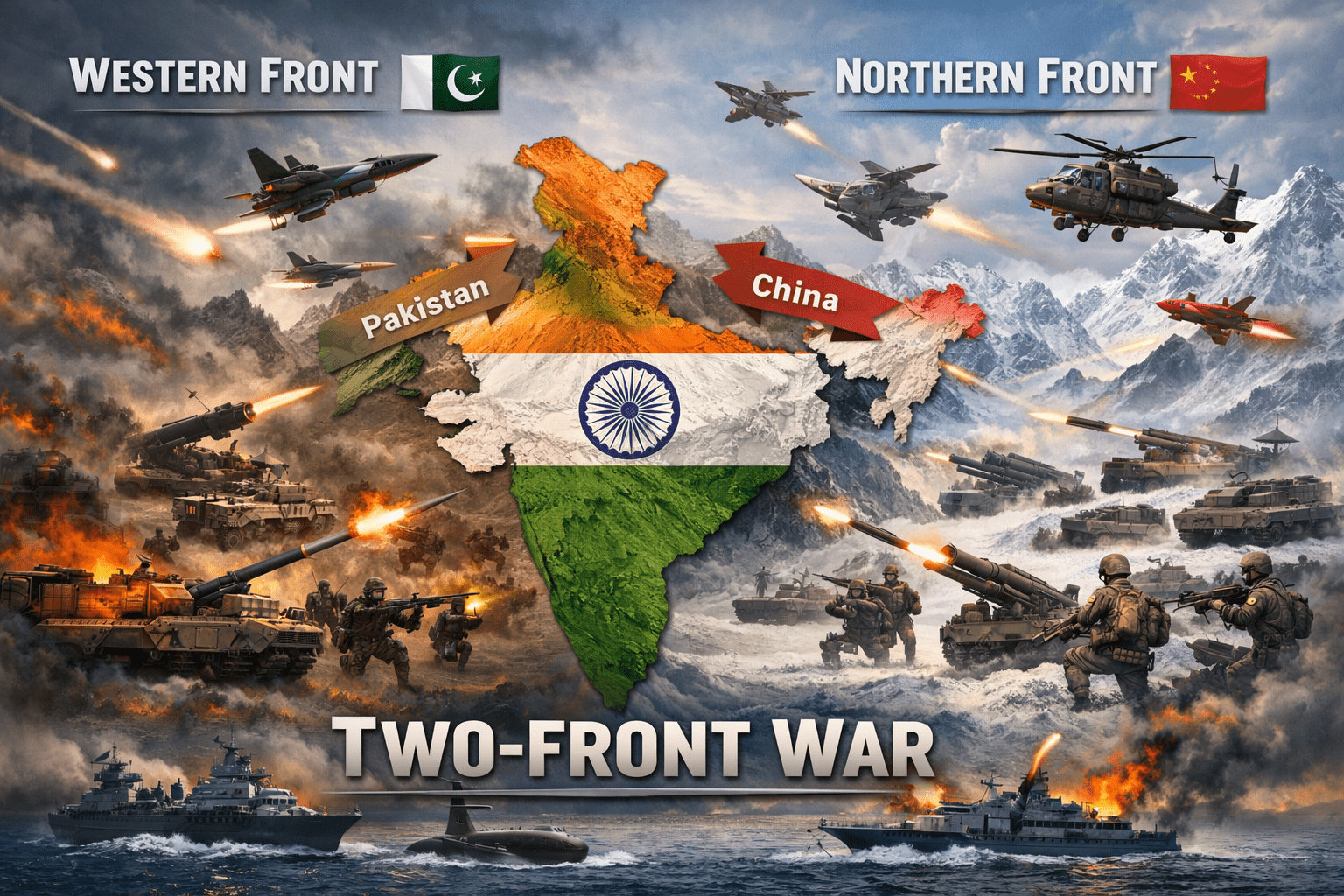
For decades, India’s “two-front war” scenario existed in strategic briefings, simulation rooms, and defence white papers. It was acknowledged as a theoretical possibility — China in the north, Pakistan in the west — but treated as a worst-case contingency rather than an imminent planning baseline.
That posture has shifted.
Since 2020, the Line of Actual Control has transformed from a lightly managed boundary into a permanently activated military zone. Tens of thousands of troops remain forward deployed in eastern Ladakh. Infrastructure build-up on both sides has accelerated. Surveillance assets operate at heightened levels. Meanwhile, the western front has not disappeared; it has simply evolved. Cross-border volatility, drone intrusions, limited ceasefire violations, and the potential for calibrated escalation remain embedded risks.
The convergence of these pressures has forced India’s strategic establishment to confront a central question: is the country’s military architecture structurally capable of handling simultaneous pressure on both fronts?
At the core of that answer lies one of the most consequential defence reforms in independent India’s history — the creation of integrated theatre commands.
From Service Silos to Theatre Logic
India’s armed forces were historically organized along service-specific lines. The Army, Navy, and Air Force maintained separate operational commands, logistics chains, and planning doctrines. Coordination happened during joint exercises and crises, but the institutional architecture remained compartmentalized.
That model reflected a different era — one where conflicts were sequential, geographically contained, and slower in tempo.
The security environment today is neither slow nor compartmentalized. It is multi-domain, technologically compressed, and strategically layered. Cyber operations precede kinetic exchanges. Space assets shape battlefield awareness. Long-range missiles blur frontlines. Decision windows shrink from days to hours.
China recognized this shift earlier. In 2016, Beijing reorganized the People’s Liberation Army into theatre commands, integrating ground, air, rocket, and support forces under unified regional structures. Pakistan, operating at a smaller scale, maintains centralized operational decision-making structures designed for rapid mobilization.
India’s move toward theatre commands, catalyzed by the appointment of the Chief of Defence Staff in 2020, is therefore both reactive and evolutionary. The principle is straightforward: reorganize forces into geographically defined theatres where land, air, and maritime assets operate under a unified commander.
In the two-front context, this likely translates into:
-
A Northern Theatre focused on China.
-
A Western Theatre oriented toward Pakistan.
-
A Maritime command aligned with broader Indo-Pacific contingencies.
In theory, this reduces inter-service friction, accelerates decision-making, and aligns assets to geography. In practice, it touches every dimension of military planning.
The northern frontier presents high-altitude warfare, extended supply lines, and heavy ISR dependence. The western frontier demands mechanized maneuver capability, air-ground integration, and rapid mobilization. These are fundamentally different operational ecosystems.
Theatre commands aim to tailor integration to those ecosystems. But institutional reform of this magnitude does not proceed without friction.
The Air Force has historically cautioned against geographically fragmenting air power, arguing that flexibility and centralized control allow massing of force where needed. The Army, bearing the brunt of forward deployment, sees advantages in theatre-level synchronization. The Navy must reconcile continental focus with growing Chinese presence in the Indian Ocean.
The result is deliberate evolution rather than rapid transformation. Yet the pace of external change raises a critical point: reform cannot indefinitely lag reality.
India’s two-front challenge is no longer a speculative alignment of adversaries. Even absent formal military coordination between Beijing and Islamabad during a crisis, strategic opportunism remains plausible. A northern flare-up could incentivize probing pressure in the west. A western escalation could test northern vigilance.
Simultaneity does not require conspiracy — it requires timing. And simultaneity exposes structural weaknesses.
In a dual-front contingency, India must prioritize force allocation, maintain escalation control, and sustain logistics under pressure. Under service-centric models, coordination risks delay. Theatre commands are intended to compress the decision loop.
But structure alone does not guarantee success.
Capability development remains decisive. Air defence networks, long-range artillery, integrated ISR grids, cyber resilience, and rapid mobility are indispensable. Theatre commands amplify capability; they do not substitute for it.
The deeper test will emerge over the next five years.
2026–2030: Projecting the Two-Front Posture
Between 2026 and 2030, India is unlikely to face continuous full-scale war. What it is highly likely to face is sustained competitive pressure punctuated by crisis spikes.
Three plausible scenarios define the projection horizon.
Persistent High-Altitude Standoff
By 2026, it is plausible that 50,000–60,000 Indian troops remain forward deployed along key northern sectors, supported by hardened infrastructure, enhanced airlift capacity, and integrated ISR coverage. Rotational cycles continue, but the posture becomes normalized.
The western front, while relatively stable, maintains rapid-response formations numbering 30,000–40,000 in active readiness, backed by air defence and surveillance networks.
Escalation in this scenario is localized and managed — patrol clashes, infrastructure disputes, cyber intrusions, tactical signaling. Theatre commands function primarily as coordination accelerators rather than wartime engines.
Budgetary implications become visible here. Sustained forward deployment may drive 60–65% of continental modernization funding toward the northern theatre by 2030, emphasizing surveillance, precision artillery, and air mobility.
The risk is economic and operational fatigue rather than open war.
Limited Dual-Front Escalation
More complex is the scenario in which a northern crisis overlaps with calibrated western pressure.
Imagine a flare-up in eastern Ladakh in 2027. Within days, ceasefire violations or drone incidents rise along the western front. Not necessarily coordinated, but opportunistically aligned.
India could find itself managing:
-
70,000+ troops actively engaged in northern sectors.
-
40,000–50,000 troops in heightened readiness along the western border.
-
Elevated air sortie rates across both theatres.
-
Naval deployments signaling deterrence in the Arabian Sea and eastern Indian Ocean.
Escalation would likely unfold in phases — ISR probes, limited artillery exchanges, stand-off precision strikes. Airspace contestation becomes a possibility.
In such a scenario, theatre commands must demonstrate operational clarity. Force prioritization becomes critical. Air power allocation must balance northern urgency with western deterrence. Logistics throughput must support dual theatres without overstretch.
Quantitatively, sustaining such a posture would require India to maintain at least 35–40 operationally ready combat squadrons with high serviceability rates by 2028. Heavy-lift capability must allow rebalancing of forces within 72–96 hours. Ammunition stockpiles must sustain elevated expenditure cycles.
Escalation control becomes the decisive variable. Theatre commands must operate within clearly defined political thresholds to prevent inadvertent horizontal expansion.
High-Intensity, Short-Duration Dual Conflict
Least probable but most consequential is a compressed high-intensity conflict on both fronts.
In such a scenario — perhaps triggered by a severe border incident — India could mobilize over 120,000 troops across northern and western sectors in active combat posture. Artillery duels, drone swarms, precision missile exchanges, and localized air superiority contests could unfold within days.
Logistics demand would surge. Ammunition expenditure rates could triple compared to peacetime norms. Air defence networks would face saturation attempts. Cyber and space assets would be contested.
In this environment, theatre commands would need to function as autonomous yet synchronized warfighting entities. Political leadership would confront rapid escalation decisions within compressed timelines.
Nuclear deterrence ceilings would constrain geographic expansion, but kinetic intensity could be high within bounded sectors.
The success or failure of integration would become immediately visible.
Integration as Strategic Signaling
Beyond operational mechanics, theatre reform carries diplomatic weight.
A clearly operational Northern Theatre signals sustained strategic focus on China. A Western Theatre signals readiness without overextension. Integrated structures convey seriousness to partners evaluating India’s role in regional stability.
At the same time, India’s democratic structure adds complexity. Civilian oversight remains central. Crisis management requires seamless alignment between theatre commanders and political leadership.
Theatre commands therefore must not merely integrate services — they must integrate decision frameworks.
Escalation ladders must be clearly articulated. Crisis communication channels must remain open. Rapid consultation mechanisms must be institutionalized.
Without this alignment, structural reform risks becoming cosmetic.
The Strategic Endgame
By 2030, India’s deterrence credibility will not be measured solely by force size. It will be measured by integrated response capacity under simultaneous stress.
Theatre commands represent an attempt to align architecture with reality — to ensure that a two-front challenge does not paralyze decision-making or fragment operational coherence.
The transformation will take time. Cultural integration between services cannot be mandated overnight. Doctrines must be refined through exercises. Communication networks must be hardened. Procurement priorities must reflect joint logic.
But the direction reflects a deeper strategic acknowledgment: India no longer views the two-front challenge as a remote contingency. It is planning structurally for simultaneity.
In a region defined by persistent competition rather than episodic war, preparedness is organizational as much as material.
If executed with clarity and discipline, India’s two-front theatre command reform could anchor deterrence for the next generation. If mismanaged, it risks creating friction precisely when speed and coherence are most needed.
The coming decade will determine which of those outcomes prevails.

