
















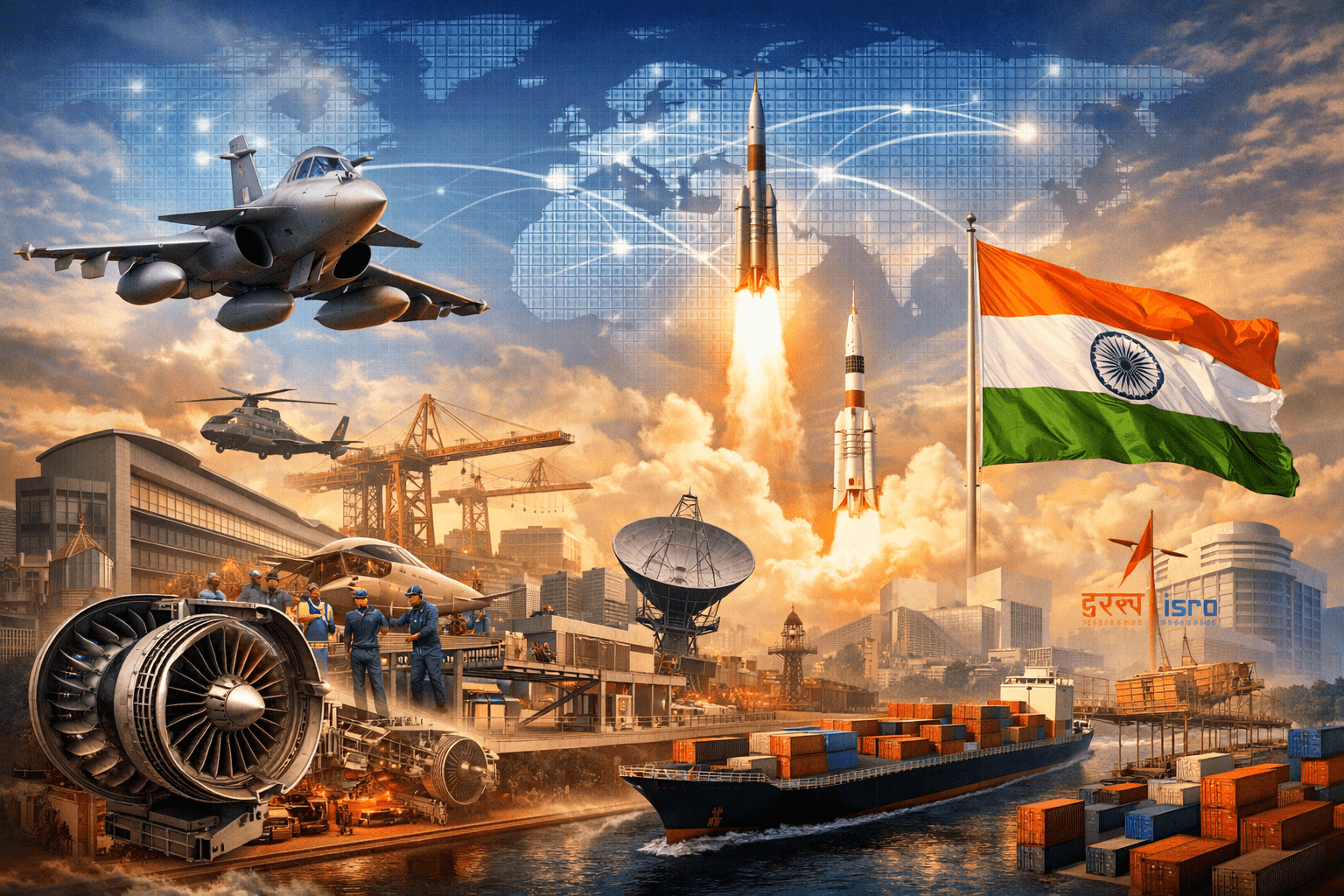
When India signed the Rafale deal, it was framed as a capability upgrade for the Indian Air Force. Nearly a decade later, the story has shifted. What is now unfolding is not just about squadron strength. It is about whether India can finally anchor itself inside the global aerospace manufacturing system — not as a buyer, but as a structural participant.
Across Hyderabad, Bengaluru, Nagpur and Tamil Nadu’s emerging aerospace corridors, conversations have quietly moved from offsets to engine cores, from airframes to certification pipelines. The Rafale ecosystem — and particularly Safran’s expanding footprint — has become a proxy for a much larger question: can India convert defence procurement into industrial sovereignty by 2030?
The answer is still uncertain. But the next four years will be decisive.
The Engine Pivot: Where the Real Stakes Lie
In aerospace circles, there is an unspoken hierarchy of value. Airframes are complex. Avionics are sensitive. Weapons integration is strategic. But propulsion — the engine core — is the crown jewel.
India has historically struggled in this domain. The Kaveri program’s long development arc exposed the difficulty of mastering high-pressure compressors, turbine metallurgy and combustion stability. Even today, frontline aircraft depend on imported propulsion systems.
This is why Safran’s growing engagement in India matters beyond business headlines.
The establishment of MRO facilities for both civil and military engines is already underway. Engine maintenance capability reduces lifecycle dependency. But the more consequential discussion is about final assembly lines and deeper module manufacturing for the M88 engine family, tied to potential additional Rafale orders.
Assembly alone does not equal sovereignty. But it builds something that India has lacked: process familiarity at scale.
Engine production is not simply machining and bolting. It is about tolerances measured in microns, thermal endurance under extreme loads, and quality systems that tolerate zero deviation. If India meaningfully integrates into this chain between 2026 and 2028, the long-term compounding effect could be significant.
However, industry officials privately acknowledge a critical nuance — intellectual property will remain tightly held unless co-development agreements are structured differently from past offset-driven contracts.
That distinction will define the 2030 outcome.
Supply Chains: The Quieter Revolution
While headlines focus on aircraft assembly, the more important shift is happening one layer below — in India’s Tier-2 and Tier-3 aerospace manufacturers.
Over the past three years, Indian firms have gradually climbed the value ladder. Precision forging, complex castings, turbine blade machining, composite aerostructures and high-tolerance gearbox components are increasingly part of domestic capability.
This evolution is not cosmetic. Aerospace supply chains operate on long trust cycles. Once certified, suppliers become embedded in global production programs for decades.
By 2026, India is no longer trying to prove basic competence. The conversation has shifted to scale, repeatability and export integration.
Certification regimes such as AS9100D and NADCAP are becoming more common across Indian facilities. But industry analysts caution that certification alone does not guarantee competitiveness. Delivery reliability and cost discipline will determine whether India becomes a preferred manufacturing base or merely an offset beneficiary.
Between 2026 and 2030, the real test will not be how many components are made in India — but how many high-value modules are trusted globally.
Jobs and Skills: The Human Capital Story
The aerospace sector’s expansion is not just measured in dollars of output but people in manufacturing halls and test facilities. Safran’s ramped-up commitments exemplify this trend.
The French group — which already operates multiple facilities in India — expects its India-linked revenue to more than triple to over €3 billion ($3.4 billion) by 2030, up from much smaller bases today, underlining growth both in civil aviation and defence work.
That kind of industrial expansion carries job impacts that go beyond headline numbers. Safran’s MRO facilities — both for civil engines like the CFM LEAP series and military engines such as the Rafale’s M88 — are expected to employ hundreds of high-skill professionals initially, with broader employment creeping into the low thousands as operations mature.
Initial phases of the Hyderabad M88 MRO alone were projected to create about 150 jobs by 2026, with potential to scale toward 900 additional roles in follow-on phases tied to increased production and servicing work.
But fixed plant jobs tell only part of the story. Unlike assembly lines, aerospace supply chains involve a wide network of engineers, machinists, quality assurance specialists, avionics technicians, materials scientists and logistics professionals.
National workforce forecasts point to a much larger horizon: India’s broader aerospace and space tech ecosystem — which includes drones, satellites, and other advanced systems — is forecast to potentially generate over 200,000 new jobs by the early 2030s as the industry’s footprint expands.
These numbers start to clarify just how different the industry could look by the close of the decade: where tens of thousands of new skilled workers support advanced airframe and engine assembly lines, a growing supplier base supports global OEM integration, and MRO capacity begins to repatriate what has traditionally been imported work.
The 2026–2028 Window: Industrial Consolidation
The immediate phase ahead is about consolidation.
If the proposed additional Rafale deal (potentially ~114 jets) does go through — and a substantial portion is manufactured in India — then production capacity requirements will necessitate multi-layered industrial participation.
Tata Advanced Systems Ltd, for example, has agreements to manufacture major fuselage sections in India, with these assemblies expected to start coming off Indian lines by 2027–28.
From a throughput perspective, if India were producing even a couple dozen high-end military aircraft per year by the late 2020s, the associated supply chain — engines, avionics, landing gear, structural assemblies — would represent a production ecosystem greater than what India historically managed domestically. This would move India from a net importer of aerospace systems to a regional production hub with exportable expertise.
Simultaneously, engine MRO and possibly final assembly work would mature from pilot stages to full operational capability. That would deepen local expertise in inspection regimes, hot-section repairs and lifecycle diagnostics.
This phase is less about technological breakthroughs and more about industrial discipline. Workforce pipelines must scale. Aerospace-focused training programs will need to produce not just engineers but skilled technicians versed in aero standards rather than generic mechanical practice.
Failure to synchronize talent development with industrial expansion could slow momentum. Aerospace manufacturing tolerates no shortcuts.
2028–2030: The Strategic Fork in the Road
The second half of the decade is where strategic differentiation occurs.
Three trajectories are visible.
The first — and most probable — is assembly-led expansion without deep IP transfer. India would become a robust manufacturing hub, capable of producing engines and airframe sections under license, exporting components and supporting lifecycle services. This would strengthen the economy, boost employment and enhance operational autonomy in maintenance. But core engine design would remain external.
The second trajectory involves genuine co-development, particularly tied to India’s Advanced Medium Combat Aircraft program. If India secures participation in core architecture design — combustion systems, turbine materials, adaptive cycle research — the country would cross a threshold it has pursued for decades.
Such an arrangement would require substantial financial commitment and political leverage. But the payoff would be transformational. By 2030, India would not just assemble engines; it would understand and shape them.
The third trajectory is less discussed but plausible — industrial overstretch. Rapid expansion without adequate coordination between public and private sectors could create bottlenecks in quality control, financing and certification. Simultaneously, excessive reliance on foreign-origin platforms could divert funding from indigenous R&D.
Industry insiders acknowledge this balancing act. The Rafale ecosystem must complement Tejas Mk-II and AMCA — not crowd them out.
The Civil Aviation Sweet Spot: Opportunities Emerging from the Ecosystem
Civil-military convergence is perhaps the most underappreciated opportunity. While defence ecosystems often get the headlines, civil aviation growth in India creates a parallel runway for industrial expansion.
India is now one of the world’s fastest-growing domestic airline markets, with carriers ordering thousands of new aircraft over the next decade. This drives demand for maintenance, repair, overhaul, and parts sourcing, not just assembly.
Safran’s civil engine operations provide economic stability and scale that defence programs alone cannot. Shared manufacturing infrastructure across civil and military domains enhances resilience.
Current projections indicate that India’s civil MRO market alone could reach $4 billion by 2031 as operators repatriate engine servicing and fleet care that is currently outsourced overseas.
This dual-track growth — defence and civil — insulates the aerospace industrial base against cyclical downturns in one sector and creates a larger, more resilient manufacturing ecosystem.
Export leverage is another dimension. If India becomes a critical production node for Rafale components, its position in third-country export ecosystems strengthens indirectly.
Then there is the skill multiplier effect. Aerospace-grade manufacturing expertise spills into space propulsion, advanced materials research, hypersonic experimentation and robotics-driven precision engineering.
These secondary effects often matter more than the headline contracts.
The Structural Risks
Yet optimism must be tempered.
Technology depth remains the central vulnerability. Without structured pathways to design-level knowledge, India risks plateauing at advanced assembly. If India’s participation remains limited to licensed assembly without meaningful technology transfer in critical segments like propulsion design, the country could emerge as a manufacturing partner but not a strategic technology owner. This is the structural debate playing out behind the public headlines.
Talent pipelines remain another critical constraint. Aerospace manufacturing demands highly trained technicians and engineers with specialized skills that cannot be scaled overnight. While vocational and higher-education reforms are underway, the full effect of such initiatives will only be visible in the latter half of the decade.
Financing structures for MSMEs also require modernization. Aerospace contracts demand upfront capital expenditure with long gestation periods. Without supportive financial instruments, smaller suppliers may struggle to scale.
Finally, policy tools such as production-linked incentives (PLI) are being discussed as necessary to cement competitiveness, with industry voices warning that without such incentives India risks losing ground to export hubs like Morocco and Turkey that are aggressively courting aerospace investment.
Where India Stands in Early 2026
As of now, India has momentum — not yet mastery.
The ecosystem is expanding. Global OEMs are deepening engagement. Indigenous suppliers are climbing the value chain. But sovereignty in aerospace is not achieved through factory announcements alone. It is achieved through negotiated IP depth, sustained R&D funding and long-term institutional patience.
The Rafale deal opened a door. The 2026–2030 period will determine whether India steps through into propulsion competence — or remains a highly capable manufacturing partner within someone else’s technological architecture.
The difference will not be visible in headlines. It will be visible in engine test cells, metallurgy labs and contract clauses few outside the industry ever read.
And by 2030, the results will speak for themselves.
How India Might Look by 2030
When the smoke clears a few years from now, the Indian aerospace landscape could look dramatically different:
- A $20 billion + domestic aerospace manufacturing market, integrating both defence and civil supply chains.
- Safran and other global OEMs with expanded revenue footprints from India, collectively generating thousands of jobs and driving export orders.
- A burgeoning MRO industry worth several billion dollars annually as domestic operators optimize fleet maintenance.
- A critical mass of certified Indian aerospace suppliers integrated into Airbus, Boeing and other OEM global systems.
- A skilled aerospace workforce measured not in hundreds, but tens of thousands, supporting advanced assembly lines, engine modules, testing labs and design hubs.
This is the industrial test of the decade — one that moves beyond procurement headlines and into quantified outcomes that can be benchmarked year-by-year.

