







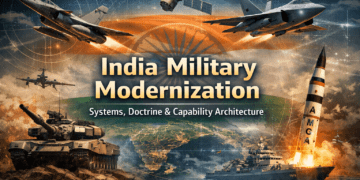













Modernization is often mistaken for acquisition.
In India’s defense discourse, the conversation gravitates toward numbers — fighter squadrons, submarines, artillery regiments, drones. Hardware dominates the headlines because hardware is visible.
But the most consequential development in the India military transformation process is not about what the country is buying.
It is about how it organizes power.
And that is where theatre commands become central.
From Service Silos to Structural Rewiring
For decades, India’s armed forces operated under a service-centric command architecture. The Army fought land battles. The Air Force controlled air assets. The Navy managed maritime operations. Coordination occurred, but authority remained segmented.
That model was adequate when wars were geographically isolated and escalation unfolded in stages.
Today, India faces a two-front reality in which crises can unfold simultaneously across domains.
A border confrontation along the Line of Actual Control can coincide with maritime signaling in the Indian Ocean and cyber activity targeting air-defense systems. In such an environment, segmented authority introduces delay.
Delay is no longer neutral.
Under the traditional structure, inter-service coordination depends on layered communication channels. Professionalism mitigates friction, but structural separation still costs time.
Theatre commands aim to remove that latency by consolidating operational authority within geographic commands that control all relevant assets — land, air, and maritime.
This is not administrative reform. It is structural rewiring.
And it sits at the core of India’s evolving military architecture.
Why the External Environment Forces Reform
The push toward theatre integration is inseparable from India’s strategic environment. China reorganized its military into integrated theatre commands in 2016, creating unified operational control structures across regions, including the Western Theatre Command facing India.
This structural consolidation shortened Chinese decision loops and enhanced joint responsiveness.
India’s military transformation cannot ignore that asymmetry. While India operates within democratic checks and institutional debate, it must still ensure that operational tempo does not lag behind adversaries.
The debate, therefore, is not about imitation.
It is about parity of responsiveness.
India cannot afford to operate under slower coordination cycles in a high-altitude standoff environment where minutes shape tactical leverage.
The Air Power Debate: Flexibility vs. Immediacy
The most visible friction within the theatre command discussion revolves around air power.
The Indian Air Force has consistently argued that air assets must remain centrally controlled to preserve strategic flexibility.
Air power, by doctrine, is inherently fluid and capable of shifting across theatres. Fragmenting it risks reducing its strategic concentration.
This argument is doctrinally coherent.
However, theatre integration advocates counter that localized crises require immediate access to air assets without bureaucratic negotiation cycles. In a fast-moving border escalation, commanders cannot afford layered approval delays.
The tension between centralized flexibility and decentralized responsiveness lies at the heart of India’s theatre command reform.
This is not institutional ego. It is competing operational logic.
Resolving it defines whether the India military transformation process matures structurally or stalls.
The Economic and Logistical Imperative
There is a fiscal dimension often overlooked in public discourse.
Maintaining parallel ISR systems, communication grids, and logistics architectures across three services creates redundancy. India’s defense budget, though substantial, operates under competing national priorities. Efficiency is not optional.
Theatre commands encourage shared infrastructure, standardized digital systems, and unified logistics pipelines. Over time, integration reduces duplication and optimizes capital expenditure.
In that sense, theatre reform aligns with the broader modernization logic discussed in Article 1 of this series, where AI-enabled systems depend on integrated data architecture. Fragmented commands undermine network-centric warfare.
Structural reform supports technological reform.
Without unified authority, AI-driven C4ISR risks becoming fragmented insight rather than operational advantage.
The Nuclear Dimension: Speed with Control
India’s strategic environment is uniquely complex. It faces two nuclear-armed adversaries. In such a setting, command and control clarity is indispensable.
Theatre commands can enhance escalation management by providing unified situational awareness and reducing inter-service ambiguity. But they also compress operational timelines. Faster integration must not translate into destabilizing automation.
India’s doctrinal emphasis on civilian oversight and credible minimum deterrence imposes guardrails. Theatre integration must accelerate execution without diluting accountability.
The India military transformation journey must therefore balance speed with control.
Cultural Resistance and Generational Shift
Structural reform is harder than technological procurement because it redistributes authority.
Service identities are deeply embedded in career trajectories, budget allocations, and operational prestige. Theatre commands challenge long-standing equilibrium. Resistance is therefore inevitable.
Yet operational realities are reshaping perspectives.
Officers who experienced the Doklam crisis and the extended Ladakh deployments witnessed firsthand the friction created by segmented command structures.
Jointness, for them, is not theory. It is operational necessity.
Transformation often follows generational turnover. India appears to be at that inflection point.
Where India Stands in 2026
Progress is incremental but visible.
The creation of the Chief of Defence Staff institutionalized joint oversight.
Maritime theatre discussions have advanced further than continental integration.
Interoperable communication systems are improving.
Joint exercises increasingly simulate integrated operational control.
However, full theatre implementation remains incomplete.
Partial reform creates strategic ambiguity. Too much fragmentation weakens tempo; too much haste risks doctrinal instability. The path forward requires calibrated acceleration.
This stage of the India military transformation process is therefore transitional — structurally evolving but not yet consolidated.
Why Theatre Commands Are the Bridge to the Cognitive Shift
Article 1 in this series examined the rise of AI-enabled C4ISR and the shift toward cognition-centric deterrence.
That transformation enhances battlefield awareness, data fusion, and predictive insight.
But insight alone is insufficient.
Without unified command authority, enhanced cognition cannot translate into coordinated action. Theatre commands represent the bridge between information dominance and decision dominance.
They are the institutional counterpart to digital modernization.
If India completes theatre integration, AI systems and networking reforms gain structural relevance. If integration falters, modernization risks becoming layered over legacy command silos.
Theatre commands therefore determine whether the India military transformation is cosmetic or architectural.
The 2030 Test
By 2030, the success of reform will not be measured in policy announcements but in operational outcomes.
Fully integrated theatre exercises under unified command structures.
Cross-service budgeting aligned with theatre priorities.
Shared ISR grids operating seamlessly across domains.
Doctrine reflecting simultaneous, multi-domain operations rather than service sequencing.
If those markers materialize, India’s structural transformation will be irreversible.
If they do not, modernization may remain technologically impressive but organizationally incomplete.
The Strategic Meaning
Theatre commands signify that India recognizes modern conflict as simultaneous, networked, and tempo-driven.
They acknowledge that deterrence credibility depends not just on assets but on how quickly those assets can be synchronized.
In that sense, theatre reform is not about bureaucracy.
It is about readiness architecture.
And architecture, in a region defined by compressed escalation cycles, may be the most decisive factor of all.
But structure alone does not define transformation. Command reform determines how India fights — it does not determine where the next strategic frontier lies.
As theatre integration reshapes internal coordination, another shift is unfolding outward, toward geography itself. India’s security calculus is no longer confined to mountain borders or continental flashpoints.
The Indian Ocean is emerging as the decisive arena where trade, deterrence, and great-power competition intersect.
In Article 3, we move from institutional architecture to maritime strategy — examining how India’s military transformation extends from command rooms to sea lanes.

