























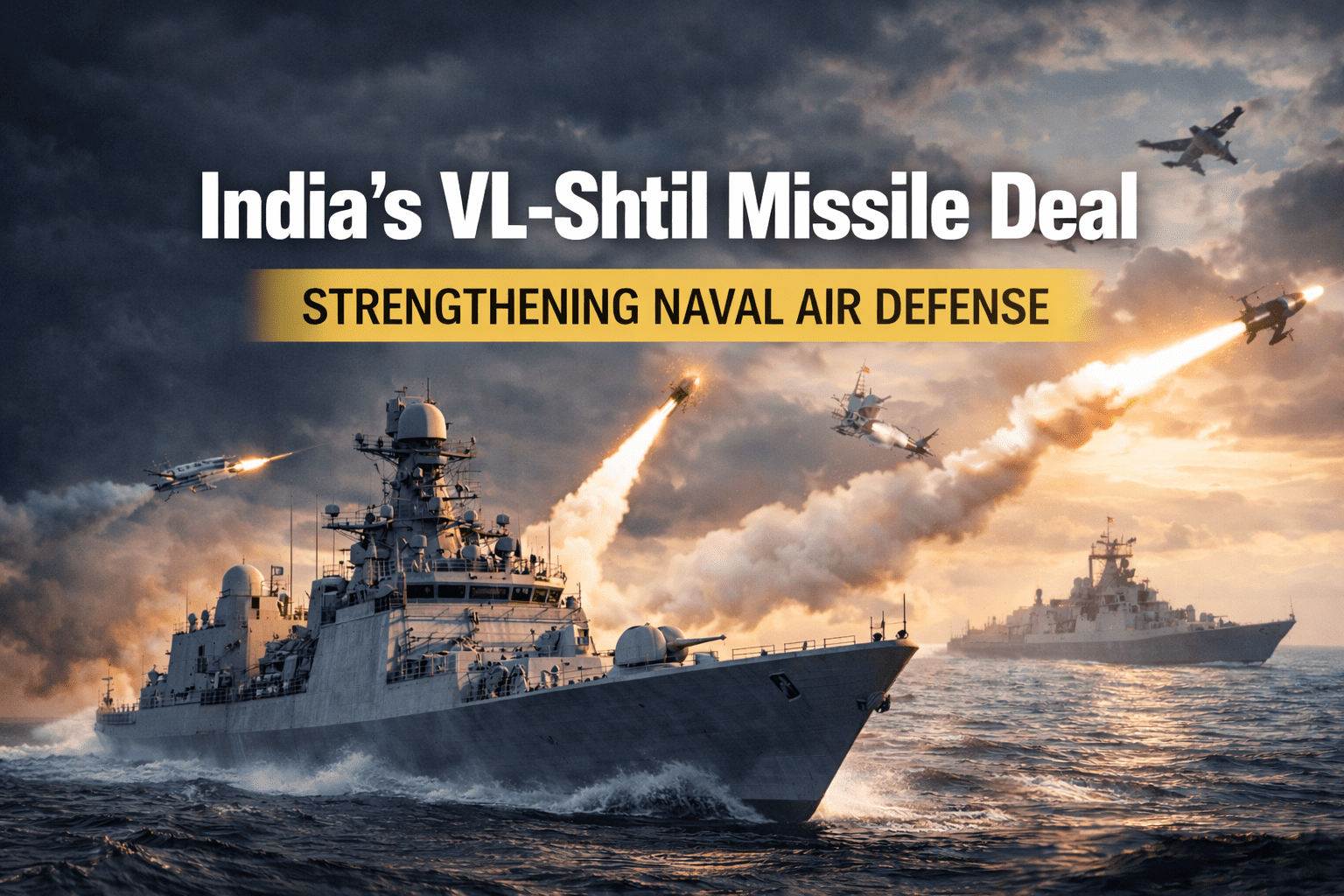
India recently signed a $260 million contract with Russia’s Rosoboronexport for the procurement of VL-Shtil surface-to-air missiles for its frontline warships. At first glance, the development appears to be a routine replenishment of naval air defense systems. Yet the deeper implications of the VL-Shtil missile India deal reach far beyond procurement.
The Indo-Pacific maritime environment is undergoing a rapid transformation. Long-range anti-ship missiles, drones, and maritime strike aircraft are increasingly defining naval warfare. Warships today operate under constant surveillance and within the engagement envelope of multiple strike platforms.
In this environment, survivability has become the central requirement of naval power.
India’s decision to reinforce its fleet with VL-Shtil missiles suggests a clear recognition of this reality. Rather than focusing solely on offensive firepower, the Indian Navy is strengthening the defensive layers that allow ships to remain operational in contested waters.
The VL-Shtil missile India procurement therefore reveals something fundamental about how New Delhi views the future of naval warfare.
Sea control increasingly depends on the ability to survive missile attacks.
Surviving the Missile Age of Naval Warfare
Modern naval combat is defined by missile saturation.
Anti-ship cruise missiles have multiplied across Asia. They are faster, harder to detect, and often launched in coordinated salvos. At the same time, unmanned aerial systems are now widely used for reconnaissance and targeting.
A warship may detect incoming threats from multiple directions within seconds. Reaction time becomes critical.
This is where the VL-Shtil missile India program becomes strategically important.
The VL-Shtil system uses vertical launch technology, which allows missiles to be fired instantly toward any direction. Unlike older rail-launch systems that required physical alignment before firing, vertical launch significantly reduces engagement delay.
The system provides several operational advantages.
First, it enables rapid response to incoming aerial threats.
Second, it allows multiple simultaneous engagements against different targets.
Third, it strengthens the layered air defense structure of the fleet.
For the Indian Navy, which increasingly operates across large sections of the Indo-Pacific, these features improve the survivability of surface combatants.
And survivability directly translates into operational endurance.
Why India Still Relies on Russian Naval Systems
The VL-Shtil missile India deal also highlights a broader structural reality in Indian defense procurement.
Despite growing partnerships with Western suppliers and expanding indigenous production, a significant portion of India’s naval infrastructure still relies on Russian-origin systems.
Many Indian warships were designed with Russian launchers, sensors, and combat management architecture. Replacing these systems mid-service is technically complex and financially expensive.
Naval vessels are designed to operate for several decades. Their combat systems are deeply integrated into the ship’s architecture. Changing a core component such as an air defense system often requires modifications to radar systems, fire control software, and power distribution.
In this context, the VL-Shtil missile India procurement reflects continuity rather than dependency.
India is maintaining operational compatibility with existing platforms while gradually diversifying its defense partnerships.
The transition away from Russian systems will occur over time. It cannot happen overnight without disrupting fleet readiness.
Air Defense Is Becoming the Core of Naval Combat Power
Much of the public discussion about naval power focuses on carriers, submarines, or long-range strike missiles. These systems are certainly important.
However, the ability of a fleet to defend itself from aerial threats is becoming equally decisive.
The Indo-Pacific is rapidly turning into one of the most missile-dense maritime theaters in the world.
China has deployed a wide range of anti-ship cruise missiles capable of targeting ships hundreds of kilometers away.
Pakistan has also expanded its maritime strike capabilities. Several Southeast Asian countries are investing heavily in missile systems as well.
In such an environment, naval engagements may begin with missile salvos launched from aircraft, submarines, or coastal batteries.
Without strong air defense systems, surface combatants could face severe operational risk.
The VL-Shtil missile India acquisition strengthens the defensive shield around Indian naval task groups. It allows ships to intercept aerial threats before they reach critical distance.
This defensive capability enables fleets to operate closer to contested areas without unacceptable risk.
India’s Maritime Geography and Strategic Imperatives
India’s naval strategy is closely tied to geography.
The country sits near key sea lanes connecting the Middle East, Africa, and East Asia. Energy shipments and commercial trade routes pass through the Indian Ocean before heading toward major Asian economies.
Protecting these maritime corridors is a core mission of the Indian Navy.
At the same time, the Indian Ocean has become increasingly competitive.
China has expanded its naval presence through submarine deployments, surveillance missions, and port visits across the region. Several regional navies are modernizing their fleets and acquiring advanced missile systems.
Under these conditions, Indian warships must be capable of operating in areas where missile threats are constant.
The VL-Shtil missile India program directly supports that requirement. By strengthening naval air defense, the Indian Navy ensures that its ships can remain deployed across wider areas of the Indo-Pacific.
The Defense Industry Dimension
Another layer of the VL-Shtil missile India deal lies in the defense industrial ecosystem.
Russia’s defense export sector has faced significant disruptions due to sanctions and logistical challenges. Payment mechanisms, supply chains, and production timelines have all been affected.
India’s continued procurement therefore has broader implications.
It signals that New Delhi intends to maintain certain segments of its defense relationship with Moscow, particularly where legacy platforms require sustained support.
At the same time, India has accelerated domestic production initiatives under the Make in India framework. Indigenous missile programs, radar systems, and naval electronics are gradually expanding.
Over time, these efforts may reduce dependence on foreign suppliers.
However, such transitions require long development cycles. Until indigenous alternatives fully mature, systems like VL-Shtil will continue to play an important role.
What Many Analysts Overlook
Much commentary on naval procurement tends to emphasize offensive capability.
Aircraft carriers project power.
Submarines threaten shipping lanes.
Missile systems provide long-range strike capacity.
Yet modern naval operations depend equally on defensive resilience.
A fleet that cannot defend itself against missile attacks cannot maintain forward presence. Without presence, influence at sea diminishes rapidly.
The VL-Shtil missile India deal therefore addresses a core requirement of maritime strategy.
It ensures that Indian warships can continue operating in contested environments where missile threats are increasingly common.
Regional Ripple Effects
Defense procurements rarely occur in isolation.
India strengthening the air defense of its naval fleet influences regional military calculations. Other actors must consider the improved defensive envelope around Indian ships operating in the Indian Ocean.
China may adjust strike planning models for maritime scenarios. Pakistan could emphasize expansion of its anti-ship missile inventory. Smaller regional navies may accelerate investments in both offensive missiles and defensive interceptors.
This interaction often creates a technological cycle.
As missile threats become more sophisticated, air defense systems must evolve to keep pace. Sensors become more advanced, interceptors faster, and defensive networks more integrated.
The VL-Shtil missile India procurement represents one step in this ongoing cycle of maritime competition.
Looking Toward the Next Five Years
Over the next three to five years, several trends are likely to shape the operational relevance of the VL-Shtil missile India system.
First, missile saturation tactics will become more common in naval warfare. Adversaries may attempt to overwhelm ship defenses with large salvos.
Second, unmanned reconnaissance platforms will improve targeting accuracy for maritime strike missions.
Third, naval task groups will increasingly rely on layered defensive systems combining long-range interceptors, electronic warfare, and close-in defenses.
In this environment, the effectiveness of naval air defense systems will directly influence fleet survivability.
The VL-Shtil missile India deal therefore represents preparation for a maritime battlespace that is becoming faster, more lethal, and more technologically complex.
The Strategic Meaning Behind the Missile Purchase
The procurement of VL-Shtil missiles is not simply about adding more interceptors to the Indian Navy’s inventory.
It reflects a deeper strategic calculation.
India is strengthening the defensive backbone of its fleet at a time when naval warfare is shifting toward missile-dominated engagements. It is also navigating the difficult transition between legacy Russian systems and emerging indigenous capabilities.
The result is a procurement strategy that prioritizes operational readiness while gradually reshaping the defense industrial ecosystem.
Ultimately, the VL-Shtil missile India deal highlights a simple but critical reality of modern naval warfare.
The fleet that survives the first missile salvo retains the freedom to shape everything that follows.

