








Let’s be honest—defence news usually lands in our feeds with a thud of jargon. We hear about “MoUs” and “strategic partnerships,” and our eyes tend to glaze over. But what happened this week in Mumbai and Bengaluru was different. It wasn’t just another diplomatic photo-op.
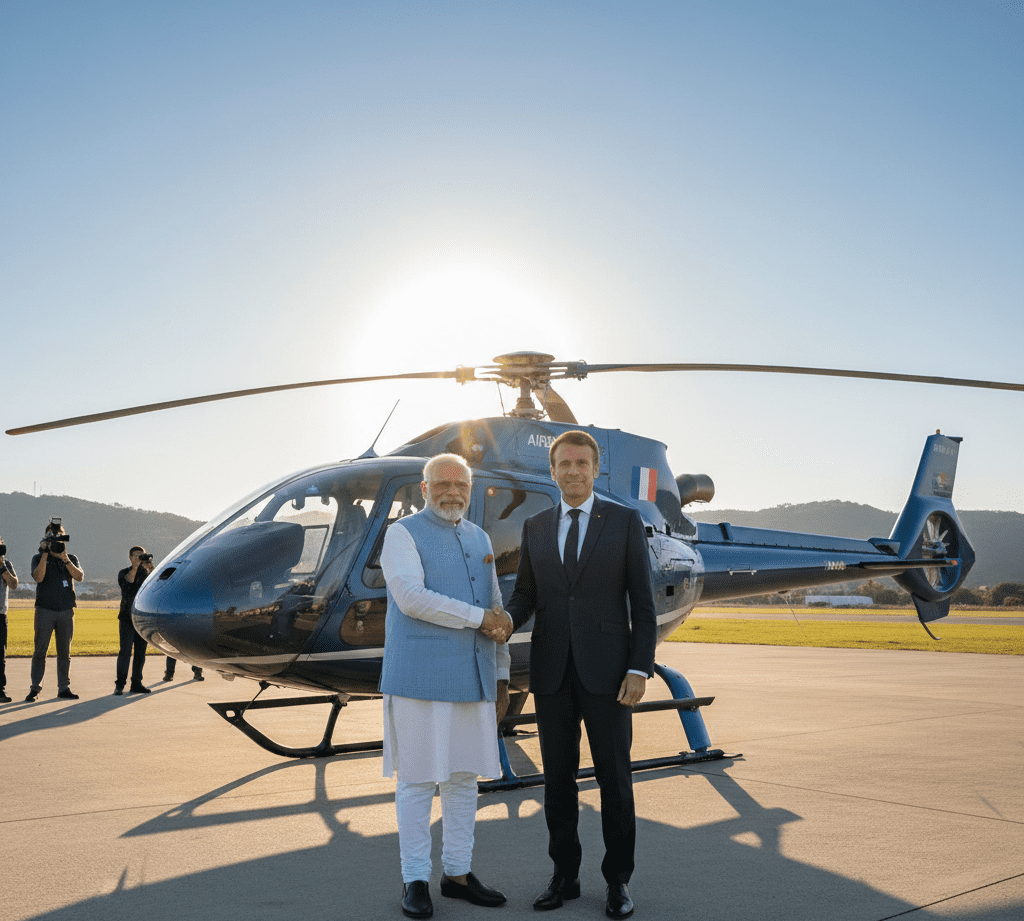
On February 17, 2026, Prime Minister Narendra Modi and French President Emmanuel Macron didn’t just shake hands; they literally pressed the “start” button on a future where India isn’t just a buyer, but a builder for the world.
We are talking about a “Special Global Strategic Partnership” that feels, for the first time, less like a slogan and more like a blueprint for the 21st century.
If you’ve been scrolling past the headlines, stop. Here is why the H125 helicopter factory and the AMCA engine deal actually matter to you, to the neighbourhood, and to the global balance of power.
The Helicopter That Defies Gravity (And Borders)
There is something poetic about the fact that the inaugural project of this renewed partnership is a helicopter that can land on top of Mount Everest. The H125 is not just a machine; it’s a metaphor.
The new Final Assembly Line (FAL) in Vemagal, Karnataka, set up by Tata Advanced Systems and Airbus, is a big deal for two reasons .
First, it is the first time the private sector in India is running a helicopter assembly line. This isn’t the 1980s-era public sector undertaking model. This is the “Tata-ness” of Indian industry merging with the aerodynamic genius of France.
Defence Minister Rajnath Singh noted that the investment is expected to exceed ₹1,000 crore, and it’s going to create a supply chain ecosystem that touches thousands of MSMEs .
Second, and this is where it gets geopolitical: “This helicopter will be exported to the entire world,” Modi declared .
Think about that for a second. India is about to become an export hub for a rotorcraft that is the gold standard for high-altitude operations. By early 2027, the first “Made in India” H125 will roll out, and it will immediately be marketed to South Asia and beyond.
For years, the global South has had to choose between expensive Western tech and less reliable Russian hardware. India is positioning itself as the “middle path”- a trusted, reliable, and potentially more affordable alternative. The H125M (the military variant) could very well become the workhorse for friendly nations looking for agile, Everest-proof utility without the NATO price tag.
The “Heart” of the Matter: The AMCA Engine
But the helicopters, as impressive as they are, were the appetizer. The main course is happening in the engine bays of the future.
We now have a clearer picture of the timeline for the Advanced Medium Combat Aircraft (AMCA), India’s fifth-generation stealth fighter. The goal is a late 2028 rollout . But what makes this jet truly lethal is what’s under the hood, or rather, what will be under the hood.
France’s Safran has been selected to co-develop the 120-kilonewton engine that will power the AMCA Mk-II . This is a €6.7 billion ($7 billion) bet on Indian engineering .
Let’s cut through the technical noise here. For decades, India struggled with the Kaveri engine project. It was a national ambition that faced technical dead ends. Building a modern fighter engine is harder than building the airframe itself. The blades spin at temperatures hotter than the melting point of the metal; the tolerances are measured in atoms.
By partnering with Safran, India isn’t just buying 120kN of thrust; it is buying the metallurgy, the design philosophy, and the industrial process. The deal includes complete transfer of technology .
This means that by 2032-2035, when the engine is certified and ready for serial production, India will have a capability that only the US, Russia, China, and a handful of European nations possess: the ability to build a jet engine that pushes a fighter into supersonic cruise without afterburners (supercruise) .
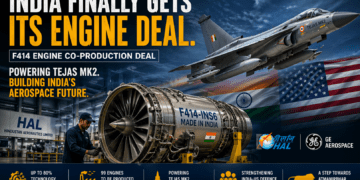
The AMCA will have a split personality. The first batch (Mk-I) will fly with American GE F414 engines to get the jets in the air quickly. But the Mk-II, the true stealth warrior, will fly with an Indo-French heart . That is strategic depth.
Hammer Time: Precision at Scale
In the old days, if India wanted to bomb a terrorist launch pad across the border, it had to rely on imports for the smart bits. Not anymore.
In a parallel announcement, Bharat Electronics Limited (BEL) and Safran signed an MoU to manufacture HAMMER missiles in India .
Why does this matter?
Because we saw the HAMMER in action during Operation Sindoor against Pakistan in May 2025 . This is the AASM (Highly Agile Modular Munition Extended Range) weapon that turns a dumb bomb into a precision-guided menace. It has a range of over 60 kilometers, allowing pilots to launch it while staying out of range of enemy air defences .
By manufacturing it in India, we are essentially ensuring that the Indian Air Force never runs out of smart punch. Furthermore, the missile will be integrated not just with the Rafale, but also with the indigenous Tejas.
This is the “Atmanirbhar Bharat” (Self-Reliant India) doctrine in action: French design, Indian assembly, and a guaranteed supply chain for the next 30 years.
The Ground Reality: Trust in an Uncertain World
You have to look at the larger canvas to understand why this is happening now.
President Macron paid tribute to the 26/11 Mumbai terror attack victims at the Taj Hotel . That was a powerful gesture. It signaled that France understands India’s core security concerns, specifically, the cross-border terrorism emanating from Pakistan .
In a world where the US is looking inward and Europe is jittery about Russia, France has doubled down on “strategic autonomy.”
So has India. Modi mentioned that the world is passing through a “phase of uncertainty,” and that this partnership is a “force for global stability” .
This isn’t just about buying jets. It is about building a parallel axis of trust. From the depths of the ocean (Scorpène submarines) to the heights of Everest (H125), India and France are essentially saying: We will build the hardware of the future together, and we won’t ask for permission from anyone else to use it.
The Road Ahead
The next few years are going to be fascinating. By 2027, watch for the first green-lit H125 taking off from Karnataka. By 2028, keep your eyes peeled for the first taxi trials of the AMCA with its Indian-French engine.
This isn’t just a corporate joint venture; it is the sound of a new world order being assembled, one turbine blade at a time. And for once, India isn’t just in the audience, it’s on the stage, building the machinery.

