



























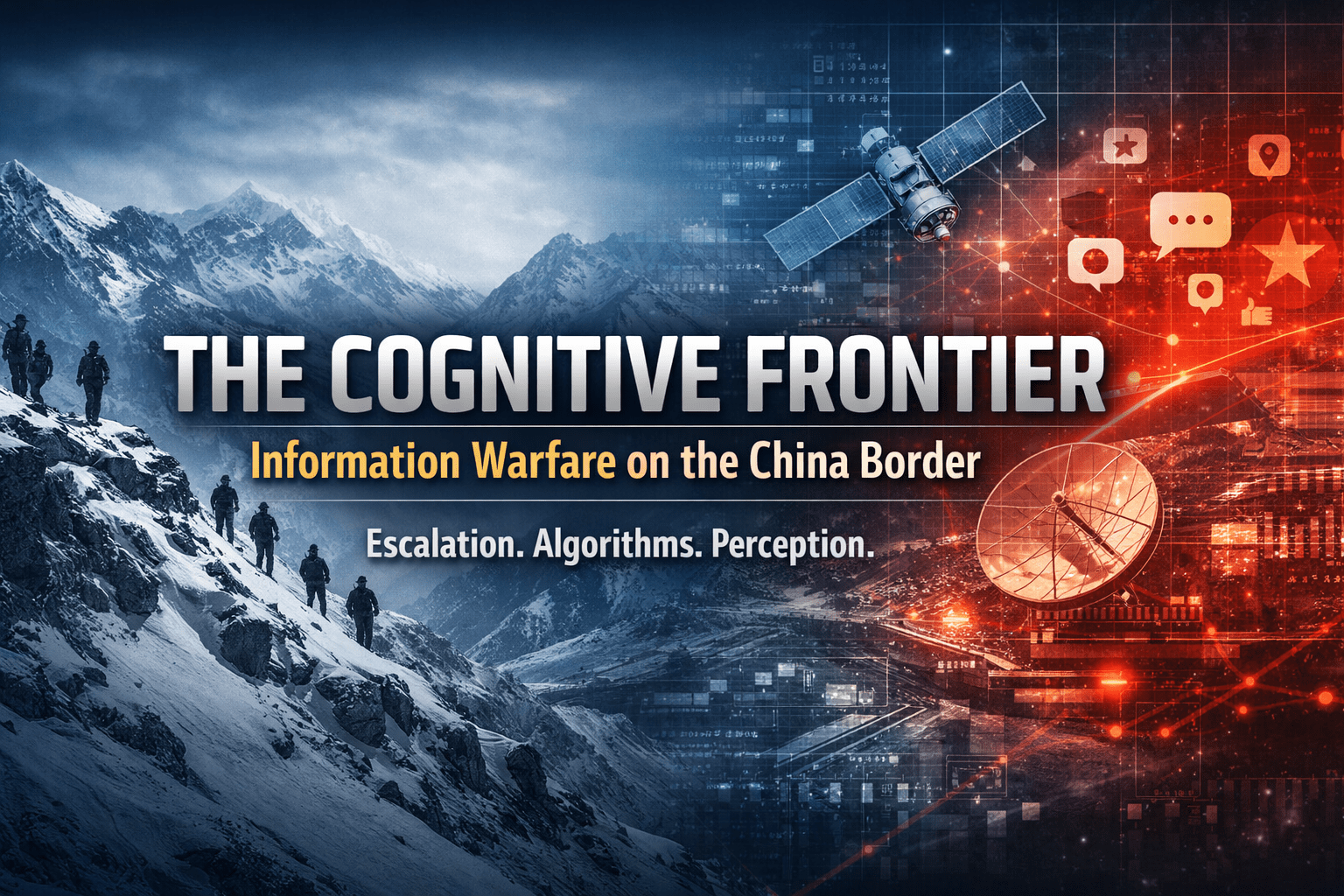
There is now a second Line of Actual Control.
It does not run through Pangong Tso, Depsang, or Tawang. It runs through satellite feeds, AI-curated timelines, diplomatic briefings, and short, viral video clips. It is contested daily, often invisibly, and it may prove more decisive than physical terrain.
Information Warfare on the China Border is no longer an abstract academic phrase. It is an operational reality shaping how crises unfold, how deterrence is perceived, and how escalation is managed between two nuclear-armed states.
The Himalayan frontier has become a cognitive battlespace. And neither side is improvising.
Runways, Roads, and the Optics of Permanence
Infrastructure on the frontier used to be measured in tonnage capacity and troop mobility. Today, it is also measured in narrative impact.
When China expands airfields at Hotan or Ngari, satellite imagery circulates globally within hours. When India upgrades Nyoma airfield or operationalizes the Sela Tunnel, those visuals become signals of resilience and resolve. These are not just engineering projects. They are perception-shaping assets.
Infrastructure imagery is now released strategically, not accidentally. Each runway extension is a message before it becomes a military advantage.
Beijing synchronizes physical build-up with media framing. India has begun responding in kind, highlighting its accelerated infrastructure in Arunachal Pradesh and Ladakh. In this evolving contest, Information Warfare on the China Border begins long before patrols cross paths.
Permanence is projected visually.
The PLA’s Integrated Psychological Doctrine
China’s military doctrine does not treat information as a supporting function. It treats it as a battlespace.
The People’s Liberation Army integrates cyber capabilities, electronic warfare, space assets, and psychological operations into coordinated campaigns designed to shape adversary perception. This includes curated drill footage, carefully timed diplomatic statements, amplified nationalist narratives, and systematic legal framing.
Lawfare has become a particularly important instrument. Renaming villages in Arunachal Pradesh, publishing updated maps, issuing white papers on sovereignty, and embedding claims in formal documentation are not symbolic acts. They are cumulative conditioning tools.
Over time, repetition reshapes international discourse.
Information Warfare on the China Border is therefore not simply about viral clips. It is about narrative layering. Legal, diplomatic, and media signals converge to create psychological momentum.
Territory is contested physically. Legitimacy is contested cognitively.
Algorithmic Escalation: AI and the Speed of Perception
The next serious border confrontation will not be defined by television coverage. It will be defined by algorithms.
Drone footage, potentially edited within minutes. AI-assisted translation spreading commentary across languages instantly. Bot networks amplifying selective interpretations. Deepfake risks complicating verification.
Crisis timelines have compressed dramatically.
Imagine a localized scuffle near Tawang in 2028. Within fifteen minutes, a short, emotionally charged clip circulates widely. Markets react before governments verify facts. External observers comment prematurely. Domestic outrage narrows political maneuverability.
By the time official briefings emerge, narrative positions have hardened.
This is the new escalation ladder. Information Warfare on the China Border now operates at algorithmic speed.
The side that frames first often influences escalation dynamics before physical realities are fully understood.
Escalation Modeling: The Ladder Has Moved
Traditional escalation models assumed a linear progression:
— Patrol friction
– Local clash
– Mobilization
– Theater reinforcement
– War
That framework is increasingly outdated. The contemporary ladder often begins in the informational domain:
– Narrative spike
– Viral amplification
– Domestic outrage
– Diplomatic freeze
– Forward force signaling
– Limited kinetic friction
In this structure, information is not reactive. It is the first rung.
This shift carries strategic consequences.
First, decision time shrinks. Leaders must respond not only to battlefield facts but to public perception.
Second, miscalculation risk rises. Selectively framed visuals can provoke disproportionate responses.
Third, escalation control becomes more complex. Even if both capitals prefer de-escalation, domestic narrative pressure can limit flexibility.
Information Warfare on the China Border therefore functions as a pre-kinetic escalator.
India’s expanding ISR grid along the frontier is not merely about surveillance. It is about narrative sovereignty. Independent verification capacity strengthens crisis stability.
Escalation modeling must now incorporate algorithmic variables alongside troop strength.
Domestic Politics and Psychological Leverage
Information operations intersect directly with domestic political realities.
China’s leadership faces economic headwinds, demographic strain, and property secto
r fragility. Controlled displays of firmness along the border reinforce domestic legitimacy. Yet sustained escalation carries economic and reputational costs.
India’s democratic environment presents a different calculus. Election cycles, media plurality, and competitive politics create rapid narrative churn. This fragmentation enhances transparency but complicates strategic coherence during fast-moving crises.
Information Warfare on the China Border exploits these asymmetries.
Beijing’s centralized information ecosystem enables synchronized messaging across military, diplomatic, and media organs. India’s open ecosystem requires disciplined crisis communication without undermining democratic debate.
The psychological contest is not only bilateral. It is internal.
Space, Counter-Space, and Narrative Control
The cognitive battlefield rests on orbital infrastructure.
Satellite imagery shapes public perception. Secure communication links enable coordinated messaging. Navigation systems underpin operational confidence.
If satellite feeds are disrupted during a crisis, narrative dominance may shift before facts stabilize.
China’s counter-space capabilities raise a subtle but decisive question: who controls the first visual of a confrontation?
India’s investment in military satellite constellations and secure communications is therefore not purely operational. It is foundational to narrative resilience.
Information Warfare on the China Border increasingly depends on space superiority. The first battlefield may be orbital.
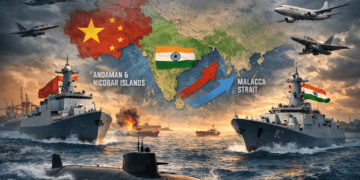
Maritime Ripple Effects and Indo-Pacific Signaling
The psychological contest in the Himalayas has maritime implications.
Regional states observe how India absorbs and manages pressure. If Beijing can shape an enduring perception of Indian vulnerability on its northern frontier, it subtly enhances Chinese leverage in the Indian Ocean Region.
Alignment decisions are influenced by perceived resilience.
Quad partners evaluate not only India’s hardware capabilities but its escalation discipline. ASEAN states assess whether India can sustain continental pressure while remaining a credible maritime actor.
Information Warfare on the China Border therefore extends beyond mountains. It influences Indo-Pacific balance calculations.
Perception travels faster than ships.
Geoeconomic Undercurrents
Narrative stability affects capital flows.
Supply chains adjust based on geopolitical risk assessments. Infrastructure initiatives such as the India–Middle East–Europe Economic Corridor factor in frontier stability perceptions.
If a persistent narrative of volatility dominates, investment behavior shifts.
Beijing understands this dynamic. Psychological pressure contributes to strategic signaling about India’s operating environment.
Conversely, India’s emphasis on frontier integration and infrastructure permanence communicates confidence. It counters narratives of instability.
Information Warfare on the China Border thus intersects with geoeconomic competition.
Markets respond to perception as much as policy.
Civil-Military Fusion Versus Democratic Resilience
China’s civil-military fusion model enables coordination between state agencies, technology firms, and data platforms. Narrative campaigns can be synchronized efficiently.
India does not operate under that architecture. Nor should it.
However, strategic coherence in the cognitive domain requires coordination between defense, diplomacy, intelligence, and technology sectors.
Rapid fact verification, disciplined briefings, and structured crisis communication frameworks enhance resilience.
The objective is not censorship. It is credibility.
Democratic information resilience may become India’s long-term advantage. Transparency, if paired with institutional discipline, strengthens deterrence rather than weakens it.
What Many Analysts Still Miss
Most commentary treats psychological operations as tactical supplements to physical confrontation.
That misses the structural shift.
The real objective is conditioning.
Repeated micro-crises, amplified through selective release and strategic framing, normalize instability. Over time, political fatigue grows. Concessions framed as “stability measures” appear pragmatic.
Deterrence credibility erodes quietly, not dramatically.
Information Warfare on the China Border is about long-term perception management, not headline moments.
The danger lies in incremental cognitive adjustment.
2026–2030: Three Plausible Paths
First scenario: Persistent informational friction without major kinetic incidents. Both sides invest heavily in AI monitoring, cyber defense, and narrative discipline. The frontier remains tense but managed.
Second scenario: Algorithm-driven escalation. A localized incident spreads virally before diplomatic containment. Decision compression increases miscalculation risk.
Third scenario: Tacit informational restraint. Both capitals recognize the destabilizing potential of uncontrolled narrative amplification. Informal boundaries emerge.
Which trajectory unfolds depends not only on troop deployments but on psychological maturity.
The Structural Shift
The border is no longer primarily geographic.
It is cognitive.
Control over perception shapes deterrence. Narrative timing influences escalation. Algorithmic amplification alters crisis stability.
Information Warfare on the China Border has transformed the Himalayas into a laboratory for escalation psychology.
India’s challenge is not to replicate centralized information control. It is to develop institutional resilience that integrates technology, transparency, and strategic discipline.
If perception becomes the first battlefield, then credibility becomes the decisive asset.
The mountains still test armies.
Now they test minds.
And the side that masters escalation psychology will quietly shape the future balance of power in the Indo-Pacific.

