













THE CONTEXT
The Indian Ocean Region (IOR) has emerged as the central arena of 21st-century geopolitical competition. For India, this vast maritime space—stretching from the Strait of Hormuz to the Malacca Strait—is not merely a strategic periphery but the lifeline of its trade, energy security, and global aspirations. Nearly 90% of India’s trade by volume and 80% of its crude oil imports transit these waters .
By 2030, the strategic landscape of the IOR will be fundamentally reshaped by three intersecting forces: China’s systematic naval expansion, India’s own maritime modernization, and the evolving posture of other major powers including the United States, France, Japan, and Australia. Understanding how these forces interact is essential for assessing India’s strategic options and the future stability of the region.
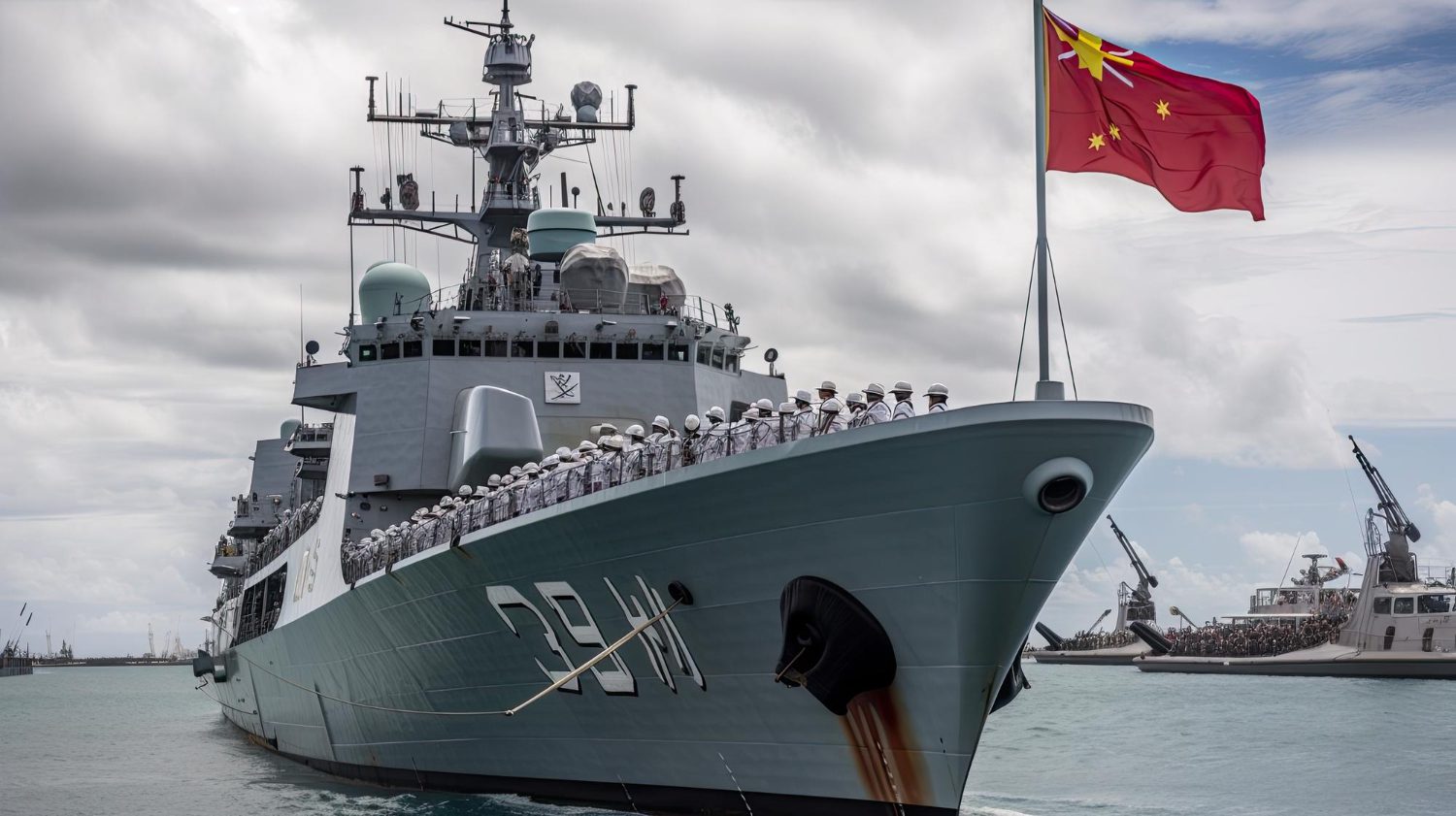
China’s presence in the Indian Ocean is not new—the People’s Liberation Army Navy (PLAN) has maintained a continuous anti-piracy escort mission in the Gulf of Aden since 2008, typically rotating three ships through the region . What has changed is the scale, ambition, and strategic rationale underpinning this presence. From a focused counter-piracy mission, China’s IOR footprint has expanded to include base infrastructure, submarine deployments, and increasingly capable surface action groups.
The implications for India are profound.
As Chinese strategic analyst Zhou Bo noted at a December 2025 conference, “If we are to maintain a more long-term and legitimate presence in the Indian Ocean, the biggest obstacle is actually India”.
This candid assessment captures the essence of the emerging maritime dynamic: two Asian giants with competing interests, geographical advantages, and growing naval capabilities are navigating a shared maritime space with minimal trust and no established rules of engagement.
THE ANALYSIS: CHINA’S INDIAN OCEAN REGION (IOR) TRAJECTORY TO 2030
The Drivers of China’s Naval Expansion
China’s growing Indian Ocean presence is driven by multiple imperatives. First, as the world’s largest trading nation, China depends critically on sea lines of communication (SLOCs) that traverse the Indian Ocean. Over 90% of China’s trade with Europe, Africa, and the Middle East passes through these waters. Second, China’s energy imports—particularly oil from the Persian Gulf—are almost entirely maritime. Any disruption to these routes would have immediate consequences for the Chinese economy.
Third, China’s broader strategic ambition to project power globally requires a naval architecture that can support operations far from home waters. The Indian Ocean represents the critical intermediate zone between China’s near seas (the South and East China Seas) and the western Indian Ocean, Mediterranean, and African maritime approaches where Chinese interests are growing.
The Physical Footprint: Ports, Bases, and Access
By 2030, China’s physical presence in the Indian Ocean Region (IOR) will likely include:
- Djibouti Military Base: China’s first overseas military facility, operational since 2017, serves as a logistics hub for PLAN operations in the western Indian Ocean and Gulf of Aden .
- Gwadar Port (Pakistan): Operationally controlled by China, Gwadar provides potential naval access at the mouth of the Persian Gulf, though its current utility is constrained by insurgency and infrastructure limitations.
- Hambantota Port (Sri Lanka): Acquired on a 99-year lease after Sri Lanka defaulted on Chinese loans, Hambantota has become the symbol of China’s “string of pearls” strategy, though its military use remains circumscribed by Sri Lankan sovereignty concerns.
- Kyaukpyu (Myanmar): A deep-water port and pipeline terminus that offers China access to the Bay of Bengal, potentially bypassing the Malacca Strait for some energy imports.
- Reunion and Seychelles: China has explored logistical arrangements in the western Indian Ocean, though firm bases remain elusive due to Indian and Western counter-efforts.
Naval Capabilities: What the PLAN Will Field
By 2030, the PLA Navy will have consolidated its position as the world’s largest naval force by hull count, with capabilities specifically relevant to the IOR including:
- Aircraft Carriers: China is projected to operate four to five carrier strike groups by 2030, including both conventionally powered and nuclear-powered vessels. These will enable sustained power projection and air defence coverage for task forces operating at distance from Chinese shores.
- Type 055 Destroyers: These 13,000-ton vessels, already deployed to the IOR, are among the world’s most capable surface combatants, equipped with long-range surface-to-air missiles and land-attack cruise missiles.
- Nuclear Submarines: Both SSNs (nuclear attack submarines) and SSBNs (nuclear ballistic missile submarines) are increasingly operating in the IOR. Submarine forays into the northern Indian Ocean have been tracked by Indian surveillance assets since at least 2014.
- Logistics and Support: A growing fleet of replenishment ships, hospital ships, and ocean-going tugs enables sustained operations far from Chinese ports.
The Strategic Challenge for India
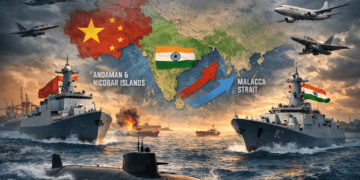
From New Delhi’s perspective, China’s IOR expansion presents a multi-dimensional challenge. The geographical reality is inescapable: India occupies a central position in the Indian Ocean, with the Andaman and Nicobar Islands commanding the approaches to the Malacca Strait. China, by contrast, is a “resident” but not “littoral” power, operating at the end of extended supply lines.
However, as Zhou Bo observed, “The Indian Ocean is not India’s ocean”.
India’s traditional assumption of predominant influence in its maritime neighbourhood is being tested by China’s willingness to engage with IOR littoral states on terms that often bypass Indian sensitivities.
Academic analysis confirms this dynamic: “India considers the Indian Ocean as its ‘backyard’ and deems China’s activities as its ‘encirclement'”.
The perception of strategic encirclement—with Chinese infrastructure and influence spreading across India’s maritime periphery—has become a dominant lens through which Indian strategists view China’s IOR posture.
THE INDIA ANGLE: RESPONSE OPTIONS AND STRATEGIC CALCULUS
India’s Maritime Doctrine: From SAGAR to MAHASAGAR
India’s maritime strategy has evolved significantly in response to China’s expansion. The SAGAR (Security and Growth for All in the Region) doctrine, articulated in 2015, framed the Indian Ocean as a “shared commons” and emphasized collective security and capacity-building for littoral states .
In March 2025, Prime Minister Modi announced an evolution of this doctrine: MAHASAGAR (Mutual and Holistic Advancement for Security and Growth Across Regions). As articulated during visits to the Maldives and Trinidad and Tobago, MAHASAGAR expands India’s maritime vision beyond the Indian Ocean to the wider Global South, promising technology transfer, trade expansion, grant assistance, and security cooperation .
Critically, MAHASAGAR remains deliberately broad and vague. As analysts at Singapore’s Institute of South Asian Studies note, this is “not a bug but a feature of Indian strategy”—it reinforces India’s image as a major maritime power without committing to fundamental policy changes that could escalate rivalry with China .
Military Modernization: Closing the Capability Gap
India’s naval modernization, while proceeding more slowly than desired, will by 2030 field capabilities designed specifically to address Chinese IOR presence:
- Indigenous Aircraft Carrier 2 (IAC-2): Following INS Vikrant’s commissioning, India’s second indigenous carrier (planned for the early 2030s) will enable sustained carrier operations in both the Bay of Bengal and Arabian Sea.
- Nuclear Submarines: The Arihant-class SSBNs provide sea-based nuclear deterrence, while the planned acquisition or indigenous construction of SSNs will address the underwater capability gap.
- P-8I Long-Range Maritime Patrol Aircraft: India’s fleet of Boeing P-8Is, already the backbone of maritime domain awareness, will be augmented with additional aircraft and upgraded sensors.
- Information Fusion Centre–IOR: Located in Gurugram, this centre collates maritime information from partner nations and commercial sources, enhancing situational awareness across the region.
The Quad and Multilateral Partnerships
India has strengthened maritime cooperation through the Quad (with the US, Australia, and Japan) and bilateral partnerships with France (which has substantial territories in the IOR), the UK, and Gulf states. Exercises such as Malabar, Milan, and La Perouse demonstrate growing interoperability and shared commitment to a rules-based maritime order .
However, India remains cautious about formal alliances. As one analysis notes, while a closer maritime partnership with the US would strengthen India’s position, “it would escalate the maritime rivalry with China” . India’s strategic autonomy doctrine therefore translates into calibrated cooperation—deep enough to signal resolve, shallow enough to avoid provoking a destabilizing security dilemma.
Hedging Through Regional Engagement
India has intensified diplomatic and economic engagement with IOR littoral states, recognizing that China’s influence grows where Indian presence recedes. The Maldives, which tilted toward China in 2024, returned to closer ties with India in 2025 as economic pressures mounted . Sri Lanka, despite the Hambantota lease, continues to balance between New Delhi and Beijing.
The challenge, as academic analysis highlights, is that “fragile maritime governance in the neighbourhood” and “weak institutions, corruption, and elite capture” have enabled external strategic leverage . India’s difficulty in offering timely, financially competitive alternatives limits its ability to shape maritime governance norms.
WHAT TO WATCH
Indicators of Escalation or Accommodation
Several indicators will signal the trajectory of India-China maritime competition through 2030:
- PLAN Carrier Deployments: The first extended deployment of a Chinese carrier strike group to the western Indian Ocean would mark a qualitative escalation in China’s power projection capability.
- New Base Agreements: Any additional Chinese military facility in the IOR—particularly in Seychelles, Myanmar, or the Maldives—would trigger immediate Indian counter-measures.
- Underwater Infrastructure: Competition over seabed cables, underwater surveillance networks, and autonomous systems will intensify as the underwater domain becomes the next frontier of maritime rivalry.
- Quad Maritime Coordination: The Quad’s ability to move beyond symbolic exercises toward integrated maritime domain awareness and coordinated responses will test China’s tolerance for collective balancing.
The Cooperation Paradox
Despite the competitive dynamic, cooperation remains possible in specific domains. Zhou Bo notes that “unlike the China-India border issue, we have no territorial or maritime disputes in the Indian Ocean” .
Both nations have previously cooperated in anti-piracy operations, and their positions on the UN Convention on the Law of the Sea (UNCLOS) are more aligned than commonly recognized—both have invoked Article 298 to exclude military activities from compulsory dispute settlement .
The question for 2030 is whether India and China can develop stable communication channels to prevent naval encounters from escalating.
As one academic study recommends, “To prevent escalation during naval encounters, stable communication channels should be developed between China and India. Both states need to strengthen joint maritime domain awareness by expanding information-sharing networks and coordinated surveillance mechanisms”.
Strategic Implications
By 2030, the Indian Ocean will be a multipolar maritime space where India’s geographical advantages contend with China’s growing naval capabilities and infrastructure footprint. India’s strategy—combining military modernization, multilateral partnerships, and calibrated diplomatic engagement—reflects a recognition that the era of Indian predominance has given way to an era of competitive coexistence.
The maritime domain, as India’s Ministry of Defence has recognized, is no longer optional or secondary: “The seas now shape national security, trade and energy flows, climate resilience, and regional leadership”. India’s rise as a major power will depend as much on its engagement with the Indian Ocean as on developments along its land borders.

