



























Conversations around hypersonic weapons tend to begin with speed and quickly drift toward alarm. “Mach 5 and above” has become shorthand for strategic disruption. Yet speed alone does not redefine deterrence.
What matters is how these systems interact with existing defense architectures and decision-making timelines. In the South Asian context, that interaction is most often framed around China’s expanding hypersonic inventory and the adaptability of India’s air defense network.
A measured assessment requires looking beyond headline numbers and into structural dynamics.
Understanding China’s Hypersonic Push
China’s most frequently cited operational system is the DF-17. It is assessed to carry a hypersonic glide vehicle that separates from its booster and maneuvers within the atmosphere at very high speeds. Unlike traditional ballistic missiles that follow relatively predictable arcs, a glide vehicle can adjust its trajectory during flight. That maneuverability, combined with sustained velocity, complicates tracking and interception.
There are also growing references to systems such as the DF-27, which may incorporate advanced maneuverable payloads. While details remain limited in open sources, the pattern suggests continued investment in systems designed specifically to penetrate layered air defenses rather than merely extend range.
China’s broader strategic logic appears consistent. Hypersonic weapons fit into an anti-access framework where the goal is to deter intervention and hold high-value targets at risk. Their value lies in compressing response time and introducing uncertainty into defensive calculations.
Why Hypersonic Glide Vehicles Are Disruptive
The disruptive element of hypersonic glide vehicles is not simply that they are fast. Ballistic missiles have long reached hypersonic speeds during portions of their trajectory. The difference is maneuverability at lower altitudes.
By flying on depressed trajectories and executing lateral adjustments, glide vehicles reduce predictability. Radar systems must constantly update tracking solutions rather than relying on a largely ballistic path. Interceptors optimized for high-altitude exo-atmospheric engagements face greater complexity when targets remain within the atmosphere and maneuver dynamically.
The net effect is compressed decision space. Detection, classification, engagement authorization, and interceptor launch must all occur within narrower timeframes.
India’s Layered Air Defense Structure
India’s air defense architecture is layered rather than singular. The induction of the S-400 Triumf has enhanced long-range engagement capability against aircraft and certain missile threats. Complementing this, India has developed a two-tier ballistic missile defense program aimed at intercepting incoming ballistic missiles in both exo-atmospheric and endo-atmospheric phases.
These systems were originally optimized against conventional ballistic threats with relatively predictable trajectories. Hypersonic glide vehicles introduce additional variables that stress radar discrimination and interceptor guidance systems. This does not render defenses ineffective, but it does increase technical demands.
Early warning is another key factor. Persistent tracking of maneuvering hypersonic objects increasingly depends on space-based infrared sensors. Terrestrial radar coverage alone may struggle with low-altitude, high-speed glide paths, particularly across complex terrain. India’s space-based surveillance capabilities are expanding, yet this remains an area where scale and integration will shape future resilience.
Reaction Time and Decision Architecture
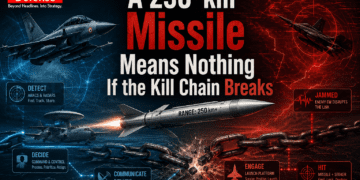
Perhaps the most understated issue is reaction time. Hypersonic systems shorten the interval between detection and potential impact. This places pressure not only on interceptors but on command-and-control frameworks. Decision latency, communication redundancy, and automation protocols become critical.
In high-speed engagements, seconds matter. Defensive success depends as much on network integration as on interceptor performance. A technologically capable missile defense system can still face challenges if sensor fusion and command coordination are not seamless.
Interpreting the Balance
It would be misleading to frame China’s hypersonic arsenal as a decisive advantage in isolation. These systems are costly and technically demanding. Their operational effectiveness depends on targeting accuracy, intelligence integration, and doctrinal clarity. Hypersonic weapons are not deployed in unlimited numbers, nor do they negate deterrence principles.
At the same time, India’s defensive layers must evolve to address maneuverable high-speed threats. Enhancing early warning, improving discrimination algorithms, strengthening electronic warfare integration, and expanding redundancy of critical infrastructure all contribute to maintaining strategic stability.
The competition, therefore, is less about raw speed and more about systems integration. Hypersonic missiles compress timelines and increase uncertainty, but they do not eliminate the logic of deterrence. The side that best integrates sensors, decision-making frameworks, and layered defenses will shape the equilibrium more decisively than the side that simply fields faster missiles.
In the end, hypersonic weapons are part of an ongoing cycle between offense and defense. They introduce new stresses into regional security dynamics, but they also accelerate adaptation. The strategic question is not whether hypersonic threats exist, but how effectively institutions adjust to manage them.

