




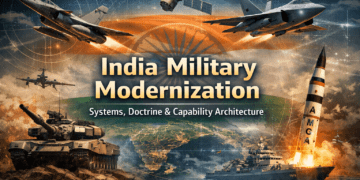










India’s decision to accelerate the Advanced Medium Combat Aircraft (AMCA) programme is not simply about keeping pace with global aerospace trends. It reflects a structural recognition that airpower dominance in the 2035–2050 window will be defined not by incremental upgrades to fourth-generation fighters, but by survivability, sensor fusion, and sovereign control over combat systems.
The AMCA is India’s answer to that strategic horizon.
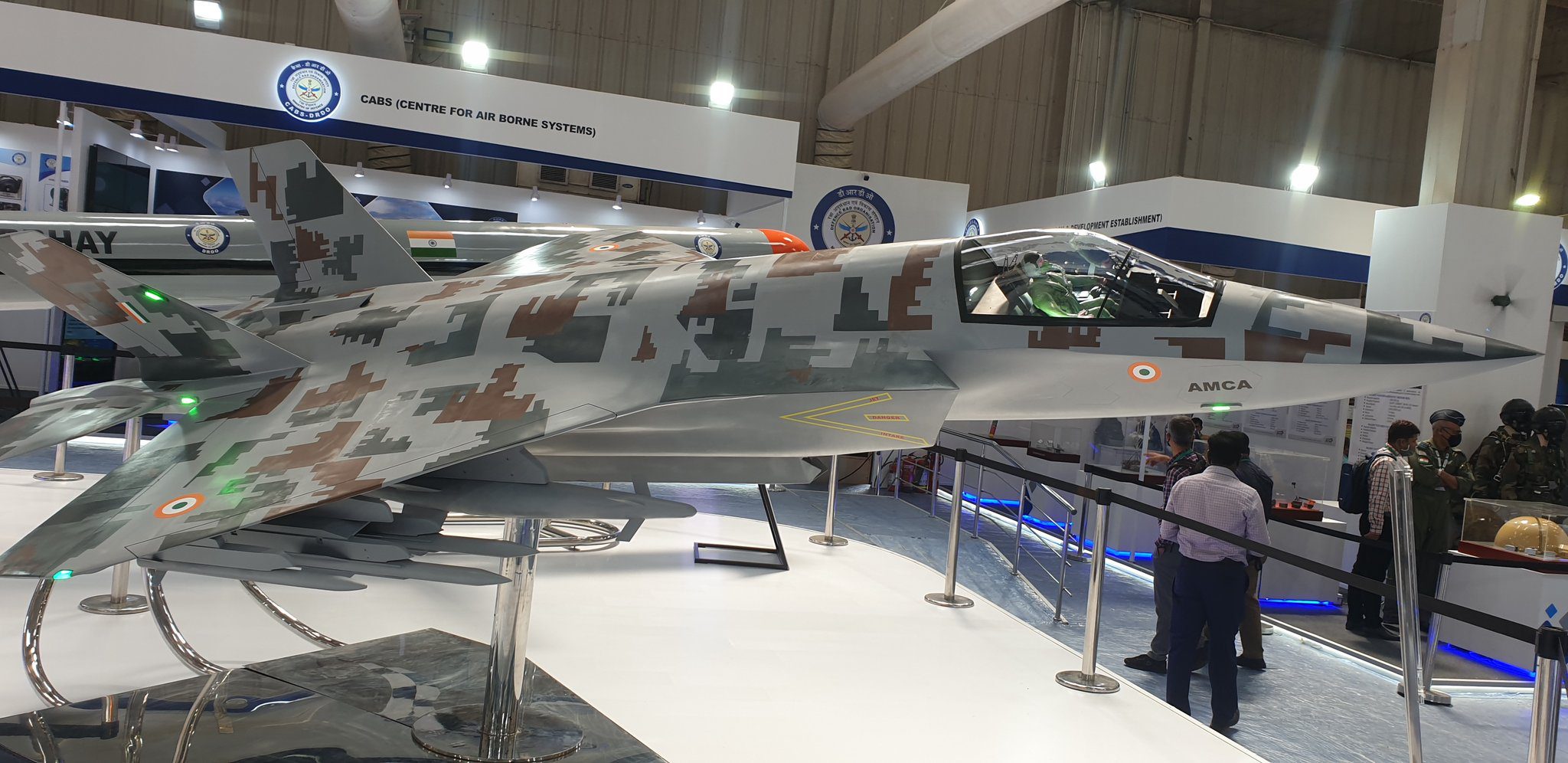
Led by the Defence Research and Development Organisation (DRDO) in collaboration with the Aeronautical Development Agency and Hindustan Aeronautics Limited, the AMCA is envisioned as a twin-engine, stealth, multirole fighter capable of competing in a fifth-generation battlespace.
But beyond the aircraft itself lies a more consequential ambition: technological sovereignty in high-end combat aviation.
The Strategic Trigger: Why Acceleration Became Necessary
India’s fifth-generation calculus sharpened under three converging pressures.
First, the regional airpower environment has evolved rapidly. China’s operational deployment of stealth platforms and growing integrated air defence networks has compressed the survivability margins of legacy aircraft. Even high-end fourth-generation fighters face increasing risk in contested airspace dominated by long-range sensors and advanced surface-to-air missile systems.
Second, India’s force structure timeline demands foresight. Aircraft inducted in the 2030s will likely serve into the 2060s. Decisions delayed today compound vulnerability tomorrow.
Third, global supply chains for advanced military aviation are increasingly restrictive. Sovereign control over mission systems, software, electronic warfare libraries, and data links is becoming as important as physical airframes.
Acceleration, therefore, is not about prestige. It is about preserving strategic agency.
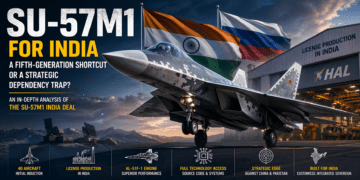
Beyond Stealth: What Fifth Generation Really Means
Public discourse often reduces fifth-generation capability to radar cross-section and internal weapons bays. That is only the visible layer.
True fifth-generation competence integrates four core elements:
- Low Observability — shaping, materials, and signature management across radar and infrared spectra.
- Sensor Fusion — the ability to merge data from radar, electronic support measures, infrared search and track systems, and external networks into a unified tactical picture.
- Network-Centric Warfare Integration — seamless connectivity with airborne early warning platforms, ground assets, and potentially unmanned loyal wingman systems.
- Software Authority — sovereign ability to modify mission systems, update electronic warfare databases, and integrate indigenous weapons without external veto.
For India, the fourth element is arguably the most critical. The AMCA programme seeks to move the country from aircraft operator to aircraft architect.
The Engine Question: India’s Hardest Challenge
Every indigenous fighter programme eventually converges on propulsion.
High-thrust turbofan engines demand mastery of advanced metallurgy, turbine blade cooling techniques, and materials capable of withstanding extreme temperatures and rotational stress. India’s previous efforts have yielded valuable experience but not yet a fully competitive fifth-generation powerplant.
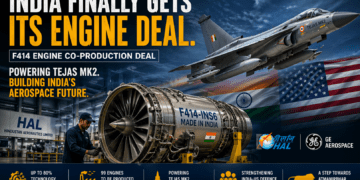
The acceleration strategy for AMCA recognises this constraint. Initial variants may rely on an upgraded foreign engine, while parallel indigenous engine development continues toward a higher-thrust solution for later blocks.
This staggered approach reduces schedule risk while preserving long-term sovereignty ambitions.
The engine pathway will likely determine whether AMCA achieves strategic independence or remains partially dependent.
Industrial Architecture: A Shift from PSU-Centric to Ecosystem Model
One of the more consequential dimensions of AMCA acceleration lies in industrial reform.
India’s aerospace manufacturing has traditionally been dominated by public sector entities. The new model envisions deeper private sector participation in subsystems, avionics, composites, and potentially final assembly.
This ecosystem approach serves two purposes.
- It distributes technical exposure across a broader industrial base, increasing resilience.
- It also compresses development timelines by leveraging competitive manufacturing efficiencies.
If AMCA evolves into a multi-vendor ecosystem rather than a single-entity programme, it could catalyse a durable aerospace supply chain capable of sustaining future export ambitions.
Weapons Integration and Autonomy
A fifth-generation aircraft without sovereign weapons integration authority risks strategic limitation.
AMCA’s design philosophy is reportedly structured around internal carriage of indigenous munitions, including next-generation air-to-air missiles and compact cruise missile variants under development.
Internal integration is not merely aerodynamic; it demands deep software compatibility, launch envelope optimisation, and sensor alignment.
If executed effectively, this architecture allows India to evolve its weapons suite independent of foreign clearance cycles.
That is the difference between owning a platform and owning a capability.
Timeline Compression and Risk Management
Acceleration inevitably introduces risk.
Aircraft development traditionally proceeds through iterative prototyping, testing, redesign, and certification. Compressing these phases risks unforeseen structural or systems integration challenges.
India’s strategy appears to involve parallelisation rather than simple speed-up — advancing design, materials testing, and subsystem development simultaneously to reduce sequential delays.
The danger lies in insufficient testing maturity.
The opportunity lies in shortening the window between prototype rollout and squadron induction, thereby preventing generational lag.
Strategic patience must coexist with industrial urgency.
Strategic Signalling and Geopolitical Implications
An accelerated AMCA programme also carries geopolitical weight.
It signals that India intends to remain a frontline aerospace power rather than a perpetual importer of high-end fighters. It reinforces deterrence credibility by projecting future capability rather than reactive procurement.
Moreover, successful fifth-generation development opens doors to export partnerships in the Indo-Pacific and beyond, particularly among nations seeking alternatives to dominant supplier blocs.
In a multipolar defence market, autonomy translates into influence.
The Rafale Bridge and Doctrinal Continuity
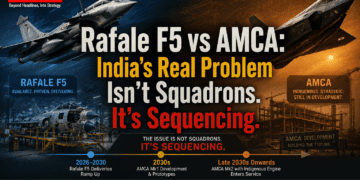
India’s expanding Rafale fleet from Dassault Aviation serves as a doctrinal bridge. It secures high-end 4.5-generation capability through the 2030s, allowing AMCA development to proceed without operational panic.
This sequencing stabilises airpower posture while nurturing fifth-generation ambition.
The critical task will be ensuring that Rafale industrial collaboration feeds technical insights into AMCA development rather than creating technological silos.
Learning transfer must be deliberate.
The Software Frontier
Perhaps the least discussed but most decisive frontier is software.
Fifth-generation aircraft are flying data centres. Code governs sensor fusion, threat recognition, flight control augmentation, and electronic warfare responses.
If India achieves sovereign software stacks within AMCA, it gains strategic elasticity. Threat libraries can be updated independently. New weapons can be integrated rapidly. Tactical doctrine can evolve without external mediation.
Without software authority, stealth becomes cosmetic.
The Long View: 2040 and Beyond
By the early 2040s, India’s air combat inventory will likely consist of a mix of Rafale squadrons, upgraded indigenous fighters, and AMCA variants.
The doctrinal question is whether AMCA becomes:
- A symbolic technological milestone,
Or - the nucleus of a sovereign, export-capable aerospace ecosystem.
Acceleration suggests India aims for the latter.
Ambition with Consequence
The AMCA acceleration strategy represents India’s most serious attempt to enter the elite circle of fifth-generation aircraft developers.
It is technologically risky. It is financially demanding. It requires institutional reform and disciplined coordination across agencies.
But it is strategically necessary.
Airpower in the mid-21st century will reward nations that control not only aircraft design, but propulsion, software, weapons integration, and industrial supply chains.
India’s fifth-generation ambition is therefore not about matching peers.
It is about ensuring that, in a contested Indo-Pacific security environment, sovereignty extends into the skies.
If executed with depth and discipline, AMCA will not merely add a new fighter to the inventory. It will redefine India’s aerospace trajectory for decades.

