

















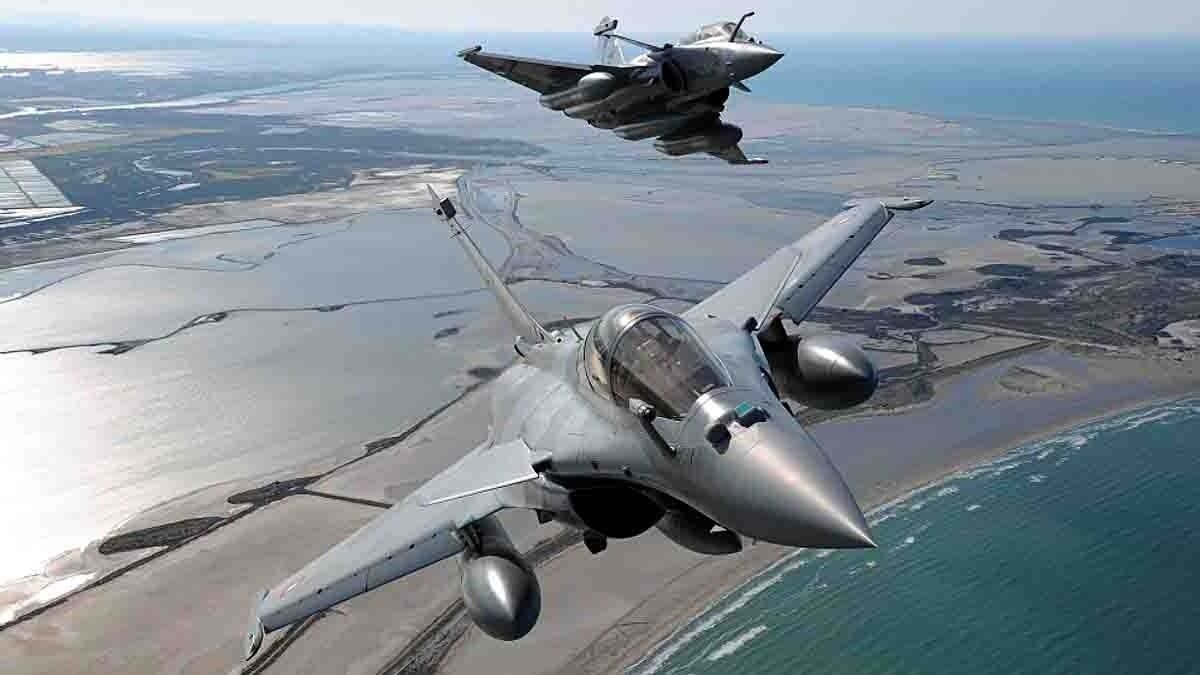
In the strategic lexicon of modern defence industrialisation, manufacturing sovereignty has replaced mere procurement as the true yardstick of capability. India’s decision to build a Rafale fighter production ecosystem in Nagpur is far more than a regional aerospace investment; it’s a deliberate push to embed high-end aerospace manufacture within the Indian industrial base, in line with Make in India goals and broader national security ambitions.
This initiative has three interlinked dimensions:strategic localisation targets, technology transfer frameworks, and supply-chain development with Indian industry partners. Together, they reflect a shift from being a consumer of advanced platforms to becoming a co-producer of them.
Nagpur: From Assembly Line to Aerospace Ecosystem
The Nagpur facility — currently operated by Dassault Reliance Aerospace Limited (a joint venture between Dassault Aviation and Reliance Group) — is the fulcrum of India’s Rafale industrial strategy.
But this site is evolving. What began as a facility focused on structural manufacturing and limited assembly is being positioned for higher-value manufacturing, systems integration, and possibly final aircraft assembly for the expanded Rafale fleet.
This is a strategic evolution — one that aligns Indian manufacturing capacity with long-term defence planning rather than episodic contract execution.
Localisation: Ambition Meets Targets
A Gradual Increase, Not Overnight Transition
Localisation is not binary. It is incremental — and it matters how that increment is structured.
Initial expectations for high-end platforms like Rafale typically hover around 30–40% indigenous content in early production lots. But the current roadmap sets a more ambitious trajectory: local content is expected to exceed 50% by the end of the 114-aircraft delivery cycle.
This gradual dilution of foreign inputs reflects two strategic realities:
- Capability development takes time — especially for aerospace-grade metallurgy, integrated avionics, and high-precision subsystems.
- System-level integration rights remain a negotiation fulcrum — full sovereignty over certain mission systems cannot be assumed at deal inception.
The target is not just cost savings; it is technical absorption.
Each percentage point of localisation represents real transfers: machining skills, precision tooling, quality assurance protocols, supply-chain governance, and certification competencies.
Technology Transfer: Beyond Blueprints
“Technology transfer” is often invoked casually, but in defence aerospace it has a precise, layered meaning:
- Design Authority Participation – Allowing Indian engineers to engage in design feedback loops rather than simple execution of foreign blueprints.
- Tooling and Manufacturing Know-How – Embedding machining methods, composite lay-up processes, heat-treatment protocols, and rig testing within local vendors.
- Software and Systems Interfaces – Allowing integration of indigenous subsystems (e.g., mission computers, radios, defensive aids) without external gatekeeping.
In Nagpur, these transfers are being operationalised through structured collaboration workshops, personnel exchanges, and joint qualification programmes.
Significantly, the localisation drive is gradually moving from sub-component production toward systems-level assembly — a sign that the partnership views Indian industry not as an adjunct supplier but as a co-developer of sovereign capability.
Indian Industry’s Role: TASL, HAL and Beyond
India’s aerospace ambition is only as strong as the industrial base that supports it.
Tata Advanced Systems Limited (TASL)
Tata Advanced Systems Limited has emerged as one of the most significant Indian industrial contributors. TASL is already involved in:
- Structural components manufacturing
- Precision machining
- Sub-assembly work
- Supply-chain linkage to global aerospace vendors
TASL’s participation signals that Indian private industry is no longer on the periphery of defence manufacturing — it is central to it.
Hindustan Aeronautics Limited (HAL)
Hindustan Aeronautics Limited, India’s traditional aerospace public sector lead, remains indispensable.
While TASL and private vendors diversify India’s supply chain, HAL contributes legacy domain expertise in aircraft systems, airframe integration, and certification pathways that are critical for complex platforms like Rafale.
The complementarity between private agility and HAL’s systemic experience strengthens the overall ecosystem rather than competing with it.
Tier-2 and Tier-3 MSMEs
Hundreds of smaller enterprises — precision tool makers, electronics fabricators, composite workshops – are being integrated upstream. This creates cascading industrial effects:
- Higher employment across skill levels
- Quality certification ecosystems aligned with international aerospace standards
- Export potential for non-defence high-precision components
The impact of localisation extends beyond assembly halls — it reshapes the fabric of India’s precision manufacturing base.
Supply Chain: Complexity, Quality, and Resilience
Aerostructure supply chains for fighter aircraft are among the most demanding in manufacturing. They require:
- Ultra-tight tolerances
- Aerospace-grade materials
- Redundant quality assurance checkpoints
- Traceable certification for every part in the chain
Building this ecosystem in India is a generational task.
The Nagpur roadmap addresses this by prioritising tiered localisation:
Phase 1: Low-risk sub-assemblies and auxiliary structures
Phase 2: High-precision subsystems and sub-integration
Phase 3: Systems assembly and validation engineering
Each phase includes rigorous quality gates and collaborative design reviews with Dassault engineers.
Most importantly, the Indian supply chain is being tied into global aerospace standards, not localised in isolation. This ensures that Indian vendors can compete for global aerospace work, not just captive Rafale contracts.
Certification and Regulatory Maturity
Industrial localisation is only meaningful if the products meet global certification standards.
This requires infrastructure for:
- Non-destructive testing (NDT)
- Environmental stress screening
- Fatigue life quantification
- ISO/AS9100 aerospace quality compliance
Learning these competencies positions India to certify components not just for Rafale, but for future indigenous platforms such as Tejas variants and AMCA.
Certification proficiency is a capability multiplier – enabling Indian vendors to service global defence and civil aerospace markets.
Strategic Implications: Sovereignty Through Industrial Depth
The localisation journey in Nagpur is not just an industrial ambition. It is a strategic hedge.
- Economic leverage becomes capability leverage
- Sovereign production reduces geopolitical supply risks
- Skilled human capital becomes a long-term asset
- Exportable aerospace components create global industrial linkages
In short, India is building industrial sovereignty, not procurement dependency.
Risks and Realistic Constraints
This strategy is ambitious and rightly so, but it is not without risk.
Firstly, true systems-level localisation – especially in avionics and mission systems – remains challenging due to intellectual property and export control realities. India may not immediately gain full source-code control over certain proprietary systems.
Secondly, building industrial depth at speed requires sustained investment in skills and infrastructural capacity. Aerospace manufacturing tolerances are unforgiving; one quality failure can cascade into reputational and operational risk.
Finally, managing the complex interplay between public and private sector entities – each with different cultures, incentives, and absorptive capacities — requires strong governance and strategic clarity.
Yet, these risks are acknowledged within the roadmap rather than ignored. Incremental capability absorption is the guiding principle.
The Making of a Hub — Not Just a Line
The Nagpur Rafale manufacturing initiative is more than a production line. It is a strategic architecture designed to embed high-end aerospace capability within India’s industrial DNA.
Localisation targets reflect a long-term vision – not instant transformation. Technology transfer mechanisms are structured for deep absorption, not superficial compliance. Indian vendors are being elevated from ancillary suppliers to core ecosystem participants.
If this roadmap succeeds, India will no longer be a buyer of advanced fighters – it will be a co-producer with sovereign manufacturing autonomy, export potential, and a sustainable industrial foundation.
Nagpur will not just assemble aircraft. It will assemble India’s aerospace future.

