











IndoAsia Defense
  • Home
  • Air
    • All
    • Air Defence
    • Drones
    • Fighters
    • ISR & Mobility
    Ghatak UCAV stealth, autonomy, integration

    Inside India’s Ghatak UCAV Program: Stealth, Autonomy, and the Integration Gap

    The F414 engine co-production agreement between Hindustan Aeronautics Limited and GE Aerospace

    India-US F414 Engine Deal Explained: Technology Transfer, Tejas Mk2, and AMCA

    What is the Su-57M1 India deal

    Su-57M1 for India: A Fifth-Generation Shortcut or a Strategic Dependency Trap?

    India indigenous long range surveillance radar with X-band drone detection capability

    450km Eyes, Machine-Speed Decisions: How India’s Indigenous Long Range Surveillance Radar Is Rewriting Air Defence

    Why Software Defined Radios Are the IAF’s Most Consequential Upgrade

    IAF Signs BEL Deal for Software Defined Radios: Rewiring India’s Air Combat Network

    How the Ghatak UCAV Stealth Design Redefines India’s Drone Warfare Doctrine

    Ghatak UCAV: India’s Carbon Composite Stealth Strategy Dissected

    Ballistic Missile Defense system intercepting incoming missile during midcourse phase

    How Ballistic Missile Defense Works: Inside Modern Missile Interception Systems

    Swarm logistics drones delivering military supplies in high-altitude Himalayan terrain with Indian Army presence

    Swarm Logistics Drones in Himalayan Warfare: Can India Close the Supply Gap with China?

    India’s 6th-Gen Fighter Strategy FCAS vs GCAP Explained

    India’s 6th-Gen Fighter Strategy: FCAS vs GCAP Explained

  • Land
    • All
    • Armour & Artillery
    • China Front
    • Future Combat
    • Pakistan Front
    The Indo-Pacific Is Fragmenting, Not Uniting Against China

    Why the Indo-Pacific Will Not Unite Against China

    The India-South Korea defence deal

    The India-South Korea Defence Deal Through China’s Operational Lens

    Railways as War Arteries Can India Match China’s Military Mobility Before the Next Crisis

    Railways as War Arteries: Can India Match China’s Military Mobility Before the Next Crisis?

    China maritime front in Indian Ocean

    What If China Opens a Maritime Front in the Indian Ocean During a LAC Conflict?

    What is Indian military modernization strategy in 2026?

    Indian Military Modernization: Systems, Doctrine, and Capability Architecture (2026-27)

    Tank launching loitering munition in battle

    From Smoke to Strike: India’s Indigenous Loitering Munitions for T-72, T-90, and Arjun Tanks

    How China Mobilizes Forces Along the LAC Speed, Systems, and Strategic Control

    How China Mobilizes Forces Along the LAC: Systems, Speed, and Strategic Signaling

    Ballistic Missile Defense system intercepting incoming missile during midcourse phase

    How Ballistic Missile Defense Works: Inside Modern Missile Interception Systems

    Swarm logistics drones delivering military supplies in high-altitude Himalayan terrain with Indian Army presence

    Swarm Logistics Drones in Himalayan Warfare: Can India Close the Supply Gap with China?

  • Navy
    • All
    • Fleet Expansion
    • Indian Ocean
    • Maritime Security
    • Submarines
    Mogami-class frigate deal overview

    Japan’s Mogami-Class Frigate Offer to India: What the Transfer Terms Reveal About Tokyo’s Indo-Pacific Calculus

    China maritime front in Indian Ocean

    What If China Opens a Maritime Front in the Indian Ocean During a LAC Conflict?

    The Strait of Hormuz Crisis

    India’s Oil Artery Under Threat: Strategic Implications of a Hormuz Crisis

    India’s VL-Shtil Missile Deal with Russia

    India’s VL-Shtil Missile Deal with Russia: Strengthening Naval Air Defense in the Indo-Pacific

    Andaman & Nicobar Command Sleeping Giant of India’s Maritime Strategy

    Andaman & Nicobar Command: Sleeping Giant of India’s Maritime Strategy

    Maritime Surveillance 2.0: Why EO/IR Modernisation Matters for India’s Ocean Security

    Maritime Surveillance 2.0: Why EO/IR Modernisation Matters for India’s Ocean Security

    2030 Will Decide the India ASEAN Maritime Equation

    2030 Will Decide the India ASEAN Maritime Equation

    India Military Transformation Series — Part 3: Maritime Power and the Indian Ocean Imperative

    India Military Transformation Series — Part 3: Maritime Power and the Indian Ocean Imperative

    Indian Navy TEDBF PPP Model: China Factor and 2030–2040 Carrier Strategy

    Indian Navy TEDBF PPP Model: China Factor and 2030–2040 Carrier Strategy

  • Indo-Pacific
    • All
    • 2035 Outlook
    • China Strategy
    • India Strategy
    • Pakistan Outlook
    DRDO-developed Guided Pinaka

    At ₹70 Lakh Per Rocket, DRDO-developed Guided Pinaka May Represent India’s Shift Toward Scalable Precision Warfare

    The Indo-Pacific Is Fragmenting, Not Uniting Against China

    Why the Indo-Pacific Will Not Unite Against China

    Mogami-class frigate deal overview

    Japan’s Mogami-Class Frigate Offer to India: What the Transfer Terms Reveal About Tokyo’s Indo-Pacific Calculus

    The India-South Korea defence deal

    The India-South Korea Defence Deal Through China’s Operational Lens

    Railways as War Arteries Can India Match China’s Military Mobility Before the Next Crisis

    Railways as War Arteries: Can India Match China’s Military Mobility Before the Next Crisis?

    india military integration gap

    Is India Building Military Power Faster Than It Can Integrate It?

    China maritime front in Indian Ocean

    What If China Opens a Maritime Front in the Indian Ocean During a LAC Conflict?

    Can India Fight Beyond 30 Days? Inside India’s War Sustainment Reality

    Can India Fight Beyond 30 Days? Inside India’s War Sustainment Reality

    What is Indian military modernization strategy in 2026?

    Indian Military Modernization: Systems, Doctrine, and Capability Architecture (2026-27)

  • Joint
    • All
    • Integrated Ops
    • Procurement Reform
    • Theater Commands
    India's strategic challenge sustainability first

    India Can Strike in 22 Minutes. Can It Sustain for 22 Weeks?

    Ballistic Missile Defense system intercepting incoming missile during midcourse phase

    How Ballistic Missile Defense Works: Inside Modern Missile Interception Systems

    India defence proposals Rs 2.38 trillion showing S-400 system, strike drones, fighter jets and military architecture shift

    India Defence Proposals Rs 2.38 Trillion: Why This Approval Changes How India Will Fight, Not Just What It Buys

    DAP 2026 India’s Quiet Revolution in Defence Procurement

    DAP 2026: India’s Quiet Revolution in Defence Procurement

    Integrated Battle Groups vs China’s Western Theater Command

    Integrated Battle Groups vs China’s Western Theater Command: Can Doctrine Survive the Himalayan Reality?

    Andaman & Nicobar Command Sleeping Giant of India’s Maritime Strategy

    Andaman & Nicobar Command: Sleeping Giant of India’s Maritime Strategy

    India Military Transformation Series — Part 2: The Theatre Command Reckoning

    India Military Transformation Series — Part 2: The Theatre Command Reckoning

    India AI C4ISR modernization

    India Military Transformation Series — Part 1: India AI C4ISR Modernization

    India’s Two-Front Theatre Command: Preparing for Simultaneous Conflict

    India’s Two-Front Theatre Command: Preparing for Simultaneous Conflict

  • Tech
    • All
    • AI & Autonomous Systems
    • Cyber
    • Electronic Warfare
    • Space
    Why Software Defined Radios Are the IAF’s Most Consequential Upgrade

    IAF Signs BEL Deal for Software Defined Radios: Rewiring India’s Air Combat Network

    Source Code or ICD India’s Source Code Negotiation Explained

    Source Code or ICD: India’s Source Code Negotiation Explained

    Supply Chain Weaponization

    Supply Chain Weaponization: Strategic Autonomy Meets Semiconductor Reality

    AI-driven battlefield in India's military

    The Algorithm of Borders: What India’s Military AI Push Actually Looks Like on the Ground

    India AI C4ISR modernization

    India Military Transformation Series — Part 1: India AI C4ISR Modernization

    PRAHAR Explained India Counter Terror Policy Prahaar

    PRAHAAR Explained: Why ‘PRAHAAR’ India’s National Counter-terrorism Doctrine, Signals the End of Traditional Warfare

    The Weapons Making the AMCA Unbeatable

    The Weapons Making the AMCA Unbeatable

    India’s Aerospace Ecosystem After Rafale: The 2026–2030 Industrial Test

    India’s Aerospace Ecosystem After Rafale: The 2026–2030 Industrial Test

    PLA’s Cyber Warfare Units and the Question of Indian Critical Infrastructure Resilience

    PLA’s Cyber Warfare Units and the Question of Indian Critical Infrastructure Resilience

  • Industry
    • All
    • Budget
    • Exports
    • Make in India
    • Supply Chains
    India's strategic challenge sustainability first

    India Can Strike in 22 Minutes. Can It Sustain for 22 Weeks?

    India-UAE defence pact and Gulf strategy

    India-UAE Defence Pact: Why Abu Dhabi Is Becoming India’s Western Strategic Depth

    Ghatak UCAV stealth, autonomy, integration

    Inside India’s Ghatak UCAV Program: Stealth, Autonomy, and the Integration Gap

    The India-South Korea defence deal

    The India-South Korea Defence Deal Through China’s Operational Lens

    The F414 engine co-production agreement between Hindustan Aeronautics Limited and GE Aerospace

    India-US F414 Engine Deal Explained: Technology Transfer, Tejas Mk2, and AMCA

    Why Software Defined Radios Are the IAF’s Most Consequential Upgrade

    IAF Signs BEL Deal for Software Defined Radios: Rewiring India’s Air Combat Network

    How the Ghatak UCAV Stealth Design Redefines India’s Drone Warfare Doctrine

    Ghatak UCAV: India’s Carbon Composite Stealth Strategy Dissected

    Swarm logistics drones delivering military supplies in high-altitude Himalayan terrain with Indian Army presence

    Swarm Logistics Drones in Himalayan Warfare: Can India Close the Supply Gap with China?

    India defence proposals Rs 2.38 trillion showing S-400 system, strike drones, fighter jets and military architecture shift

    India Defence Proposals Rs 2.38 Trillion: Why This Approval Changes How India Will Fight, Not Just What It Buys

  • Global
    • All
    • China-Pak
    • Emerging Tech
    • Middle Eeast
    • Regional Trends
    • US-India
    • US-Israel
    India-UAE defence pact and Gulf strategy

    India-UAE Defence Pact: Why Abu Dhabi Is Becoming India’s Western Strategic Depth

    The Indo-Pacific Is Fragmenting, Not Uniting Against China

    Why the Indo-Pacific Will Not Unite Against China

    Ghatak UCAV stealth, autonomy, integration

    Inside India’s Ghatak UCAV Program: Stealth, Autonomy, and the Integration Gap

    The F414 engine co-production agreement between Hindustan Aeronautics Limited and GE Aerospace

    India-US F414 Engine Deal Explained: Technology Transfer, Tejas Mk2, and AMCA

    india military integration gap

    Is India Building Military Power Faster Than It Can Integrate It?

    India indigenous long range surveillance radar with X-band drone detection capability

    450km Eyes, Machine-Speed Decisions: How India’s Indigenous Long Range Surveillance Radar Is Rewriting Air Defence

    What is Indian military modernization strategy in 2026?

    Indian Military Modernization: Systems, Doctrine, and Capability Architecture (2026-27)

    India defence proposals Rs 2.38 trillion showing S-400 system, strike drones, fighter jets and military architecture shift

    India Defence Proposals Rs 2.38 Trillion: Why This Approval Changes How India Will Fight, Not Just What It Buys

    India’s 6th-Gen Fighter Strategy FCAS vs GCAP Explained

    India’s 6th-Gen Fighter Strategy: FCAS vs GCAP Explained

  • Resources
    • India Military Capability Index
    • India vs China Military Balance
    • China Western Theater Command Guide
    • Pakistan Military Tracker 2026-27
    • India’s Military Doctrine Library
    • India vs China vs Pakistan Missile Arsenal Comparison
    • India’s Missile List
    • India Missile Range Map
    • Indo-Pacific Military Power Map
    • Indo-Pacific Defense Timeline
    • Global Military Balance Dashboard
    • Global Weapons Systems Database
    • Global Missile Systems Database
  • What If
    • China India Naval Conflict
No Result
View All Result
  • Home
  • Air
    • All
    • Air Defence
    • Drones
    • Fighters
    • ISR & Mobility
    Ghatak UCAV stealth, autonomy, integration

    Inside India’s Ghatak UCAV Program: Stealth, Autonomy, and the Integration Gap

    The F414 engine co-production agreement between Hindustan Aeronautics Limited and GE Aerospace

    India-US F414 Engine Deal Explained: Technology Transfer, Tejas Mk2, and AMCA

    What is the Su-57M1 India deal

    Su-57M1 for India: A Fifth-Generation Shortcut or a Strategic Dependency Trap?

    India indigenous long range surveillance radar with X-band drone detection capability

    450km Eyes, Machine-Speed Decisions: How India’s Indigenous Long Range Surveillance Radar Is Rewriting Air Defence

    Why Software Defined Radios Are the IAF’s Most Consequential Upgrade

    IAF Signs BEL Deal for Software Defined Radios: Rewiring India’s Air Combat Network

    How the Ghatak UCAV Stealth Design Redefines India’s Drone Warfare Doctrine

    Ghatak UCAV: India’s Carbon Composite Stealth Strategy Dissected

    Ballistic Missile Defense system intercepting incoming missile during midcourse phase

    How Ballistic Missile Defense Works: Inside Modern Missile Interception Systems

    Swarm logistics drones delivering military supplies in high-altitude Himalayan terrain with Indian Army presence

    Swarm Logistics Drones in Himalayan Warfare: Can India Close the Supply Gap with China?

    India’s 6th-Gen Fighter Strategy FCAS vs GCAP Explained

    India’s 6th-Gen Fighter Strategy: FCAS vs GCAP Explained

  • Land
    • All
    • Armour & Artillery
    • China Front
    • Future Combat
    • Pakistan Front
    The Indo-Pacific Is Fragmenting, Not Uniting Against China

    Why the Indo-Pacific Will Not Unite Against China

    The India-South Korea defence deal

    The India-South Korea Defence Deal Through China’s Operational Lens

    Railways as War Arteries Can India Match China’s Military Mobility Before the Next Crisis

    Railways as War Arteries: Can India Match China’s Military Mobility Before the Next Crisis?

    China maritime front in Indian Ocean

    What If China Opens a Maritime Front in the Indian Ocean During a LAC Conflict?

    What is Indian military modernization strategy in 2026?

    Indian Military Modernization: Systems, Doctrine, and Capability Architecture (2026-27)

    Tank launching loitering munition in battle

    From Smoke to Strike: India’s Indigenous Loitering Munitions for T-72, T-90, and Arjun Tanks

    How China Mobilizes Forces Along the LAC Speed, Systems, and Strategic Control

    How China Mobilizes Forces Along the LAC: Systems, Speed, and Strategic Signaling

    Ballistic Missile Defense system intercepting incoming missile during midcourse phase

    How Ballistic Missile Defense Works: Inside Modern Missile Interception Systems

    Swarm logistics drones delivering military supplies in high-altitude Himalayan terrain with Indian Army presence

    Swarm Logistics Drones in Himalayan Warfare: Can India Close the Supply Gap with China?

  • Navy
    • All
    • Fleet Expansion
    • Indian Ocean
    • Maritime Security
    • Submarines
    Mogami-class frigate deal overview

    Japan’s Mogami-Class Frigate Offer to India: What the Transfer Terms Reveal About Tokyo’s Indo-Pacific Calculus

    China maritime front in Indian Ocean

    What If China Opens a Maritime Front in the Indian Ocean During a LAC Conflict?

    The Strait of Hormuz Crisis

    India’s Oil Artery Under Threat: Strategic Implications of a Hormuz Crisis

    India’s VL-Shtil Missile Deal with Russia

    India’s VL-Shtil Missile Deal with Russia: Strengthening Naval Air Defense in the Indo-Pacific

    Andaman & Nicobar Command Sleeping Giant of India’s Maritime Strategy

    Andaman & Nicobar Command: Sleeping Giant of India’s Maritime Strategy

    Maritime Surveillance 2.0: Why EO/IR Modernisation Matters for India’s Ocean Security

    Maritime Surveillance 2.0: Why EO/IR Modernisation Matters for India’s Ocean Security

    2030 Will Decide the India ASEAN Maritime Equation

    2030 Will Decide the India ASEAN Maritime Equation

    India Military Transformation Series — Part 3: Maritime Power and the Indian Ocean Imperative

    India Military Transformation Series — Part 3: Maritime Power and the Indian Ocean Imperative

    Indian Navy TEDBF PPP Model: China Factor and 2030–2040 Carrier Strategy

    Indian Navy TEDBF PPP Model: China Factor and 2030–2040 Carrier Strategy

  • Indo-Pacific
    • All
    • 2035 Outlook
    • China Strategy
    • India Strategy
    • Pakistan Outlook
    DRDO-developed Guided Pinaka

    At ₹70 Lakh Per Rocket, DRDO-developed Guided Pinaka May Represent India’s Shift Toward Scalable Precision Warfare

    The Indo-Pacific Is Fragmenting, Not Uniting Against China

    Why the Indo-Pacific Will Not Unite Against China

    Mogami-class frigate deal overview

    Japan’s Mogami-Class Frigate Offer to India: What the Transfer Terms Reveal About Tokyo’s Indo-Pacific Calculus

    The India-South Korea defence deal

    The India-South Korea Defence Deal Through China’s Operational Lens

    Railways as War Arteries Can India Match China’s Military Mobility Before the Next Crisis

    Railways as War Arteries: Can India Match China’s Military Mobility Before the Next Crisis?

    india military integration gap

    Is India Building Military Power Faster Than It Can Integrate It?

    China maritime front in Indian Ocean

    What If China Opens a Maritime Front in the Indian Ocean During a LAC Conflict?

    Can India Fight Beyond 30 Days? Inside India’s War Sustainment Reality

    Can India Fight Beyond 30 Days? Inside India’s War Sustainment Reality

    What is Indian military modernization strategy in 2026?

    Indian Military Modernization: Systems, Doctrine, and Capability Architecture (2026-27)

  • Joint
    • All
    • Integrated Ops
    • Procurement Reform
    • Theater Commands
    India's strategic challenge sustainability first

    India Can Strike in 22 Minutes. Can It Sustain for 22 Weeks?

    Ballistic Missile Defense system intercepting incoming missile during midcourse phase

    How Ballistic Missile Defense Works: Inside Modern Missile Interception Systems

    India defence proposals Rs 2.38 trillion showing S-400 system, strike drones, fighter jets and military architecture shift

    India Defence Proposals Rs 2.38 Trillion: Why This Approval Changes How India Will Fight, Not Just What It Buys

    DAP 2026 India’s Quiet Revolution in Defence Procurement

    DAP 2026: India’s Quiet Revolution in Defence Procurement

    Integrated Battle Groups vs China’s Western Theater Command

    Integrated Battle Groups vs China’s Western Theater Command: Can Doctrine Survive the Himalayan Reality?

    Andaman & Nicobar Command Sleeping Giant of India’s Maritime Strategy

    Andaman & Nicobar Command: Sleeping Giant of India’s Maritime Strategy

    India Military Transformation Series — Part 2: The Theatre Command Reckoning

    India Military Transformation Series — Part 2: The Theatre Command Reckoning

    India AI C4ISR modernization

    India Military Transformation Series — Part 1: India AI C4ISR Modernization

    India’s Two-Front Theatre Command: Preparing for Simultaneous Conflict

    India’s Two-Front Theatre Command: Preparing for Simultaneous Conflict

  • Tech
    • All
    • AI & Autonomous Systems
    • Cyber
    • Electronic Warfare
    • Space
    Why Software Defined Radios Are the IAF’s Most Consequential Upgrade

    IAF Signs BEL Deal for Software Defined Radios: Rewiring India’s Air Combat Network

    Source Code or ICD India’s Source Code Negotiation Explained

    Source Code or ICD: India’s Source Code Negotiation Explained

    Supply Chain Weaponization

    Supply Chain Weaponization: Strategic Autonomy Meets Semiconductor Reality

    AI-driven battlefield in India's military

    The Algorithm of Borders: What India’s Military AI Push Actually Looks Like on the Ground

    India AI C4ISR modernization

    India Military Transformation Series — Part 1: India AI C4ISR Modernization

    PRAHAR Explained India Counter Terror Policy Prahaar

    PRAHAAR Explained: Why ‘PRAHAAR’ India’s National Counter-terrorism Doctrine, Signals the End of Traditional Warfare

    The Weapons Making the AMCA Unbeatable

    The Weapons Making the AMCA Unbeatable

    India’s Aerospace Ecosystem After Rafale: The 2026–2030 Industrial Test

    India’s Aerospace Ecosystem After Rafale: The 2026–2030 Industrial Test

    PLA’s Cyber Warfare Units and the Question of Indian Critical Infrastructure Resilience

    PLA’s Cyber Warfare Units and the Question of Indian Critical Infrastructure Resilience

  • Industry
    • All
    • Budget
    • Exports
    • Make in India
    • Supply Chains
    India's strategic challenge sustainability first

    India Can Strike in 22 Minutes. Can It Sustain for 22 Weeks?

    India-UAE defence pact and Gulf strategy

    India-UAE Defence Pact: Why Abu Dhabi Is Becoming India’s Western Strategic Depth

    Ghatak UCAV stealth, autonomy, integration

    Inside India’s Ghatak UCAV Program: Stealth, Autonomy, and the Integration Gap

    The India-South Korea defence deal

    The India-South Korea Defence Deal Through China’s Operational Lens

    The F414 engine co-production agreement between Hindustan Aeronautics Limited and GE Aerospace

    India-US F414 Engine Deal Explained: Technology Transfer, Tejas Mk2, and AMCA

    Why Software Defined Radios Are the IAF’s Most Consequential Upgrade

    IAF Signs BEL Deal for Software Defined Radios: Rewiring India’s Air Combat Network

    How the Ghatak UCAV Stealth Design Redefines India’s Drone Warfare Doctrine

    Ghatak UCAV: India’s Carbon Composite Stealth Strategy Dissected

    Swarm logistics drones delivering military supplies in high-altitude Himalayan terrain with Indian Army presence

    Swarm Logistics Drones in Himalayan Warfare: Can India Close the Supply Gap with China?

    India defence proposals Rs 2.38 trillion showing S-400 system, strike drones, fighter jets and military architecture shift

    India Defence Proposals Rs 2.38 Trillion: Why This Approval Changes How India Will Fight, Not Just What It Buys

  • Global
    • All
    • China-Pak
    • Emerging Tech
    • Middle Eeast
    • Regional Trends
    • US-India
    • US-Israel
    India-UAE defence pact and Gulf strategy

    India-UAE Defence Pact: Why Abu Dhabi Is Becoming India’s Western Strategic Depth

    The Indo-Pacific Is Fragmenting, Not Uniting Against China

    Why the Indo-Pacific Will Not Unite Against China

    Ghatak UCAV stealth, autonomy, integration

    Inside India’s Ghatak UCAV Program: Stealth, Autonomy, and the Integration Gap

    The F414 engine co-production agreement between Hindustan Aeronautics Limited and GE Aerospace

    India-US F414 Engine Deal Explained: Technology Transfer, Tejas Mk2, and AMCA

    india military integration gap

    Is India Building Military Power Faster Than It Can Integrate It?

    India indigenous long range surveillance radar with X-band drone detection capability

    450km Eyes, Machine-Speed Decisions: How India’s Indigenous Long Range Surveillance Radar Is Rewriting Air Defence

    What is Indian military modernization strategy in 2026?

    Indian Military Modernization: Systems, Doctrine, and Capability Architecture (2026-27)

    India defence proposals Rs 2.38 trillion showing S-400 system, strike drones, fighter jets and military architecture shift

    India Defence Proposals Rs 2.38 Trillion: Why This Approval Changes How India Will Fight, Not Just What It Buys

    India’s 6th-Gen Fighter Strategy FCAS vs GCAP Explained

    India’s 6th-Gen Fighter Strategy: FCAS vs GCAP Explained

  • Resources
    • India Military Capability Index
    • India vs China Military Balance
    • China Western Theater Command Guide
    • Pakistan Military Tracker 2026-27
    • India’s Military Doctrine Library
    • India vs China vs Pakistan Missile Arsenal Comparison
    • India’s Missile List
    • India Missile Range Map
    • Indo-Pacific Military Power Map
    • Indo-Pacific Defense Timeline
    • Global Military Balance Dashboard
    • Global Weapons Systems Database
    • Global Missile Systems Database
  • What If
    • China India Naval Conflict
No Result
View All Result
IndoAsia Defense
No Result
View All Result
Home Industry Make in India

India Defence Industrial Policy 2047 Explained

India’s defence industrial roadmap to 2047 reflects a long-term strategy to move beyond procurement dependence and build sovereign military production. The policy seeks to strengthen India’s defence manufacturing base, expand exports, and establish strategic autonomy in an increasingly contested Indo-Pacific security environment.

IndoAsia Defense by IndoAsia Defense
April 1, 2026
in 2035 Outlook, Budget, Exports, India Strategy, Industry, Make in India, Supply Chains
0
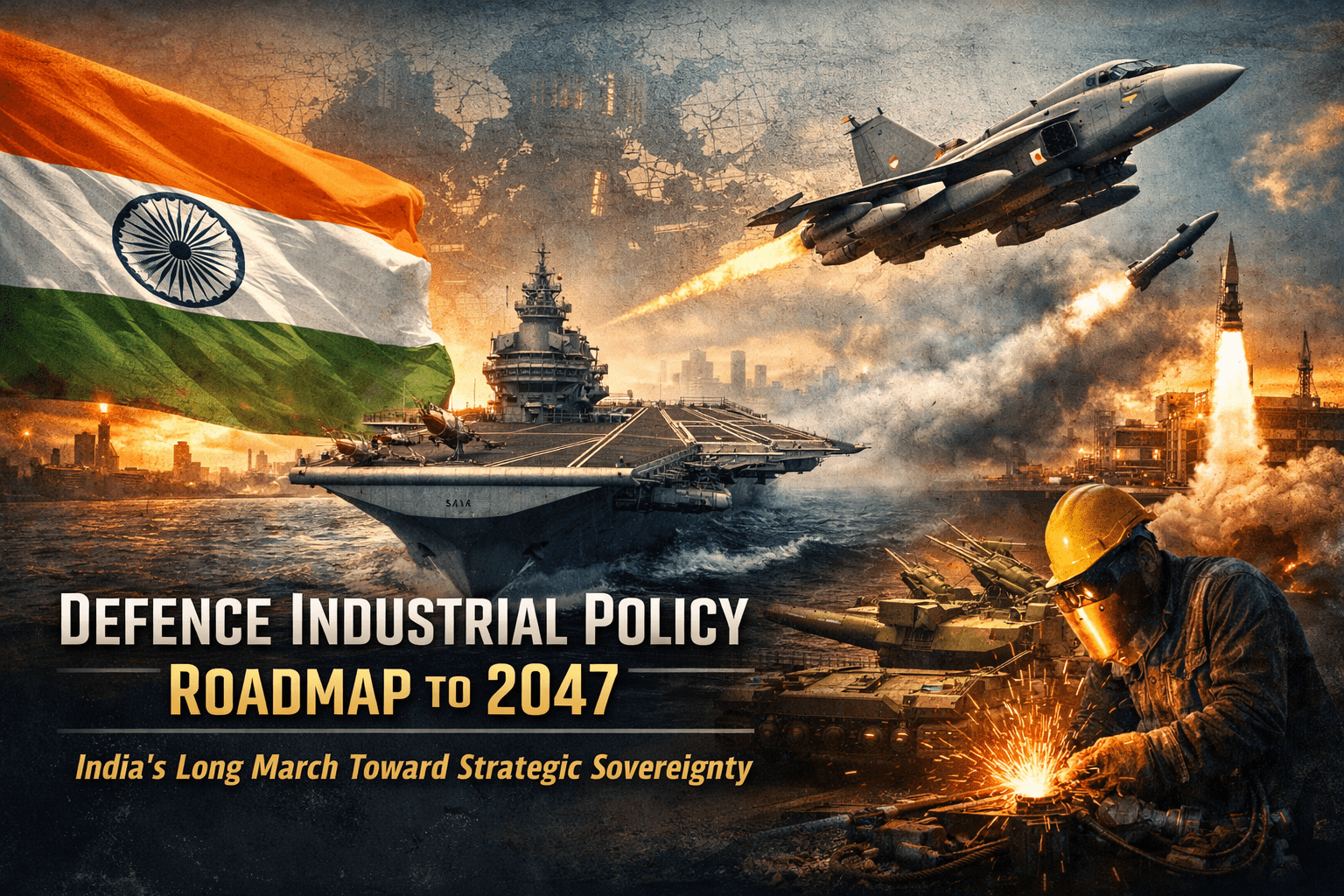
Defence Industrial Policy Roadmap to 2047 India’s Long March Toward Strategic Sovereignty
0
SHARES
30
VIEWS
Share on LinkedinShare on FacebookShare on Twitter

What Is India Defence Industrial Policy 2047?

India Defence Industrial Policy 2047 begins by shifting the centre of gravity from platforms to production power. For decades, India’s defence discourse has been dominated by visible assets such as fighter jets, submarines, missile systems, and drones, reinforcing the idea that military strength is defined by acquisition.

This emphasis on platforms has shaped procurement cycles, political messaging, and even public perception of capability. Yet this framing masks a deeper structural reality that determines how power is actually sustained. What ultimately matters is not the inventory a military fields at the start of a conflict, but the industrial capacity it can mobilize as that conflict evolves.

This is where the policy marks a decisive break from the past. India Defence Industrial Policy 2047 reframes military capability as a function of industrial depth rather than procurement volume. A force built through imports can achieve immediate readiness, but it remains exposed to supply chain disruptions, political constraints, and technological dependence.

By contrast, a force backed by domestic production capacity can absorb losses, adapt systems, and sustain operations over time. The policy therefore elevates manufacturing from a supporting role to a central pillar of national security. This shift redefines deterrence itself, linking it not just to what India can deploy, but to what it can continuously generate under pressure.

From Procurement Dependence to Industrial Sovereignty

India Defence Industrial Policy 2047 seeks to move India from procurement dependence toward industrial sovereignty. The distinction is not about increasing domestic content alone, but about controlling the underlying architecture of defence systems.

Earlier initiatives under Atmanirbhar Bharat defence improved local participation but often operated within the framework of licensed production. In such arrangements, critical technologies, design authority, and upgrade pathways remained external, limiting India’s ability to independently evolve its capabilities.

The current policy attempts to shift this balance by prioritizing design ownership and indigenous systems development. This involves not only expanding domestic manufacturing but also strengthening research ecosystems, encouraging private sector innovation, and integrating academia into defence R&D pipelines.

The objective is to reposition India within the global defence value chain, moving from a downstream assembler to an upstream designer and integrator. This transition is complex and uneven, but it is central to achieving genuine strategic autonomy. Without ownership of core technologies, self-reliance remains partial and conditional.

The Speed vs Sovereignty Dilemma

The central tension within India Defence Industrial Policy 2047 is the dilemma between speed and sovereignty. India’s security environment demands rapid capability enhancement, particularly in the context of a potential two-front conflict scenario. Immediate operational requirements often necessitate imports or licensed production, which can deliver systems quickly but reinforce dependency. At the same time, building indigenous capability requires long development cycles, sustained funding, and tolerance for initial inefficiencies.

This creates a structural contradiction within policy execution. India Defence Industrial Policy 2047 attempts to manage this tension through a hybrid approach that combines domestic development with selective international collaboration. Co-development agreements and technology partnerships are used to bridge capability gaps while building internal expertise.

However, the balance remains fragile. Procurement pressures can easily override long-term industrial objectives, especially during periods of heightened threat perception. The challenge lies in maintaining strategic discipline, ensuring that short-term urgency does not compromise long-term sovereignty.

Industrial Deterrence and the Economics of War Endurance

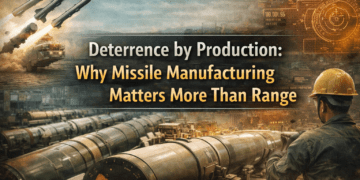
India Defence Industrial Policy 2047 introduces industrial deterrence as a defining element of modern military power. Traditional measures such as force size or technological sophistication capture only the initial phase of conflict. Increasingly, the outcome of wars is determined by the ability to sustain operations over extended periods. This shifts the focus from stockpiles to production cycles, where manufacturing capacity becomes the decisive factor.

India’s defence production has crossed approximately ₹1.27 lakh crore, reflecting a steady expansion of industrial capability. Yet the significance of this growth lies not in absolute numbers but in its strategic implications. A country that can replenish munitions, repair platforms, and scale production under wartime conditions alters the adversary’s cost-benefit calculus.

Deterrence begins to incorporate not just the threat of retaliation, but the certainty of endurance. India Defence Industrial Policy 2047 embeds this logic into the broader framework of military planning, linking industrial output directly to operational sustainability.

India’s Hybrid Model in a World of Industrial Extremes

India Defence Industrial Policy 2047 positions the country within a hybrid model in a global landscape defined by industrial extremes. The United States represents a private sector-led system characterized by innovation and competitive contracting, while China operates a state-driven model with deep integration between civilian and military industries. India’s approach combines elements of both, reflecting its institutional diversity and economic structure.

Dimension India (2047 Vision) China United States
Ownership Structure Mixed public-private State-dominated Private-led
Innovation Model Hybrid State-driven Market-driven
Export Orientation Expanding Aggressive Mature
Procurement System Reforming Centralized Competitive
Technology Control Selective sovereignty High state control Corporate-led

This hybrid model introduces both flexibility and complexity. Coordination between public sector undertakings, private firms, and research institutions becomes critical. Unlike more centralized systems, India must rely on policy coherence rather than structural uniformity. The implication is that progress will likely be uneven, with advances concentrated in specific sectors rather than across the entire ecosystem. India Defence Industrial Policy 2047 therefore reflects a strategy of selective depth rather than comprehensive parity.

Breaking the PSU Monopoly: The Private Sector Moment

India Defence Industrial Policy 2047 marks a decisive shift toward expanding the role of private industry in defence manufacturing. For decades, production was dominated by public sector undertakings, which operated within a relatively insulated environment. While these entities built foundational capacity, they often lacked the competitive pressures needed to drive rapid innovation and efficiency.

The entry of private firms introduces new dynamics into the system. Companies are bringing advanced manufacturing techniques, integration capabilities, and a stronger orientation toward exports. This is gradually reshaping the defence manufacturing ecosystem, creating a more competitive and diversified industrial base.

However, structural constraints persist. Procurement processes, legacy relationships, and regulatory frameworks continue to influence outcomes, sometimes limiting the pace of change. The success of India Defence Industrial Policy 2047 will depend on how effectively these institutional barriers are addressed.

The Hidden Layer: Critical Minerals and Supply Chain Power

India Defence Industrial Policy 2047 extends beyond manufacturing into the domain of resource security. Modern defence systems depend on a range of critical minerals, including rare earth elements, lithium, and specialized alloys. These materials are essential for advanced electronics, propulsion systems, and precision-guided munitions. Control over these inputs is therefore a prerequisite for industrial capability.

Global supply chains for many of these resources are concentrated, with China playing a dominant role in processing and refinement. This creates a structural vulnerability for countries seeking to build independent defence industries.

India has begun addressing this challenge through initiatives such as the National Critical Mineral Mission and international partnerships aimed at diversifying supply sources. The integration of resource strategy into industrial policy reflects a broader understanding that manufacturing autonomy begins with material access.

Defence Exports as Strategic Leverage, Not Just Revenue

India Defence Industrial Policy 2047 treats defence exports as instruments of strategic leverage rather than purely commercial activity. Export relationships create long-term dependencies, interoperability frameworks, and political alignment between states. As India expands its manufacturing base, it gains the ability to influence regional security dynamics through the supply of military systems.

Exports are already growing, supported by increasing confidence in indigenous platforms. However, their significance lies in their strategic impact. By supplying equipment to partner nations, India can strengthen alliances, build trust, and extend its influence across key regions.

This is particularly relevant in the Indo-Pacific, where countries are actively seeking diversified defence partnerships. India Defence Industrial Policy 2047 thus integrates exports into a broader geopolitical strategy.

Financing the War Machine: Capital, Risk, and State Power

India Defence Industrial Policy 2047 depends fundamentally on how effectively it can finance large-scale industrial transformation. Defence manufacturing requires substantial upfront investment, long development timelines, and uncertain returns.

These characteristics make it inherently risky for private capital without strong state backing. The policy therefore explores mechanisms to distribute risk, including procurement guarantees, public-private partnerships, and export-linked incentives.

The challenge lies in balancing ambition with fiscal sustainability. Excessive reliance on state funding can strain public finances, while insufficient support can deter private participation. This creates a delicate equilibrium that must be managed over decades. Financing is not merely a supporting function but a central pillar of the policy’s success. Without a robust financial architecture, the objectives of India Defence Industrial Policy 2047 will remain aspirational rather than operational.

2047 Scenario: From Importer to Indo-Pacific Security Provider

India Defence Industrial Policy 2047 envisions a long-term transformation in which India evolves from a major arms importer into a net security provider in the Indo-Pacific. This scenario involves achieving self-sufficiency in critical systems while developing the capacity to supply allies with reliable defence equipment. Such a shift would significantly expand India’s strategic footprint.

In this future, defence exports could scale dramatically, supported by a diversified and technologically capable industrial base. India would play a central role in regional security architectures, leveraging its manufacturing strength to build enduring partnerships. The realization of this scenario depends on sustained policy execution, technological progress, and stable geopolitical conditions.

The Structural Bet on Industrial Power

India Defence Industrial Policy 2047 ultimately represents a structural bet on industrial power as the foundation of military strength. It seeks to align production capability, technological ownership, and strategic autonomy into a unified framework.

The policy’s ambitions are significant, but so are the constraints that shape its implementation. Tensions between speed and sovereignty, public and private sector roles, and ambition and affordability will define its trajectory.

What distinguishes this policy is its recognition that industrial capacity is inseparable from strategic freedom. In a world of contested supply chains and prolonged conflict scenarios, the ability to design, produce, and sustain military systems domestically becomes a decisive advantage.

India Defence Industrial Policy 2047 is therefore not just about building weapons, but about building the conditions under which military power can be exercised independently and sustained over time.

————————————-

FAQs

What is India Defence Industrial Policy 2047?

India Defence Industrial Policy 2047 is a long-term framework aimed at transforming India into a self-reliant and globally competitive defence manufacturing power with strong domestic capability and export potential.

Why is industrial capacity important for military power?

Industrial capacity determines how effectively a country can sustain operations, replenish losses, and adapt systems during prolonged conflicts.

What role does the private sector play in this policy?

Private firms are expected to drive innovation, improve efficiency, and expand India’s defence export footprint alongside public sector institutions.

How does this policy affect India’s strategic autonomy?

By reducing dependence on foreign suppliers and increasing control over technology and production, the policy enhances India’s ability to act independently.

What are the biggest risks to the policy’s success?

Key risks include technological gaps, financing constraints, procurement inefficiencies, and the challenge of balancing short-term capability needs with long-term industrial goals.


READ NEXT

  • DAP 2026: India’s Quiet Revolution in Defence Procurement
  • India Private Defence Industry: Are Tata, L&T and Adani Challenging PSU Dominance?
  • Chips, Rare Earths, and Telecom: India’s Industrial Counter to China’s Supply Chain Leverage
  • How PLI Schemes Are Reshaping India’s Military Electronics Ecosystem
Tags: Popular Stories
Previous Post

India’s 6th-Gen Fighter Strategy: FCAS vs GCAP Explained

Next Post

India Defence Exports Strategy: How India Is Turning Manufacturing into Geopolitical Leverage

IndoAsia Defense

IndoAsia Defense

IndoAsia Defense Team is a specialist research and analysis group focused on India’s military modernization and Indo-Pacific strategic dynamics. The platform delivers structured, data-driven insights on doctrine, force posture, defense technology, and regional power balance.

Next Post
India Defence Exports Strategy

India Defence Exports Strategy: How India Is Turning Manufacturing into Geopolitical Leverage

Leave a Reply Cancel reply

Login with your Social ID

Your email address will not be published. Required fields are marked *

Category

  • Air
  • Global
  • Indo-Pacific
  • Industry
  • Joint
  • Land
  • Navy
  • Tech

Defence Capabilities

  • Air Defence
  • Drones
  • Fighters
  • ISR & Mobility
  • China Military
  • Emerging Tech
  • Regional Trends
  • U.S. Posture

Strategy

  • 2035 Outlook
  • China Strategy
  • India Strategy
  • Pakistan Outlook
  • Budget
  • Exports
  • Make in India
  • Supply Chains

Operations

  • Integrated Ops
  • Procurement Reform
  • Theater Commands
  • Armour & Artillery
  • China Front
  • Future Combat
  • Pakistan Front
  • Fleet Expansion

Resources

  • India vs China Military Balance
  • Indo-Pacific Military Power Map
  • Global Military Balance Dashboard
  • Global Weapons Systems Database
  • Global Missile Systems Database
  • Indo-Pacific Defense Timeline
  • India Military Capability Index
  • About
  • Contact
  • Privacy & Policy
  • Editorial Policy
  • Cookie Policy
  • Disclaimer
  • Terms And Conditions
Facebook Linkedin X-twitter
© 2026 IndoAsia Defense. All Rights Reserved.
No Result
View All Result
  • Home
  • Air
    • Air Defence
    • Drones
    • Fighters
    • ISR & Mobility
  • Land
    • Armour & Artillery
    • China Front
    • Future Combat
    • Pakistan Front
  • Navy
    • Fleet Expansion
    • Indian Ocean
    • Maritime Security
    • Submarines
  • Indo-Pacific
    • 2035 Outlook
    • China Strategy
    • India Strategy
    • Pakistan Outlook
  • Joint
    • Integrated Ops
    • Procurement Reform
    • Theater Commands
  • Tech
    • AI & Autonomous Systems
    • Cyber
    • Electronic Warfare
    • Space
  • Industry
    • Budget
    • Exports
    • Make in India
    • Supply Chains
  • Global
    • China-Pak
    • Emerging Tech
    • Regional Trends
    • US-India