





















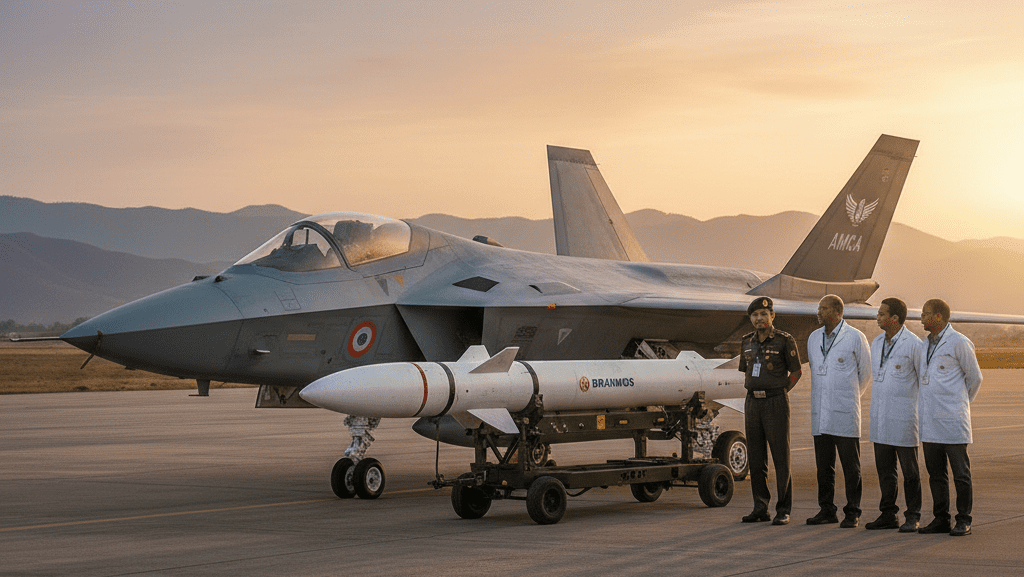
When people talk about the future of Indian air power, they usually focus on two headline programs: the Advanced Medium Combat Aircraft (AMCA) and the growing family of indigenous missile systems developed by Defence Research and Development Organisation (DRDO).
Individually, both are ambitious. Together, they could redefine how India fights in the air.
But here’s the part that often gets glossed over — integrating advanced missile systems into a fifth-generation fighter is not simply a procurement decision.
It is a complex technological choreography involving stealth design, avionics architecture, networked warfare, pilot training, and long-term doctrine. If integration is done right, India doesn’t just field a new aircraft; it fields a new way of war.
Let’s unpack what that really means.
The Missile Ecosystem India Is Building
The most talked-about system in recent years has been the Rudram series — India’s indigenous anti-radiation missile designed to target enemy radar systems. The strategic logic is simple: neutralize air defence networks before they can track and target Indian aircraft.
But the Rudram is only one piece of a broader ambition.
There are ongoing efforts around compact cruise missile concepts tailored for air launch, smarter air-to-surface precision weapons, and modular warhead designs.
The direction is clear: smaller form factors, extended stand-off ranges, better seekers, and deeper network integration. The emphasis isn’t brute force. It’s survivability, adaptability, and precision.
Now place these weapons inside the internal bays of the Advanced Medium Combat Aircraft (AMCA).
That’s where things get interesting.
The Stealth Equation: Why Size and Shape Matter
The AMCA is being designed as a stealth-first platform. That changes everything about weapon integration.
External pylons are easy: you bolt the missile on, run the wiring, and conduct flight tests. But every external store increases radar cross-section. For a stealth aircraft, that defeats the purpose.
So DRDO’s missile designers must work backwards from the aircraft’s internal bay dimensions. That means:
- Warhead miniaturization without compromising destructive capability
- Compact propulsion systems that still offer long stand-off range
- Foldable or optimized control surfaces for internal carriage.
Even the missile’s radar signature matters. A stealth aircraft carrying a non-stealthy internal payload still risks detection once bay doors open during release.
This is engineering under constraint — and constraint often drives innovation.
It’s Not Just Physical Integration — It’s Digital Fusion
Modern air combat isn’t about isolated systems. It’s about connected systems.
The AMCA will likely feature advanced sensor fusion, meaning radar, infrared search and track (IRST), electronic warfare sensors, and possibly space-based data feeds will be synthesized into a single tactical picture.
For missiles to fully leverage this architecture, they must:
- Communicate in real time with aircraft mission computers
- Accept mid-course updates
- Operate within encrypted, jam-resistant data links
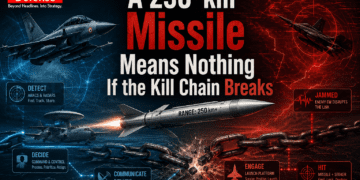
That’s a leap from older “fire and forget” concepts. We’re entering a “fire, update, retarget” era.
In a contested environment — particularly along the Himalayan frontier or in the maritime domain — the ability to dynamically retask weapons mid-flight could be decisive.
Training the Human Behind the Machine
This is the part rarely discussed outside professional circles: even the most advanced weapons suite is only as effective as the pilot operating it.
India has been steadily modernizing its training ecosystem through advanced simulators and integrated mission rehearsal environments. Platforms such as the HAL Tejas have already forced doctrinal shifts toward digital cockpit management and beyond-visual-range engagements. The AMCA will multiply that complexity.
Future pilots will need to manage:
- Stealth profiles and emission control discipline
- Networked targeting inputs from multiple domains
- Coordinated missile launches with unmanned systems
Simulation becomes critical here. Real-world flight testing is expensive and limited. High-fidelity simulators allow pilots to rehearse suppression-of-enemy-air-defence (SEAD) missions using systems like Rudram in digitally replicated threat environments.
This is not just about stick-and-throttle skill anymore. It’s about cognitive bandwidth. The pilot becomes a battlefield manager.
How India Stacks Up Globally
Any serious analysis must ask: how does this integration effort compare internationally?
The United States has long integrated indigenous weapons tightly with platforms like the F-35 Lightning II. The synergy between American missiles and their stealth aircraft is deep, iterative, and battle-tested.
China has followed a similar path, pairing indigenous air-to-surface and anti-radiation missiles with platforms like the Chengdu J-20.
Europe, through programs like the Eurofighter Typhoon, has relied on multinational missile development but still emphasizes tight platform-weapon harmonization.
India’s approach is distinctive because it is happening in parallel: aircraft and advanced missile ecosystems are being matured simultaneously rather than sequentially. That adds complexity but also strategic independence.
The real test will be timeline discipline and iterative refinement. Integration is rarely perfect in the first cycle. It requires relentless testing, feedback, redesign, and doctrinal evolution.
Export Potential: A Future Combat Package?
This is where the conversation becomes strategic.
If India successfully integrates AMCA with a full suite of indigenous stand-off and precision weapons, it doesn’t just gain airpower — it gains a potentially exportable combat package.
Several friendly nations seek advanced fighters but are constrained by:
- Cost of Western systems
- Export restrictions tied to US or European platforms
- Political sensitivities
An AMCA paired with DRDO-developed weapons could offer a semi-autonomous alternative. Not necessarily to compete head-on with the F-35, but to provide a capable, sovereign-operable solution.
However, export success would depend on reliability, production scale, and lifecycle support — areas where India must prove consistency.
The Bigger Strategic Shift
This integration story is not merely about hardware. It represents India transitioning from a platform-buyer to a systems integrator nation.
– Indigenous air-to-surface and stand-off weapons reduce geopolitical vulnerability
– Domestic supply chains strengthen industrial resilience
– Operational flexibility expands across land and maritime theatres
In a multipolar world where sanctions and supply disruptions are increasingly weaponized, integration autonomy becomes as important as kinetic lethality.
If done right, the AMCA-DRDO missile pairing won’t just be about winning dogfights. It will be about shaping deterrence.
And deterrence, at its core, is about credibility.

