




























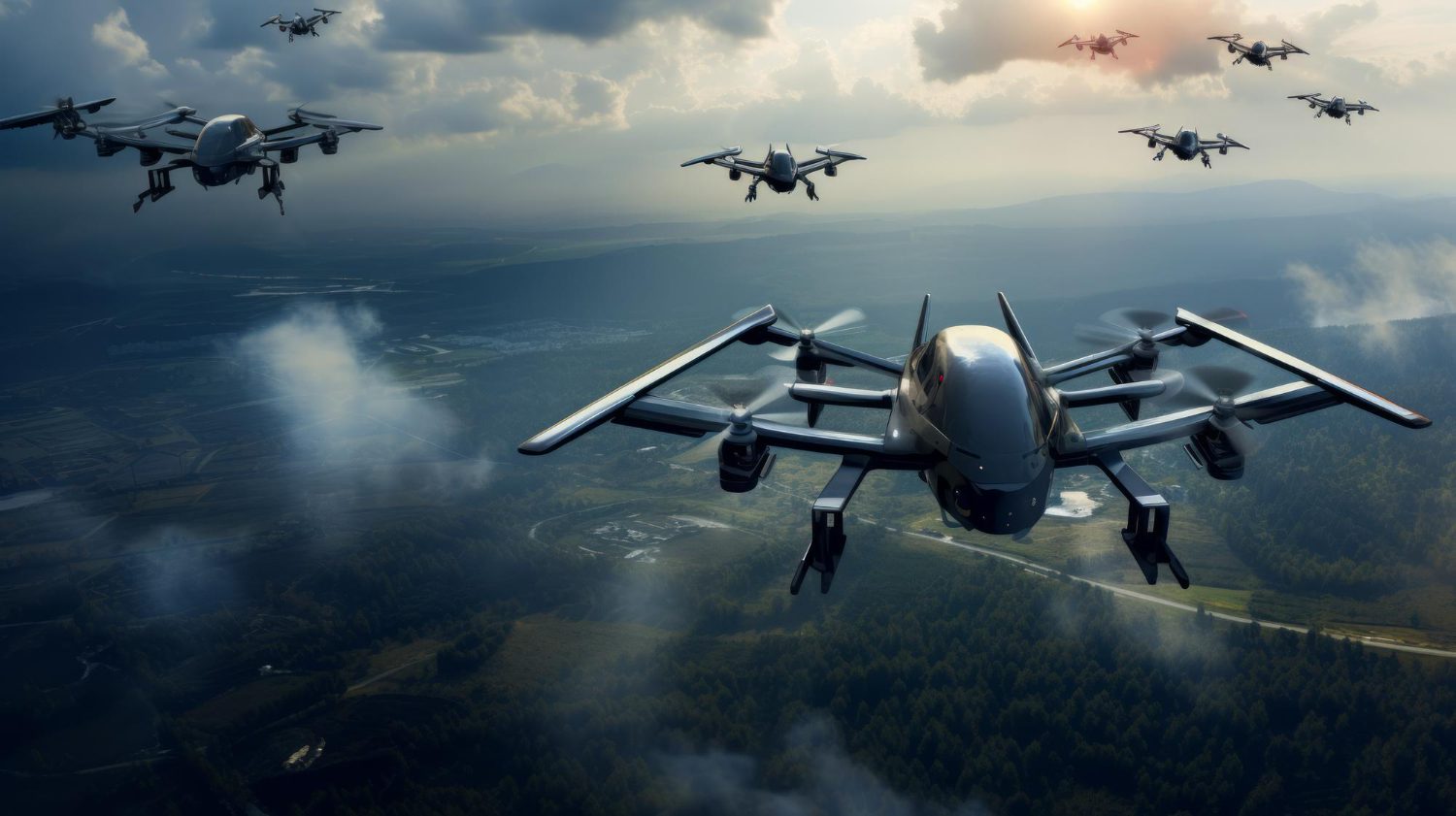
Stealth Drones and Distributed Strike Mark New Phase in Indian Airpower
India’s military modernisation drive is entering a decisive unmanned phase, with defence planners advancing large-scale induction plans for stealth unmanned combat aerial vehicles (UCAVs), multi-mission drones, strategic ISR airships, and autonomous long-range precision strike systems.
According to defence planning discussions and programme trajectories, the roadmap includes approximately 150 stealth UCAVs, around 350 multi-role unmanned platforms, and the parallel development of distributed long-range strike systems under emerging CLRTS/DS concepts. The shift reflects a structural transformation in how India intends to project airpower across contested theatres.
The expansion comes amid evolving regional security dynamics, rising anti-access and area-denial (A2/AD) capabilities across Asia, and increasing emphasis on persistent surveillance and distributed lethality.
Stealth UCAVs Move from Concept to Capability
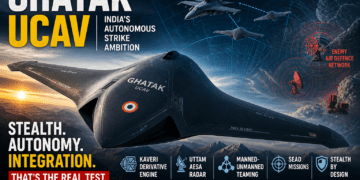
At the centre of India’s stealth drone ambitions is the flying-wing UCAV programme being developed under the aegis of the Defence Research and Development Organisation, widely associated with the Ghatak project.
The Ghatak UCAV is designed to operate as a deep-penetration strike asset with low observable characteristics. Unlike conventional drones focused primarily on surveillance, this class of platform is being developed with offensive payload capabilities in mind.
Defence analysts note that stealth UCAVs are particularly relevant in environments saturated with integrated air defence systems. With adversaries deploying long-range surface-to-air missiles, electronic warfare grids, and networked radar systems, manned aircraft face increasing operational risk during deep-strike missions. Stealth unmanned systems offer a lower-risk alternative capable of conducting suppression-of-enemy-air-defence operations, precision strikes, and reconnaissance in contested airspace.
Scaling the fleet to around 150 units would allow sustained deployment across multiple theatres rather than limited experimental use.
350 Multi-Mission Drones to Anchor Persistent ISR
Parallel to stealth UCAV development, India is expected to induct roughly 350 multi-mission unmanned platforms over time. These drones will serve as the backbone of long-endurance intelligence, surveillance, and reconnaissance (ISR) coverage.
Existing acquisitions and evaluations, including platforms such as the MQ-9B SkyGuardian, have demonstrated the utility of high-endurance UAVs for maritime surveillance, border monitoring, and precision targeting.
Military planners increasingly view persistence as a decisive advantage. Continuous ISR coverage along sensitive land borders and across the Indian Ocean Region enables real-time situational awareness and faster decision cycles. Modern multi-role drones are also capable of carrying precision-guided munitions, transforming them from observers into strike enablers.
With 24/7 aerial monitoring, armed forces can maintain surveillance dominance without rotating high-cost manned platforms at similar frequency.
Strategic ISR Airships Reconsidered
In a move that reflects evolving ISR doctrine, advanced airship concepts are being revisited for strategic surveillance roles. High-altitude airships equipped with radar and electronic intelligence payloads could offer extended dwell time over fixed sectors at lower operational cost compared to aircraft or satellite deployments.
Airships provide continuous coverage rather than episodic overflights. In mountainous or maritime environments, this persistence supports anomaly detection and pattern analysis over time. While not substitutes for space-based assets or drones, such platforms could add a resilient layer to India’s ISR architecture.
The focus is on endurance and wide-area coverage rather than speed.
Autonomous Long-Range Strike Systems Gain Attention
Alongside aerial platforms, attention is also turning to autonomous long-range precision strike systems frequently described under CLRTS or distributed strike concepts. Though detailed specifications remain limited in the public domain, the operational philosophy is clear: unmanned platforms capable of delivering precision munitions at extended ranges with reduced real-time human control.
These systems combine cruise missile principles with autonomous navigation and networked targeting inputs. By reducing dependence on forward basing and minimizing pilot exposure, they expand India’s deep-strike options while maintaining operational flexibility.
In maritime contexts, distributed autonomous strike platforms could hold hostile assets at risk across vast operational distances. On land, they offer deterrent reach without escalating the deployment of manned formations.
A Shift Toward Distributed Lethality
Defence observers describe the modernisation effort as a transition from platform-centric to network-centric force architecture.
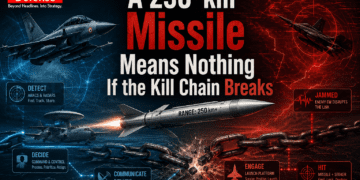
In a fully integrated operational scenario, a high-altitude ISR platform detects suspicious movement. A multi-mission drone verifies and designates the target. A stealth UCAV penetrates contested airspace. A long-range autonomous strike system delivers precision munitions. Data flows securely between systems throughout the engagement cycle.
Such distributed architectures complicate adversary planning and shorten response timelines.
The emphasis is increasingly on compression of decision cycles and expansion of operational reach.
Drivers Behind the Expansion
The unmanned acceleration is driven by several factors. Regional militaries are investing heavily in long-range missile systems, electronic warfare, and integrated air defence networks. The risk calculus for manned operations is evolving.
Unmanned systems offer scalability, persistence, and lower political risk in attrition scenarios. They provide redundancy in case of communication or infrastructure disruptions. Most importantly, they enable simultaneous operations across multiple fronts.
India’s modernisation roadmap suggests a recognition that future conflicts will reward distributed, autonomous, and networked forces rather than concentrated formations alone.
Challenges Ahead
Despite momentum, significant hurdles remain. Secure communication networks resistant to jamming are essential for autonomous operations. Indigenous propulsion systems must support long-endurance missions. Artificial intelligence integration requires rigorous testing, validation, and safeguards.
Industrial scalability will determine whether ambitious platform numbers translate into operational strength. Doctrinal adaptation within command structures will also be critical as unmanned systems take on increasingly central combat roles.
The Road Ahead
India’s combat and strike force modernisation is no longer limited to fighter upgrades or missile inductions. The rapid scaling of stealth UCAVs, multi-mission drones, ISR airships, and autonomous long-range strike systems signals a broader transformation.
As these platforms mature and integrate into a unified command network, the character of India’s airpower could shift toward a distributed, persistent, and increasingly autonomous model.
The cockpit remains central — but the future battlefield is likely to be populated by far more machines operating alongside it.

