





























India’s missile programs often dominate headlines. But missiles are hardware. Doctrine is software.
And in the architecture of India strategic deterrence, software matters more.
Missiles can be built, tested, and paraded. Deterrence, however, must be believed. That belief is shaped not just by range or payload, but by clarity of doctrine, survivability of forces, and political signaling discipline.
If the earlier parts of this series examined how India is modernizing cognition, command, maritime reach, and airpower capacity, Part 5 addresses the stabilizing core: how India manages escalation in a two-front nuclear environment.
Credible Minimum Deterrence in a Changing Region
India’s nuclear doctrine rests on two pillars: credible minimum deterrence and No First Use (NFU).
Credible minimum deterrence does not mean numerical parity. It means possessing sufficient survivable capability to impose unacceptable damage in retaliation. The emphasis is on survivability, not excess.
But the regional environment has shifted.
China’s silo expansion, mobile launch systems, and sea-based nuclear patrols suggest a move toward more diversified deterrence structures. Pakistan’s development of tactical nuclear weapons aims to complicate India’s conventional response calculus.
In this context, credible minimum deterrence is no longer static. It must adapt to evolving adversary postures.
The question is not whether India changes doctrine. It is whether force posture evolves in ways that sustain doctrinal credibility.
No First Use: Stability or Constraint?
India’s No First Use policy has long been viewed as a stabilizing commitment. It reduces crisis ambiguity and lowers the risk of miscalculation during high-tension standoffs.
However, NFU operates effectively only when second-strike capability is unquestioned.
That is where sea-based deterrence becomes critical.
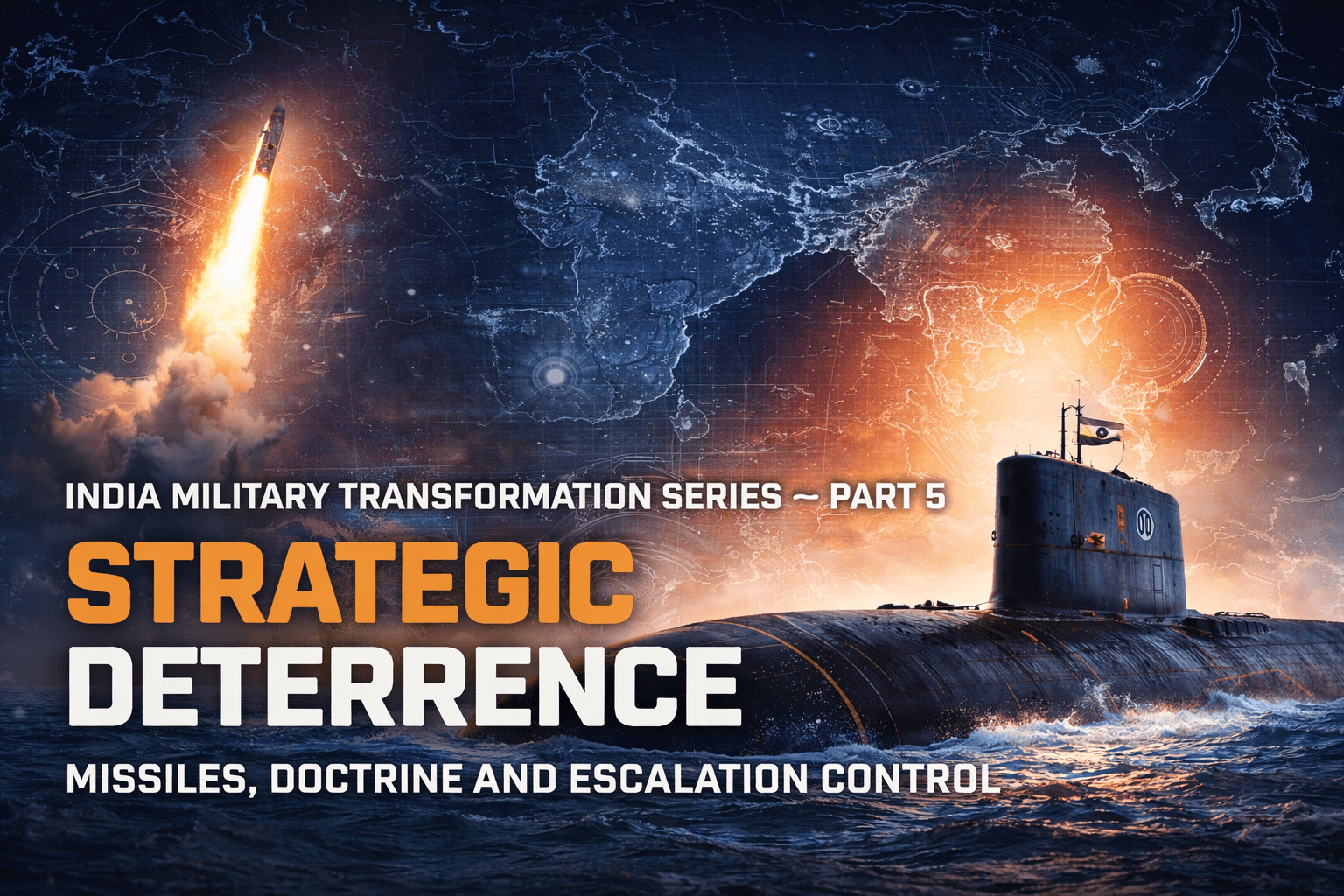
The operationalization of platforms like INS Arihant strengthens survivability. A submerged ballistic missile submarine is inherently more difficult to neutralize than fixed silos or visible airbases. Its mere existence complicates adversary planning.
But survivability is not only about submarines. It includes mobility, hardened storage, communication redundancy, and secure launch authority protocols.
India strategic deterrence, therefore, depends on redundancy across land, sea, and air — not as symbolic triad completion, but as insurance against decapitation risk.
Escalation Control in a Two-Front Environment
India faces a unique escalation geometry.
China presents a long-range, high-capacity strategic competitor. Pakistan presents a geographically proximate, escalation-prone adversary with a history of rapid signaling through tactical nuclear references.
Managing simultaneous pressure from both requires doctrinal clarity and operational flexibility.
In a crisis with Pakistan, India must deter tactical nuclear signaling without prematurely invoking strategic escalation. In a confrontation with China, the deterrence balance operates at a higher threshold but with far greater missile density.
This dual environment creates what might be called layered deterrence management.
Conventional precision weapons — such as the BrahMos — serve as escalation buffers. They allow calibrated retaliation without immediately crossing nuclear thresholds. Long-range ballistic systems like Agni-V anchor strategic equilibrium at the upper tier.
The interplay between these layers defines escalation space.
Too few options, and escalation becomes binary.
Too many ambiguities, and deterrence loses credibility.
Command and Control: The Invisible Backbone
Deterrence ultimately depends on decision-making speed and communication integrity.
India’s nuclear command authority remains centralized — deliberately so. Centralization reinforces political oversight and reduces accidental escalation risks.
However, modernization introduces complexity. Digital communication networks must be secure against cyber intrusion. Satellite links must withstand electronic warfare. AI-assisted early warning systems must avoid false positives.
The modernization of India strategic deterrence therefore extends beyond missile range to network resilience.
A launch capability that cannot communicate securely is symbolic, not strategic.
Tactical Nuclear Signaling and the Stability Debate
Pakistan’s development of short-range tactical nuclear systems was designed to counter India’s conventional superiority. The implicit message: any deep conventional thrust risks nuclear response.
India’s response has avoided symmetrical tactical development. Instead, the emphasis has remained on assured retaliation at a higher strategic tier.
This restraint is deliberate.
Introducing battlefield nuclear weapons lowers thresholds and compresses decision timelines. It increases delegation pressures and reduces escalation control.
India’s choice to avoid matching tactical nuclear systems reflects a doctrine aimed at preserving escalation discipline rather than matching optics.
That said, deterrence credibility requires visible readiness. Periodic testing, modernization cycles, and publicized capability milestones reinforce belief without doctrinal change.
Industrial and Technological Depth
Strategic deterrence also depends on sustained production capability.
Missile propulsion systems, guidance accuracy, re-entry vehicle design, and warhead survivability require advanced materials science and consistent funding pipelines. Civilian technological ecosystems — from metallurgy to electronics — directly influence strategic reliability.
India’s push for indigenous development reduces vulnerability to supply disruption. But strategic systems cannot tolerate quality compromise.
Transformation here is slow by design.
Reliability outranks speed.
The Broader Strategic Meaning
Across five articles, a pattern emerges.
India’s military transformation is not a sprint toward dominance. It is a measured expansion of credible capacity across domains.
Within that arc, India strategic deterrence serves as the stabilizing anchor. AI and theatre reform increase responsiveness. Maritime expansion increases depth. Airpower modernization increases flexibility. Missile forces ensure that escalation remains bounded.
Deterrence is not about using force. It is about shaping calculations before force is used.
India’s doctrine — if sustained with credible modernization — maintains strategic stability while avoiding reckless arms race behavior.
The transformation underway is evolutionary. But its implications are structural.
Looking Ahead — Article 6
If missiles anchor deterrence, the next frontier lies in the domains that precede kinetic escalation.
Cyber operations, space resilience, anti-satellite capability, and information warfare are increasingly shaping conflict onset.
In Part 6, we examine how India’s military transformation extends into orbit and cyberspace — where deterrence becomes invisible, but no less decisive.

