



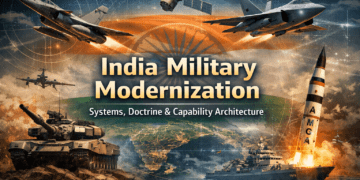










The global security environment in 2026 is not defined by a single dominant rivalry. It is defined by layered competition. The United States and China remain locked in structural contestation, Russia’s confrontation with the West continues to reshape military-industrial supply chains, and the Indo-Pacific has firmly become the central arena of geopolitical maneuvering. For India, this is not abstract geopolitics. It is an immediate strategic reality.
The vocabulary of “strategic autonomy” still holds, but its meaning has evolved. India today operates in a world where alignment is fluid, deterrence is multi-domain, and industrial resilience is as important as military capability. The question is no longer whether the global order is multipolar. The question is how India navigates it without being constrained by it.
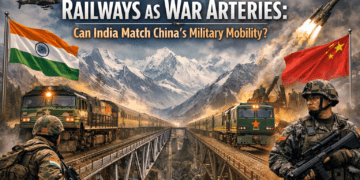
At the center of India’s doctrine remains the two-front challenge. The Line of Actual Control with China has stabilized tactically since the intense crises of the early 2020s, but stabilization does not mean normalization. Forward deployments remain dense. Infrastructure on both sides has permanently altered mobilization timelines. Rapid reinforcement is now measured in hours and days, not weeks. This compression of warning cycles changes escalation dynamics fundamentally.
Simultaneously, Pakistan continues its calibrated strategy of pressure below conventional war thresholds. Drone intrusions, tactical signaling, and persistent proxy frameworks have not disappeared. They have adapted. The western front is less about large-scale maneuver and more about persistent disruption. India therefore must maintain readiness in the north without neglecting deterrence credibility in the west.
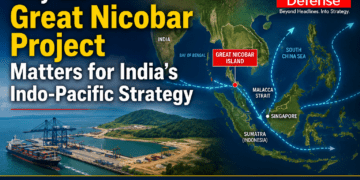
Maritime strategy, however, has become the decisive domain. The Indian Ocean is no longer a secondary theater; it is a primary arena of influence. Energy flows from West Asia, trade routes through Malacca, and digital undersea cable networks form the backbone of India’s economic security. Disruption in the Red Sea over the past year demonstrated how quickly global trade arteries can become contested. Insurance rates spike, shipping reroutes, and supply chains feel immediate strain. For India, maritime security is no longer optional—it is existential.
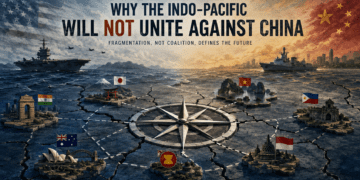
The Quadrilateral Security Dialogue has matured into a structured coordination mechanism rather than a symbolic grouping. Its recent emphasis on maritime domain awareness, resilient supply chains, and technology standards reflects realism. The Quad is not a military alliance, but it does shape operational environments. Naval exercises now focus as much on information fusion and ISR integration as on maneuver drills. This is quiet but consequential progress.
Meanwhile, NATO has continued to articulate China as a systemic challenge. The Euro-Atlantic and Indo-Pacific theaters are increasingly discussed in a single breath at strategic forums. This does not mean NATO will expand into Asia militarily. It does mean that technology controls, defense innovation, and strategic narratives are converging. India benefits from this convergence when it comes to advanced technology access, but it must manage the perception of bloc alignment carefully.
The most important external influence on Indian strategic thinking remains the war in Ukraine. By 2026, it has become a laboratory of modern warfare. The central lesson is not simply that drones matter. It is that scale matters. Drone production lines, ammunition manufacturing capacity, electronic warfare resilience, and industrial endurance have proven decisive. Tactical brilliance without industrial depth collapses under prolonged attrition.
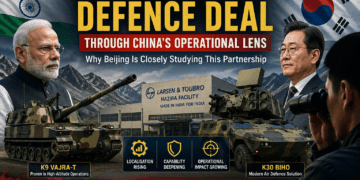
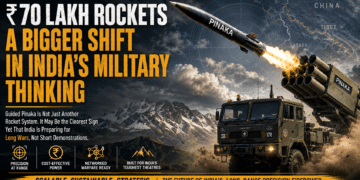
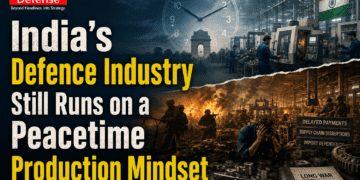
India has internalized these lessons. Ammunition stockpiles are being recalibrated. Indigenous drone ecosystems have expanded rapidly. Private sector participation in defense manufacturing is no longer a slogan; it is increasingly visible in procurement pipelines. The debate now is not about whether India should indigenize, but about how quickly it can close critical technology gaps—especially in propulsion, semiconductors, and advanced materials.
Another emerging factor in 2026 is the acceleration of AI-enabled military systems. Autonomous ISR platforms, predictive logistics algorithms, and decision-support systems are moving from experimental stages to operational adoption globally. For India, integration rather than invention will determine near-term advantage. The military challenge is to fuse legacy platforms with emerging technologies without creating fragmented architectures.
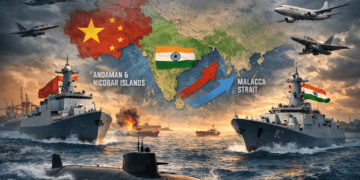
China’s trajectory continues to shape the outer boundary of India’s strategic planning. The People’s Liberation Army has expanded naval deployments into the Indian Ocean with greater regularity. These deployments are not aggressive in isolation, but their normalization signals long-term intent. Carrier groups, submarines, and intelligence-gathering vessels operating near the region establish patterns that are difficult to reverse.
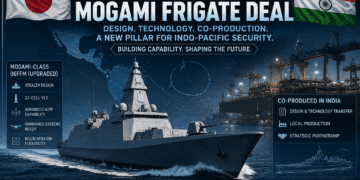
India’s response has not been rhetorical. Naval commissioning schedules have accelerated. Surveillance integration with regional partners has deepened. Maritime exercises are now as much about signaling presence as about interoperability. The strategic message is clear: the Indian Ocean is not an uncontested operating space.
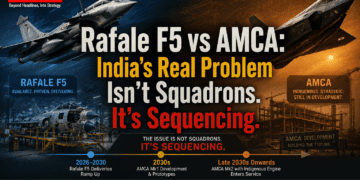
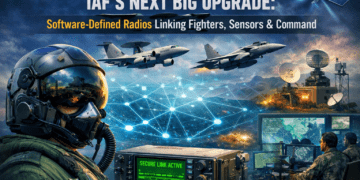
Air power also occupies renewed centrality. The Indian Air Force is transitioning toward a more network-centric architecture. The debate around fighter squadron strength continues, but the deeper shift lies in sensor fusion and long-range precision capabilities. In a compressed battlespace, the side that sees first and strikes first retains advantage.
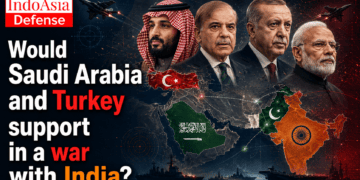
Strategic autonomy in 2026 therefore looks different from strategic autonomy in 2016. It is less about distancing and more about diversification. India deepens ties with the United States in technology and maritime coordination while sustaining legacy defense cooperation with Russia where practical. It works closely with Israel in niche domains such as UAVs and missile defense. It engages France as a resident Indo-Pacific power. This web of partnerships distributes risk without binding India into treaty constraints.
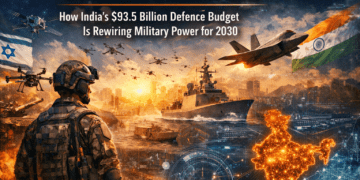
Domestic political consensus around defense modernization has also hardened. Defense budgets have stabilized at levels that support sustained capital expenditure. The public conversation around security has shifted from episodic crisis response to long-term capability building. This continuity is strategically valuable.
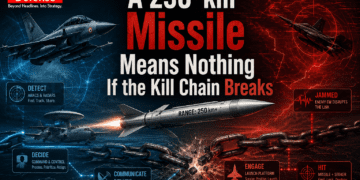
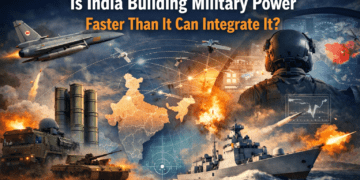
The challenge ahead lies in integration. India is acquiring advanced systems across domains—air defense, submarines, ISR platforms, cyber capabilities—but integration across these systems determines effectiveness. Layered deterrence works only when sensors, shooters, and decision-makers operate in synchronized loops. Fragmented procurement without architectural coherence creates vulnerability.
Finally, economic resilience underpins everything. Strategic competition is not purely military; it is financial and technological. Supply chain disruptions over the past few years have highlighted vulnerabilities in critical minerals, semiconductors, and energy transit routes. Defense planning must align with industrial policy. Strategic thinking must align with trade diplomacy.
India in 2026 is not reacting to global shifts; it is actively positioning within them. It is neither an alliance-bound power nor an isolated actor. It is a pivot state in a contested Indo-Pacific, managing continental friction while expanding maritime reach.
The multipolar order is not stable. It is competitive, transactional, and occasionally volatile. But within this environment, India’s doctrine is becoming clearer. Maintain deterrence on land. Expand influence at sea. Diversify partnerships. Accelerate industrial capacity. Integrate technology.
Grand strategy is ultimately about choices under constraint. India’s current trajectory suggests that it understands the constraints—and is gradually expanding its choices.

