


















Strategic forecasting is not about prediction. It is about identifying structural pressure before it fractures.
Between now and 2035, India will not operate in a crisis-defined security environment. It will operate in a competition-defined one. Military postures will remain forward. Maritime spaces will grow denser. Technology cycles will compress. Economic interdependence will coexist with strategic distrust.
The decisive variable is alignment: whether economic growth, military reform, industrial policy, and diplomatic calibration reinforce one another.
The coming decade is less about ambition and more about institutional execution.
Continental Pressure: Sustained Northern Militarization
The post-2020 security equilibrium along the Line of Actual Control has hardened into a long-duration forward deployment model. Infrastructure expansion, airfield upgrades, ISR saturation, and rapid reinforcement capabilities have shifted the frontier from patrol competition to positional deterrence.
The modernization tempo of the People’s Liberation Army ensures that deterrence stability will rest on credibility rather than diplomatic optimism. Western Theater Command reforms, integrated air defense layering, long-range rocket artillery, and unmanned systems proliferation suggest a structurally upgraded adversary by 2035.
The risk is not necessarily full-scale war. It is prolonged militarized tension.
Sustained high-altitude deployment creates fiscal drag, readiness fatigue, and logistical strain. Planning assumptions must therefore incorporate concurrency — simultaneous northern and western stress scenarios — rather than sequential crises.
Deterrence endurance becomes as critical as deterrence signaling.
The Pakistan Variable: Sub-Conventional and Escalatory Risk
The western front will remain fluid, but differently so.
While conventional force asymmetry has widened in India’s favor, escalation dynamics remain sensitive. Sub-conventional infiltration, cross-border drone activity, and information warfare will likely persist below conventional thresholds.
Pakistan’s internal economic fragility may reduce sustained conventional escalation appetite, yet paradoxically increase reliance on asymmetric tools. Tactical missile systems and nuclear signaling frameworks continue to shape escalation ceilings.
By 2035, stability on the western front will depend less on force ratios and more on escalation control, intelligence depth, and crisis signaling discipline.
Dual-front stress, even without formal coordination between adversaries, compresses India’s operational bandwidth.
Maritime Domain: Retaining Strategic Depth
Long-term elasticity lies at sea.
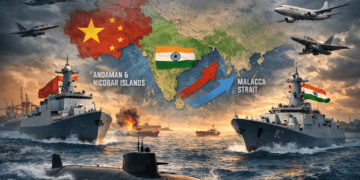
The expanding operational footprint of the People’s Liberation Army Navy across the Indian Ocean — submarine patrols, dual-use port access, survey vessels — represents normalization, not anomaly.
India’s maritime leverage by 2035 will hinge on:
- Submarine fleet survivability
- Carrier aviation integration
- Anti-submarine warfare networks
- Maritime domain awareness coverage
- Logistics access agreements
Carrier battle groups provide signaling. Submarines provide denial. Maritime ISR networks provide awareness.
Sea power offers calibrated escalation options that continental deployments cannot. But naval power compounds slowly. Shipbuilding cadence between 2026–2032 will determine operational reality in 2035.
If underwater capability expansion lags, strategic depth compresses.
Space Security: The Invisible High Ground
By 2035, space will be inseparable from terrestrial deterrence.
ISR satellites, communication constellations, navigation resilience, and missile early warning systems form the backbone of modern warfare. Counter-space capabilities — kinetic and non-kinetic — are now integrated into major power doctrines.
India’s deterrence credibility will increasingly depend on:
- Satellite redundancy
- Rapid launch replacement capacity
- Electronic counter-space resilience
- Integrated space command structures
Vulnerability in orbit translates directly to battlefield opacity.
The state that maintains space persistence under disruption will dominate escalation ladders.
Technology and Industrial Depth: From Assembly to Innovation
Modern power is defined by decision velocity.
AI-assisted targeting, autonomous maritime systems, electronic warfare integration, and cyber-ISR fusion will compress reaction timelines. By 2035, force size will matter less than network integration speed.
India has accelerated domestic procurement shares and private-sector participation. Yet structural challenges remain:
- Aero-engine dependence
- Semiconductor ecosystem depth
- Long R&D gestation cycles
- Procurement procedural drag
If defense-industrial policy converges with civilian high-tech ecosystems — particularly AI, electronics, propulsion, and materials science — vulnerability narrows.
If modernization timelines lag technological velocity, asymmetry widens.
Industrial depth is not optional. It is strategic insulation.
Institutional Reform: Theaterization and Jointness
Organizational reform will determine operational coherence.
The transition toward integrated theater commands is designed to reduce service silos, unify logistics, and enhance joint planning. By 2035, the effectiveness of theaterization will influence India’s ability to handle concurrency.
True jointness is not structural alone. It requires:
- Shared ISR architecture
- Unified logistics chains
- Cross-domain doctrine integration
- Inter-service procurement coordination
If reforms stall or remain partial, decision cycles elongate. If integration matures, India gains escalation control and resource optimization advantages.
Institutional coherence multiplies force effectiveness.
Defense Exports and Strategic Signaling
India’s evolution into a credible defense exporter could alter its strategic profile.
Supplying platforms, missiles, and patrol vessels to Southeast Asia, Africa, and the Indian Ocean littoral does more than generate revenue. It shapes security dependencies.
By 2035, if India becomes a reliable mid-tier defense supplier, it gains diplomatic leverage and interoperability dividends.
Export credibility requires:
- Predictable delivery timelines
- After-sales support ecosystems
- Competitive financing structures
- Technology protection mechanisms
Strategic influence increasingly flows through supply chains.
Economic Momentum and Energy Architecture
Military transformation rests on macroeconomic stamina.
Sustained growth above structural thresholds allows capital expenditure continuity and R&D depth. Growth volatility compresses modernization windows.
Energy security will remain foundational. Diversified hydrocarbon sourcing, strategic reserves, renewable expansion, and resilient maritime trade routes underpin operational endurance.
Supply chain localization in critical minerals, electronics, and pharmaceuticals reduces coercive exposure.
Economic resilience is deterrence insurance.
Supply Chain Realignment and China+1 Dynamics
Global manufacturing diversification presents opportunity.
If India captures segments of high-value manufacturing relocating from East Asia, it enhances both economic depth and technological ecosystem density.
However, infrastructure bottlenecks, logistics efficiency, regulatory predictability, and labor skill alignment will determine capture rates.
Strategic autonomy is reinforced when economic integration is diversified, not concentrated.
Demographic Window: Dividend or Drag
India’s demographic profile remains structurally favorable through the 2030s.
The decisive question is skills conversion.
If education reform, STEM capacity expansion, and vocational alignment with defense and semiconductor sectors accelerate, the demographic dividend strengthens strategic autonomy.
If employment absorption lags workforce expansion, internal stress rises.
Human capital is long-term power capital.
Internal Resilience and Non-Kinetic Stress
Future crises may originate outside conventional battlefields.
Climate volatility will affect Himalayan infrastructure and coastal naval assets. Cyber intrusion attempts targeting financial systems and energy grids will intensify. Information warfare campaigns will attempt to shape domestic perception during crises.
Resilience therefore includes:
- Distributed energy grids
- Critical infrastructure hardening
- Cyber command integration
- Space redundancy
- Institutional credibility
Modern deterrence is cumulative. Internal coherence reinforces external posture.
Strategic Pathways to 2035
Three structural trajectories remain plausible:
Consolidated Stabilizer
Economic growth sustains, theater reforms mature, maritime expansion accelerates, industrial depth strengthens. India emerges as a resilient Indo-Pacific stabilizer.
Managed Constraint
Modernization continues unevenly. Growth moderates. Strategic maneuvering space narrows but remains functional.
Compressed Flexibility
Fiscal strain, industrial lag, and institutional inertia create modernization gaps. India reacts more than shapes.
The divergence between these pathways will depend on execution discipline between 2026 and 2032.
The Strategic Inflection Window
If reform momentum continues—if theater integration matures, maritime expansion sustains pace, and technological ecosystems accelerate—India will likely enter 2035 as a structurally resilient regional stabilizer with expanding Indo-Pacific influence.
The window between 2026 and 2035 is a strategic consolidation phase. Decisions taken now—industrial, organizational, fiscal—will determine whether India approaches the mid-2030s as a system-shaping actor or a reactive power navigating others’ initiatives.
Shipbuilding decisions made today determine fleet balance in 2035. Semiconductor investments now determine AI sovereignty later. Theater integration choices shape concurrency management capacity.
If modernization slows or fiscal pressures mount, India may find itself managing simultaneous pressures with constrained maneuvering space.
The decisive factor is not aspiration. It is alignment. Economic growth, defense reform, technological absorption, and diplomatic calibration must reinforce one another rather than compete for bandwidth.
Strategic rise is not demographic inevitability. It is engineered alignment. By 2035, India will not be judged by ambition. It will be judged by integration.

