














Strategic and Blue-Water Fleet Expansion: Ambition, Debate, and the Reality of Naval Priorities
India’s long-term maritime ambition remains unmistakable: sustained blue-water capability, credible power projection across the Indo-Pacific, and the ability to operate independently far from home shores. But behind the strategic vocabulary lies a more complex story — one shaped by budget constraints, internal debate, and competing modernization priorities.
Naval planners are pushing for a long-term expansion that includes a new aircraft carrier, roughly ten next-generation destroyers and frigates, advanced amphibious platforms, possible nuclear propulsion for future surface combatants, and Compact Autonomous Surface Craft (CASC) for anti-submarine warfare.
Yet not all of these ambitions sit at the same level of approval or urgency.
The gap between roadmap and reality is where the real story lies.
Approved and Under Construction: The Surface Fleet Core
India’s surface combatant modernization is the most grounded and tangible component of the expansion plan.
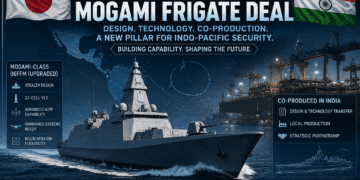
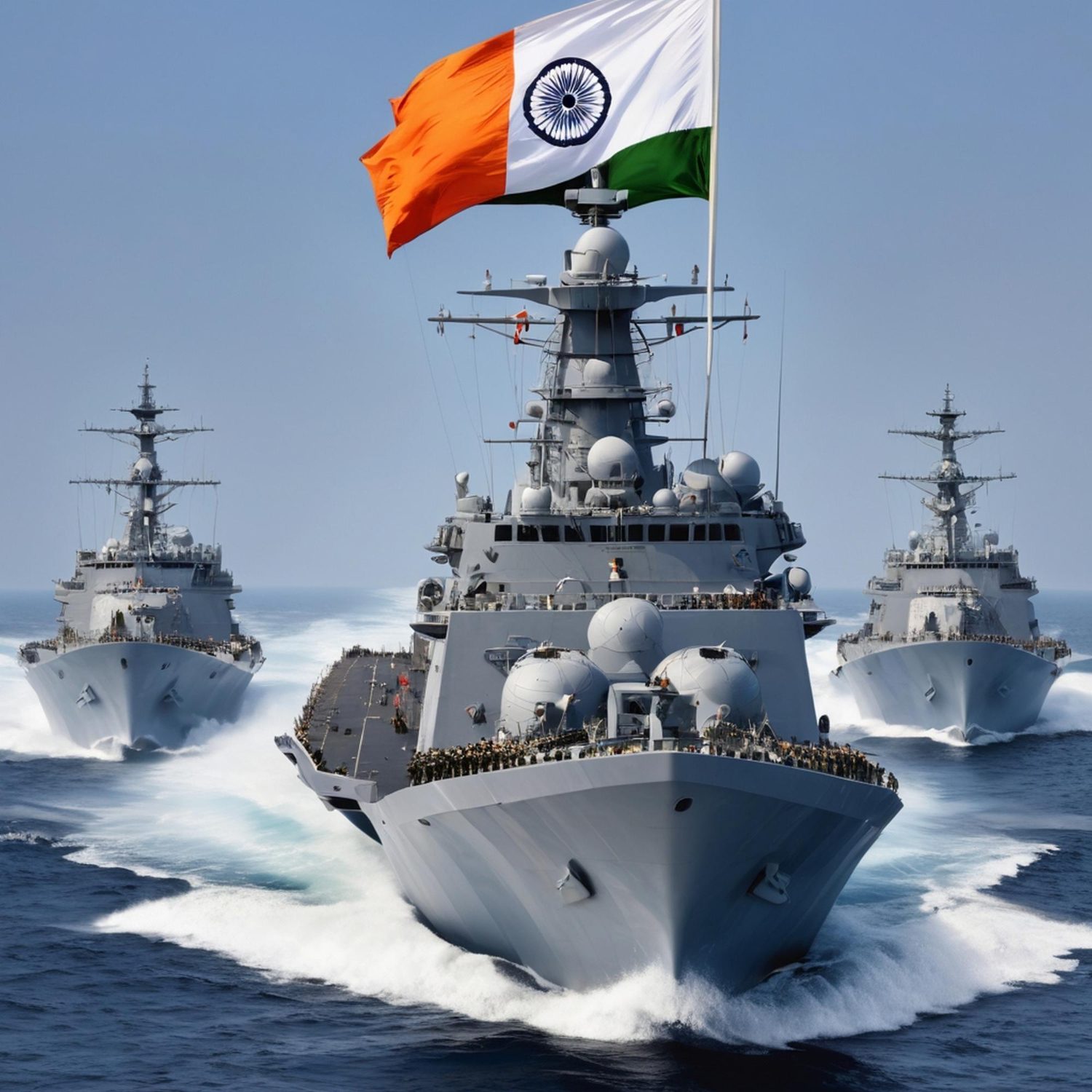
The induction of the Visakhapatnam-class destroyer is already underway, strengthening area air defence and multi-role capability. The upcoming Nilgiri-class frigate will further modernize escort fleets with improved stealth features and advanced sensors.
These programs are funded, in production, and consistent with India’s established doctrine of carrier battle groups and task-force operations.
Future destroyer and frigate projects remain under evaluation, but expansion of escort strength is broadly uncontested within naval circles. Surface combatants are essential not only for fleet protection but also for independent maritime operations and sea control missions.
This portion of the roadmap reflects continuity rather than controversy.
The Third Aircraft Carrier: Strategic Logic vs Fiscal Caution
The proposal for a third aircraft carrier, often associated with INS Vishal, remains under evaluation.
India currently operates INS Vikramaditya and the indigenously built INS Vikrant. Naval planners argue that a three-carrier structure ensures one operational carrier on each seaboard while another undergoes refit — a standard model for sustained carrier availability.
However, competing priorities include submarine expansion, which many within the defence establishment consider more urgent.
The Indian Navy’s submarine fleet remains numerically constrained relative to strategic requirements. With increasing Chinese submarine deployments in the Indian Ocean Region, underwater capability is seen by many analysts as the more immediate deterrent necessity.
Budget allocations will determine pace. A modern aircraft carrier represents an enormous capital commitment, stretching into tens of thousands of crores. In an environment where defence budgets must also support the Army’s modernization and the Air Force’s fighter recapitalization, the carrier debate is far from settled.
Within India’s defence establishment, the discussion reflects two schools of thought. One views carriers as indispensable instruments of maritime power projection and strategic signalling. The other questions survivability in an era of long-range anti-ship ballistic missiles and precision strike capabilities.
The outcome remains undecided.
Submarine Expansion: The Immediate Priority
If one program reflects the clearest operational urgency, it is submarine expansion.
India operates nuclear-powered assets such as INS Arihant, but the conventional submarine fleet requires replenishment and scaling. Project 75 and its follow-on efforts aim to address this gap, yet timelines have stretched.
Within internal prioritisation debates, submarines are increasingly viewed as the backbone of sea denial strategy. They offer stealth, survivability, and credible deterrence at comparatively lower visibility than carriers.
In practical terms, submarine induction may command greater near-term attention than the third carrier proposal. That reality shapes how fleet expansion sequencing is likely to unfold.
Amphibious Platforms: Needed but Delayed
Advanced amphibious assault ships remain part of the Navy’s stated ambitions. Landing platform docks would enhance expeditionary capability, humanitarian assistance operations, and rapid deployment capacity across island territories.
However, these platforms have faced repeated procurement delays due to cost considerations and shipyard viability concerns.
They remain operationally relevant but fiscally sensitive.
Nuclear Propulsion for Surface Combatants: Long-Term Vision
The possibility of nuclear propulsion for future surface combatants remains conceptual rather than programmatic.
India’s experience with nuclear-powered submarines demonstrates technical capability, but extending that to large surface vessels would require enormous investment in infrastructure, reactor design adaptation, and doctrinal shifts.
At present, this sits firmly in the long-term horizon category rather than near-term induction.
Compact Autonomous Surface Craft (CASC): Emerging Layer
The procurement of Compact Autonomous Surface Craft for enhanced anti-submarine warfare reflects a growing recognition that unmanned systems will shape maritime security.
While no large-scale, publicly confirmed CASC program is yet visible, the Indian Navy has shown increasing interest in unmanned surface and underwater vehicles. Given the expanding undersea competition in the Indo-Pacific, autonomous ASW platforms represent a logical future layer in maritime defence architecture.
This is an emerging capability space rather than a finalized acquisition pipeline.
Balancing Ambition with Arithmetic
India’s blue-water aspirations are strategically coherent. The Indian Ocean Region is central to trade security, energy flows, and geopolitical influence. A navy capable of sustained operations across this space enhances both deterrence and diplomatic leverage.
Yet defence modernisation does not occur in a vacuum.
Fiscal prioritisation pressures are real. Simultaneous requirements across land, air, cyber, and space domains constrain available capital. Industrial capacity and shipbuilding timelines also shape execution speed.
Naval planners are pushing for long-term expansion. The political leadership must weigh cost, urgency, and strategic payoff. Budget allocations will ultimately determine pace.
The coming decade is likely to reflect sequencing rather than simultaneity: submarine strengthening first, surface combatant scaling next, and carrier decisions following fiscal clarity.
The Strategic Outlook
India’s maritime roadmap is not fantasy. It is grounded in doctrine and geography. But it is also subject to internal debate, fiscal arithmetic, and evolving threat assessments.
The vision of a larger blue-water fleet remains intact. The timeline, however, will be determined not by ambition alone, but by prioritisation choices within a constrained strategic environment.
In that tension between aspiration and allocation lies the true story of India’s naval future.

