








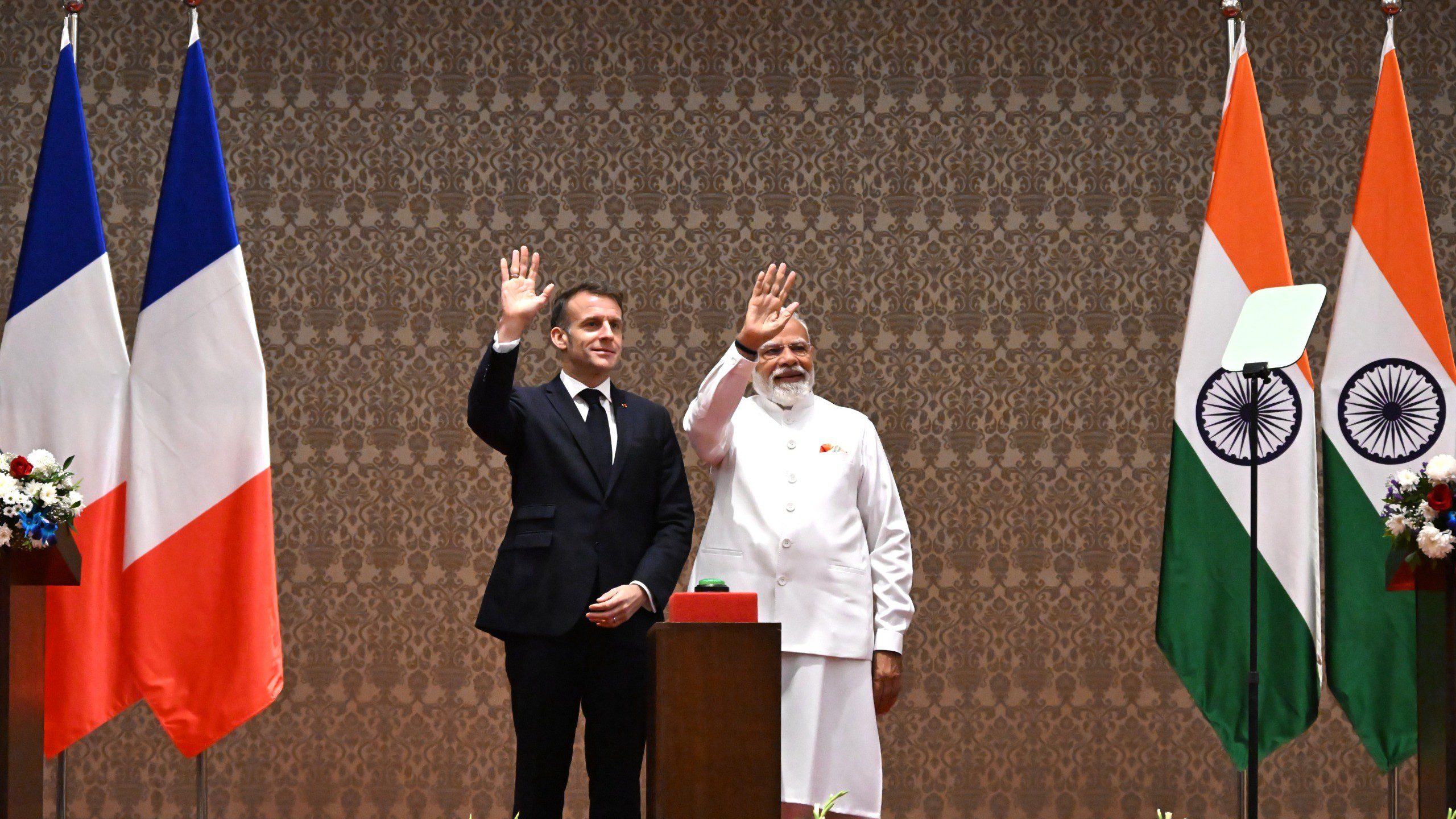
When Emmanuel Macron lands in New Delhi, the optics extend far beyond ceremonial diplomacy. His visit represents a deliberate geopolitical signal — one that ties defence cooperation, industrial strategy, energy transition, and Indo-Pacific security into a single strategic arc between France and India.
At a time of systemic flux in global power alignments, Paris and New Delhi are not merely reinforcing an existing partnership. They are redefining its scope.
The Rafale deal may be the headline. The real story lies in the architecture beneath it.
A Strategic Partnership That Predates the Moment
The Indo-French relationship has long operated with unusual steadiness. Unlike other major defence relationships, it has been marked by continuity across political cycles, limited public friction, and an absence of strategic conditionalities.
Macron’s visit must be interpreted against this backdrop. It consolidates a “Special Strategic Partnership” that spans aerospace, maritime security, space cooperation, and civil nuclear energy.
In defence diplomacy, continuity is power. France has consistently positioned itself as a reliable technology partner willing to engage in deeper industrial collaboration. India, for its part, has sought partners that align with its doctrine of strategic autonomy — cooperation without dependency.
Macron’s presence in India underscores that alignment is not transactional. It is structural.
Beyond Rafale: The Industrial Dimension
The expansion of Rafale procurement from Dassault Aviation has created the scaffolding for a broader industrial partnership. But Macron’s visit signals that both sides intend to widen the aperture.
The conversation is no longer confined to aircraft delivery. It now includes:
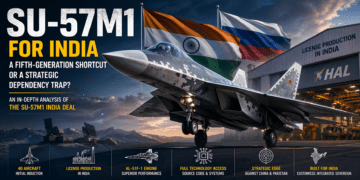
- Localisation thresholds in fighter production
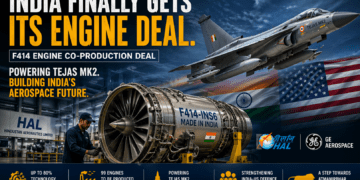
- Engine assembly and maintenance ecosystems
- Joint development frameworks in advanced aerospace technologies
- Expanded supply chain participation for Indian firms
Localisation is not simply about cost efficiency. It is about capability absorption.
France understands that India’s defence market will increasingly privilege co-development over outright imports. Macron’s diplomatic messaging reflects that shift. The emphasis is on embedding French firms within India’s long-term industrial growth story rather than securing episodic contracts.
If executed deeply, localisation under Rafale could serve as a template for future joint ventures in avionics, propulsion, and systems integration.
Energy and Industrial Linkages: Expanding the Strategic Envelope
Defence diplomacy does not operate in isolation. Macron’s visit also intersects with civil nuclear cooperation and energy transition dialogue.
France’s nuclear energy expertise aligns with India’s expanding clean energy ambitions. Cooperation in reactor technology, safety systems, and long-term fuel cycle arrangements extends the strategic partnership into the civilian domain.
Why does this matter for defence?
Because industrial trust compounds across sectors. Joint ventures in nuclear energy, aerospace manufacturing, and advanced materials create overlapping ecosystems of engineers, supply chains, and regulatory familiarity.
This integration reduces friction in defence technology sharing and fosters long-term alignment.
Energy, in this context, becomes strategic glue.
Technology Sharing: Expectation Versus Reality
The central question in any advanced defence partnership is the depth of technology access.
India’s expectations are clear. It seeks:
- Greater participation in mission systems integration
- Autonomy in weapons integration
- Access to engine maintenance and potentially manufacturing ecosystems
- Industrial participation beyond final assembly
France, balancing export controls and domestic industrial interests, must calibrate how far it is prepared to go.
Macron’s visit provides political cover to expand the envelope. High-level diplomatic signalling can unlock technical negotiations that would otherwise stall at bureaucratic levels.
However, genuine technology transfer is not a single agreement; it is a process. It requires trust, intellectual property safeguards, and reciprocal industrial benefit.
The durability of the Indo-French defence relationship will ultimately depend on how this balance evolves.
The Indo-Pacific Convergence
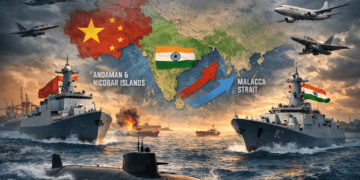
France is not merely a European power engaging India from afar. It is an Indo-Pacific resident state with overseas territories and a permanent maritime presence.
This shared geography creates natural alignment.
Maritime domain awareness, joint naval exercises, and coordinated freedom-of-navigation principles reflect overlapping strategic concerns. Macron’s visit reinforces that Indo-French defence ties extend from airpower to maritime security.
In an era of heightened competition in the Indo-Pacific, coordinated signalling between Paris and New Delhi carries weight.
It suggests a willingness to shape, not merely respond to, regional security dynamics.
Defence Industrial Cooperation Frameworks: Toward Co-Development?
The next phase of Indo-French defence cooperation may move from licensed production toward collaborative design.
Potential avenues include:
- Advanced unmanned systems
- Electronic warfare suites
- Engine research partnerships
- Space-based surveillance cooperation
If Macron’s visit catalyses frameworks for joint R&D rather than solely production contracts, it would represent a qualitative shift.
India aspires to transition from buyer to builder. France seeks reliable long-term industrial partners in Asia. Their incentives increasingly converge.
Strategic Autonomy in a Multipolar Era
For India, the Indo-French partnership serves as a pillar of diversification. It reduces overreliance on any single defence supplier and strengthens bargaining leverage across relationships.
For France, India represents a stable and growing strategic actor capable of shaping Indo-Pacific security architecture.
Macron’s visit therefore sends a dual message:
- To Europe — that France intends to anchor its Indo-Pacific presence through credible partnerships.
- To Asia — that France is prepared to engage at strategic depth, not merely commercial scale.
The Political Signal
Diplomatic visits often generate symbolic language. What distinguishes this engagement is its strategic consistency.
Macron’s outreach is less about ceremony and more about embedding French industry within India’s defence and energy growth trajectory.
If localisation deepens, if joint R&D frameworks expand, and if technology sharing matures beyond assembly-level cooperation, this partnership could evolve into one of India’s most consequential long-term defence relationships.
From Transaction to Architecture
Macron’s visit should not be reduced to the Rafale headline. It represents an effort to build strategic architecture — integrating defence procurement, industrial participation, energy collaboration, and Indo-Pacific security alignment.
The future of the Indo-French partnership will hinge on three tests:
- Depth of localisation
- Sincerity of technology sharing
- Expansion into co-development domains
If these converge, the partnership moves from transactional arms sales to strategic industrial alliance.
In a multipolar world where autonomy is currency, that evolution matters — not just for Paris and New Delhi, but for the balance of power across the Indo-Pacific.
The Review
macOS Sierra
A wonderful serenity has taken possession of my entire soul, like these sweet mornings of spring which I enjoy with my whole heart. I am alone, and feel the charm of existence in this spot, which was created for the bliss of souls like mine.
PROS
- Good low light camera
- Water resistant
- Double the internal capacity
CONS
- Lacks clear upgrades
- Same design used for last three phones
- Battery life unimpressive

