






























Strategic competition in Asia is usually described through military deployments. Fighter aircraft patrol contested borders.
Naval fleets maneuver across the Indian Ocean and the Western Pacific. Missile ranges and air defense systems dominate defense planning.
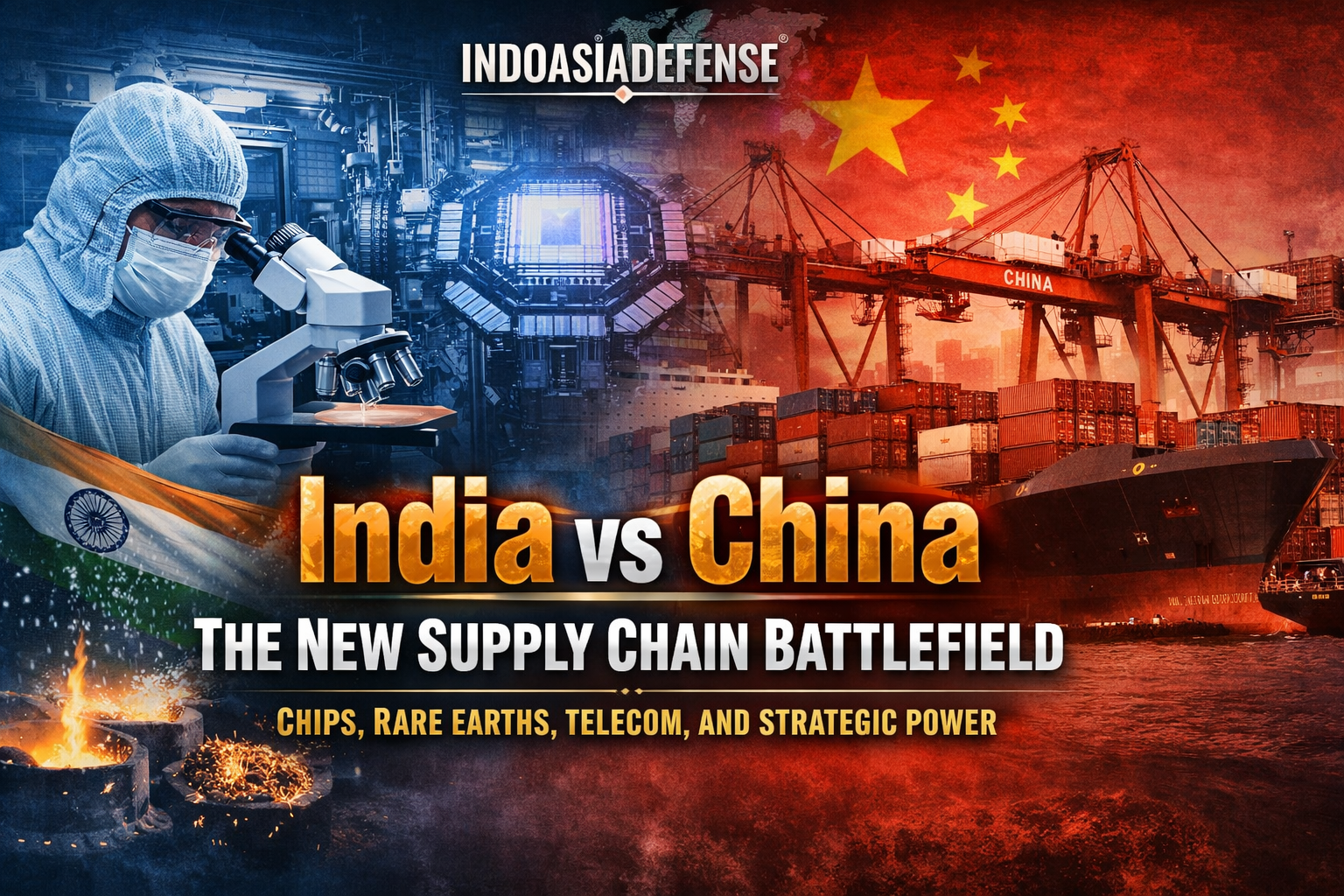
Yet beneath this visible layer lies another battlefield that increasingly shapes power in the Indo-Pacific. It runs through semiconductor fabrication plants, rare earth refineries, electronics assembly lines, and telecommunications hardware factories.
China recognized the geopolitical value of industrial power decades ago. Over the past thirty years it built the world’s most dense manufacturing ecosystem.
Entire supply chains from raw materials to finished electronics sit within tightly integrated industrial clusters across Guangdong, Jiangsu, and Zhejiang provinces.
Today China accounts for roughly 35 to 40 percent of global electronics manufacturing output, making it the largest industrial hub in the modern world.
This concentration of production has created something more than economic influence. It has created strategic leverage.
India’s current manufacturing push must therefore be understood as something larger than economic policy. It is an attempt to reshape the industrial balance of power in Asia and dilute China’s ability to weaponize supply chains.
China’s Supply Chain Dominance Is Structural
China’s industrial rise produced deep control over multiple technological ecosystems. This control does not necessarily rely on monopolizing raw materials. Instead it often rests further downstream in processing, component manufacturing, and large-scale industrial clustering.
Rare earth minerals illustrate the structure of this power. China accounts for around 60 to 70 percent of global rare earth mining. However the real leverage lies in refining and processing.
More than 85 percent of global rare earth separation and nearly 90 percent of rare earth magnet production occur in China.
These magnets power critical technologies including missile guidance systems, electric motors, radar arrays, and drone propulsion systems.
The semiconductor ecosystem reveals a similar pattern. China does not dominate advanced chip fabrication, which remains concentrated in Taiwan and South Korea.
However Chinese firms control large segments of assembly, packaging, and testing capacity, often referred to as OSAT services. At the same time China consumes more than 35 percent of global semiconductor output, giving it influence over global supply chains.
Electronics manufacturing adds another layer. Shenzhen and the surrounding Pearl River Delta have evolved into one of the most sophisticated industrial clusters in history.
Component suppliers, contract manufacturers, logistics firms, and design houses operate within a few hundred kilometers of each other. This geographic density produces extraordinary cost efficiency and production speed.
For countries dependent on these networks, supply chains can become geopolitical vulnerabilities.
The Rare Earth Lesson from Japan
The strategic implications of supply chain concentration became visible in 2010 during a maritime dispute between China and Japan near the Senkaku islands.
After Japanese authorities detained the captain of a Chinese fishing vessel, rare earth shipments from China to Japan suddenly slowed. The restrictions were never formally declared. Instead Chinese customs authorities simply delayed export clearances.
At the time Japan depended on China for more than 90 percent of its rare earth imports.
The result was immediate anxiety across Japanese electronics and automotive manufacturers. Prices spiked and companies scrambled to secure alternative supplies.
The episode lasted only a few months, but its strategic signal was unmistakable. Industrial dominance could translate into geopolitical leverage without formal sanctions or military confrontation.
Many governments quietly absorbed the lesson. India appears to be among them.
The Strategic Trigger in New Delhi
For years India’s manufacturing ambitions remained largely economic in focus. Policy discussions revolved around job creation, export competitiveness, and domestic market growth.
The geopolitical context shifted dramatically after the 2020 border clashes in the Galwan Valley. The confrontation marked the most serious military crisis between India and China in decades.
The aftermath triggered a series of economic responses from New Delhi. More than 200 Chinese mobile applications were banned. Investment rules for Chinese firms tightened.
Telecom procurement policies changed. Several technology projects involving Chinese companies were halted.
At the same time India accelerated policies aimed at reducing structural economic dependence on Chinese technology supply chains.
The government’s Production Linked Incentive program, which spans fourteen sectors and carries a total commitment exceeding $26 billion, became the centerpiece of this strategy.
Defense electronics manufacturing alone receives incentives worth more than $4 billion, designed to catalyze production that could reach $300 billion annually within the decade.
This is not simply industrial policy. It is an attempt to build strategic resilience.
Semiconductors and the Technology Security Equation
The semiconductor sector illustrates both the ambition and the scale of the challenge.
India currently represents less than one percent of the global semiconductor manufacturing value chain.
At the same time the country imports between $25 billion and $30 billion worth of semiconductor components each year to support its electronics and telecommunications industries.
Recognizing the vulnerability, New Delhi launched the India Semiconductor Mission, backed by incentives worth nearly $10 billion.
The objective is to attract fabrication plants, packaging facilities, and semiconductor design investment.
Even partial success could reshape India’s technological ecosystem.
Semiconductor fabrication acts as an anchor industry. Around it cluster materials suppliers, advanced electronics manufacturers, research institutions, and highly skilled technical labor.
Over time such ecosystems support the development of radar electronics, electronic warfare systems, satellite hardware, and advanced communication technologies.
For a country with growing defense technological ambitions, semiconductor resilience is not merely an economic issue. It is a national security requirement.
Rare Earth Processing and the Missile Economy
Rare earth minerals rarely dominate headlines, yet they sit at the heart of modern defense technology.
Permanent magnets derived from rare earth elements power precision actuators in missile guidance systems. They are essential components in advanced radar arrays, electric propulsion systems, and numerous electronic warfare devices.
China’s near monopoly over rare earth processing therefore has implications for global defense supply chains.
India possesses significant rare earth deposits within its coastal mineral sands.
However extraction and refining infrastructure remains limited. Expanding domestic processing capacity would not only support electronics manufacturing but also strengthen India’s defense industrial base.
The stakes extend beyond national self-sufficiency. If alternative rare earth processing hubs emerge across the Indo-Pacific, China’s ability to influence these supply chains could gradually weaken.
Telecommunications and the Digital Infrastructure Contest
Telecommunications networks form the digital backbone of modern economies. They also create potential vectors for cyber surveillance and infrastructure vulnerability.
During the early expansion of 4G and 5G networks, Chinese telecom vendors rapidly gained global market share by offering lower cost equipment and rapid deployment.
However several countries raised concerns about potential security vulnerabilities within critical communications infrastructure.
India responded by restricting Chinese telecom vendors from core network infrastructure while simultaneously supporting domestic alternatives and partnerships with trusted international suppliers.
The shift reflects a broader recognition that digital infrastructure is part of national security architecture.
The Strategic Premium of Industrial Resilience
Yet building alternative supply chains carries an unavoidable economic tradeoff.
Chinese manufacturing ecosystems achieved global dominance partly because of extraordinary cost efficiency.
Large industrial clusters reduce transportation costs, accelerate production cycles, and allow suppliers to operate at immense scale.
Rebuilding similar ecosystems elsewhere will inevitably require higher costs.
Governments must therefore decide who pays the strategic premium for resilience.
In some cases taxpayers fund subsidies through industrial incentives. In others consumers absorb higher prices for domestically produced electronics and technology components.
The tension between efficiency and resilience now shapes industrial policy across multiple countries.
India’s Internal Constraints
Even as India pushes forward with industrial expansion, significant internal challenges remain.
Manufacturing ecosystems depend on reliable infrastructure, efficient logistics, regulatory predictability, and skilled labor. India still faces bottlenecks in several of these areas.
Logistics costs remain higher than in many competing manufacturing hubs.
Land acquisition delays continue to slow major industrial projects. Regulatory procedures can vary across state governments, complicating investment planning.
Execution will determine whether India’s manufacturing ambitions translate into genuine industrial scale.
The Wider Geopolitical Context
India’s industrial strategy also intersects with broader global efforts to restructure technology supply chains.
The United States has introduced sweeping export controls targeting advanced semiconductor technologies destined for China.
Washington’s CHIPS and Science Act aims to rebuild domestic semiconductor manufacturing while encouraging allied countries to expand trusted supply networks.
Within the Quad partnership, discussions increasingly focus on critical minerals, semiconductor supply chains, and emerging technology cooperation.
Meanwhile the Indo-Pacific Economic Framework includes a dedicated supply chain resilience pillar aimed at diversifying manufacturing networks across the region.
India’s growing industrial ecosystem could position the country as a major node within these emerging technology alliances.
The Taiwan Shock Scenario
One strategic scenario illustrates why supply chain resilience has become such a central policy concern.
A conflict in the Taiwan Strait would disrupt more than 60 percent of global semiconductor fabrication capacity almost immediately.
Electronics supply chains across the world would experience severe shocks.
Countries dependent on fragile global manufacturing networks would face immediate industrial disruption.
Military supply chains could also be affected, as modern weapons systems rely heavily on advanced microelectronics.
Diversified manufacturing ecosystems therefore provide more than economic stability. They provide strategic insurance during geopolitical crises.
The Industrial Balance of Power in Asia
China’s manufacturing scale remains formidable. However supply chains across Asia are gradually diversifying.
Vietnam has become a major electronics assembly hub.
Mexico is absorbing manufacturing relocation tied to North American supply chains. Indonesia is investing heavily in nickel processing for electric vehicle batteries.
India’s advantage lies in scale. Its large domestic market, expanding workforce, and growing technology sector create the potential for a vast manufacturing ecosystem if policy execution remains consistent.
Whether India emerges as the primary alternative to China or one of several regional manufacturing hubs will shape the future economic geography of the Indo-Pacific.
The Trump Shock: Tariffs, Legal Battles, and the Fragility of Global Trade Rules
India’s manufacturing strategy is unfolding in a global environment where the rules governing trade and technology are themselves becoming unstable. The return of Donald Trump to the White House has intensified this uncertainty.
High tariffs imposed by Washington on a range of Indian exports have already demonstrated that even strategic partners are not immune from economic pressure.
The measures reflect Trump’s long-standing preference for transactional trade relationships rather than predictable multilateral frameworks.
For India, the consequences are immediate.
The United States is one of India’s largest export markets and a central partner in emerging technology supply chains.
When tariff barriers suddenly rise, the investment calculus for manufacturing becomes more complicated. Firms considering India as a production hub must now weigh not only geopolitical risks in Asia but also the possibility of abrupt policy shifts in Washington.
At the same time, the two countries are negotiating a potential India–United States free trade agreement, an effort that reflects mutual recognition that economic cooperation remains strategically valuable despite tariff tensions.
If successful, such an agreement could stabilize trade flows and deepen technological collaboration in sectors ranging from semiconductors to advanced electronics.
Yet even this path is clouded by legal uncertainty within the United States itself.
The U.S. Supreme Court’s ruling declaring certain tariff authorities unlawful has introduced a new layer of unpredictability into American trade policy.
The decision raises questions about how future tariffs will be implemented and whether executive trade actions could face increasing judicial scrutiny.
For global supply chains, this legal and political turbulence matters.
Semiconductor fabrication plants, electronics manufacturing clusters, and rare earth processing facilities require investment horizons measured in decades.
Companies allocating billions of dollars toward new facilities need confidence that trade rules will remain stable over time.
When major economies oscillate between tariff escalation, legal disputes, and renegotiated trade agreements, the global manufacturing landscape becomes harder to predict.
For India, this volatility produces both opportunity and risk.
On one hand, intensifying U.S.–China economic confrontation may accelerate supply chain diversification away from China.
Western companies seeking geopolitical insulation could increasingly look toward India as an alternative manufacturing base.
On the other hand, Washington’s willingness to impose tariffs even on friendly partners underscores a deeper reality of the emerging global economy: industrial policy is becoming a tool of geopolitical bargaining rather than purely economic cooperation.
India’s manufacturing expansion must therefore navigate a world where trade relationships are increasingly fluid, alliances are more transactional, and supply chains themselves have become instruments of strategic competition.
The Strategic Shift Underway
China’s industrial dominance, America’s escalating technology controls, and the re-emergence of tariff-driven economic nationalism are simultaneously reshaping the global manufacturing order.
The contest between India and China will not be decided solely along contested border regions or through naval deployments in distant seas.
It will also unfold across semiconductor fabrication plants, mineral processing facilities, telecommunications hardware factories, and electronics manufacturing clusters.
China’s rise demonstrated that industrial capacity can translate into geopolitical leverage. India’s manufacturing strategy reflects a recognition that military power alone cannot offset structural economic dependencies.
If India succeeds in building durable manufacturing ecosystems across critical technologies, the balance of economic influence across Asia could gradually shift.
Not through dramatic confrontation. But through the slow accumulation of industrial power.

