










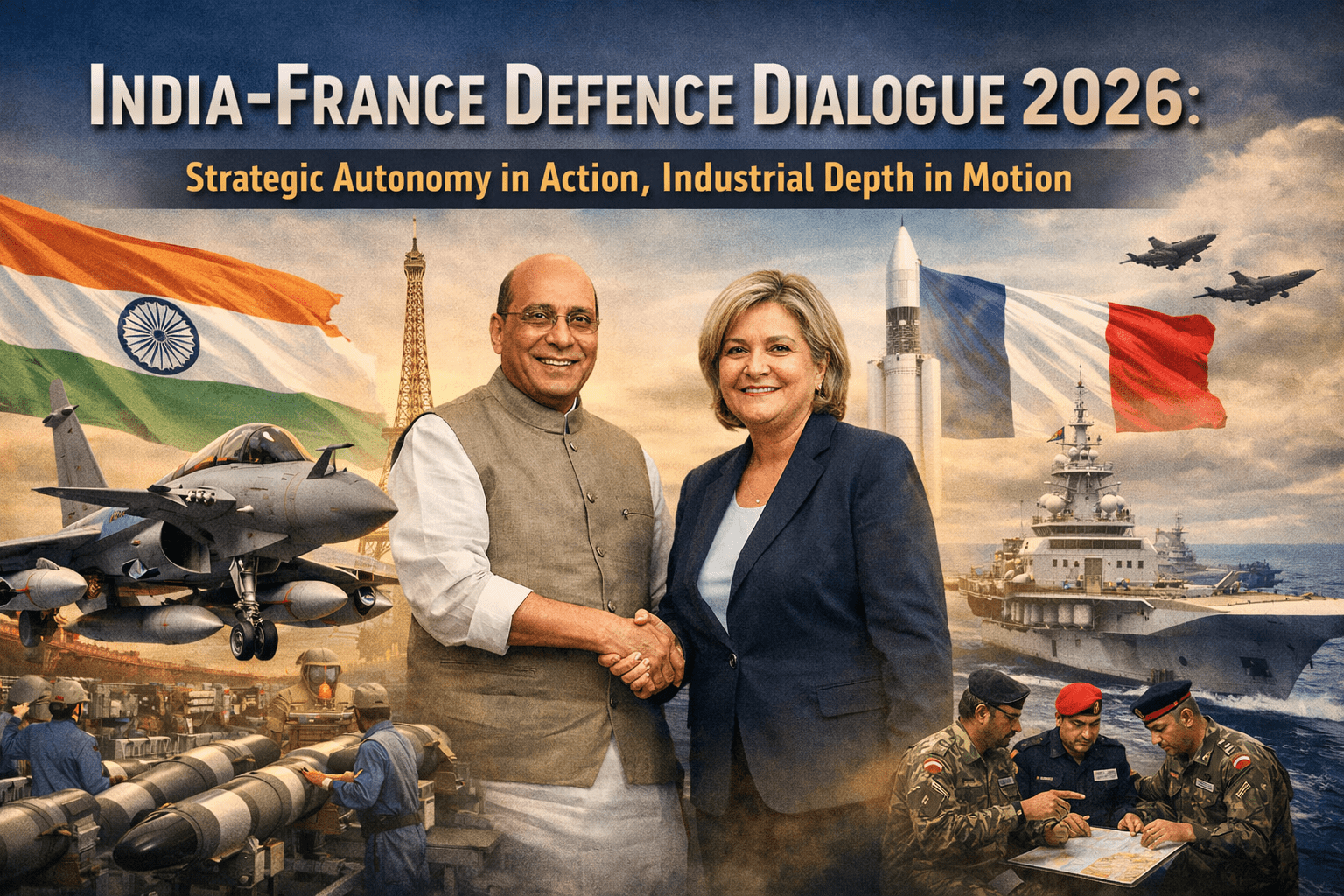
The 6th India-France Annual Defence Dialogue in Bengaluru was framed politely — co-production, officer exchanges, a renewed 10-year framework.
But if you strip away diplomatic language, the real subtext is unmistakable.
It was two strategically autonomous powers quietly reinforcing each other in a decade that is anything but stable.
Yes, the headlines mentioned the renewal of a 10-year defence cooperation framework, reciprocal officer deployments, and the joint manufacturing of Hammer missiles by BEL and Safran. But if you zoom out from the press notes and look at the timing, the venue, and the industrial direction, a clearer picture emerges.
India and France are fortifying a partnership designed to withstand a harsher 2026–2035 security environment – one shaped above all by China’s military assertiveness, supply chain weaponisation, and multi-domain expansion.
This wasn’t ceremonial diplomacy. This dialogue was not about optics.
It was about preparing for stress. It was architecture building.
Why Bengaluru Mattered
The dialogue was held not in Delhi’s diplomatic corridors but in Bengaluru — India’s aerospace and defence innovation hub.
That choice matters.
This is India’s aerospace nerve centre – home to design bureaus, avionics labs, missile integration teams, private defence startups, and the ecosystem that supports everything from Tejas upgrades to UAV programs.
Choosing Bengaluru over New Delhi told you that this partnership is moving downstream – from strategic alignment to industrial embedding.
It signalled that the future of the partnership lies not in press releases but in production lines.
Not in speeches but in subsystems. Not in symbolic alignment but in industrial embedding.
India is no longer satisfied with platform acquisition alone. India is moving from being a buyer to being a builder.
The conversation has shifted toward ecosystem participation: subsystems, electronics, propulsion, and guided munition chains.
France understands that and positioning itself as a long-term co-architect.
The China Subtext: What Wasn’t Said Out Loud
No official statement from Bengaluru framed the dialogue as counter-balancing Beijing.
They didn’t need to. Diplomacy rarely does.
But context speaks.
The Indian Ocean Region is seeing sustained PLA Navy deployments.
Chinese naval deployments in the Indian Ocean have become routine. The Line of Actual Control remains unsettled. On land, the Line of Actual Control remains frictional, not resolved.
India’s challenge is twofold:
- Maintain deterrence on the northern land frontier
- Maintain credible maritime posture in the Indian Ocean
India is modernising under budget constraints. It cannot afford fragile supply lines in a short, sharp conflict.
France’s relevance emerges precisely here.
It is the only major European power with permanent Indian Ocean territories and assets. It operates blue-water naval forces capable of sustained deployments. It maintains independent strategic decision-making capacity — unlike some bloc-bound actors.
France wants a credible Indo-Pacific presence without relying solely on transatlantic dynamics. France sees in India scale, geography, and long-term Indo-Pacific anchoring.
India sees in France a technologically advanced power that is neither treaty-bound to Indo-Pacific escalation frameworks nor politically unpredictable.
The China factor is the gravitational field around which this cooperation orbits. The defence dialogue sits squarely in that overlap.
It does not create an alliance. It creates options. And in geopolitics, options are power.
The Hammer Missile Deal: Precision, Sustainability and Scale
The global security environment of 2026 is not forgiving. Europe is rearming. The Indo-Pacific is militarising. Supply chains are weaponised. Precision munitions have become as strategic as fighter jets.
India sits at the crossroads of two persistent pressures — a tense Himalayan frontier with China and an increasingly contested Indian Ocean. France, the only major European power with permanent territories and forces in the Indian Ocean, understands that geography matters again.
The MoU between Bharat Electronics Limited and Safran for co-manufacturing the Hammer (Highly Agile Modular Munition Extended Range) missile in India looks straightforward.
But operationally, it’s more consequential than it appears.
It is about ensuring that in the event of crisis, India does not wait on foreign supply chains to replenish high-end munitions.
That is not a minor shift. It is a sovereignty shift.
Hammer is already integrated on India’s Rafale fleet and compatible with the LCA Tejas. It offers stand-off precision strike with modular guidance kits — critical in mountainous terrain and limited escalation scenarios.
Now consider India’s present air power reality.
The Indian Air Force operates roughly 30–31 squadrons against an authorised 42. Platform recapitalisation is ongoing but slow. That means qualitative edge must compensate for quantitative gaps.
Precision munitions become force multipliers.
In a 10–14 day limited high-intensity engagement, a Rafale squadron could expend several hundred precision weapons if sortie rates surge. Historically, replenishment of imported precision-guided munitions has been vulnerable to supply delays and geopolitical clearance cycles.
Localised production changes the resilience equation.
If the BEL-Safran joint venture scales to 300–500 units annually by 2028, India reduces wartime depletion anxiety. More importantly, it builds indigenous integration competence — guidance electronics, sub-assemblies, testing infrastructure.
That’s not screwdriver technology. That’s ecosystem entry.
10 Years of Framework: Stability in a Volatile Era
If this trajectory continues, by 2035 India and France could anchor a broader India–Europe defence corridor in the Indo-Pacific.
Joint maritime coordination, co-development of advanced systems, and deeper supply-chain integration are all plausible.
A 10-year defence cooperation renewal may sound administrative, but in today’s geopolitical climate, it’s strategic insurance.
- Europe is rearming
- The Indo-Pacific is militarising
- Global supply chains are under stress
- Export control regimes are tightening
India values France because Paris has historically maintained policy continuity even during politically complex moments. France values India because it offers scale, strategic independence, and Indo-Pacific depth.
Not an alliance. Not a bloc.
It’s pragmatic convergence- a durable alignment of interests between two powers that prefer autonomy over dependency.
In a world increasingly divided into rigid camps, that flexibility is strategic capital.
Officer Exchanges: The Quiet Multiplier
Perhaps the most overlooked decision was the reciprocal deployment of military officers.
This is not ceremonial exchange. It builds doctrinal familiarity. It creates operational trust.
It improves interoperability during joint exercises and maritime coordination. It matters in anti-submarine warfare drills, carrier group coordination, and Western Indian Ocean presence missions.
If tensions rise in the Western Indian Ocean or beyond, familiarity shortens reaction time.
Wars are not only fought with hardware. They are managed through relationships. When officers know each other’s command cultures, coordination during crises becomes friction-light.
It’s strategic intimacy without formal alliance entanglement – very much aligned with India’s approach to partnerships.
The Strategic Autonomy Thread
Both nations speak the language of strategic autonomy — and they mean it.
India does not want dependence traps. France does not want subordination within bloc politics. Both prefer multipolar balance.
That shared worldview is the ideological glue.
But here’s the hard reality: strategic autonomy without industrial capability is rhetoric. Strategic autonomy with co-production, localisation, and supply-chain resilience becomes actionable.
The Hammer deal is a small but tangible step in that direction.
The Private Sector Gap — and Opportunity
One aspect that still deserves stronger emphasis is the Indian private defence sector.
India’s defence industrial landscape in 2026 is not just PSUs. It includes agile private players working on seekers, composite materials, UAV payloads, AI-enabled battlefield systems, and electronic warfare components.
If France’s SME defence ecosystem connects meaningfully with Indian startups, this partnership could expand beyond state-led programs.
Future dialogues should explicitly address:
- Advanced avionics collaboration
- Drone and loitering munition co-development
- Cyber and electronic warfare integration
- Space-based ISR cooperation
Modern conflict is multi-domain. Air-to-ground munitions are just one layer.
Budget and Force Reality Check
India’s defence budget is growing, but capital outlay remains under pressure from pensions and revenue commitments.
Large platform acquisitions – fighters, submarines, transport aircraft – consume massive fiscal bandwidth. Precision munitions, in contrast, offer high combat return per rupee spent.
If co-production reduces per-unit cost even modestly, India improves fiscal efficiency in strike capability.
Between 2026 and 2030, if India increases domestic precision weapon production by 40–50% relative to 2024 baselines, it strengthens high-tempo war endurance without proportional budget spikes.
That’s smart force design.
The Indo-Pacific Context
The Indian Ocean is not abstract geopolitics anymore. It’s an operational theatre.
- Chinese naval deployments remain persistent
- Sea lines of communication are strategic arteries
- Western Indian Ocean chokepoints are contested spaces
France’s territories and presence give it enduring relevance there. India sees itself as the first responder and net security provider.
Aligning operational doctrines in this theatre is not symbolic — it’s future-proofing.
The Bottom Line
The 6th India-France Defence Dialogue did not produce dramatic headlines. But it marked a quiet hardening of strategic ties at a moment when fragility defines the global order.
It produced something more durable:
- A decade-long institutional anchor
- Precision munition co-production
- Officer-level interoperability
- Industrial depth expansion
In an era of fragile supply chains and accelerating military competition, that combination is strategic ballast.
India and France are not just buying and selling.
They are building resilience together. They are preparing for uncertainty.
And in the 2026–2030 window, resilience may matter more than spectacle and the most important geopolitical messages are the ones delivered without raising your voice.

