















India Defence Exports Strategy Explained
The India defence exports strategy marks a structural shift in how India is positioning itself within the global security architecture. It is no longer sufficient for India to build military capability for domestic use alone. The emerging framework links defence manufacturing India with external influence, transforming production capacity into an instrument of geopolitical reach.
India’s defence exports have crossed ₹20,000 crore in recent years, but the number itself is only a surface indicator. The deeper transition lies in intent. For decades, India functioned primarily as a large-scale importer of defence systems, with procurement cycles shaping capability and external suppliers influencing force structure. The India defence exports strategy begins to reverse that logic by embedding exports into the core of industrial and strategic planning.
This shift aligns closely with the broader India defence industrial policy 2047, where domestic production, defence self-reliance India, and export capability are treated as interdependent pillars. Manufacturing is no longer viewed as a support function. It is becoming central to how India builds, sustains, and projects power over time.
From Procurement Dependence to Export-Oriented Strategy
India’s historical defence model was built around procurement efficiency rather than industrial autonomy. Capability gaps were identified and filled through imports, often under time pressure and geopolitical constraints. While this model delivered immediate capability, it also created long-term dependencies in maintenance, spares, and upgrades.
The India defence exports strategy represents a departure from this structure. It introduces a production-driven logic in which domestic manufacturing must not only meet internal demand but also scale outward. This outward orientation is critical. Without exports, production lines remain underutilized. Without sustained production, industrial ecosystems fail to mature.
This transition requires more than capacity expansion. It requires alignment across policy, financing, certification, and diplomacy. Export strategy cannot operate in isolation. It must be integrated into procurement reform, industrial incentives, and foreign policy signaling. This is where the structural nature of the shift becomes evident. India is not simply exporting more. It is reorganizing the relationship between industry and strategy.
Why Defence Exports Reshape Strategic Power
Defence exports differ fundamentally from conventional trade flows. A military system delivered to another state creates a long-term operational relationship that extends far beyond the initial transaction. Training programs, maintenance cycles, spare parts supply, and software updates create ongoing dependencies that bind systems and institutions together.
Over time, these technical relationships evolve into doctrinal alignment. Armed forces that operate similar systems tend to converge in how they think about operations, planning, and risk. This is why defence exports India cannot be viewed purely as a commercial activity. They function as instruments of strategic influence.
The United States has historically used defence exports to build alliance structures. Russia has sustained long-term partnerships through legacy systems and maintenance ecosystems. France has combined exports with diplomatic positioning to maintain influence in multiple regions. India is now entering this space at a moment when many states are actively seeking diversification.
Within the framework of defence self-reliance India, exports also serve a domestic function. They sustain industrial scale, reduce per-unit costs, and create incentives for technological advancement. The relationship between exports and industrial capacity is therefore mutually reinforcing. One cannot expand without the other.
The BrahMos Moment and the Shift to High-End Exports
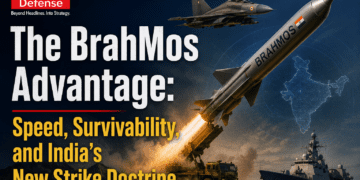
The export of the BrahMos missile system represents a decisive shift in the India defence exports strategy. It marks the transition from low-value exports to high-impact systems capable of altering regional deterrence dynamics.
Historically, India’s exports were limited to components, spares, and basic platforms. These exports generated revenue but did not create strategic leverage. BrahMos changes that equation. It demonstrates that India can compete in a segment of the market where performance, reliability, and operational impact are the primary determinants.
For the Philippines, the acquisition of BrahMos provides a credible coastal defence capability that complicates adversary planning. For India, the export signals a willingness to shape regional security environments without deploying forces directly. This represents a more subtle form of influence, where capability transfer substitutes for presence.
The implications extend beyond a single system. The success of BrahMos establishes a template for exporting other high-value systems, particularly in domains where India has developed technological depth. It also signals to potential buyers that India is capable of delivering complex, mission-critical platforms.
Structural Constraints Limiting Export Expansion
Despite visible progress, the India defence exports strategy continues to face structural constraints that limit its scalability. These constraints are not temporary. They reflect deeper institutional and industrial realities.
Financing remains one of the most significant barriers. Many potential buyers, particularly in Southeast Asia and Africa, require structured credit arrangements. Competing suppliers often integrate financing into export packages, reducing upfront costs and increasing competitiveness. India’s financing mechanisms are still evolving, which constrains its ability to compete in price-sensitive markets.
Certification and testing frameworks present another challenge. Global defence markets rely on established standards that ensure interoperability and reliability. While India’s capabilities are improving, the absence of universally recognized certification ecosystems can create hesitation among buyers.
Production consistency is equally critical. Export commitments require predictable delivery timelines and resilient supply chains. Variability in production capacity reduces credibility, particularly for complex systems that require long lead times.
Procedural delays further compound these issues. Export approvals and inter-agency coordination can introduce friction into the process, affecting responsiveness in competitive environments. Ongoing reforms under procurement frameworks indicate recognition of these constraints, but execution remains the decisive factor.
Private Sector and the Evolution of Export Capability
The expansion of defence exports India is closely tied to the transformation of its industrial base. Private sector participation has introduced new dynamics into defence manufacturing India, particularly in terms of efficiency, innovation, and market orientation.
Private firms operate under different incentives than traditional public sector entities. They prioritize cost optimization, supply chain integration, and export viability. This shift has begun to alter the structure of India’s defence ecosystem, making it more responsive to global market demands.
However, integration remains incomplete. Procurement systems still reflect legacy structures that favor established entities. Unless these systems evolve to fully incorporate private sector capabilities, the export potential of the industrial base will remain constrained.
Industrial Scale and Export Economics
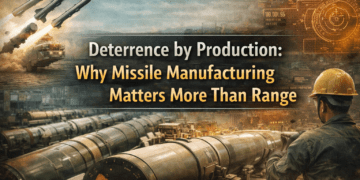
Exports are not an optional extension of defence manufacturing. They are essential for sustaining industrial scale. Defence production requires continuous utilization of manufacturing capacity to remain economically viable.
The relationship between domestic demand and export markets can be understood through a simple comparison:
| Factor | Domestic-Only Model | Export-Integrated Model |
|---|---|---|
| Production Scale | Limited | Expanded |
| Cost Efficiency | Moderate | Improved |
| Innovation Incentives | Low | High |
| Supply Chain Depth | Shallow | Strengthened |
This comparison highlights a structural reality. Without exports, production remains constrained. With exports, industrial ecosystems deepen and mature. The India defence exports strategy is therefore not just about expanding markets. It is about sustaining the industrial base itself.
Indo-Pacific Demand and Strategic Positioning
The Indo-Pacific region presents a unique opportunity for India’s export strategy. Several states in the region are recalibrating their defence procurement strategies in response to evolving security dynamics. They seek diversification, cost-effective solutions, and partners that do not impose restrictive conditions.
India occupies a distinctive position within this landscape. It is not perceived as a coercive supplier, nor is it bound by rigid alliance structures. This allows India to offer systems that are both credible and politically flexible.
Exports become an extension of this positioning. They allow India to build long-term relationships without formal alliances. Over time, these relationships can evolve into networks of influence that shape regional security outcomes.
Scenario: India Defence Exports Strategy to 2035
Looking ahead, the trajectory of the India defence exports strategy will depend on how effectively current constraints are addressed. By 2035, several pathways emerge.
In one trajectory, India successfully scales production, strengthens certification frameworks, and expands financing mechanisms. Exports grow across multiple domains, including missiles, naval platforms, and electronic warfare systems. India becomes a consistent supplier across the Indo-Pacific.
In a more constrained trajectory, structural limitations persist. Export growth continues but remains limited to select systems and markets. Industrial expansion remains uneven, reducing long-term competitiveness.
The divergence between these outcomes will depend not on policy intent, but on execution depth.
Conclusion: Manufacturing as Strategic Influence
The India defence exports strategy reflects a broader transformation in how India conceptualizes power. Manufacturing is no longer confined to domestic capability building. It becomes an instrument of external influence.
Exports extend the reach of industrial capacity. Industrial capacity sustains military capability. Together, they shape geopolitical positioning.
If executed effectively, this strategy will enable India to move beyond participation in the global defence market and begin shaping the structure of that market itself.
FAQs
What is India defence exports strategy?
India defence exports strategy focuses on expanding India’s role as a global supplier of military systems by integrating domestic manufacturing with international demand and long-term strategic partnerships.
Why are defence exports important for India?
Defence exports help India sustain industrial capacity, reduce dependence on imports, and build strategic relationships that extend influence across regions such as the Indo-Pacific.
What are India’s major defence exports?
India exports missile systems such as BrahMos, along with naval platforms, artillery systems, and defence electronics to multiple regions including Southeast Asia and the Middle East.
How do defence exports support defence self-reliance India?
Defence exports increase production scale, improve technological capability, and strengthen domestic industrial ecosystems, supporting long-term self-reliance.
Which regions are key for India defence exports strategy?
The Indo-Pacific, Middle East, and parts of Africa are key regions where India is expanding its defence export footprint.

