



























Great Nicobar Project and the Future of India’s Maritime Power
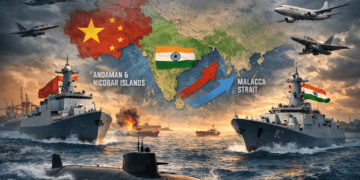
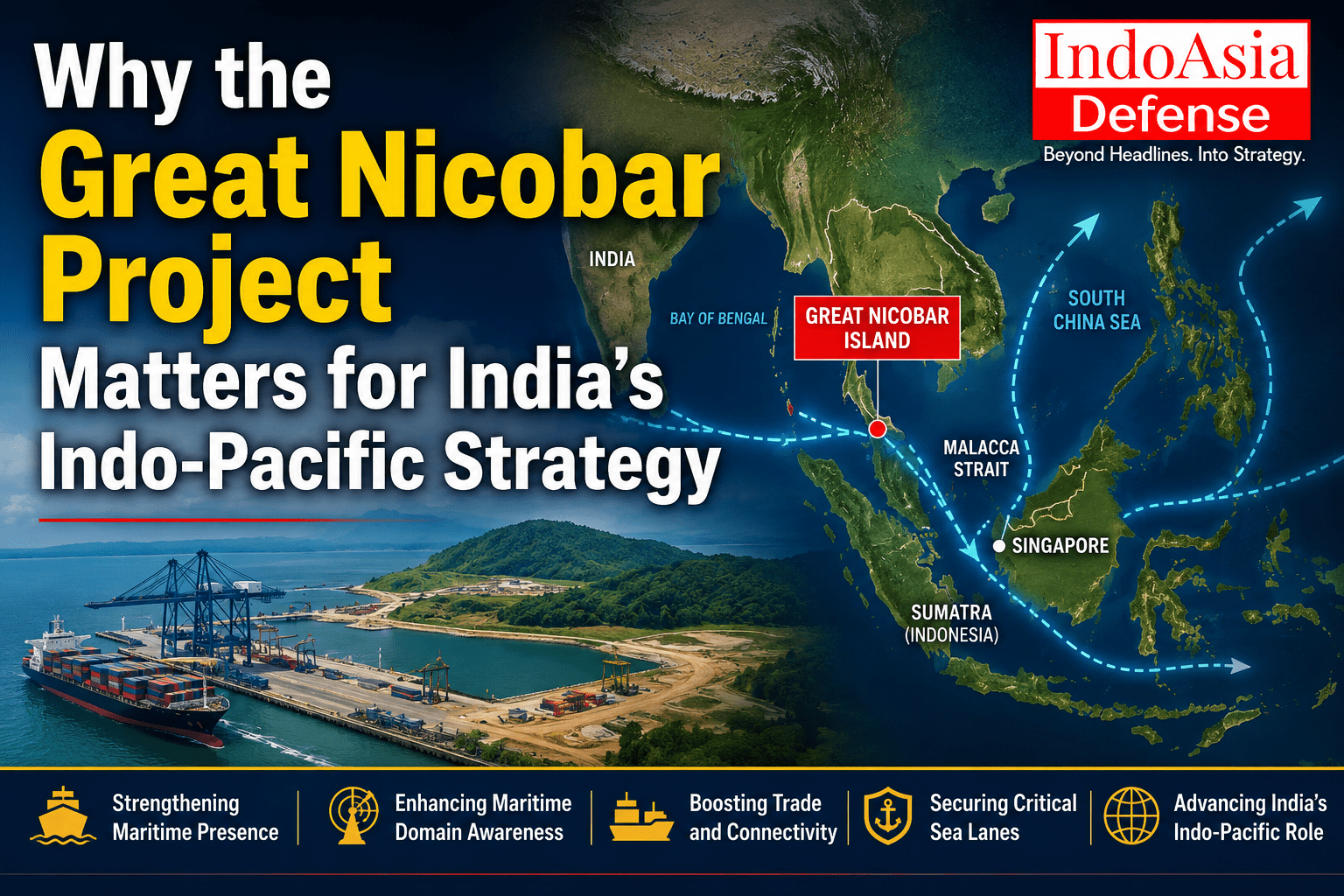
There is a map that appears in almost every serious discussion about India’s maritime future.
It shows the Andaman and Nicobar Islands stretching southward from the Bay of Bengal toward Southeast Asia. On the same map, a dense stream of commercial shipping moves through the Malacca Strait before entering the Indian Ocean.
The conclusion seems obvious.
If geography alone determined strategic influence, the Andaman and Nicobar Islands would already be one of India’s most important assets.
Yet for most of independent India’s history, that geography remained underutilized.
The islands were strategically valuable, but they were also remote. They hosted military facilities, but lacked the infrastructure needed to support larger economic and logistical activity. Policymakers regularly described them as critical to India’s maritime future, yet investment rarely matched the rhetoric.
The Great Nicobar project is an attempt to change that.
At first glance, it looks like a massive infrastructure initiative. It includes a deep-sea transshipment port, an international airport, power generation facilities, roads, and township development. The total cost is estimated at roughly ₹81,000 crore to ₹90,000 crore.
But viewing the project purely through an infrastructure lens misses its larger significance.
The Great Nicobar project is best understood as an effort to transform one of India’s greatest geographic advantages into a lasting source of economic and strategic influence.
The port is important.
The airport is important.
But the larger story is about India’s evolving vision of the Indo-Pacific.
Project Snapshot
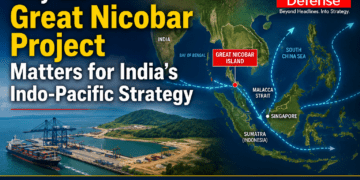
The Great Nicobar development plan is centered on Galathea Bay, located on the southeastern coast of Great Nicobar Island.
The proposed International Container Transshipment Port is the project’s centerpiece. It is expected to be developed in phases, with an initial capacity of roughly 4 million TEUs and a long-term target that could eventually exceed 14 million TEUs annually.
Alongside the port, the government plans to build a greenfield international airport capable of handling both civilian and strategic requirements. Supporting infrastructure includes power generation systems, transport networks, water facilities, and urban development.
The port has already been notified as India’s 13th major port.
If current timelines hold, the first phase could become operational around 2028.
These figures are impressive.
Yet the project’s importance cannot be measured only in containers handled or ships serviced.
Its real value comes from location.
And location has always been Great Nicobar’s strongest asset.
Why Great Nicobar Matters
To understand Great Nicobar, it helps to begin with a simple question.
Why did Singapore become one of the world’s most important ports?
The answer is not simply governance, infrastructure, or investment. Geography came first.
Singapore sits astride major maritime routes connecting East Asia, South Asia, the Middle East, and Europe. Trade naturally flows through the region.
Great Nicobar benefits from a similar geographical reality.
The island lies close to the western approaches of the Malacca Strait. This narrow passage connects the Indian Ocean with the South China Sea and the wider Pacific.
Every year, tens of thousands of commercial vessels pass through these waters.
Oil tankers carrying energy from the Persian Gulf to East Asia use the route.
Container ships connecting Europe and Asia use the route.
Raw materials, manufactured goods, and critical components move through the same corridor.
Few locations under Indian sovereignty sit so close to this concentration of global commerce.
That matters because modern maritime power is not only about warships.
It is also about proximity to trade.
Countries that sit near major shipping routes gain opportunities that others do not. They can develop ports, attract investment, build logistics networks, and shape commercial flows.
For decades, India possessed this advantage on paper.
Great Nicobar is an attempt to capitalize on it.
The Island Delhi Often Discussed but Rarely Developed
One of the more interesting aspects of the Great Nicobar story is how long it took to reach this point.
Indian policymakers have been discussing the strategic importance of the Andaman and Nicobar Islands for decades.
The islands were hardly unknown to planners.
Military strategists regularly highlighted their proximity to the Malacca Strait. Naval officers emphasized their importance for maritime surveillance. Successive governments acknowledged their value.
Yet acknowledgement and development are not the same thing.
For much of the post-independence period, India’s strategic focus remained overwhelmingly continental.
Wars with Pakistan shaped military priorities.
Border tensions with China demanded attention.
Internal security challenges consumed resources.
The maritime domain often came second.
This was understandable.
India’s most immediate threats were located on land.
The consequence, however, was that the Andaman and Nicobar Islands frequently remained a future priority rather than a present one.
The result was a curious contradiction.
India possessed one of the most strategically located island chains in the world.
Yet much of its potential remained unrealized.
The Great Nicobar project suggests that Delhi may finally be moving beyond recognition and toward execution.
The Unsinkable Aircraft Carrier Analogy Only Goes So Far
The Andaman and Nicobar Islands are often described as India’s unsinkable aircraft carrier.
The phrase captures an important truth.
The islands provide a forward position in the eastern Indian Ocean. They allow India to monitor critical sea lanes and maintain a presence near one of the world’s most important maritime chokepoints.
But the analogy has limits.
Aircraft carriers do not operate in isolation.
They require logistics.
They require maintenance.
They require fuel, communications, personnel, and supply chains.
The same logic applies to islands.
A strategically located island chain without supporting infrastructure can provide presence.
It struggles to provide sustained influence.
This is where Great Nicobar becomes important.
The project is not merely about creating another port.
It is about building the infrastructure needed to support a larger long-term presence.
Ports improve logistics.
Airports improve connectivity.
Power systems improve resilience.
Economic activity attracts people, investment, and services.
Together, these elements create depth.
The significance of Great Nicobar lies in the fact that it attempts to build all of these things simultaneously.
Why the British and Japanese Reached the Same Conclusion
The strategic value of the Andaman and Nicobar Islands is not a modern discovery.
The British recognized it more than a century ago.
When the British established their penal settlement at Port Blair in 1858, punishment was only part of the story. The islands also occupied an important position along maritime routes connecting British India with Southeast Asia.
Control of the islands provided visibility over the Bay of Bengal and the approaches to the wider region.
The Japanese reached a similar conclusion during the Second World War.
Japanese forces occupied the islands in 1942. The occupation lasted until 1945.
The decision was not accidental.
The islands occupied a strategic position astride maritime routes and offered potential military advantages in the Bay of Bengal.
Different powers.
Different eras.
Similar conclusions.
The geography has not changed.
What has changed is the strategic environment around it.
Today, the Indo-Pacific sits at the center of global economic activity. Maritime trade has become more important than ever. Competition among major powers increasingly revolves around access, logistics, and connectivity.
The islands matter for the same reason they mattered to earlier powers.
They sit in the right place.
India’s Bid to Become a Major Transshipment Hub
Beyond strategy, the Great Nicobar project also has a clear economic rationale.
A large portion of India’s international container traffic continues to be transshipped through foreign ports before reaching global destinations.
Singapore plays a major role.
Colombo plays a major role.
Port Klang and several other regional hubs also handle substantial volumes of Indian cargo.
This arrangement works.
But it also creates dependence.
A significant share of the value generated by maritime logistics accrues outside India.
The Galathea Bay project aims to change that.
Its location offers a natural advantage. Ships travelling through the Malacca Strait already pass close to Great Nicobar. Unlike many mainland ports, the facility does not require major route deviations.
That reduces costs.
It also increases attractiveness for shipping operators.
Yet success should not be assumed.
Building a port is difficult.
Building a globally competitive transshipment hub is even harder.
Singapore did not become a maritime giant because of geography alone. It succeeded because geography, infrastructure, governance, and commercial ecosystems reinforced one another over decades.
Great Nicobar will face similar challenges.
It must attract shipping traffic.
It must develop supporting services.
It must create a reliable operating environment.
Most importantly, it must prove that it can compete against established regional players.
There is also a risk of overselling the project.
Some commentary presents Great Nicobar as an automatic game changer for India’s maritime position.
Reality is more complicated.
Ports do not generate influence simply because they exist.
Gwadar offers an important reminder. Despite years of attention, its commercial performance has often fallen short of expectations.
Infrastructure creates opportunity. It does not guarantee success.
That said, Great Nicobar begins with one advantage that cannot be replicated.
Location.
The opportunity already exists. The challenge now is execution.
China’s Malacca Dilemma and the Great Nicobar Factor
No discussion of Great Nicobar is complete without discussing China.
For more than two decades, Chinese strategists have worried about what former Chinese President Hu Jintao famously described as the “Malacca Dilemma.”
The concern is simple.
China’s economy depends on maritime trade. A large share of its imported oil passes through the Indian Ocean before entering the South China Sea via the Malacca Strait.
This creates a vulnerability.
Any major disruption to those routes could create economic and military challenges for Beijing.
China has spent years trying to reduce that risk.
The China-Pakistan Economic Corridor is part of that effort. So are energy pipelines through Myanmar. Investments in overseas ports serve a similar purpose.
These projects provide alternatives.
They do not replace maritime trade.
The reality is that China’s economy will remain heavily dependent on sea lines of communication for the foreseeable future.
This is where Great Nicobar enters the picture.
Its value is often misunderstood.
The project is not about blockading Chinese shipping.
Such claims are unrealistic.
India is not going to shut down the Malacca Strait during peacetime. Nor would doing so be in its own interests.
The real significance is more subtle.
A stronger Indian presence near the western approaches to Malacca increases New Delhi’s awareness of maritime activity. It improves surveillance. It improves logistics. It creates additional options during periods of tension.
Strategic competition is often about shaping calculations.
Great Nicobar gives India another way to do that.
From Outpost to Strategic Ecosystem
One of the biggest mistakes analysts make is treating military infrastructure and economic infrastructure as separate categories.
History suggests otherwise.
The world’s most influential maritime hubs are rarely just military facilities.
They are ecosystems.
Singapore is not important because it hosts ships.
It is important because shipping, finance, logistics, infrastructure, and trade reinforce one another.
The same principle applies elsewhere.
China’s overseas infrastructure strategy follows a similar logic. Commercial projects often create strategic benefits over time.
Great Nicobar reflects a comparable idea.
The project combines a port, an airport, transportation infrastructure, energy systems, and urban development.
Each component supports the others.
The objective is not merely to establish a stronger military presence.
The objective is to create permanence.
That distinction matters.
Military deployments can be temporary.
Economic ecosystems tend to endure.
If Great Nicobar succeeds, it will be more than a strategic outpost.
It will become a long-term center of activity in the eastern Indian Ocean.
China’s String of Pearls and India’s Sovereign Pearl
For years, discussions about the Indian Ocean have been dominated by one phrase.
The String of Pearls.
The term refers to China’s expanding network of ports and infrastructure projects stretching across key maritime routes.
Gwadar in Pakistan often receives the most attention.
Hambantota in Sri Lanka is another prominent example.
Djibouti hosts China’s first overseas military base.
Kyaukpyu in Myanmar adds another piece to the puzzle.
Not every project serves a military function.
That is not the point.
The broader objective is strategic flexibility.
Infrastructure creates options.
Great Nicobar offers India a fundamentally different model.
Unlike China’s overseas facilities, Great Nicobar sits on sovereign Indian territory.
India does not require access agreements.
It does not depend on host governments.
It does not need to worry about political changes in another country.
The island is already Indian.
That makes it uniquely valuable.
In strategic terms, Great Nicobar may eventually become India’s most important maritime asset.
Not because it is the largest.
Not because it hosts the most military hardware.
But because geography, sovereignty, and infrastructure converge in one place.
What Would Great Nicobar Mean During a Crisis?
The true value of strategic infrastructure often becomes visible only during a crisis.
Imagine a future India-China confrontation that extends beyond the Himalayan frontier.
Imagine heightened tensions in the South China Sea.
Imagine a Taiwan contingency that draws major naval forces deeper into the Indo-Pacific.
In each of these scenarios, Great Nicobar expands India’s options.
Maritime patrol aircraft could operate more efficiently.
Logistics support for naval deployments could improve.
Surveillance systems could maintain greater persistence.
Submarine monitoring efforts could become more effective.
Supply and maintenance activities could be sustained more easily.
None of these advantages guarantees success.
Strategy rarely works that way.
But they increase flexibility.
And flexibility often shapes outcomes.
This point is especially important because the Andaman and Nicobar Command already exists.
The military foundation is present.
Great Nicobar strengthens the infrastructure that supports it.
For years, analysts described the Andaman and Nicobar Islands as a sleeping giant.
The project can be viewed as an attempt to wake it up.
The Strategic Cost of Delay
The Great Nicobar project has generated substantial debate.
Much of that debate has focused on environmental concerns.
Those concerns deserve serious attention.
The island contains sensitive ecosystems. It supports unique biodiversity. Questions surrounding conservation and indigenous communities cannot simply be ignored.
At the same time, strategic decisions involve trade-offs.
Every choice has costs.
Including the choice to do nothing.
This is the part of the discussion that often receives less attention.
For decades, India acknowledged the strategic value of the Andaman and Nicobar Islands.
Yet investment remained limited.
Meanwhile, the regional environment continued to evolve.
China expanded its naval presence.
Competing ports attracted capital.
The Indo-Pacific became the world’s most important geopolitical theater.
The opportunity cost of inaction grew larger.
The debate therefore should not be framed as development versus environment.
It should be framed as how India balances strategic requirements with environmental responsibility.
The challenge is not whether infrastructure should be built.
The challenge is how it should be built.
The False Choice Between Environment and Strategy
Public discussions often present the issue as a binary choice.
Protect the environment.
Or pursue development.
Reality is more complicated.
A country of India’s size cannot afford to ignore environmental concerns.
Nor can it afford to neglect strategically important regions.
The real test is whether institutions can manage both objectives simultaneously.
That requires planning.
It requires oversight.
It requires accountability.
Most importantly, it requires the willingness to recognize that strategic infrastructure and environmental stewardship are not automatically incompatible.
The success or failure of Great Nicobar will ultimately be judged on that basis.
Not simply on the number of ships it handles.
But on how responsibly it is developed.
The Second Chapter of India’s Andaman Strategy
Twenty-five years ago, India created the Andaman and Nicobar Command.
The decision reflected an important realization.
The islands mattered.
They mattered because of geography.
They mattered because of location.
They mattered because they sat near some of the world’s most important maritime routes.
Yet recognition moved faster than infrastructure.
The command existed.
The supporting ecosystem did not.
That is what makes Great Nicobar significant.
The project is not simply about a port.
It is not simply about an airport.
It is not even primarily about containers or cargo.
It is about converting geographic advantage into lasting influence.
Whether the project succeeds will depend on execution.
Commercial viability will matter.
Environmental management will matter.
Governance will matter.
None of those questions has been fully answered yet.
But the broader strategic logic is difficult to ignore.
For decades, India possessed one of the most valuable maritime locations in the Indo-Pacific.
Great Nicobar is an attempt to finally use it.
Frequently Asked Questions
What is the Great Nicobar Project?
The Great Nicobar Project is a large-scale infrastructure initiative that includes a transshipment port, international airport, township development, and supporting infrastructure on Great Nicobar Island.
Why is Great Nicobar strategically important?
Its location near the western approaches to the Malacca Strait places it close to one of the world’s busiest maritime trade routes.
Can Great Nicobar help India counter China?
The project improves India’s maritime awareness, logistics, and strategic options in the eastern Indian Ocean. Its value lies in influence and flexibility rather than blockade capabilities.
Why is the project controversial?
The project has generated debate because of concerns related to biodiversity, forest clearance, coastal ecosystems, and indigenous communities.
How does Great Nicobar relate to the Andaman and Nicobar Command?
The command provides India’s military presence in the islands. Great Nicobar strengthens the economic and logistical foundations that can support a larger long-term presence in the region.

