










IndoAsia Defense
  • Home
  • Air
    • All
    • Air Defence
    • Drones
    • Fighters
    • ISR & Mobility
    A 250-km Missile Means Nothing If the Kill Chain Breaks

    India’s 250-km Missile Debate Is Not About Outmatching the PL-15

    Rafale F5 vs AMCA

    Rafale F5 vs AMCA: If India Buys Rafale F5, What Happens to AMCA?

    BrahMos Advantage

    BrahMos Missile Explained: The Missile That Enables India’s Stand-Off Strike Strategy

    Ghatak UCAV stealth, autonomy, integration

    Inside India’s Ghatak UCAV Program: Stealth, Autonomy, and the Integration Gap

    The F414 engine co-production agreement between Hindustan Aeronautics Limited and GE Aerospace

    India-US F414 Engine Deal Explained: Technology Transfer, Tejas Mk2, and AMCA

    What is the Su-57M1 India deal

    Su-57M1 for India: A Fifth-Generation Shortcut or a Strategic Dependency Trap?

    India indigenous long range surveillance radar with X-band drone detection capability

    450km Eyes, Machine-Speed Decisions: How India’s Indigenous Long Range Surveillance Radar Is Rewriting Air Defence

    Why Software Defined Radios Are the IAF’s Most Consequential Upgrade

    IAF Signs BEL Deal for Software Defined Radios: Rewiring India’s Air Combat Network

    How the Ghatak UCAV Stealth Design Redefines India’s Drone Warfare Doctrine

    Ghatak UCAV: India’s Carbon Composite Stealth Strategy Dissected

  • Land
    • All
    • Armour & Artillery
    • China Front
    • Future Combat
    • Pakistan Front
    Rafale F5 vs AMCA

    Rafale F5 vs AMCA: If India Buys Rafale F5, What Happens to AMCA?

    Missiles and Manufacturing Why Production Depth Defines India’s Strike Power

    Why Missile Production Depth Matters More Than Range for India

    The Indo-Pacific Is Fragmenting, Not Uniting Against China

    Why the Indo-Pacific Will Not Unite Against China

    The India-South Korea defence deal

    The India-South Korea Defence Deal Through China’s Operational Lens

    Railways as War Arteries Can India Match China’s Military Mobility Before the Next Crisis

    Railways as War Arteries: Can India Match China’s Military Mobility Before the Next Crisis?

    China maritime front in Indian Ocean

    What If China Opens a Maritime Front in the Indian Ocean During a LAC Conflict?

    What is Indian military modernization strategy in 2026?

    Indian Military Modernization: Systems, Doctrine, and Capability Architecture (2026-27)

    Tank launching loitering munition in battle

    From Smoke to Strike: India’s Indigenous Loitering Munitions for T-72, T-90, and Arjun Tanks

    How China Mobilizes Forces Along the LAC Speed, Systems, and Strategic Control

    How China Mobilizes Forces Along the LAC: Systems, Speed, and Strategic Signaling

  • Navy
    • All
    • Fleet Expansion
    • Indian Ocean
    • Maritime Security
    • Submarines
    Japan Mogami-class frigate deal overview

    Japan’s Mogami-Class Frigate Offer to India: What the Transfer Terms Reveal About Tokyo’s Indo-Pacific Calculus

    China maritime front in Indian Ocean

    What If China Opens a Maritime Front in the Indian Ocean During a LAC Conflict?

    The Strait of Hormuz Crisis

    India’s Oil Artery Under Threat: Strategic Implications of a Hormuz Crisis

    India’s VL-Shtil Missile Deal with Russia

    India’s VL-Shtil Missile Deal with Russia: Strengthening Naval Air Defense in the Indo-Pacific

    Andaman & Nicobar Command Sleeping Giant of India’s Maritime Strategy

    Andaman & Nicobar Command: Sleeping Giant of India’s Maritime Strategy

    Maritime Surveillance 2.0: Why EO/IR Modernisation Matters for India’s Ocean Security

    Maritime Surveillance 2.0: Why EO/IR Modernisation Matters for India’s Ocean Security

    2030 Will Decide the India ASEAN Maritime Equation

    2030 Will Decide the India ASEAN Maritime Equation

    India Military Transformation Series — Part 3: Maritime Power and the Indian Ocean Imperative

    India Military Transformation Series — Part 3: Maritime Power and the Indian Ocean Imperative

    Indian Navy TEDBF PPP Model: China Factor and 2030–2040 Carrier Strategy

    Indian Navy TEDBF PPP Model: China Factor and 2030–2040 Carrier Strategy

  • Indo-Pacific
    • All
    • 2035 Outlook
    • China Strategy
    • India Strategy
    • Pakistan Outlook
    The Sindoor Dividend 2.0: How India’s $93.5 Billion Defence Budget Is Rewiring Military Power for 2030

    The Sindoor Dividend 2.0: How India’s $93.5 Billion Defence Budget Is Rewiring Military Power for 2030

    Rafale F5 vs AMCA

    Rafale F5 vs AMCA: If India Buys Rafale F5, What Happens to AMCA?

    Why Operation Sindoor's Victory Raises Harder Questions Than It Answers

    Operation Sindoor: The Uncomfortable Questions India Hasn’t Answered

    DRDO-developed Guided Pinaka

    At ₹70 Lakh Per Rocket, DRDO-developed Guided Pinaka May Represent India’s Shift Toward Scalable Precision Warfare

    The Indo-Pacific Is Fragmenting, Not Uniting Against China

    Why the Indo-Pacific Will Not Unite Against China

    Japan Mogami-class frigate deal overview

    Japan’s Mogami-Class Frigate Offer to India: What the Transfer Terms Reveal About Tokyo’s Indo-Pacific Calculus

    The India-South Korea defence deal

    The India-South Korea Defence Deal Through China’s Operational Lens

    Railways as War Arteries Can India Match China’s Military Mobility Before the Next Crisis

    Railways as War Arteries: Can India Match China’s Military Mobility Before the Next Crisis?

    india military integration gap

    Is India Building Military Power Faster Than It Can Integrate It?

  • Joint
    • All
    • Integrated Ops
    • Procurement Reform
    • Theater Commands
    India's strategic challenge sustainability first

    India Can Strike in 22 Minutes. Can It Sustain for 22 Weeks?

    Ballistic Missile Defense system intercepting incoming missile during midcourse phase

    How Ballistic Missile Defense Works: Inside Modern Missile Interception Systems

    India defence proposals Rs 2.38 trillion showing S-400 system, strike drones, fighter jets and military architecture shift

    India Defence Proposals Rs 2.38 Trillion: Why This Approval Changes How India Will Fight, Not Just What It Buys

    DAP 2026 India’s Quiet Revolution in Defence Procurement

    DAP 2026: India’s Quiet Revolution in Defence Procurement

    Integrated Battle Groups vs China’s Western Theater Command

    Integrated Battle Groups vs China’s Western Theater Command: Can Doctrine Survive the Himalayan Reality?

    Andaman & Nicobar Command Sleeping Giant of India’s Maritime Strategy

    Andaman & Nicobar Command: Sleeping Giant of India’s Maritime Strategy

    India Military Transformation Series — Part 2: The Theatre Command Reckoning

    India Military Transformation Series — Part 2: The Theatre Command Reckoning

    India AI C4ISR modernization

    India Military Transformation Series — Part 1: India AI C4ISR Modernization

    India’s Two-Front Theatre Command: Preparing for Simultaneous Conflict

    India’s Two-Front Theatre Command: Preparing for Simultaneous Conflict

  • Tech
    • All
    • AI & Autonomous Systems
    • Cyber
    • Electronic Warfare
    • Space
    Why Software Defined Radios Are the IAF’s Most Consequential Upgrade

    IAF Signs BEL Deal for Software Defined Radios: Rewiring India’s Air Combat Network

    Source Code or ICD India’s Source Code Negotiation Explained

    Source Code or ICD: India’s Source Code Negotiation Explained

    Supply Chain Weaponization

    Supply Chain Weaponization: Strategic Autonomy Meets Semiconductor Reality

    AI-driven battlefield in India's military

    The Algorithm of Borders: What India’s Military AI Push Actually Looks Like on the Ground

    India AI C4ISR modernization

    India Military Transformation Series — Part 1: India AI C4ISR Modernization

    PRAHAR Explained India Counter Terror Policy Prahaar

    PRAHAAR Explained: Why ‘PRAHAAR’ India’s National Counter-terrorism Doctrine, Signals the End of Traditional Warfare

    The Weapons Making the AMCA Unbeatable

    The Weapons Making the AMCA Unbeatable

    India’s Aerospace Ecosystem After Rafale: The 2026–2030 Industrial Test

    India’s Aerospace Ecosystem After Rafale: The 2026–2030 Industrial Test

    PLA’s Cyber Warfare Units and the Question of Indian Critical Infrastructure Resilience

    PLA’s Cyber Warfare Units and the Question of Indian Critical Infrastructure Resilience

  • Industry
    • All
    • Budget
    • Exports
    • Make in India
    • Supply Chains
    The Sindoor Dividend 2.0: How India’s $93.5 Billion Defence Budget Is Rewiring Military Power for 2030

    The Sindoor Dividend 2.0: How India’s $93.5 Billion Defence Budget Is Rewiring Military Power for 2030

    Rafale F5 vs AMCA

    Rafale F5 vs AMCA: If India Buys Rafale F5, What Happens to AMCA?

    BrahMos Advantage

    BrahMos Missile Explained: The Missile That Enables India’s Stand-Off Strike Strategy

    Missiles and Manufacturing Why Production Depth Defines India’s Strike Power

    Why Missile Production Depth Matters More Than Range for India

    India’s Defence Budget Crisis

    India Is Trying To Fund Two Different Militaries At The Same Time

    India’s Defence MSME Blind Spot Could Become a Wartime Liability

    India’s Defence MSME Blind Spot Could Become a Wartime Liability

    India's strategic challenge sustainability first

    India Can Strike in 22 Minutes. Can It Sustain for 22 Weeks?

    India-UAE defence pact and Gulf strategy

    India-UAE Defence Pact: Why Abu Dhabi Is Becoming India’s Western Strategic Depth

    Ghatak UCAV stealth, autonomy, integration

    Inside India’s Ghatak UCAV Program: Stealth, Autonomy, and the Integration Gap

  • Global
    • All
    • China-Pak
    • Emerging Tech
    • Middle Eeast
    • Regional Trends
    • US-India
    • US-Israel
    Rafale F5 vs AMCA

    Rafale F5 vs AMCA: If India Buys Rafale F5, What Happens to AMCA?

    India-UAE defence pact and Gulf strategy

    India-UAE Defence Pact: Why Abu Dhabi Is Becoming India’s Western Strategic Depth

    The Indo-Pacific Is Fragmenting, Not Uniting Against China

    Why the Indo-Pacific Will Not Unite Against China

    Ghatak UCAV stealth, autonomy, integration

    Inside India’s Ghatak UCAV Program: Stealth, Autonomy, and the Integration Gap

    The F414 engine co-production agreement between Hindustan Aeronautics Limited and GE Aerospace

    India-US F414 Engine Deal Explained: Technology Transfer, Tejas Mk2, and AMCA

    india military integration gap

    Is India Building Military Power Faster Than It Can Integrate It?

    India indigenous long range surveillance radar with X-band drone detection capability

    450km Eyes, Machine-Speed Decisions: How India’s Indigenous Long Range Surveillance Radar Is Rewriting Air Defence

    What is Indian military modernization strategy in 2026?

    Indian Military Modernization: Systems, Doctrine, and Capability Architecture (2026-27)

    India defence proposals Rs 2.38 trillion showing S-400 system, strike drones, fighter jets and military architecture shift

    India Defence Proposals Rs 2.38 Trillion: Why This Approval Changes How India Will Fight, Not Just What It Buys

  • Resources
    • India Military Capability Index
    • India vs China Military Balance
    • China Western Theater Command Guide
    • Pakistan Military Tracker 2026-27
    • India’s Military Doctrine Library
    • India vs China vs Pakistan Missile Arsenal Comparison
    • India’s Missile List
    • India Missile Range Map
    • Indo-Pacific Military Power Map
    • Indo-Pacific Defense Timeline
    • Global Military Balance Dashboard
    • Global Weapons Systems Database
    • Global Missile Systems Database
  • What If
    • China India Naval Conflict
No Result
View All Result
  • Home
  • Air
    • All
    • Air Defence
    • Drones
    • Fighters
    • ISR & Mobility
    A 250-km Missile Means Nothing If the Kill Chain Breaks

    India’s 250-km Missile Debate Is Not About Outmatching the PL-15

    Rafale F5 vs AMCA

    Rafale F5 vs AMCA: If India Buys Rafale F5, What Happens to AMCA?

    BrahMos Advantage

    BrahMos Missile Explained: The Missile That Enables India’s Stand-Off Strike Strategy

    Ghatak UCAV stealth, autonomy, integration

    Inside India’s Ghatak UCAV Program: Stealth, Autonomy, and the Integration Gap

    The F414 engine co-production agreement between Hindustan Aeronautics Limited and GE Aerospace

    India-US F414 Engine Deal Explained: Technology Transfer, Tejas Mk2, and AMCA

    What is the Su-57M1 India deal

    Su-57M1 for India: A Fifth-Generation Shortcut or a Strategic Dependency Trap?

    India indigenous long range surveillance radar with X-band drone detection capability

    450km Eyes, Machine-Speed Decisions: How India’s Indigenous Long Range Surveillance Radar Is Rewriting Air Defence

    Why Software Defined Radios Are the IAF’s Most Consequential Upgrade

    IAF Signs BEL Deal for Software Defined Radios: Rewiring India’s Air Combat Network

    How the Ghatak UCAV Stealth Design Redefines India’s Drone Warfare Doctrine

    Ghatak UCAV: India’s Carbon Composite Stealth Strategy Dissected

  • Land
    • All
    • Armour & Artillery
    • China Front
    • Future Combat
    • Pakistan Front
    Rafale F5 vs AMCA

    Rafale F5 vs AMCA: If India Buys Rafale F5, What Happens to AMCA?

    Missiles and Manufacturing Why Production Depth Defines India’s Strike Power

    Why Missile Production Depth Matters More Than Range for India

    The Indo-Pacific Is Fragmenting, Not Uniting Against China

    Why the Indo-Pacific Will Not Unite Against China

    The India-South Korea defence deal

    The India-South Korea Defence Deal Through China’s Operational Lens

    Railways as War Arteries Can India Match China’s Military Mobility Before the Next Crisis

    Railways as War Arteries: Can India Match China’s Military Mobility Before the Next Crisis?

    China maritime front in Indian Ocean

    What If China Opens a Maritime Front in the Indian Ocean During a LAC Conflict?

    What is Indian military modernization strategy in 2026?

    Indian Military Modernization: Systems, Doctrine, and Capability Architecture (2026-27)

    Tank launching loitering munition in battle

    From Smoke to Strike: India’s Indigenous Loitering Munitions for T-72, T-90, and Arjun Tanks

    How China Mobilizes Forces Along the LAC Speed, Systems, and Strategic Control

    How China Mobilizes Forces Along the LAC: Systems, Speed, and Strategic Signaling

  • Navy
    • All
    • Fleet Expansion
    • Indian Ocean
    • Maritime Security
    • Submarines
    Japan Mogami-class frigate deal overview

    Japan’s Mogami-Class Frigate Offer to India: What the Transfer Terms Reveal About Tokyo’s Indo-Pacific Calculus

    China maritime front in Indian Ocean

    What If China Opens a Maritime Front in the Indian Ocean During a LAC Conflict?

    The Strait of Hormuz Crisis

    India’s Oil Artery Under Threat: Strategic Implications of a Hormuz Crisis

    India’s VL-Shtil Missile Deal with Russia

    India’s VL-Shtil Missile Deal with Russia: Strengthening Naval Air Defense in the Indo-Pacific

    Andaman & Nicobar Command Sleeping Giant of India’s Maritime Strategy

    Andaman & Nicobar Command: Sleeping Giant of India’s Maritime Strategy

    Maritime Surveillance 2.0: Why EO/IR Modernisation Matters for India’s Ocean Security

    Maritime Surveillance 2.0: Why EO/IR Modernisation Matters for India’s Ocean Security

    2030 Will Decide the India ASEAN Maritime Equation

    2030 Will Decide the India ASEAN Maritime Equation

    India Military Transformation Series — Part 3: Maritime Power and the Indian Ocean Imperative

    India Military Transformation Series — Part 3: Maritime Power and the Indian Ocean Imperative

    Indian Navy TEDBF PPP Model: China Factor and 2030–2040 Carrier Strategy

    Indian Navy TEDBF PPP Model: China Factor and 2030–2040 Carrier Strategy

  • Indo-Pacific
    • All
    • 2035 Outlook
    • China Strategy
    • India Strategy
    • Pakistan Outlook
    The Sindoor Dividend 2.0: How India’s $93.5 Billion Defence Budget Is Rewiring Military Power for 2030

    The Sindoor Dividend 2.0: How India’s $93.5 Billion Defence Budget Is Rewiring Military Power for 2030

    Rafale F5 vs AMCA

    Rafale F5 vs AMCA: If India Buys Rafale F5, What Happens to AMCA?

    Why Operation Sindoor's Victory Raises Harder Questions Than It Answers

    Operation Sindoor: The Uncomfortable Questions India Hasn’t Answered

    DRDO-developed Guided Pinaka

    At ₹70 Lakh Per Rocket, DRDO-developed Guided Pinaka May Represent India’s Shift Toward Scalable Precision Warfare

    The Indo-Pacific Is Fragmenting, Not Uniting Against China

    Why the Indo-Pacific Will Not Unite Against China

    Japan Mogami-class frigate deal overview

    Japan’s Mogami-Class Frigate Offer to India: What the Transfer Terms Reveal About Tokyo’s Indo-Pacific Calculus

    The India-South Korea defence deal

    The India-South Korea Defence Deal Through China’s Operational Lens

    Railways as War Arteries Can India Match China’s Military Mobility Before the Next Crisis

    Railways as War Arteries: Can India Match China’s Military Mobility Before the Next Crisis?

    india military integration gap

    Is India Building Military Power Faster Than It Can Integrate It?

  • Joint
    • All
    • Integrated Ops
    • Procurement Reform
    • Theater Commands
    India's strategic challenge sustainability first

    India Can Strike in 22 Minutes. Can It Sustain for 22 Weeks?

    Ballistic Missile Defense system intercepting incoming missile during midcourse phase

    How Ballistic Missile Defense Works: Inside Modern Missile Interception Systems

    India defence proposals Rs 2.38 trillion showing S-400 system, strike drones, fighter jets and military architecture shift

    India Defence Proposals Rs 2.38 Trillion: Why This Approval Changes How India Will Fight, Not Just What It Buys

    DAP 2026 India’s Quiet Revolution in Defence Procurement

    DAP 2026: India’s Quiet Revolution in Defence Procurement

    Integrated Battle Groups vs China’s Western Theater Command

    Integrated Battle Groups vs China’s Western Theater Command: Can Doctrine Survive the Himalayan Reality?

    Andaman & Nicobar Command Sleeping Giant of India’s Maritime Strategy

    Andaman & Nicobar Command: Sleeping Giant of India’s Maritime Strategy

    India Military Transformation Series — Part 2: The Theatre Command Reckoning

    India Military Transformation Series — Part 2: The Theatre Command Reckoning

    India AI C4ISR modernization

    India Military Transformation Series — Part 1: India AI C4ISR Modernization

    India’s Two-Front Theatre Command: Preparing for Simultaneous Conflict

    India’s Two-Front Theatre Command: Preparing for Simultaneous Conflict

  • Tech
    • All
    • AI & Autonomous Systems
    • Cyber
    • Electronic Warfare
    • Space
    Why Software Defined Radios Are the IAF’s Most Consequential Upgrade

    IAF Signs BEL Deal for Software Defined Radios: Rewiring India’s Air Combat Network

    Source Code or ICD India’s Source Code Negotiation Explained

    Source Code or ICD: India’s Source Code Negotiation Explained

    Supply Chain Weaponization

    Supply Chain Weaponization: Strategic Autonomy Meets Semiconductor Reality

    AI-driven battlefield in India's military

    The Algorithm of Borders: What India’s Military AI Push Actually Looks Like on the Ground

    India AI C4ISR modernization

    India Military Transformation Series — Part 1: India AI C4ISR Modernization

    PRAHAR Explained India Counter Terror Policy Prahaar

    PRAHAAR Explained: Why ‘PRAHAAR’ India’s National Counter-terrorism Doctrine, Signals the End of Traditional Warfare

    The Weapons Making the AMCA Unbeatable

    The Weapons Making the AMCA Unbeatable

    India’s Aerospace Ecosystem After Rafale: The 2026–2030 Industrial Test

    India’s Aerospace Ecosystem After Rafale: The 2026–2030 Industrial Test

    PLA’s Cyber Warfare Units and the Question of Indian Critical Infrastructure Resilience

    PLA’s Cyber Warfare Units and the Question of Indian Critical Infrastructure Resilience

  • Industry
    • All
    • Budget
    • Exports
    • Make in India
    • Supply Chains
    The Sindoor Dividend 2.0: How India’s $93.5 Billion Defence Budget Is Rewiring Military Power for 2030

    The Sindoor Dividend 2.0: How India’s $93.5 Billion Defence Budget Is Rewiring Military Power for 2030

    Rafale F5 vs AMCA

    Rafale F5 vs AMCA: If India Buys Rafale F5, What Happens to AMCA?

    BrahMos Advantage

    BrahMos Missile Explained: The Missile That Enables India’s Stand-Off Strike Strategy

    Missiles and Manufacturing Why Production Depth Defines India’s Strike Power

    Why Missile Production Depth Matters More Than Range for India

    India’s Defence Budget Crisis

    India Is Trying To Fund Two Different Militaries At The Same Time

    India’s Defence MSME Blind Spot Could Become a Wartime Liability

    India’s Defence MSME Blind Spot Could Become a Wartime Liability

    India's strategic challenge sustainability first

    India Can Strike in 22 Minutes. Can It Sustain for 22 Weeks?

    India-UAE defence pact and Gulf strategy

    India-UAE Defence Pact: Why Abu Dhabi Is Becoming India’s Western Strategic Depth

    Ghatak UCAV stealth, autonomy, integration

    Inside India’s Ghatak UCAV Program: Stealth, Autonomy, and the Integration Gap

  • Global
    • All
    • China-Pak
    • Emerging Tech
    • Middle Eeast
    • Regional Trends
    • US-India
    • US-Israel
    Rafale F5 vs AMCA

    Rafale F5 vs AMCA: If India Buys Rafale F5, What Happens to AMCA?

    India-UAE defence pact and Gulf strategy

    India-UAE Defence Pact: Why Abu Dhabi Is Becoming India’s Western Strategic Depth

    The Indo-Pacific Is Fragmenting, Not Uniting Against China

    Why the Indo-Pacific Will Not Unite Against China

    Ghatak UCAV stealth, autonomy, integration

    Inside India’s Ghatak UCAV Program: Stealth, Autonomy, and the Integration Gap

    The F414 engine co-production agreement between Hindustan Aeronautics Limited and GE Aerospace

    India-US F414 Engine Deal Explained: Technology Transfer, Tejas Mk2, and AMCA

    india military integration gap

    Is India Building Military Power Faster Than It Can Integrate It?

    India indigenous long range surveillance radar with X-band drone detection capability

    450km Eyes, Machine-Speed Decisions: How India’s Indigenous Long Range Surveillance Radar Is Rewriting Air Defence

    What is Indian military modernization strategy in 2026?

    Indian Military Modernization: Systems, Doctrine, and Capability Architecture (2026-27)

    India defence proposals Rs 2.38 trillion showing S-400 system, strike drones, fighter jets and military architecture shift

    India Defence Proposals Rs 2.38 Trillion: Why This Approval Changes How India Will Fight, Not Just What It Buys

  • Resources
    • India Military Capability Index
    • India vs China Military Balance
    • China Western Theater Command Guide
    • Pakistan Military Tracker 2026-27
    • India’s Military Doctrine Library
    • India vs China vs Pakistan Missile Arsenal Comparison
    • India’s Missile List
    • India Missile Range Map
    • Indo-Pacific Military Power Map
    • Indo-Pacific Defense Timeline
    • Global Military Balance Dashboard
    • Global Weapons Systems Database
    • Global Missile Systems Database
  • What If
    • China India Naval Conflict
No Result
View All Result
IndoAsia Defense
No Result
View All Result
Home Industry Budget

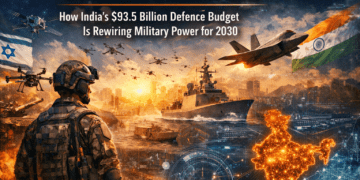
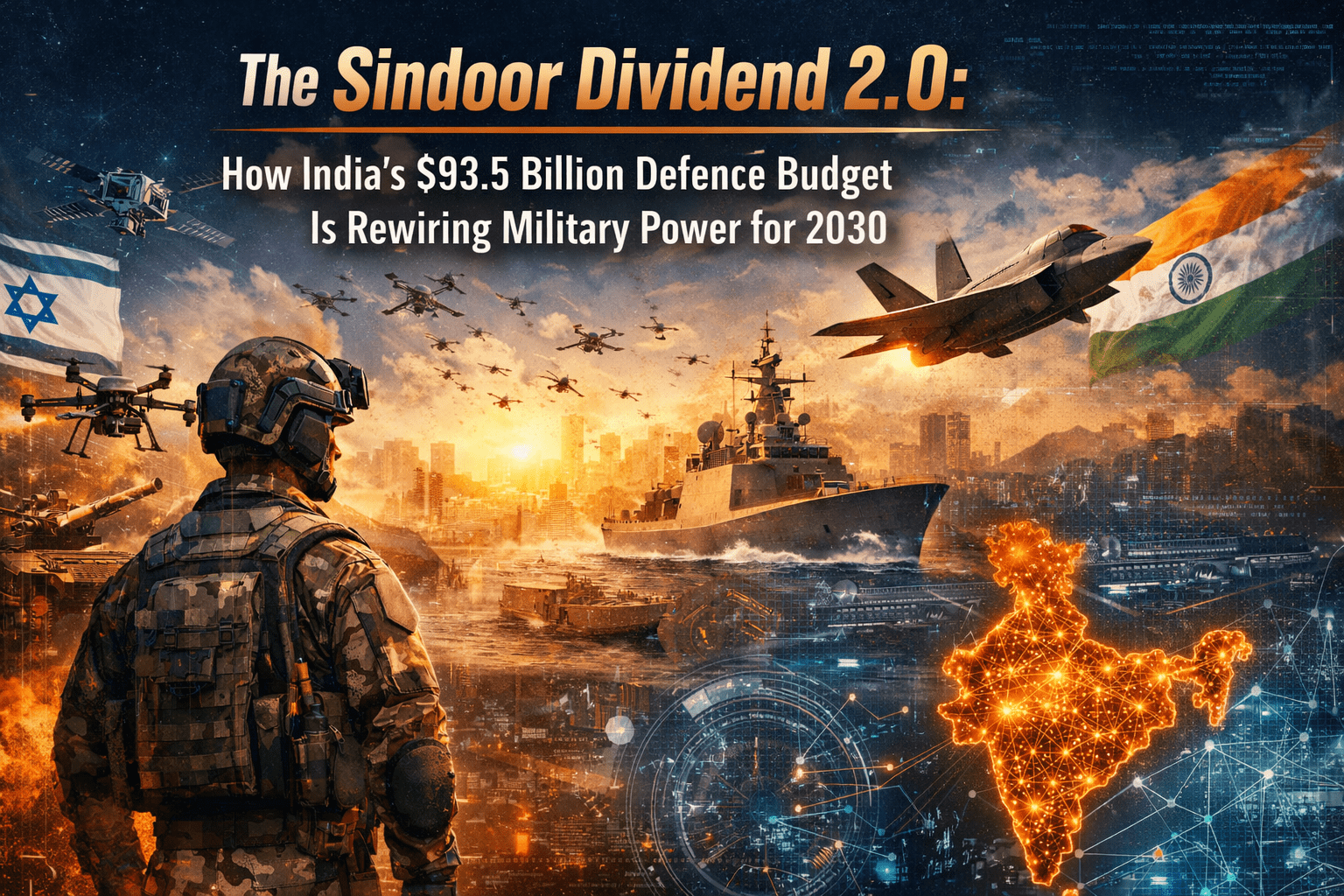
The Sindoor Dividend 2.0: How India’s $93.5 Billion Defence Budget Is Rewiring Military Power for 2030

This is not a routine defence budget. It is a conceptual shift from platform accumulation to systems integration. From buying weapons to buying decision speed. From manpower-heavy deterrence to data-enabled deterrence. But ambition alone does not guarantee transformation. The next five years will determine whether this was the moment India rewired its military architecture — or simply rebranded it.

IndoAsia Defense by IndoAsia Defense
May 28, 2026
in Budget, India Strategy, Make in India, Supply Chains
0
The Sindoor Dividend 2.0: How India’s $93.5 Billion Defence Budget Is Rewiring Military Power for 2030
0
SHARES
3
VIEWS
Share on LinkedinShare on FacebookShare on Twitter

Let’s get something straight.

India’s FY 2026–27 defence budget of $93.5 billion is not big because it’s large. It’s big because it changes what India thinks military power actually is.

For decades, India measured strength in squadrons, regiments, hull numbers, and artillery tubes. This year’s budget signals something deeper: power is now about decision speed, sensor fusion, AI-assisted targeting, and network resilience. Tanks still matter. Submarines still matter. But without the digital brain to connect them, they’re just expensive steel.

And this shift did not happen in a vacuum.

It emerged from fiscal pressure, battlefield learning, structural manpower constraints, maritime competition in the Indian Ocean, and yes, the lessons of Operation Sindoor in 2025. But if Sindoor was the spark, this budget is the institutionalization of the fire.

Let’s unpack what is really happening and what could go wrong.

The Real Story Isn’t the Headline Number

The ₹7.85 lakh crore allocation (roughly $93.5B) represents about a 15% increase year-on-year. That’s substantial, but not extraordinary in isolation.

The extraordinary part is buried in the composition.

The “other equipment” category — traditionally dull and overlooked — received a roughly 30% jump, reaching nearly $9.8 billion. That line funds:

  • AI-enabled ISR platforms

  • Autonomous and swarm drone systems

  • Secure battlefield communications

  • Network-centric warfare integration

  • Cyber and electronic warfare upgrades

In short, it funds the nervous system.

The logic is brutally simple: future conflicts will not be decided by who fires first, but by who understands the battlespace first.

And this is where India is attempting a structural pivot.

From Hardware to Decision Cycles

Operation Sindoor demonstrated something uncomfortable but instructive: tactical success increasingly depends on real-time integration rather than platform superiority.

Counter-drone systems, ISR feeds, electronic warfare overlays – these are not independent capabilities. They are nodes in a data web. When integrated correctly, they compress the OODA loop (Observe–Orient–Decide–Act).

But here’s the nuance: Sindoor did not prove India has perfected this model. It proved that when integration works, it provides an edge. The FY27 budget is an admission that integration must now become systemic, not episodic.

That is a very different level of ambition.

The Structural Constraint: The Salary Trap

Now the uncomfortable math.

Nearly 48% of the defence budget, roughly $45 billion goes toward salaries and pensions.

This is not a moral problem. It is a structural one.

India maintains a manpower-heavy force posture across two active fronts and a large peacetime deployment grid. Personnel costs crowd out capital modernization. Every rupee spent on pensions is a rupee not spent on AI or submarines.

This is where autonomy becomes not just strategic but fiscal.

If AI-enabled surveillance reduces border manpower requirements by even 10–15% over a decade, that translates into enormous downstream savings. The Agnipath model is part of this recalibration: reduce long-term pension liabilities while maintaining force intake.

But here’s the risk: if personnel reform stalls while capital tech spending rises, India could end up with a digitally ambitious but structurally constrained military.

That tension will define the next five years.

Capital vs Revenue: The Five-Year Trend

Over the past five years, India has attempted to rebalance capital and revenue expenditure, but revenue (salaries + pensions) continues to hover near or above 50%.

Capital allocation has improved but not dramatically.

If India wants to reach a 60:40 revenue-to-capital balance by 2030, either:

  • Personnel costs must stabilize, or

  • GDP growth must significantly outpace defence expenditure growth

Neither is guaranteed.

This is why AI is framed as “strategic escape velocity.” It promises efficiency gains without immediate structural cuts.

But efficiency is not automatic. It requires procurement discipline, integration capability, and private sector scaling.

The Israel Partnership Important, But Not Exclusive

Israel is critical in:

  • UAV technology

  • Electronic warfare

  • AI-assisted targeting

  • Missile defence integration

But India’s tech ecosystem is broader.

The United States is central to high-end ISR (MQ-9B Sea Guardian), engine tech discussions, and satellite integration.

France remains key in combat aviation and potentially engine collaboration for AMCA.

Germany is involved in submarine negotiations.

Domestic players like Tata Advanced Systems, L&T, BEL, HAL, Adani Defence, and Bharat Dynamics are scaling up aggressively.

The strategy is not “pivot to Israel.”
It is multi-vector co-development with domestic industrial absorption.

That distinction matters geopolitically.

The Tech-Transfer Paradox

India’s Atmanirbhar Bharat mandate reserves roughly 75% of capital acquisition for domestic industry.

But here’s the paradox:

India wants complete transfer of critical technologies — submarine AIP systems, aero engines, advanced radar algorithms — yet global suppliers guard these as crown jewels.

This creates friction.

The German submarine negotiations illustrate this tension. Advanced Air Independent Propulsion technology is not easily shared. Similarly, high-thrust jet engine core technologies remain tightly controlled.

Money alone does not unlock trust.

India must offer scale, long-term procurement certainty, and strategic alignment to unlock meaningful co-development.

The FY27 budget provides the scale. Whether the diplomatic architecture can deliver the rest is still uncertain.

The Maritime Theatre: The Real Strategic Arena

Pakistan matters tactically. China matters strategically.

Pakistan’s induction of Hangor-class AIP submarines tightens the underwater equation in the Arabian Sea. But the more consequential theatre is the Indian Ocean.

Chinese naval deployments, submarine patrols, and logistics footholds across the Indo-Pacific are expanding.

India’s budget reflects this.

Funding priorities include:

  • Long-endurance maritime surveillance drones

  • Anti-submarine warfare aircraft upgrades

  • Naval electronic warfare suites

  • Future SSN development groundwork

This is about sea control, sea denial, and maritime domain awareness.

If India wants to be a “net security provider,” it must dominate the information grid of the Indian Ocean.

That requires satellites, AI, undersea sensors, and network integration — not just hull numbers.

The China Factor: The Real Benchmark

Any serious analysis must ask: how does this compare to China?

The PLA has integrated AI into ISR, swarm drones, electronic warfare, and joint theatre command structures far more aggressively. China’s civil-military fusion model gives it a structural advantage in scaling dual-use technologies.

India is catching up — but it is not leading.
The gap is not in budget size. It is in ecosystem coherence.

China’s semiconductor access, AI training infrastructure, and drone manufacturing scale remain superior.

If export controls tighten or semiconductor supply chains fragment further, India’s digital military ambitions could face constraints.

That is a real vulnerability.

Defence Exports: The Understated Lever

India’s defence exports recently crossed approximately $2.5–3 billion annually, a significant rise from a decade ago.

The real opportunity lies in exporting:

  • Drones

  • Electronic warfare systems

  • Missile systems

  • Coastal surveillance networks

AI-enabled systems offer higher margins and strategic influence.

If India successfully builds a domestic AI-military stack, it could export affordable autonomous systems to Southeast Asia, Africa, and Latin America.

That would transform India from arms importer to selective arms exporter.

But only if execution matches ambition.

2026–2030 Outlook: Three Scenarios

Let’s move from description to projection.

Between now and 2030, three broad trajectories are plausible.

1. Accelerated Integration Scenario (Best Case)

  • AI integration across all three services operational by 2028

  • Capital-to-revenue ratio improves to 55:45

  • AMCA prototype progresses on schedule

  • SSN groundwork solidified

  • Defence exports cross $7–8B annually

India becomes a credible mid-tier military technology power.

2. Constrained Momentum Scenario (Most Likely)

  • AI adoption uneven across services

  • Personnel costs remain above 48%

  • Submarine programs face delays

  • AMCA timelines stretch

  • Export growth moderate

India modernizes incrementally, but without systemic transformation.

3. Execution Friction Scenario (Risk Case)

  • Procurement delays persist

  • Tech-transfer negotiations stall

  • Semiconductor constraints affect AI hardware

  • Private defence startups consolidate or fail

  • Budget growth flattens due to fiscal pressure

India ends up with ambitious plans and partial implementation, a digital vision trapped in bureaucratic inertia.

The Bureaucratic Test

Budgets don’t fight wars.

Institutions do.

India’s Ministry of Defence acquisition processes remain layered and slow. Integration across services remains imperfect. Private sector absorption capacity varies widely.

The true test of the Sindoor dividend is not allocation, it is absorption.

Can funds translate into integrated capability before the threat environment shifts again?

That’s the question.

The Bottom Line

This is not a routine defence budget.

It is a conceptual shift from platform accumulation to systems integration. From buying weapons to buying decision speed. From manpower-heavy deterrence to data-enabled deterrence.

But ambition alone does not guarantee transformation.

If India manages to:

  • Contain revenue expenditure growth

  • Accelerate procurement reforms

  • Secure meaningful tech transfer

  • Scale domestic AI-military manufacturing

  • Align maritime strategy with technological buildout

Then by 2030, India’s military will not just be larger — it will be smarter.

If it fails, it will have digitized the margins without transforming the core.

For now, the direction is correct. The resources are real. The geopolitical necessity is undeniable.

The next five years will determine whether this was the moment India rewired its military architecture — or simply rebranded it.

Tags: Most Read
Previous Post

India’s 250-km Missile Debate Is Not About Outmatching the PL-15

IndoAsia Defense

IndoAsia Defense

IndoAsia Defense Team is a specialist research and analysis group focused on India’s military modernization and Indo-Pacific strategic dynamics. The platform delivers structured, data-driven insights on doctrine, force posture, defense technology, and regional power balance.

Leave a Reply Cancel reply

Your email address will not be published. Required fields are marked *

Category

  • Air
  • Global
  • Indo-Pacific
  • Industry
  • Joint
  • Land
  • Navy
  • Tech

Defence Capabilities

  • Air Defence
  • Drones
  • Fighters
  • ISR & Mobility
  • China Military
  • Emerging Tech
  • Regional Trends
  • U.S. Posture

Strategy

  • 2035 Outlook
  • China Strategy
  • India Strategy
  • Pakistan Outlook
  • Budget
  • Exports
  • Make in India
  • Supply Chains

Operations

  • Integrated Ops
  • Procurement Reform
  • Theater Commands
  • Armour & Artillery
  • China Front
  • Future Combat
  • Pakistan Front
  • Fleet Expansion

Resources

  • India vs China Military Balance
  • Indo-Pacific Military Power Map
  • Global Military Balance Dashboard
  • Global Weapons Systems Database
  • Global Missile Systems Database
  • Indo-Pacific Defense Timeline
  • India Military Capability Index
  • About
  • Contact
  • Privacy & Policy
  • Editorial Policy
  • Cookie Policy
  • Disclaimer
  • Terms And Conditions
Facebook Linkedin X-twitter
© 2026 IndoAsia Defense. All Rights Reserved.
No Result
View All Result
  • Home
  • Air
    • Air Defence
    • Drones
    • Fighters
    • ISR & Mobility
  • Land
    • Armour & Artillery
    • China Front
    • Future Combat
    • Pakistan Front
  • Navy
    • Fleet Expansion
    • Indian Ocean
    • Maritime Security
    • Submarines
  • Indo-Pacific
    • 2035 Outlook
    • China Strategy
    • India Strategy
    • Pakistan Outlook
  • Joint
    • Integrated Ops
    • Procurement Reform
    • Theater Commands
  • Tech
    • AI & Autonomous Systems
    • Cyber
    • Electronic Warfare
    • Space
  • Industry
    • Budget
    • Exports
    • Make in India
    • Supply Chains
  • Global
    • China-Pak
    • Emerging Tech
    • Regional Trends
    • US-India