






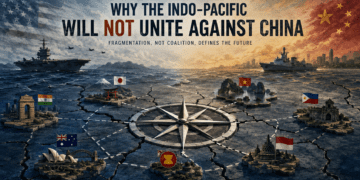









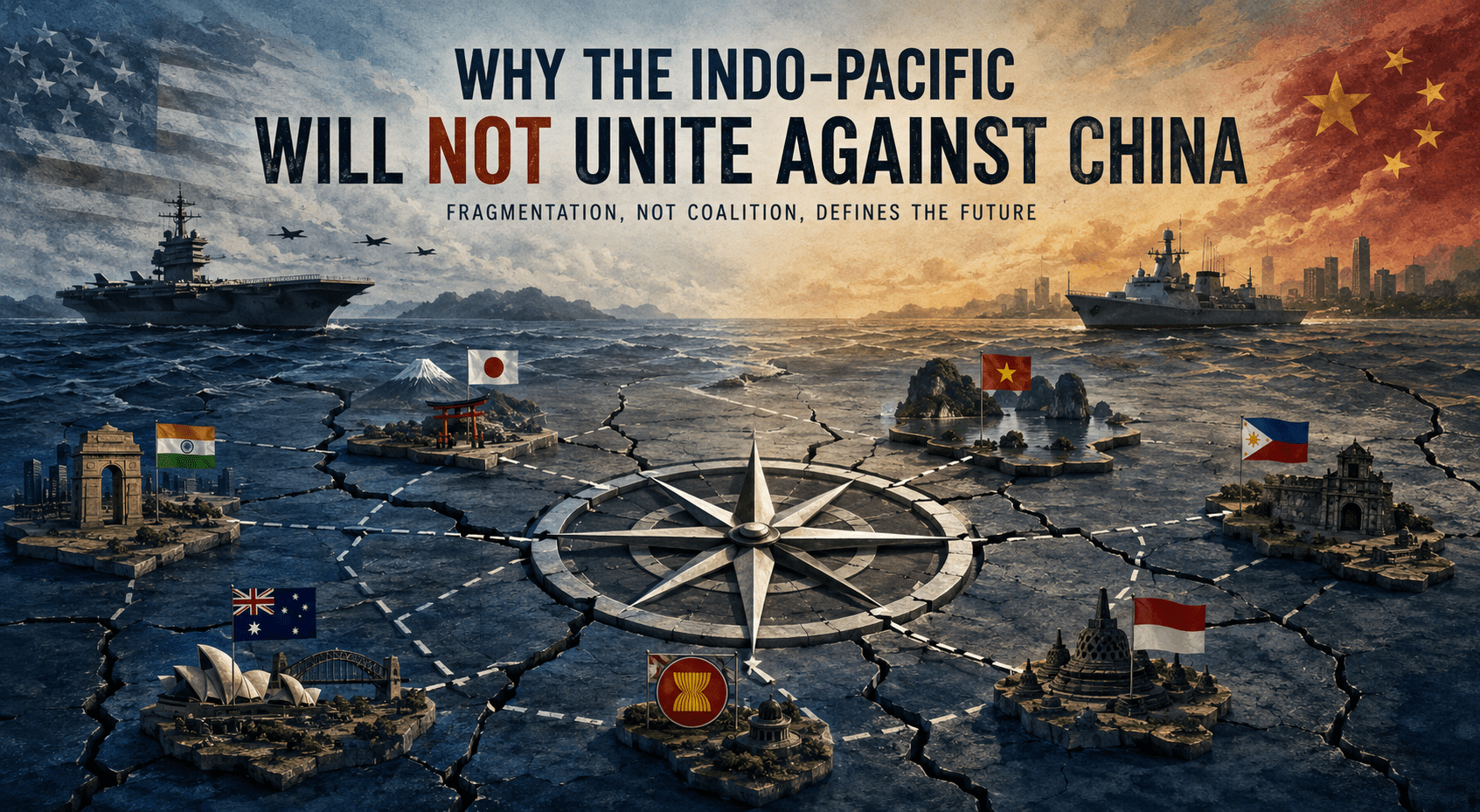
Much of today’s Indo-Pacific discourse assumes the region is gradually consolidating into a U.S.-led balancing coalition against China. IndoAsia Defense’s perspective argues the opposite. The Indo-Pacific’s defining condition is not bloc formation but strategic fragmentation.
Regional states increasingly pursue overlapping partnerships, selective balancing, economic hedging, and strategic autonomy simultaneously because their interests diverge across different security theaters. The result is an emerging order shaped less by ideological alignment than by the growing impossibility of permanent strategic choice.
The Indo-Pacific Is Entering a Post-Unipolar Transition
For much of the post-Cold War era, the Indo-Pacific operated within a relatively stable strategic assumption: the United States was the uncontested maritime hegemon, China was an emerging but still constrained continental power, and most Asian states could pursue economic growth without making hard geopolitical choices. That era is ending.
The Indo-Pacific is no longer transitioning toward a new equilibrium. It is transitioning toward a condition of prolonged strategic ambiguity where no power is strong enough to fully dominate the region, yet every major actor fears marginalization within the emerging order.
This distinction matters because much of the contemporary Western strategic discourse still approaches the region through a Cold War analytical framework. The dominant question in Washington policy circles increasingly revolves around coalition-building against China, strengthening deterrence architectures, and preserving what is termed the “rules-based international order.”
Within this framing, institutions such as the Quad are often treated as embryonic balancing alliances that will eventually consolidate into a more coherent anti-China security bloc. China’s military modernization, maritime expansion, and increasingly assertive regional posture are therefore interpreted as drivers of strategic convergence among Indo-Pacific democracies.
But this interpretation oversimplifies how Asian states actually perceive the emerging order. The Indo-Pacific is not becoming a unified geopolitical theater divided neatly between two competing blocs. Instead, it is fragmenting into overlapping security systems with different priorities, escalation thresholds, economic dependencies, and historical memories.
Tokyo’s threat perception is not Jakarta’s.
Manila’s maritime anxieties are not New Delhi’s continental calculations.
Vietnam’s balancing strategy differs sharply from Australia’s alliance-centric posture.
Even within the Quad itself, strategic alignment remains partial, conditional, and issue-specific rather than systemic.
This fragmentation is not temporary. It reflects the underlying structure of Asian geopolitics.
China’s rise unquestionably represents one of the most significant redistributions of power in modern history. China is now the world’s second-largest economy with a nominal GDP exceeding $18 trillion, the world’s largest navy by hull count with more than 370 battle force ships according to U.S. Department of Defense assessments, and the largest trading partner for most Indo-Pacific economies.
China also accounts for nearly 30 percent of global manufacturing output and dominates critical industrial supply chains across electronics, rare earth processing, battery manufacturing, and shipping infrastructure.
These developments inevitably alter regional power balances. Yet the strategic implications are interpreted differently across Asia because China represents different things to different states simultaneously.
For some, China is a military threat. For others, it is an economic lifeline.
For many, it is both at once.
That contradiction defines the Indo-Pacific more than any formal coalition structure.
China’s Rise Looks Different From Different Capitals
Western strategic analysis often speaks about “the regional response to China” as though Asia possesses a singular geopolitical perspective. In reality, perceptions of China are deeply shaped by geography, economic exposure, regime type, historical experience, and military capability.
Japan views China through the lens of direct strategic rivalry. The East China Sea disputes, Chinese naval activity around the Senkaku Islands, ballistic missile developments, and concerns over Taiwan collectively generate a perception of long-term existential competition. Japanese defense policy has consequently undergone its most significant transformation since World War II.
Tokyo’s 2022 National Security Strategy committed Japan to increasing defense spending toward 2 percent of GDP by 2027, effectively doubling military expenditures to roughly $315 billion over five years. Japan is also acquiring long-range counterstrike capabilities, including Tomahawk cruise missiles, marking a major doctrinal shift away from strictly defensive postures.
The Philippines interprets China primarily through a maritime sovereignty framework. Incidents around Second Thomas Shoal, Scarborough Shoal, and repeated Chinese Coast Guard operations have intensified security cooperation with the United States. Manila expanded access for American forces under the Enhanced Defense Cooperation Agreement (EDCA), including new locations near Taiwan-facing areas. Yet even the Philippines stops short of advocating full economic disengagement from China because Chinese trade, tourism, and investment remain economically important.
Vietnam presents another variation. Hanoi shares some of the deepest strategic suspicions toward Beijing due to centuries of historical rivalry, the 1979 Sino-Vietnamese War, and overlapping South China Sea claims. Vietnam has expanded security cooperation with the United States, India, Japan, and Australia while simultaneously adhering to its long-standing “Four Nos” defense doctrine: no military alliances, no aligning with one country against another, no foreign military bases, and no use of force in international relations. Vietnam’s strategy is not alignment but calibrated multidirectional hedging.
Indonesia’s perspective differs further. Jakarta remains deeply wary of bloc politics and rejects efforts to transform ASEAN into an anti-China coalition. Indonesian policymakers repeatedly emphasize strategic autonomy, regional neutrality, and the prevention of major power polarization. China is Indonesia’s largest trading partner, while Chinese investment plays a major role in infrastructure and industrial projects, including high-speed rail and nickel processing.
Even Australia, often considered among the most aligned U.S. partners, demonstrates the complexity of the regional environment. Canberra strengthened defense cooperation through AUKUS and adopted tougher rhetoric toward Beijing after years of political tensions and economic coercion measures. Yet China still accounts for roughly one-third of Australian exports, particularly iron ore, natural gas, and agricultural commodities. Economic dependence coexists with strategic distrust.
This diversity of perspectives matters because it undermines the assumption that shared concern over China automatically produces strategic cohesion. Anxiety does not equal alignment. Many Indo-Pacific states seek to balance against aspects of Chinese behavior while simultaneously preserving economic integration with Beijing. Their objective is not necessarily to defeat China, contain China, or isolate China. In many cases, their objective is to avoid choosing permanently between China and the United States altogether.
The Indo-Pacific Is Fragmenting Into Security Subsystems
One of the central weaknesses in contemporary Indo-Pacific strategy is the assumption that the region constitutes a coherent geopolitical theater. In practice, the Indo-Pacific is increasingly fragmenting into overlapping but distinct security systems with different strategic logics.
The Taiwan Strait is primarily shaped by U.S.-China military competition and questions of deterrence credibility. The South China Sea revolves around maritime sovereignty disputes, gray-zone coercion, and control over strategic sea lanes. The East China Sea reflects Japanese concerns over territorial integrity and maritime access.
The Himalayan frontier remains defined by land warfare, infrastructure races, and border management between India and China. The Indian Ocean introduces an entirely different set of calculations involving sea lane security, energy flows, and maritime chokepoints stretching from the Strait of Hormuz to the Malacca Strait.
Each theater contains different escalation thresholds, alliance commitments, and political sensitivities.
India may support maritime balancing in the Indian Ocean while remaining cautious about Taiwan contingencies. Southeast Asian states may oppose Chinese coercion in the South China Sea while rejecting broader anti-China bloc formation. Japan views Taiwan stability as directly connected to national security, while Indonesia sees Taiwan primarily as a destabilizing flashpoint best avoided diplomatically.
But the more important issue is that these fragmented theaters actively constrain coalition formation itself. A crisis in the Taiwan Strait would not automatically produce the same regional response as a confrontation in Ladakh or a maritime escalation near Second Thomas Shoal. The strategic priorities of Indo-Pacific states diverge too sharply for a single unified security architecture to emerge organically.
The Quad itself illustrates this limitation. Its members broadly share concerns regarding Chinese power projection, yet they do not share identical red lines, escalation thresholds, or operational priorities across multiple theaters simultaneously.
For Washington, Taiwan increasingly represents the central organizing challenge of Indo-Pacific strategy. For India, however, the continental challenge along the Line of Actual Control remains strategically more immediate than maritime contingencies in East Asia.
ASEAN states may support freedom of navigation operations in principle while remaining unwilling to participate in hard balancing over Taiwan. Australia’s alliance obligations differ fundamentally from India’s strategic autonomy doctrine.
These distinctions matter because alliance systems weaken when members perceive crises through fundamentally different strategic lenses.
Would India intervene militarily in a Taiwan contingency?
Would Southeast Asian states support prolonged escalation in the East China Sea?
Would Japan meaningfully involve itself in a future Himalayan crisis between India and China?
The uncertainty surrounding these questions reveals the limits of coalition cohesion.
The result is an Indo-Pacific architecture built less around unified deterrence than around overlapping but incomplete security alignments. States cooperate intensely in some domains while remaining deliberately ambiguous in others.
This is not a temporary failure of integration. It is increasingly becoming the structural reality of Asian geopolitics itself.
The Quad Reflects Shared Anxiety, Not Shared Strategy
The Quadrilateral Security Dialogue involving India, the United States, Japan, and Australia has become one of the most discussed strategic formations in the Indo-Pacific. Advocates increasingly portray the Quad as the foundation of a future democratic balancing coalition capable of countering Chinese expansion.
Joint naval exercises such as Malabar, growing technological cooperation, maritime domain awareness initiatives, and diplomatic coordination all reinforce perceptions of deepening strategic convergence.
Yet the Quad remains far less cohesive than many external observers assume.
The four members do not share a unified threat perception, nor do they share identical end-state objectives. The United States views the Indo-Pacific primarily through the prism of preserving regional primacy and deterring Chinese hegemony.
Japan’s focus centers heavily on East Asian maritime security and Taiwan contingencies. Australia prioritizes alliance credibility and maritime stability in the South Pacific and Southeast Asia. India, however, approaches the Quad through an entirely different strategic logic.
New Delhi does not see the Quad as an Asian NATO. Indian policymakers have repeatedly rejected formal alliance structures and continue emphasizing that the Quad is not a military bloc. India participates because the framework provides strategic flexibility, maritime cooperation, technological access, and leverage against China without imposing treaty obligations or surrendering strategic autonomy.
This distinction is fundamental rather than semantic.
Western analysis frequently treats India’s reluctance toward hard alignment as a transitional phase that will eventually disappear due to Chinese pressure along the Line of Actual Control (LAC). But this interpretation misunderstands the depth of India’s strategic culture. India’s doctrine of strategic autonomy is not diplomatic ambiguity born from indecision. It is a deeply embedded geopolitical philosophy shaped by historical experience.
India’s strategic memory includes colonial subordination, Cold War bloc politics, sanctions following nuclear tests, Pakistan’s alliance relationships with external powers, and concerns about external dependency. Indian strategists remain wary not only of Chinese dominance but also of overdependence on any single external partner, including the United States.
The contradiction within India’s Indo-Pacific strategy is therefore deliberate. India seeks access to American technology, maritime coordination, intelligence sharing, defense industrial cooperation, and balancing leverage against China. Yet India does not seek treaty obligations, Taiwan-linked military commitments, NATO-style command structures, or automatic escalation participation in U.S.-China crises.
This balancing act explains India’s continued participation in institutions such as BRICS and the Shanghai Cooperation Organisation even while simultaneously strengthening ties with the Quad. From Washington’s perspective, this can appear inconsistent. From New Delhi’s perspective, it reflects strategic diversification.
India’s approach ultimately reveals a larger truth about the Indo-Pacific: regional powers increasingly prefer flexible issue-based coalitions over rigid alliance systems.
ASEAN Does Not Want a New Cold War Architecture
Perhaps the greatest weakness in many Western Indo-Pacific strategies is the tendency to treat Southeast Asia as geopolitical terrain rather than as a collection of actors with their own strategic priorities.
ASEAN states are often discussed as countries to be “won,” “leveraged,” or “integrated” into balancing coalitions. Yet Southeast Asian governments themselves consistently resist this framing.
Their objective is generally not to defeat China or expel American influence. Instead, most seek to preserve strategic maneuverability within an increasingly polarized environment.
This explains ASEAN’s persistent emphasis on “centrality.” While often dismissed in Western commentary as diplomatic jargon lacking operational meaning, ASEAN centrality reflects a sophisticated attempt to prevent the Indo-Pacific from hardening into exclusive bloc politics.
Smaller and middle powers understand that binary geopolitical structures reduce their room for maneuver and increase vulnerability to external coercion.
Economic realities reinforce this caution. ASEAN-China trade exceeded roughly $900 billion in recent years, making China ASEAN’s largest trading partner by a substantial margin. Chinese tourism, manufacturing investment, infrastructure financing, and supply chain integration remain deeply embedded across Southeast Asia. Even states with serious maritime disputes with Beijing continue relying heavily on economic engagement with China.
At the same time, many Southeast Asian governments also welcome continued American military presence as a stabilizing counterweight. This creates a dual dependency structure: economic integration with China combined with partial security reliance on the United States.
The result is strategic hedging rather than alignment.
Singapore captures this dynamic particularly well. Despite close defense cooperation with the United States, Singapore consistently opposes framing the Indo-Pacific as a binary ideological contest. Indonesian policymakers have similarly warned against turning Southeast Asia into an arena of major-power confrontation.
Malaysia frequently adopts cautious language designed to avoid provoking either Washington or Beijing. Thailand balances alliance ties with the United States while simultaneously deepening economic engagement with China.
These states are not passive. They are pursuing rational survival strategies within a fluid geopolitical environment.
This is why the Quad’s appeal remains limited across much of Southeast Asia. Many ASEAN governments fear that overt military balancing coalitions could intensify regional polarization, increase pressure for strategic alignment, and reduce their diplomatic flexibility.
For them, the danger lies not only in Chinese assertiveness but also in the possibility of becoming trapped within an escalating U.S.-China confrontation.
The Security Dilemma Is Mutual, But Not Symmetrical
None of this means China’s behavior is benign. Beijing’s militarization of artificial islands, coercive Coast Guard operations, gray-zone tactics, pressure on Taiwan, and rejection of aspects of the 2016 Permanent Court of Arbitration ruling in the South China Sea have generated legitimate alarm across the region. Chinese maritime militia operations and increasingly aggressive military signaling contribute directly to regional instability.
The reciprocity of the security dilemma does not erase chronology. China’s large-scale island militarization, coercive maritime tactics, pressure operations against neighboring claimants, and rejection of the 2016 arbitration ruling significantly preceded the current acceleration in U.S.-aligned balancing behavior. Regional anxiety did not emerge in a vacuum.
Many Asian states expanded security cooperation with Washington not because they sought containment blocs, but because Chinese coercive behavior altered their threat calculations first.
Yet the strategic consequence of Chinese assertiveness is not automatic anti-China alignment. It is selective balancing combined with continued economic engagement.
From Washington’s perspective, expanded military deployments, alliance strengthening, freedom of navigation operations, and advanced force posture adjustments are defensive measures designed to preserve deterrence and regional stability. From Beijing’s perspective, however, these same actions often appear as components of a long-term containment architecture aimed at constraining China’s rise.
China observes expanding U.S. alliance coordination across its maritime periphery, enhanced military access agreements in the Philippines, AUKUS submarine cooperation, growing Quad coordination, and increasingly explicit Taiwan-related signaling.
Chinese strategists interpret many of these developments as evidence that Washington seeks to prevent China from achieving regional predominance even within its near seas.
This does not justify coercive behavior. But it does explain why the escalation cycle persists.
Each side interprets its own actions as defensive and the other side’s actions as offensive. This is the classic security dilemma described in international relations theory. The problem becomes particularly dangerous when both powers increasingly prepare for worst-case scenarios simultaneously.
The growing focus on a potential Taiwan contingency illustrates this danger. American strategic discourse increasingly references 2027 as a potential window for Chinese military action, partly based on PLA modernization timelines and statements regarding military readiness objectives.
Yet there remains substantial debate among analysts regarding whether 2027 reflects a political deadline, a capability milestone, or a planning assumption that has gradually hardened into conventional wisdom.
The danger is that repeated emphasis on imminent conflict timelines can itself contribute to escalation dynamics. Accelerated military preparations, forward deployments, expanded exercises, and alliance consolidation undertaken in anticipation of possible conflict may reinforce Beijing’s perception of encirclement, which then drives further Chinese military expansion.
The Indo-Pacific increasingly risks entering a condition where deterrence and provocation become difficult to distinguish.
The Belt and Road Initiative Is Infrastructure Statecraft
The Belt and Road Initiative is often discussed through overly simplistic binaries. In some Western discourse, it is portrayed primarily as a predatory debt-trap mechanism designed to undermine sovereignty. In some Chinese narratives, it is presented purely as developmental cooperation disconnected from strategic influence. Neither interpretation fully captures reality.
The BRI is best understood as geopolitical infrastructure statecraft.
China uses infrastructure financing, logistics connectivity, industrial integration, and transportation networks to expand long-term economic and political influence across Eurasia, Africa, and parts of the Indo-Pacific. This influence is real. In several cases, Chinese financing arrangements have generated substantial strategic leverage.
Sri Lanka’s Hambantota port became emblematic of debt-related dependency concerns after financial distress contributed to a 99-year lease arrangement involving Chinese firms. Djibouti hosts China’s first overseas military base near strategically vital maritime routes.
Pakistan’s China-Pakistan Economic Corridor (CPEC) deepened Islamabad’s economic and strategic dependence on Beijing. Laos accumulated large debt exposure linked to railway infrastructure. Myanmar’s corridor projects carry significant geopolitical implications for Chinese access to the Indian Ocean.
These are not imaginary concerns.
At the same time, reducing the BRI entirely to “debt-trap diplomacy” oversimplifies a far more uneven reality. Several projects have improved infrastructure connectivity, transportation efficiency, energy distribution, and industrial capacity in participating states.
Indonesia’s Jakarta-Bandung high-speed rail project, despite delays and cost overruns, demonstrated China’s ability to execute large-scale infrastructure rapidly where Western alternatives remained absent or politically constrained.
The strategic debate around the Belt and Road Initiative is therefore no longer about whether China uses infrastructure for influence. It clearly does. The real question is whether competing powers possess the financial capacity, political patience, and institutional coordination to offer alternatives at comparable scale.
This is where many Western Indo-Pacific strategies remain underdeveloped. Infrastructure gaps across Asia remain enormous. The Asian Development Bank estimates that developing Asia requires over $1.7 trillion annually in infrastructure investment through 2030 to maintain growth momentum. Yet Western-led alternatives have often struggled to match China’s speed, financing flexibility, risk tolerance, or implementation scale.
Many Asian governments therefore approach Chinese investment pragmatically rather than ideologically. They seek economic benefits while attempting to manage strategic risks. The result again is not alignment, but calibrated dependence management.
The “Rules-Based Order” Debate Is More Complicated Than Washington Admits
Few phrases dominate contemporary Indo-Pacific discourse more than the “rules-based international order.” The term appears constantly in American, Japanese, Australian, and European strategic documents. It is often presented as a neutral defense of international law, maritime freedom, sovereignty, and institutional stability.
Yet across much of the Global South, the phrase generates far more skepticism than Western policymakers sometimes recognize.
Part of the issue is historical memory. Many postcolonial states remember an international system where rules were frequently shaped by Western powers while enforcement remained selective. Interventions in Iraq, Libya, Kosovo, and elsewhere contributed to perceptions that international norms are sometimes applied inconsistently depending on geopolitical interests.
This does not mean smaller states reject international law. In fact, many Southeast Asian countries strongly support UNCLOS and legal mechanisms precisely because they provide smaller powers with tools against stronger actors. The Philippines’ arbitration victory in 2016 demonstrated this clearly.
But many states also resist narratives that appear to divide the world into defenders and challengers of an order whose legitimacy they themselves had limited role in designing.
China exploits this skepticism effectively. Beijing increasingly frames itself as a representative of Global South interests, criticizing Western dominance, unilateral sanctions, and interventionist policies. This messaging resonates in parts of Asia, Africa, Latin America, and the Middle East even among countries that remain wary of Chinese power.
The result is a far more complicated ideological environment than a simple democracy-versus-authoritarianism framework suggests.
Most Indo-Pacific states are not seeking ideological alignment. They are seeking strategic flexibility, economic growth, regime stability, and reduced vulnerability.
Multipolarity Does Not Automatically Produce Stability
One of the romantic assumptions occasionally embedded within discussions of strategic autonomy and multipolarity is that a less bloc-driven Indo-Pacific will naturally become more stable. History suggests otherwise.
Multipolar systems are often unpredictable precisely because commitments remain ambiguous and deterrence calculations become less transparent. The absence of a unified anti-China bloc does not necessarily reduce crisis risks.
In some scenarios, fragmented balancing may actually increase instability because overlapping coalition networks, accelerated military modernization, unresolved territorial disputes, technological rivalry, gray-zone coercion, and deep economic interdependence combined with strategic distrust create greater room for miscalculation.
China’s naval expansion continues at extraordinary speed. The PLA Navy is projected by some U.S. defense assessments to approach 435 ships by 2030. Japan is increasing military spending at historic levels. India is accelerating naval modernization and maritime infrastructure expansion.
Australia is investing heavily in long-range strike capabilities and nuclear-powered submarines through AUKUS. Taiwan’s security environment continues deteriorating under mounting military pressure.
This does not resemble an emerging stable equilibrium. It resembles a region preparing simultaneously for deterrence, competition, and uncertainty.
The central challenge for Indo-Pacific states is therefore not simply avoiding Chinese dominance or preserving American primacy. It is preventing strategic fragmentation from sliding into unmanaged escalation.
The Indo-Pacific Needs Managed Competition, Not Permanent Alignment
The most important strategic question facing the Indo-Pacific is no longer whether competition between the United States and China will intensify. That outcome is already underway. The real question is whether the region can prevent long-term rivalry from collapsing into systemic confrontation.
This requires moving beyond simplistic binaries.
The Indo-Pacific’s objective cannot realistically be the containment of China in the Cold War sense. China is too economically integrated, too geographically central, and too systemically important to be isolated through traditional bloc politics. Nor is Chinese regional hegemony likely to become broadly acceptable across Asia given the anxieties its growing power already generates.
The more realistic objective is managed competition under conditions of enduring rivalry.
This requires flexible coalitions rather than rigid alliance systems. Asian states increasingly prefer issue-based partnerships because they preserve maneuverability while enabling selective cooperation. Maritime security cooperation, supply chain diversification, technological coordination, and infrastructure investment can proceed without requiring universal alignment across every geopolitical issue.
Economic diversification also matters more than full decoupling. Most Indo-Pacific economies cannot realistically sever ties with China without severe domestic consequences. The practical objective is therefore reducing excessive dependency in critical sectors while maintaining broader commercial integration.
Crisis management mechanisms will become increasingly essential. Military hotlines, maritime protocols, escalation control frameworks, and transparency measures may appear insufficient during periods of rising competition, but their absence becomes far more dangerous once crisis conditions emerge.
Most importantly, middle powers will continue resisting pressure toward permanent alignment because their national interests increasingly depend on strategic flexibility. India’s multi-alignment strategy, ASEAN’s hedging behavior, Vietnam’s calibrated balancing, and Indonesia’s insistence on autonomy all point toward the same reality: the Indo-Pacific’s political architecture is being shaped not by ideological consolidation, but by the refusal of regional states to surrender maneuverability entirely to great-power rivalry.
The Indo-Pacific’s Defining Condition Is the Impossibility of Permanent Choice
The central misconception shaping much contemporary Indo-Pacific strategy is the belief that Asia is moving toward ideological consolidation. It is not.
The region is moving instead toward a condition of layered competition under deep economic interdependence, unequal power distribution, fragmented strategic priorities, and permanent strategic ambiguity. China’s rise has unquestionably intensified balancing behavior across the Indo-Pacific.
But it has not erased the deeper instinct among Asian states to avoid permanent alignment, preserve maneuverability, and prevent the emergence of a rigid bipolar order.
This is ultimately why the Indo-Pacific will not unite against China in the way many Western strategic frameworks anticipate.
Most regional states do not fundamentally view their future through binary Cold War categories. They may cooperate with the United States militarily while depending on China economically. They may resist Chinese coercion while rejecting containment blocs. They may strengthen deterrence capabilities while simultaneously opposing ideological polarization.
These positions are not contradictions. They are survival strategies within a geopolitical environment where the costs of permanent choice continue rising.
For smaller and middle powers alike, the danger increasingly lies not only in domination by a stronger China or abandonment by the United States, but in becoming trapped inside a geopolitical structure where strategic flexibility disappears altogether.
The Indo-Pacific’s emerging order is therefore being shaped as much by resistance to rigid alignment as by the balance of power itself.
The future Indo-Pacific will likely remain fragmented, competitive, and permanently negotiated. But that fragmentation is not necessarily evidence of strategic failure. It is evidence that many Asian states still believe their long-term security depends less on choosing one side permanently, and more on preserving enough autonomy to navigate between them.
—————————————————————————————————————–

